The Unseen Force Behind Stable Retaining Walls
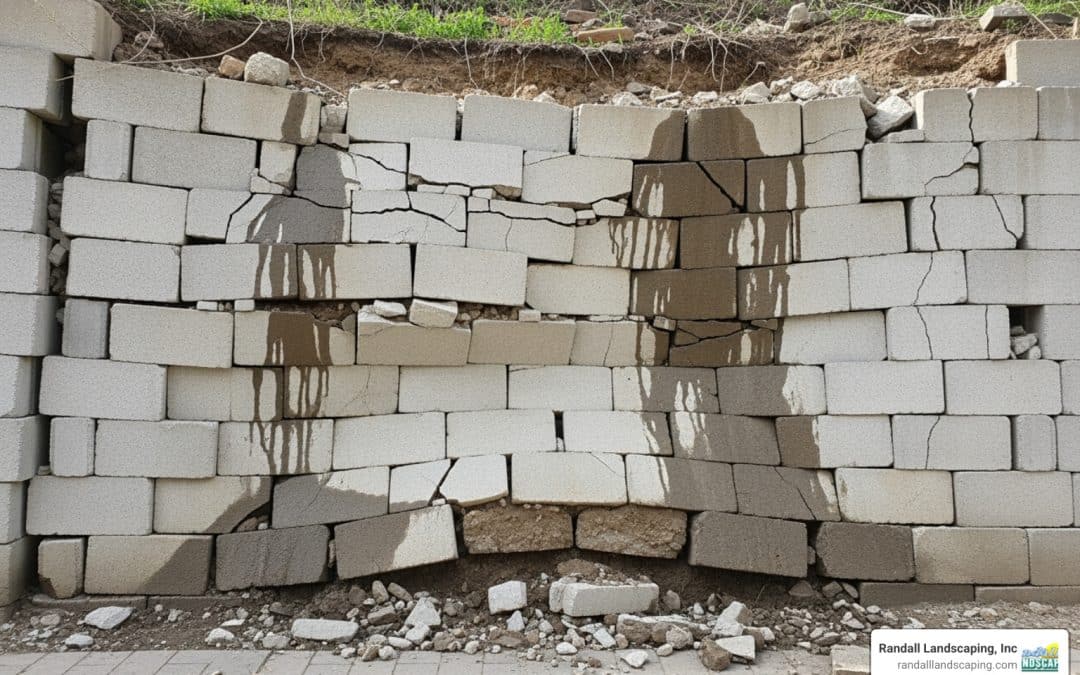
When pressure from water-saturated soil causes a retaining wall to bow, lean, or fail, it threatens your property’s structural integrity and value. Helical anchors retaining wall systems are an effective solution for stabilizing these failing walls. They work by drilling deep into stable soil behind the wall, creating a powerful connection that resists the lateral forces pushing against it.
Quick Answer: What are helical anchors for retaining walls?
- Screw-like anchors drilled into stable soil behind a failing wall.
- Provide lateral support by transferring loads to competent soil.
- Installed with minimal excavation.
- Cost $1,800-$6,000 per anchor, depending on conditions.
- Allow for immediate load testing with no curing time.
- Can hold up to 200,000 lbs per anchor in suitable soil.
Unlike traditional repair methods that require extensive excavation and long curing times, helical anchor systems offer a faster, more efficient solution. By rotating steel shafts with helical plates into the ground, these systems create immediate, testable holding capacity in almost any weather.
I’m Tommy Randall of Randall Landscaping. With nearly two decades of experience, my team has used helical anchors retaining wall installations to save properties throughout Massachusetts and New Hampshire, often where traditional methods were not feasible.
What Are Helical Tieback Anchors and How Do They Work?
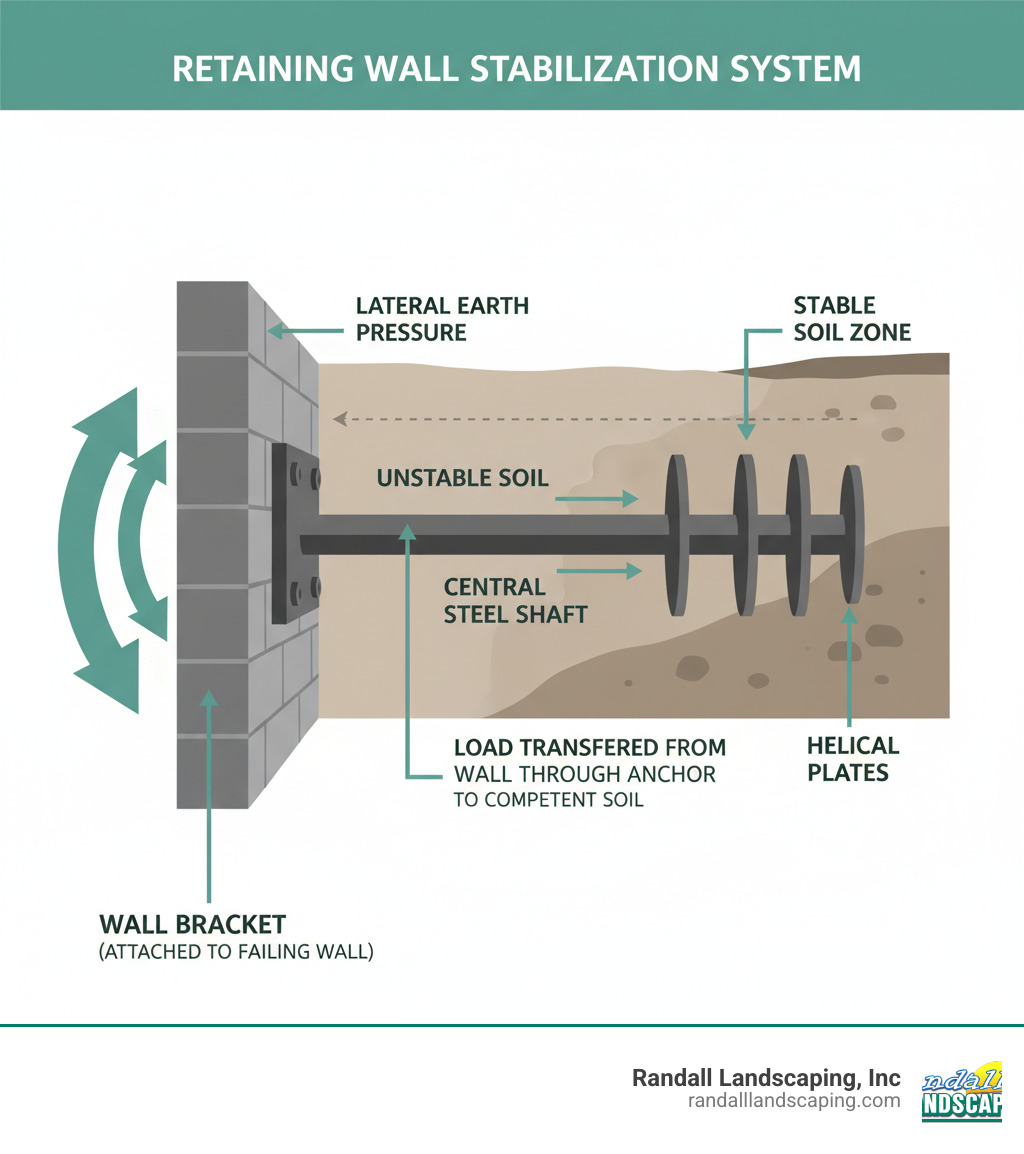
A helical tieback anchor is essentially a large steel screw used to stabilize a failing retaining wall. When soil behind a wall becomes saturated or shifts, it creates immense lateral earth pressure that can cause bowing and cracking. Helical anchors retaining wall systems counter this force with a smarter approach than traditional excavation.
These earth retention systems work by drilling deep into the stable soil behind the wall, past the unstable “active soil zone.” The anchor transfers the pushing force from the wall, through its steel shaft, and into the competent soil deep underground. Unlike concrete solutions that require weeks to cure, helical anchors allow for immediate load testing and can be installed in almost any weather. We’ve used these systems throughout Massachusetts and New Hampshire to save walls that seemed beyond repair.
For homeowners interested in comprehensive outdoor improvements, our hardscaping services often incorporate retaining wall solutions that work seamlessly with anchor systems.
The Core Components of a Helical Anchor System
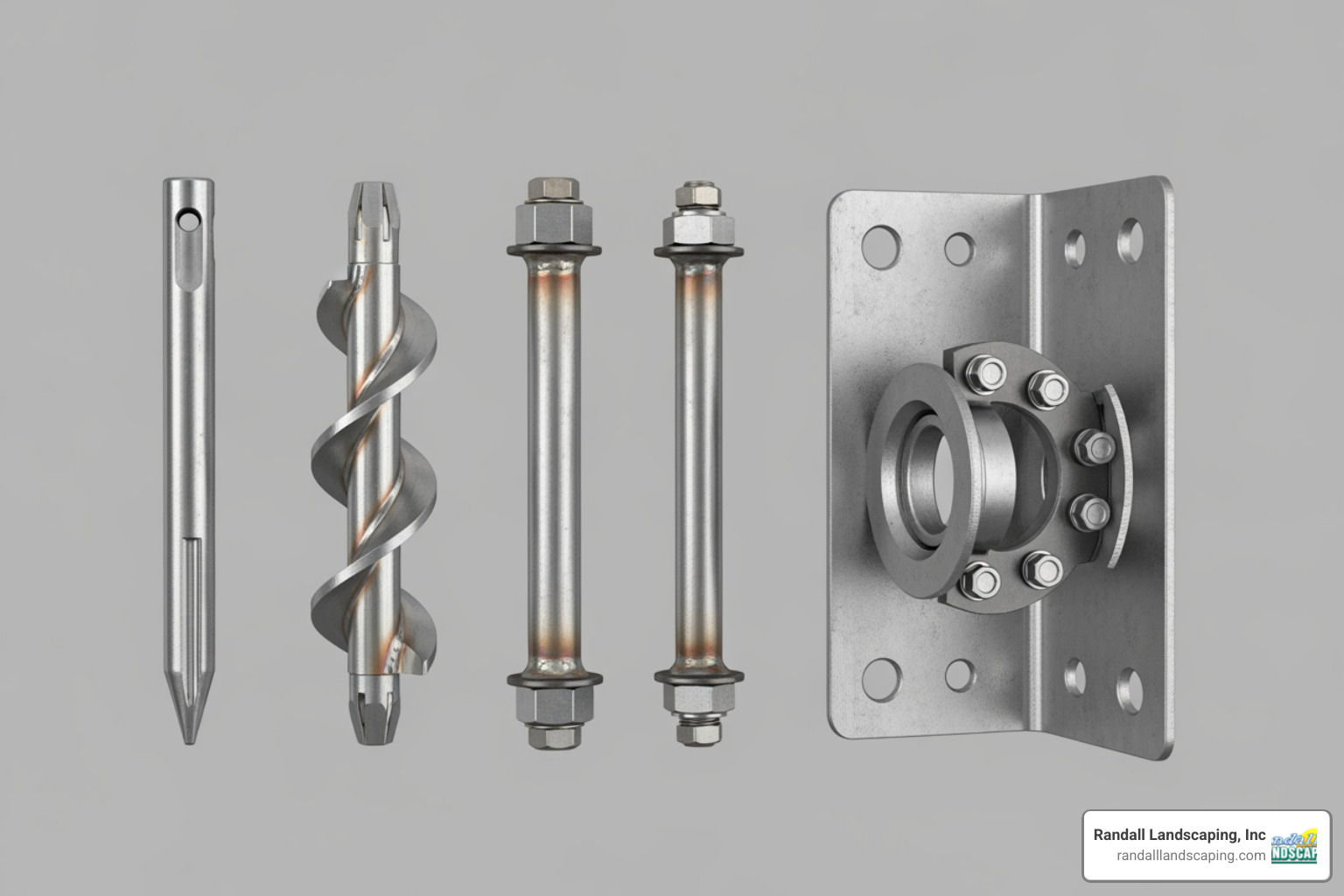
Each component in a helical anchor system has a specific job to create a strong load transfer path from the wall to stable soil.
- Lead Section: The initial piece with helical plates (helices) welded to a central steel shaft. The plates, typically 8″ to 14″ in diameter, determine the holding power.
- Extension Sections: These connect to the lead section, allowing the anchor to reach stable soil that may be 20-50 feet deep. They come in 3, 5, or 7-foot lengths for precision.
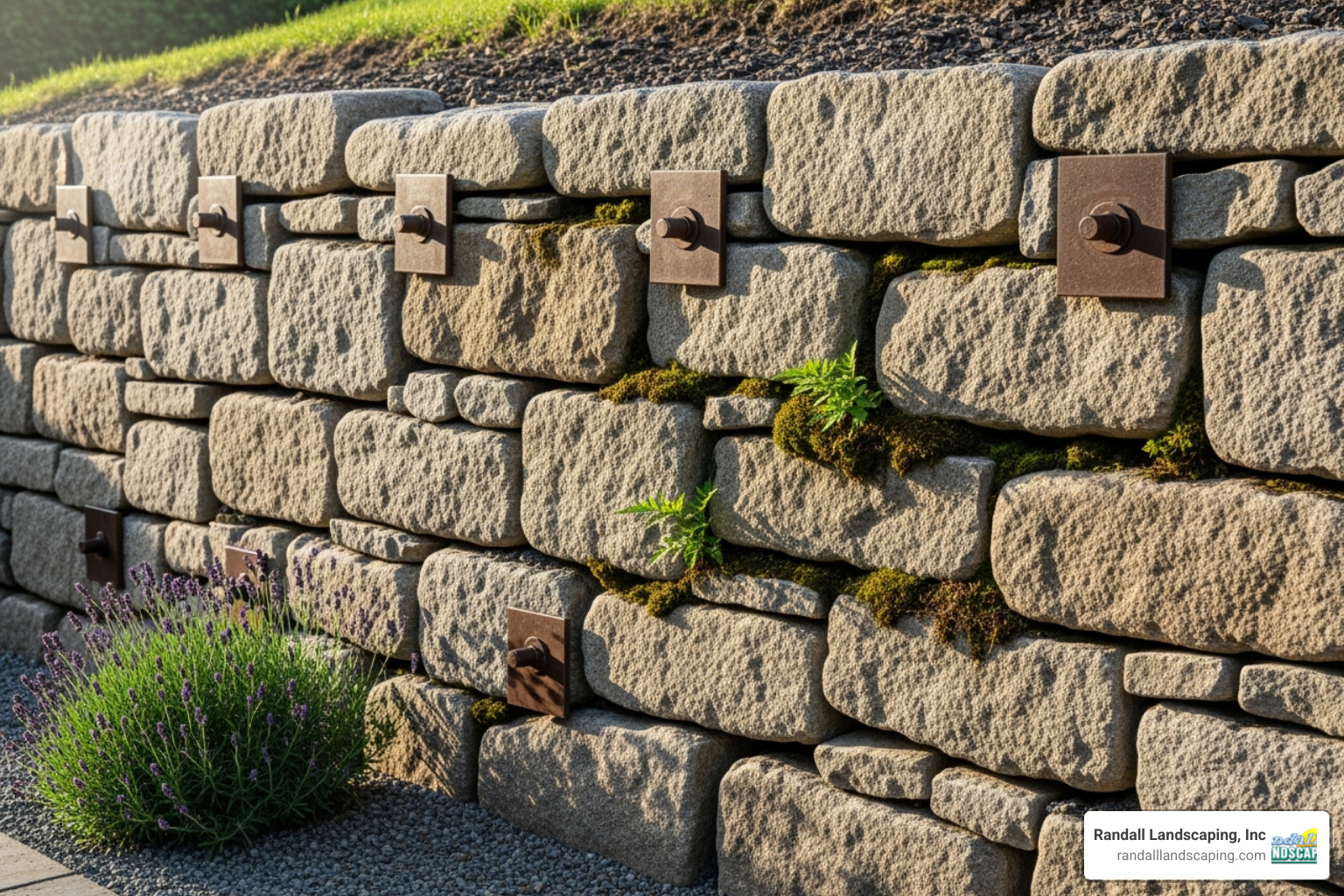
- Wall Bracket: A steel plate that attaches the anchor to the wall, distributing the holding force evenly to prevent stress and cracking.
The Science of Stability: How Anchors Resist Pressure
The effectiveness of helical anchors retaining wall systems comes from soil mechanics. As an anchor is rotated into the ground, the helical plates compact the soil, increasing its bearing capacity. This creates immense tension force resistance, with some anchors holding over 200,000 pounds.
A key principle is torque correlation. The rotational force (torque) needed to install the anchor directly relates to its holding capacity. This allows us to verify each anchor’s strength in real-time during installation. This predictable capacity eliminates guesswork and ensures your wall gets the exact support it needs, providing immediate confidence in its long-term stability.
Why Choose Helical Anchors for Your Retaining Wall?
For property owners weighing repair options, helical anchors retaining wall systems consistently outperform traditional methods like concrete deadmen. The advantages are clear in terms of speed, disruption, and reliability.
| Feature | Helical Anchors | Traditional Concrete Deadmen/Grouted Tendons |
|---|---|---|
| Installation Time | Quick; Immediate load testing; No curing delays | Slower; Requires concrete curing time (days/weeks) |
| Site Disruption | Minimal; No large excavations; Small equipment | Significant; Large excavations; Concrete trucks |
| Cost Implications | Cost-effective due to speed & reduced labor | Can be higher due to labor, materials, delays |
| Load Capacity | Predictable; Up to 200,000 lbs; Torque-verified | Variable; Depends on concrete quality/grout bond |
| Weather Impact | Installed in any weather conditions | Sensitive to cold/wet weather for curing |
| Environmental | Minimal soil spoils; Reusable in temporary applications | Concrete waste/spoils; Permanent structures |
Key benefits that make helical anchors a superior choice include:
- Minimal Excavation: We can often work through small access points, preserving your landscaping and driveway.
- Immediate Load Testing: We verify holding capacity the moment an anchor is installed, allowing projects to be completed in days, not weeks.
- All-Weather Installation: Work can proceed regardless of weather, avoiding the delays that plague concrete-based solutions.
- Reduced Labor & Equipment Costs: A streamlined process with smaller crews and equipment translates to savings.
- Environmental Benefits: The process creates minimal soil spoils and eliminates concrete waste.
Comparing Helical Anchors to Other Wall Repair Approaches
Understanding how helical anchors retaining wall systems compare to other common repairs highlights their advantages.
- Traditional Wall Anchors: These often require significant excavation 10+ feet behind the wall, which is impractical on many properties with fences, pools, or landscaping. Helical anchors solve this with exterior installation from the wall face, drilling into the soil behind it.
- Carbon Fiber Straps: This method is only suitable for minor wall movement (less than 3 inches of bowing). It provides surface reinforcement but lacks the deep anchoring needed to resist significant lateral earth pressure.
The structural repair benefits of helical anchors are most apparent in challenging sites, such as those with steep slopes or high water tables. At Randall Landscaping, we deliver quality solutions that last. Learn about our approach to quality retaining walls. For serious retaining wall issues, helical anchors offer the most reliable and efficient path to stability.
The Installation Process for Helical Anchors Retaining Wall Systems
Installing helical anchors retaining wall systems is a precise process that our team at Randall Landscaping has refined to be efficient and minimally disruptive.
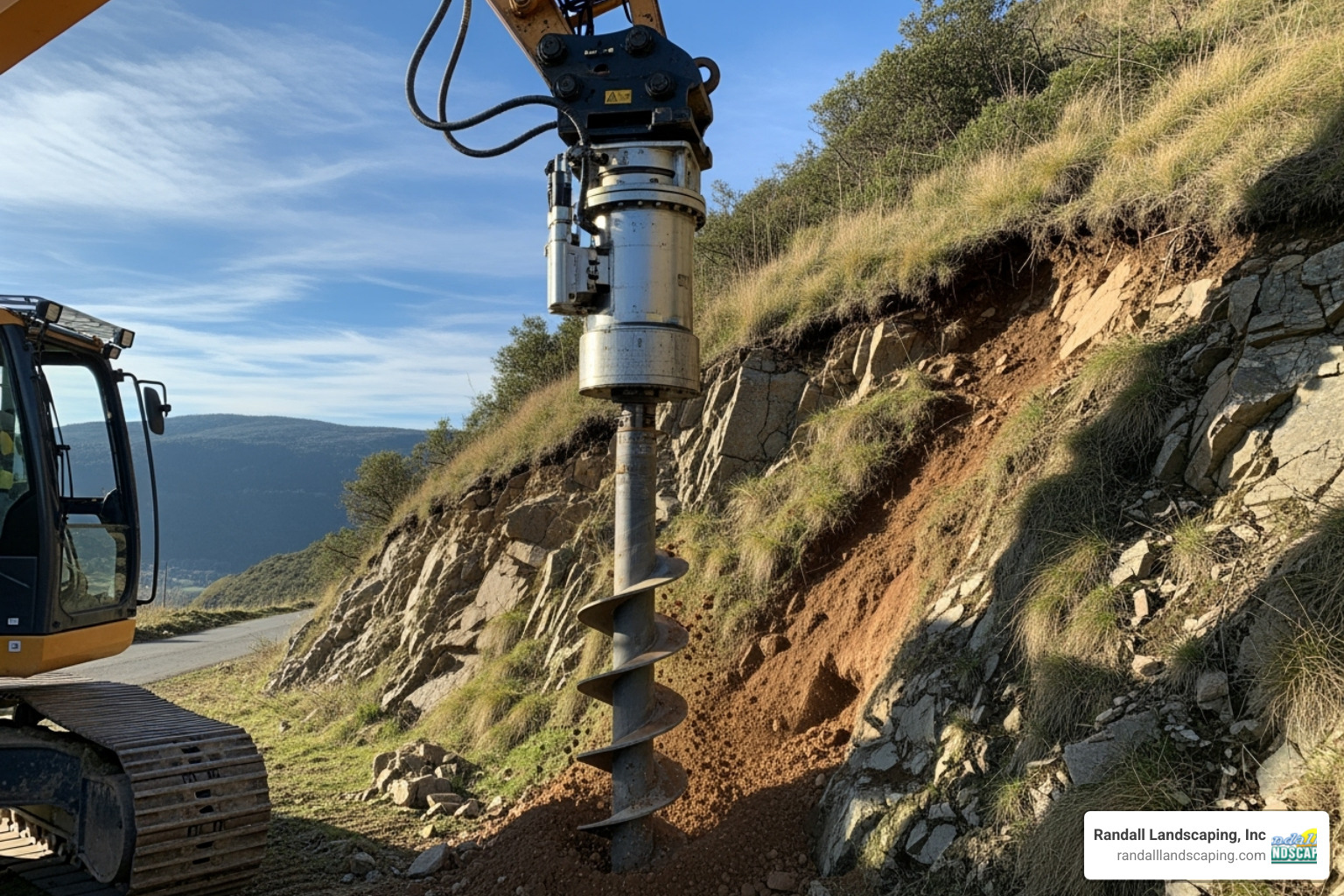
The installation uses a hydraulic torque motor, often mounted on an excavator or smaller limited access equipment for tight spaces. This versatility allows us to work on challenging sites, including those with a high water table or delicate landscaping, without major disruption.
Step 1: Site Assessment and Engineering Design
A successful installation begins with a thorough plan. This involves soil analysis to understand the ground conditions and precise load calculations to determine the force the wall must resist. Based on this data, we engineer the optimal anchor spacing, anchor angle, and helix configuration to ensure maximum stability. This detailed design phase eliminates guesswork and is crucial for a lasting repair. When investing in foundation work, always find a reputable contractor through the Better Business Bureau to ensure you’re working with qualified professionals.
Step 2: Drilling and Torque-to-Capacity Verification
During this step, we use the hydraulic motor for rotating the anchor into the ground. We advance the anchor through the unstable soil until it is firmly embedded in reaching competent soil—a stable layer deep behind the wall. Throughout the installation, we are recording installation torque. This data is vital, as the empirical torque-to-capacity relationship allows us to verify the holding strength of each anchor in real-time, a process known as proof testing.
Step 3: Termination and Wall Connection
In the final step, we connect the anchor to the wall. This involves attaching the wall plate, a robust steel bracket that distributes the anchor’s force across the wall’s surface. We then begin applying and locking-off tension to the anchor. This pre-tensioning process immediately starts to support the wall and can often pull it back toward its original position. Once the tension is locked off, we finish by restoring the landscape, ensuring the repair area blends seamlessly with your property.
Key Considerations for Helical Anchor Projects
Understanding the applications, costs, and long-term performance of helical anchors retaining wall solutions is key to making an informed decision.
Key Applications for Helical Anchors in Retaining Wall Repair
Helical tieback anchors are incredibly versatile. Common applications include:
- Bowing and Leaning Walls: The most frequent use, where anchors pull the wall back toward its proper position and hold it permanently.
- Permanent Shoring: Creating long-term stability for walls supporting critical areas like driveways, patios, or steep slopes.
- Temporary Shoring: Providing stability during construction, with the option to remove and reuse anchors later.
- Bulkheads and Seawalls: Offering immediate load-bearing capacity in challenging environments with water and soil pressure.
You can see examples of helical tieback projects to appreciate their wide range of uses. For homeowners, these systems provide lasting peace of mind. Explore our residential retaining wall solutions to see our approach.
Cost-Effectiveness of Helical Anchors for Retaining Wall Projects
While helical anchors retaining wall systems are a significant investment, they are often more economical than alternatives when considering the total project. Savings come from reduced installation time, reduced equipment needs, and less site restoration. Projects can often be completed in days instead of weeks.
Price disclaimer: The average cost for a single helical tieback can range from $1,800 to over $6,000 depending on soil conditions, anchor size, and site accessibility. These are industry averages based on internet data and not a quote from Randall Landscaping.
The final cost depends on factors like soil conditions, wall height, and accessibility, but helical anchors typically prove to be a smarter long-term investment compared to complete wall replacement.
Soil Conditions, Lifespan, and Environmental Impact
Anchor performance varies by soil type, and we adjust the anchor design accordingly for sand, clay, or other conditions. The design life of helical anchors is impressive, with the galvanized steel construction offering a service life of 75+ years.
From an environmental perspective, the installation creates minimal soil spoils, involves no concrete waste, and preserves existing landscaping due to minimal site disturbance. This makes them a sustainable choice, especially in areas with a high water table or limited access.
Frequently Asked Questions about Helical Anchors
Here are answers to the most common questions we get at Randall Landscaping about helical anchors retaining wall solutions.
How strong are helical tieback anchors?
Helical anchors are incredibly strong, with holding capacities up to 200,000 lbs per anchor in suitable soil. The final capacity depends on soil-dependent performance. We use a process called torque correlation during installation for engineering verification, which allows us to proof-test the tension loads each anchor can handle in real-time. This ensures we know its exact strength before connecting it to your wall.
How long do helical anchors last?
A properly installed helical anchor is a permanent solution with a design life of 75+ years. They are made of galvanized steel that meets strict material specifications for corrosion protection. This hot-dip galvanization protects the steel from moisture and soil elements, ensuring decades of reliable performance with no ongoing maintenance.
Can helical anchors be used in tight spaces?
Yes, and this is a major advantage. Limited access installation is a key feature of these systems. We can use smaller equipment like mini-excavators or even hand-held drive equipment to work in confined areas near pools, fences, or other buildings. This versatility for challenging job sites allows us to stabilize walls without destroying your landscape, making it an ideal solution for many properties in New Hampshire and Massachusetts.
Secure Your Landscape with Expert Retaining Wall Repair
A bowing, leaning, or cracked retaining wall is more than an eyesore; it’s a risk to your property. Failing retaining wall risks include soil erosion, damage to nearby structures, and a decrease in property value. Addressing these problems quickly is key to protecting your property value and achieving long-term stability.
This is where the helical anchor advantage comes in. Helical anchors retaining wall systems stabilize your wall quickly and permanently, with immediate, testable results you can count on—without the massive excavation and long curing times of traditional methods.
At Randall Landscaping, we have nearly two decades of experience serving the Merrimack Valley and Southern New Hampshire. Our expertise goes beyond structural repair; we ensure the fix integrates seamlessly with your landscape. We restore the surrounding area and can even paint wall plates to match, preserving your property’s aesthetic. Our reputation is built on quality work and 100% reliability.
Don’t wait for a small problem to become a costly disaster. Ready to get your retaining wall back on solid ground? Contact us to repair your retaining walls today for a consultation. We’re here to help you secure your landscape and restore your peace of mind.