Breaking Into the Commercial Landscaping Market
The journey toward landing your first commercial landscaping contract might seem daunting, but with the right approach, it’s absolutely achievable. As someone who’s walked this path, I can tell you that how to get commercial landscape contracts boils down to five key strategies that have proven successful for our team at Randall Landscaping.
First, target the right properties for your business size and capabilities. When we began expanding beyond residential work, we found locally-owned businesses, small office parks, and regional property management companies to be the perfect starting point. These clients typically have simpler decision processes than national corporations but offer more stability than residential accounts.
Building genuine relationships is absolutely essential in commercial landscaping. I’ve found that joining industry organizations like CREW and BOMA opened doors I couldn’t have accessed otherwise. These connections have become our most valuable lead sources, often resulting in warm introductions that bypass the typical cold outreach problems.
Creating professional, detailed proposals has been a game-changer for our business. Commercial decision-makers respond to thorough documentation that includes clear scope definitions, competitive yet profitable pricing, and visual elements that help them envision the finished result. The days of handwritten estimates on carbon paper are long gone in the commercial sector!
Following a structured bidding process helps ensure you’re pricing accurately while demonstrating professionalism. This means conducting comprehensive site visits, using proper measurement tools (not just eyeballing areas), and factoring in all potential costs from labor to materials to equipment wear. Overlooking even small details can erode your profit margins quickly.
Finally, persistent, professional follow-up separates successful commercial landscapers from the rest. The commercial sales cycle often stretches 3-9 months, requiring patience and consistent communication. We’ve developed a cadence of check-ins that keeps us top-of-mind without becoming pushy.
Landing commercial landscape contracts represents a significant opportunity for growth-minded landscaping businesses. While residential landscaping offers creative flexibility, how to get commercial landscape contracts requires a different approach—one focused on systematic outreach, professional presentation, and relationship building. Commercial contracts typically deliver larger contract values, more consistent revenue, and opportunities for year-round service extensions like snow management.
The commercial landscaping market operates differently from residential work. Decision-makers often aren’t property owners, contracts run on fiscal budgets, and the sales cycle tends to be longer. However, the payoff can be substantial, with commercial accounts providing stable, recurring revenue that can transform your business model.
I’m Tommy Randall, owner of Randall Landscaping, Inc., and I’ve successfully transitioned from primarily residential work to securing profitable commercial landscape contracts throughout Massachusetts and New Hampshire. Over my 18 years in the industry, mastering how to get commercial landscape contracts has been crucial to our company’s growth and stability.
What I’ve learned is that commercial clients value reliability and consistency above all else. While residential clients might forgive an occasional scheduling hiccup, commercial properties have strict appearance standards and visitor expectations that make dependability non-negotiable. This higher standard has actually improved our operations across the board, benefiting all our clients regardless of size.
Commercial vs. Residential Landscaping: Why Go B2B?
When I talk with landscaping business owners about expanding into commercial work, I often hear the same question: “Is it really that different?” The answer is a resounding yes. As Gib Durden, vice president of business development at a major landscaping firm, puts it: “It’s a totally different animal.”
Commercial landscaping operates in a world apart from residential services. Instead of dealing directly with homeowners, you’ll steer property management companies, committees, and corporate boards. While residential clients might make quick decisions, commercial prospects operate on fiscal calendars with budgeting cycles that can stretch your sales process from weeks to months.
| Aspect | Residential Landscaping | Commercial Landscaping |
|---|---|---|
| Decision Makers | Homeowners (direct) | Property managers, committees, boards |
| Contract Value | Lower per property | Higher per property |
| Profit Margins | Higher margins | Lower margins, higher volume |
| Billing Cycle | Often per-service | Monthly or quarterly |
| Sales Cycle | Days to weeks | Weeks to months |
| Price Increases | Variable/negotiated | Often automatic (3-5% annually) |
| Service Scope | Often creative, custom | Typically standardized, performance-based |
| Payment Terms | Usually prompt | Can be 30-90 days |
Most commercial properties operate on predictable fiscal budgets. Services typically split between growing season maintenance (April 15 to November 15 in our New England climate) and winter services like Commercial Snow Plowing. This creates year-round revenue opportunities that can transform your business model.
Key Benefits That Attract Growing Firms
There’s a reason why 61% of landscape companies eventually choose to specialize in either B2B or B2C markets. The benefits of commercial work can be substantial for companies ready to make the transition.
Recurring revenue becomes your new best friend with commercial contracts. Most run for 1-3 years with automatic renewal clauses, creating stable cash flow you can count on. This predictability makes planning, hiring, and equipment investments much easier.
Portfolio prestige comes naturally when you maintain high-profile commercial properties. That office park on the main highway or that shopping center everyone visits? They become living billboards for your work, visible to thousands of potential clients daily.
Cross-season work solves the winter slowdown problem. Commercial clients need year-round services, including snow management, helping maintain steady revenue during what would otherwise be lean months.
Cost predictability improves with commercial contracts that usually include automatic price adjustments of 3-5% annually. This helps offset rising labor costs, which have increased about 3% per year for the past two decades.
As Terry Delany, president of a facility management company, notes: “If you have the patience and are willing to deal with slow payments and replacing large accounts, go commercial.” It’s honest advice that acknowledges both the benefits and challenges.
Common Challenges to Prepare For
How to get commercial landscape contracts is only half the equation. Being prepared for the unique challenges of B2B work is equally important:
The long sales cycles can test your patience. Commercial deals often align with fiscal budget planning, meaning your proposal might sit for months before approval. Building a pipeline of prospects becomes essential to maintain consistent growth.
Strict specifications replace the creative freedom of residential work. Commercial contracts require adherence to detailed performance standards rather than hourly work. You’ll be judged on results, not effort.
Higher insurance requirements come with the territory. Most commercial properties require liability coverage of $2-5 million and specific endorsements that increase your insurance costs.
Crew specialization becomes necessary as your business grows. As Jim Schill, a vice president in the industry, advises: “Don’t try intermingling the same guys doing commercial and residential work.” Commercial crews need different training, equipment, and mindsets.
Lower margins are the reality of commercial landscaping’s low-margin, high-volume business model. What you lose in percentage, you gain in contract dollar value. A 15% margin on a $10,000 monthly contract beats a 30% margin on a $1,000 residential job any day.
At Randall Landscaping, we’ve steerd these challenges while building our commercial portfolio throughout Massachusetts and New Hampshire. The transition requires planning and patience, but the stability and growth potential make it worth considering for any ambitious landscaping business.
Building a High-Value Lead Pipeline
Success in commercial landscaping begins with a strategic approach to lead generation. The companies that thrive in this space don’t rely on random opportunities—they build systematic pipelines of qualified prospects.

Prospecting Blueprint: how to get commercial landscape contracts in your market
I’ve found that identifying the right commercial niches is your first step toward building a profitable contract portfolio. Not all commercial properties are created equal, and your success often depends on targeting sectors that align with your team’s strengths and equipment capabilities.
Real estate agencies and property management companies often control multiple properties, meaning one relationship can lead to several contracts. Homeowner associations and condominium complexes typically have dedicated maintenance budgets and regular board meetings where service decisions are made. Locally-owned businesses tend to have more accessible decision-makers compared to national chains.
Other promising targets include warehouses and distribution facilities (which often need simple but consistent maintenance), office parks and corporate campuses (where appearance directly impacts company image), healthcare facilities (which require specialized attention to cleanliness and safety), and educational institutions (which often have year-round maintenance needs).
Once you’ve identified your targets, it’s time to get creative with your approach. I recommend conducting regular drive-by audits of commercial areas in your territory. Look for telltale signs of maintenance issues—overgrown hedges, weedy parking lots, or faded mulch beds. These visual cues signal opportunities where you can offer immediate improvement.
Personalized introduction kits work wonders for getting your foot in the door. One of my favorite tactics comes from a landscaper who shared: “I drop off a box of cinnamon buns or cornbread to local businesses to make a memorable introduction.” This personal touch helps you stand out from the dozens of generic emails property managers receive each week.
Creating memorable door-opener moments can transform cold calls into warm conversations. As another successful contractor explained to me, “I offer to bring lunch for the office staff to secure an initial meeting.” This small investment creates goodwill that’s hard to measure but impossible to ignore.
Persistence pays off in commercial landscaping. Research shows it typically takes 7-13 interactions to convert a prospect into a customer. Maintain a consistent follow-up schedule every 2-3 weeks, being helpful rather than pushy. According to research from NovoResume, 77% of people prefer in-person networking because they can read body language, making face-to-face interactions particularly valuable in this industry.
Digital & Community Marketing Essentials
While relationship-building remains the cornerstone of how to get commercial landscape contracts, your digital presence amplifies your reach in powerful ways.
Case study videos offer compelling visual evidence of your change capabilities. As landscaper Chant Singvongsa explains: “The way I grew was organically—just constantly posting your work online. People will see it, even though you might not get the thumbs up or likes. Just keep posting.” Before-and-after footage of commercial properties speaks volumes about your capabilities without saying a word.
Social proof plays an increasingly important role in commercial decisions. Companies with strong testimonials see approximately 31% more spending from consumers. Don’t be shy about encouraging satisfied clients to share their experiences—their words carry more weight than any marketing material you could create. Consider offering small incentives for reviews, such as service discounts or additional spring clean-up services.
Your social media strategy should focus on platforms where decision-makers spend their time. With 68% of American adults on Facebook and 30% on LinkedIn, these platforms provide direct access to commercial property stakeholders. Rather than simply posting pretty pictures, share educational content about how proper landscaping reduces maintenance costs, improves property values, and supports sustainability goals.
Creating limited-time offers introduces helpful urgency into the decision-making process. One approach that’s worked well for us is offering a first-time maintenance package at a reduced rate to demonstrate our capabilities, then transitioning to standard rates upon renewal. Once clients experience exceptional service, price becomes less of an obstacle.
Community involvement isn’t just good citizenship—it’s good business. Joining local chapters of organizations like CREW (Commercial Real Estate Women) and BOMA (Building Owners and Managers Association) connects you with property managers and decision-makers in relaxed, non-sales environments where relationships can develop naturally.
Don’t forget that your reputation for quality and reliability speaks volumes. You can learn more about how positive reviews impact business growth on our customer reviews page. In commercial landscaping, your work is always on display, and every property becomes a living portfolio piece that can attract—or repel—potential clients.
How to Get Commercial Landscape Contracts: The Winning Formula
Once you’ve identified promising leads, you need a systematic approach to convert them into contracts. Following a structured bidding process dramatically increases your success rate.
Crafting Bids That Secure how to get commercial landscape contracts
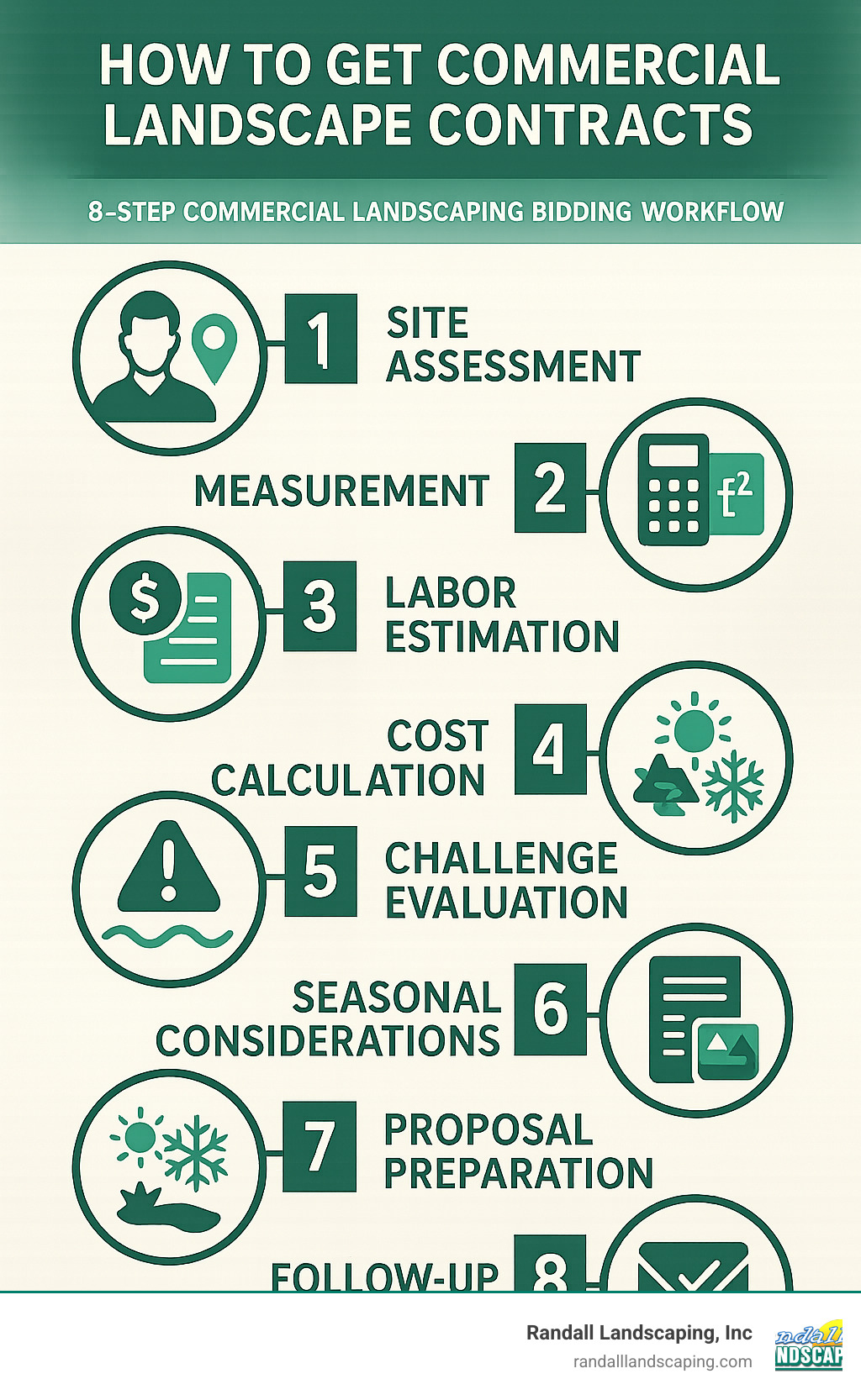
The bidding process is where many landscapers stumble. After years in the business, I’ve developed an 8-step formula that consistently helps us win contracts without leaving money on the table.
It all starts with truly understanding what your client needs. I always begin with a thorough site visit and needs assessment. During these visits, I make sure to ask about pain points with their current provider – you’d be surprised how often I hear about simple reliability issues that we can easily solve. I also discuss budget parameters and specific priorities upfront to avoid wasting everyone’s time.
Accurate measurements are absolutely crucial. We use property measurement software to precisely calculate square footage of turf, beds, and hardscapes. This technology has been a game-changer for us, dramatically improving our accuracy while cutting down the time we spend on estimates.
When calculating labor costs, we rely on production rates rather than guesswork. The formula is straightforward: Labor Hours = Measurements ÷ Production Rates. These rates tell us exactly how many square feet our equipment can service per hour, making our estimates more scientific and reliable.
Don’t forget to factor in all costs – not just labor and materials, but also equipment, overhead, and a reasonable profit margin. For newer companies in competitive markets, I suggest starting with at least a 15% margin, though this varies based on your market.
Every property has its challenges. Be sure to identify and price for site-specific issues like steep slopes, limited access points, or special landscape features that require extra attention. These details make a huge difference in your actual costs.
Weather in New England is unpredictable, as we all know too well. Build in contingencies for seasonal workload fluctuations and weather-related challenges. This protects both you and your client from unexpected surprises.
Your proposal itself matters tremendously. We create visually appealing, branded proposals that include scope details, pricing breakdowns, relevant case studies, and testimonials. A professional presentation sets you apart from competitors who might just send over a basic quote.
Finally, follow up strategically. We implement a structured follow-up process with specific intervals – typically 3 days after submission, then bi-weekly – to address questions and demonstrate our responsiveness. This persistence often makes the difference between winning and losing a contract.
Before submitting any bid, I always ask myself these 8 critical pre-bid questions:
- How many competitors are submitting proposals?
- Was this a cold call or warm referral?
- What is your financial position as a company right now?
- Do you need to buy new equipment or hire additional employees for this contract?
- What are the up-sale potentials?
- Who will be your contact if you land this account?
- How long has this potential account been in business?
- How often does the account switch landscape contractors?
According to McKinsey research, companies that invest in personalization see approximately 40% more revenue. This underscores something I’ve seen – custom proposals that address specific client needs simply perform better than generic ones.
You can learn more about our approach to commercial property maintenance on our Commercial Landscaping page.
Contract Must-Haves & Pitfalls to Avoid
A well-structured contract protects both parties and sets clear expectations. Over the years, I’ve found these elements to be absolutely essential:
Detailed Service Maps are non-negotiable. We clearly define service areas with property maps to prevent misunderstandings about scope. This visual element eliminates so many potential disputes.
Automatic Price Adjustments help maintain your profitability over time. We include annual increases of 3-5% to offset rising costs of labor, fuel, and materials. Clients understand this better when it’s explained upfront rather than surprised with later.
A Right-to-Correct Clause has saved many valuable relationships. This establishes a formal process allowing you to address any service issues before contract termination. Most clients appreciate this commitment to making things right.
Renewal Windows provide clarity for both parties. We define when and how the contract renews, typically with 30-90 day notice periods. This prevents awkward last-minute negotiations.
Out-of-Scope Rates should be crystal clear. We list services not included in monthly billing and their associated costs. This transparency prevents sticker shock when additional services are needed.
Establishing a Decision-Maker Hierarchy is often overlooked but incredibly valuable. Know who can authorize additional work, including alternates for emergencies. This prevents delays when quick decisions are needed.
In my years of experience, I’ve seen many landscapers make the same mistakes over and over. Underbidding to win work creates unsustainable relationships and undermines industry pricing. You might win the contract, but you’ll lose in the long run.
Unclear scope definitions lead to scope creep and client dissatisfaction. Be specific about exactly what services are included – and what aren’t. Missing payment terms cause headaches for everyone involved. Always include payment schedules and consequences for late payment.
Don’t overlook seasonal variations in your contracts. New England weather means service intensity varies dramatically throughout the year, and your contract should account for this reality.
With these elements in place, you’ll not only win more commercial landscape contracts – you’ll build sustainable, profitable relationships that benefit both you and your clients for years to come.
Bidding, Contracting & Technology Toolkit
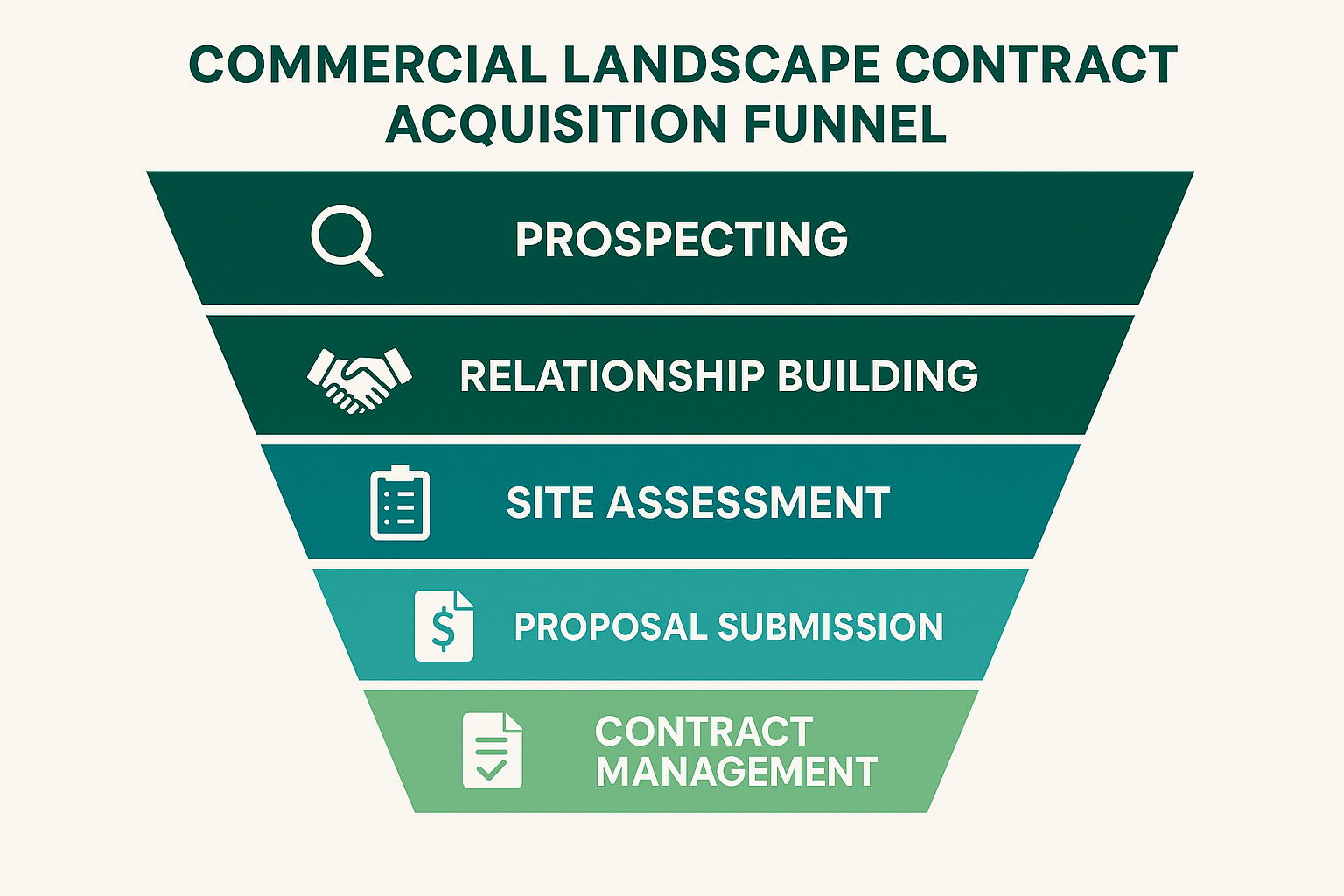
Technology has reshaped every step of the commercial-landscape sales funnel—from the first property measurement to the day you renew a multi-year agreement. Instead of repeating the bidding concepts we covered in the previous section, let’s zoom in on the digital tools and data points that keep your numbers accurate and your margins intact.
Technology That Eliminates Guesswork
• Property-measurement apps such as Go iLawn, SiteRecon, or PropertyIntel turn aerial imagery into precise square-footage reports in minutes.
• Landscape-specific CRMs (Service Autopilot, Aspire, LMN) track prospects, automate follow-ups, and store every site photo or note in one searchable profile.
• Cloud-based estimating platforms let you build proposals on-site and send e-sign contracts before you leave the parking lot. According to McKinsey research, companies that personalise outreach with live data see up to 40 % higher revenue—one more reason to ditch spreadsheets.
Data-Driven Pricing & Profit Guardrails
- Update labour production rates every quarter to reflect true crew output.
- Apply automatic fuel and material surcharges when regional price indexes jump more than 5 %.
- Set a floor margin (we recommend 15 – 30 % depending on contract size) and have your estimating software flag any bid that drops below it.
- Run break-even analyses by property so you know—in real time—whether an account is helping or hurting annual profit goals.
Modern Bid Portals & Government Opportunities
Private work isn’t the only game in town. Bid-notification services like SAM.gov, iSqFt, or BidClerk send daily alerts for municipal, school-district, and federal facilities that need grounds maintenance. Make sure you upload current certificates of insurance and references before the deadline—public-sector portals rarely grant extensions.
The Eight-Point Profit-Protection Checklist
Before you click “Send” on any proposal, confirm that you can answer “yes” to each of these safeguards:
- Do we know exactly how many competitors are bidding?
- Was the lead a warm referral or a true cold call?
- Can we service the account without new equipment purchases?
- Do labour and materials costs reflect today’s rates—not last year’s?
- Have we identified realistic up-sell opportunities (seasonal colour, improvements, snow)?
- Is a single decision-maker assigned, with backups for emergencies?
- Have we verified the client’s payment history and vendor-change frequency?
- Does the contract include a 3 – 5 % annual price adjustment tied to the CPI or a regional labour index?
Taking the extra 20 minutes to run through this checklist inside your estimating software can save months of headaches—and ensures that every contract you win is one you actually want.
Long-Term Success: Profit, Risks & Relationships
Winning contracts is just the beginning. Long-term success in commercial landscaping depends on effective client management, risk mitigation, and relationship building.

Relationship Management After the Ink Dries
The day your client signs the contract marks the true beginning of your relationship, not the end of your sales process. At Randall Landscaping, we’ve found that thoughtful client management transforms one-time contracts into lasting partnerships.
Start with a comprehensive onboarding process. Gather your team and the client for a kickoff meeting where expectations are aligned and faces are matched to names. This personal connection establishes trust right from the start and prevents misunderstandings down the road.
Quarterly property walk-throughs have proven invaluable for our client relationships. These scheduled inspections allow us to spot potential issues before they become problems and give clients regular opportunities to provide feedback. One of our property managers recently told us, “These regular walk-throughs make me feel like our property is actually being cared for, not just maintained.”
Performance metrics matter too. Establish clear KPIs with your clients—whether that’s response time to service requests or visual standards for turf height—and review them regularly. This data-driven approach transforms subjective opinions into objective discussions about service quality.
Strategic upselling isn’t just good for your bottom line; it’s valuable for your clients too. When you identify genuine improvement opportunities that improve property value, everyone wins. The key is timing these suggestions thoughtfully, not overwhelming clients with constant sales pitches.
Perhaps most importantly, assign a dedicated account manager to each commercial client. This single point of contact creates accountability and simplifies communication. As one of our long-term clients shared: “After 10 years using the same landscaper and each year the standard of care decreasing, we switched to [a new provider] and can’t be happier. The people working are polite and respectful and do not have attitudes.”
Technology for Renewal & Upsell Cycles
Smart technology usage separates thriving commercial landscape companies from those that merely survive. The renewal process should begin long before the contract expires—we recommend setting automated reminders 90-120 days before expiration to initiate renewal discussions while there’s still time for thoughtful negotiation.
Detailed asset tracking transforms your service from reactive to proactive. When you maintain comprehensive records of all services performed, you create an invaluable property history that helps identify patterns and predict future needs. This historical knowledge becomes a competitive advantage that new bidders simply can’t match.
Monitoring profitability by property isn’t just good business—it’s essential for sustainability. We track costs carefully for each account, which allows us to identify which properties might need contract adjustments at renewal time. This approach ensures we’re providing value to clients while maintaining our own profitability.
The most sophisticated commercial landscape companies use predictive maintenance, analyzing historical data to anticipate and propose preventative services before issues become visible. This approach not only generates additional revenue but positions you as a forward-thinking partner rather than just a service provider.
Risk management deserves equal attention. Maintain proper insurance coverage that meets or exceeds client requirements. Diversify your client base to avoid dangerous dependency on any single account. And always have contingency plans for equipment failures, extreme weather events, or unexpected staff shortages. The commercial landscapers who thrive long-term are those who prepare for challenges before they arise.
Frequently Asked Questions About Commercial Landscape Deals
What average pricing should I expect?
When it comes to how to get commercial landscape contracts, understanding pricing is essential. Commercial landscape maintenance pricing varies significantly based on multiple factors including property size, service scope, and regional market conditions.
Based on internet data (not Randall Landscaping quotes), average pricing typically ranges from $500 to $4,500+ per acre per month. Smaller properties like professional office buildings might pay $1,000-$3,000 monthly for comprehensive maintenance, while expansive corporate campuses can exceed $10,000 monthly.
These figures represent industry averages from internet sources, not actual pricing from Randall Landscaping, Inc. Every property has unique needs that influence final pricing.
How long does the sales cycle take?
Patience is crucial when pursuing how to get commercial landscape contracts. The typical sales cycle ranges from 3 to 9 months—significantly longer than residential sales. This extended timeline depends on several factors:
Your prospect’s fiscal calendar often dictates when decisions can be made. Many commercial properties allocate landscaping budgets annually, so your timing relative to their budget cycle matters tremendously.
The process also varies depending on whether you’re replacing an existing vendor (which might happen faster if they’re dissatisfied) or bidding on a new development (which follows construction timelines).
Complex properties with extensive requirements naturally take longer to evaluate and approve. Similarly, properties with committee-based decision making typically move slower than those where a single property manager has authority.
Plan your prospecting calendar with these timelines in mind, understanding that today’s outreach may not bear fruit for several months.
Do I need separate crews for commercial work?
Industry experts, ourselves included, strongly recommend dedicated commercial crews. As respected industry consultant Jim Schill advises: “Don’t try intermingling the same guys doing commercial and residential work.”
Having separate teams allows for specialized training in commercial property requirements, which differ significantly from residential needs. Commercial crews develop efficiency through standardized routines that residential work often doesn’t allow. They also become familiar with commercial property regulations and safety requirements.
While maintaining separate crews initially requires more organizational effort, the improvements in quality, efficiency and compliance make it worthwhile. Your commercial clients will notice the difference in consistency and professionalism, leading to higher retention rates and stronger relationships.
At Randall Landscaping, we’ve found that this specialized approach not only improves service quality but ultimately improves profitability by allowing teams to develop expertise in their specific domain.
Conclusion & Next Steps
Winning how to get commercial landscape contracts isn’t something that happens overnight. It’s a journey that rewards those who bring patience, persistence, and professionalism to the table. But the payoff can transform your business—commercial landscape work offers stability and growth potential that’s hard to match in the residential sector.
Think of what we’ve covered as your roadmap to commercial success:
We started by exploring the fundamental differences between residential and commercial landscaping—from longer sales cycles to different decision-makers and pricing structures. Understanding these differences helps you avoid costly mistakes and set realistic expectations.
Then we looked at building your lead pipeline through targeted prospecting. Successful commercial landscapers don’t wait for opportunities to find them—they systematically identify and pursue the right properties and relationships. Whether it’s through those drive-by audits, networking events, or digital marketing, consistency is key.
The bidding process is where many landscapers stumble. By following our structured approach—accurate measurements, production-rate calculations, and professional proposals—you’ll stand out from competitors who rely on guesswork and hasty estimates. Your thoroughness demonstrates professionalism that property managers notice.
Contracts need to protect both parties while setting clear expectations. Those automatic price adjustments, right-to-correct clauses, and clearly defined scopes might seem like small details, but they’re what separate sustainable relationships from problematic ones.
Finally, the work of relationship-building continues long after winning the contract. Those quarterly walk-throughs, performance reviews, and strategic upsells aren’t just about maintaining the account—they’re about growing it and building a foundation for referrals.
At Randall Landscaping, Inc., we’ve walked this path ourselves. Our journey from primarily residential work to a thriving commercial landscape business has been built on two simple principles: delivering quality work and being 100% reliable. Throughout the Merrimack Valley and Southern New Hampshire, that reputation has opened doors that advertising alone never could.
If you’re managing a commercial property and looking for a maintenance partner who understands your unique needs, we invite you to explore our Commercial Landscaping services. Our team specializes in creating customized maintenance programs that improve your property’s appearance and protect its value—all while working within your specific budget parameters.
In the commercial landscaping world, your reputation becomes your most valuable asset. By focusing on exceptional service, clear communication, and unwavering quality, you won’t just win contracts—you’ll build relationships that sustain your business through economic ups and downs for years to come.
The journey to how to get commercial landscape contracts might be challenging, but it’s one that offers rewards well worth the effort. And remember, every thriving commercial landscaping company started with that first contract. Why not make today the day you begin your own commercial landscaping success story?