
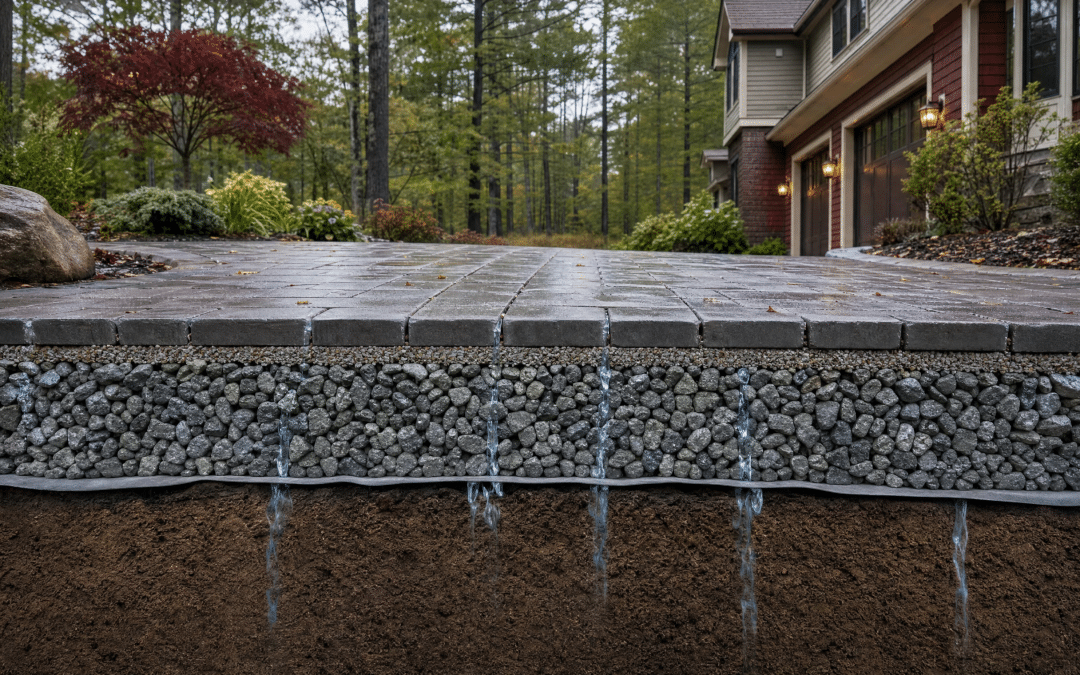
Permeable paver systems manage water through deliberately open joints and engineered layers below the surface. They are not ordinary pavers with wider gaps. Performance depends on site runoff, joint material, bedding, stone reservoir, subgrade, edge restraint, overflow, and maintenance.
Follow the water through the system
- Water enters through permeable joints between pavers.
- Open-graded bedding spreads water below the surface.
- A deeper clean-stone reservoir stores water temporarily.
- Water infiltrates into suitable subgrade, exits through an underdrain, or follows a designed combination.
- An overflow path handles events larger than the design storage.
The EPA notes that permeable-pavement performance depends heavily on the underlying layers and surrounding conditions in its permeable pavements guidance.
| Layer or condition | Job | Failure risk if ignored |
|---|---|---|
| Paver and joint system | Supports traffic while admitting water | Closed or clogged joints prevent entry |
| Bedding | Provides a level, draining setting layer | Wrong fines can restrict flow or migrate |
| Reservoir stone | Provides structural base and temporary storage | Insufficient depth or contamination reduces capacity |
| Subgrade | Supports the system and may receive infiltration | Weak or slow soil changes design needs |
| Underdrain or overflow | Controls water when infiltration or storage is exceeded | Water can back up into the pavement section |
| Edge restraint | Contains the units and base | Spread, settlement, and joint loss can develop |
Test whether the site fits
Review soil, groundwater, ledge, slope, contributing drainage area, winter maintenance, traffic loads, utilities, nearby foundations, and local stormwater requirements. A high-water table or poorly infiltrating subgrade does not automatically rule out every permeable design, but it changes storage, underdrain, liner, and overflow decisions.
Protect the system during construction
Sediment is a primary threat to permeability. Keep muddy runoff and fine soil out of the open-graded materials. Do not use completed permeable pavement as an uncontrolled construction entrance. Inspect and clean joints before closeout.
Plan winter and long-term maintenance
Use maintenance methods compatible with the surface and joint aggregate. Sand and fine debris can clog joints. Vacuuming or other approved surface maintenance may be required, and displaced joint stone must be restored with the correct material. Monitor low spots, ponding, edge movement, and runoff from adjacent areas.
Questions before choosing permeable pavers
- Where does water enter and leave the system?
- What soil and groundwater evidence supports the design?
- How much runoff area contributes to the pavement?
- What are the traffic and snow-management loads?
- Is an underdrain, liner, check dam, or overflow needed?
- How will sediment be excluded during and after construction?
- Who will inspect and maintain the joints?
Randall Landscaping installs driveway paver systems in the Southern New Hampshire and Andover area. Confirm the specific permeable products and engineered details proposed for the site before treating the surface as a stormwater solution.