
Why a Yard Maintenance Contract Is the Foundation of a Great Lawn Care Experience
A yard maintenance contract is a written agreement between a property owner and a lawn care provider that defines exactly what services will be performed, how often, and what each party is responsible for.
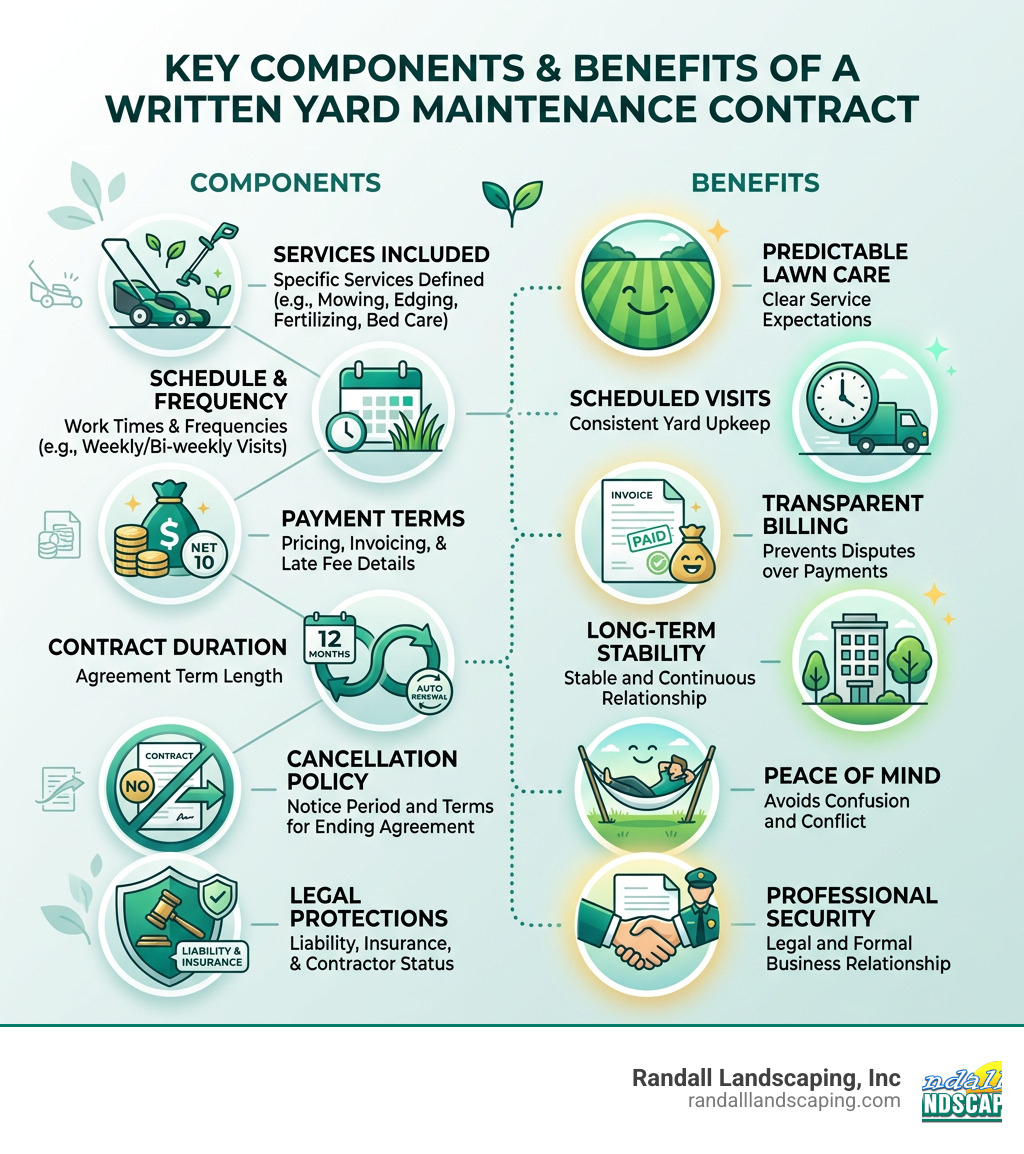
Here’s what a solid yard maintenance contract typically covers:
- Services included – mowing, edging, fertilization, bed care, debris removal
- Schedule – weekly in peak season (April–October), bi-weekly off-season (November–March)
- Payment terms – monthly invoicing, net 10 terms, late fee policies
- Contract length – usually 12 months with automatic annual renewal
- Cancellation rules – typically 30 days written notice required
- Legal protections – liability, insurance, independent contractor status
Without a contract, both homeowners and lawn care companies are exposed. Services get misunderstood. Disputes over billing become messy. And there’s no clear path forward when something goes wrong.
A good contract protects everyone. Homeowners know exactly what they’re getting. Providers know exactly what’s expected. It turns a handshake agreement into a professional, enforceable relationship.
I’m Tommy Randall, owner of Randall Landscaping, Inc., and since 2006 I’ve drafted and worked under countless versions of a yard maintenance contract across Massachusetts and Southern New Hampshire. That hands-on experience gives me a clear picture of what works, what causes problems, and how to protect both sides of the agreement.
Yard maintenance contract vocab to learn:
What is a Yard Maintenance Contract and Why is it Essential?
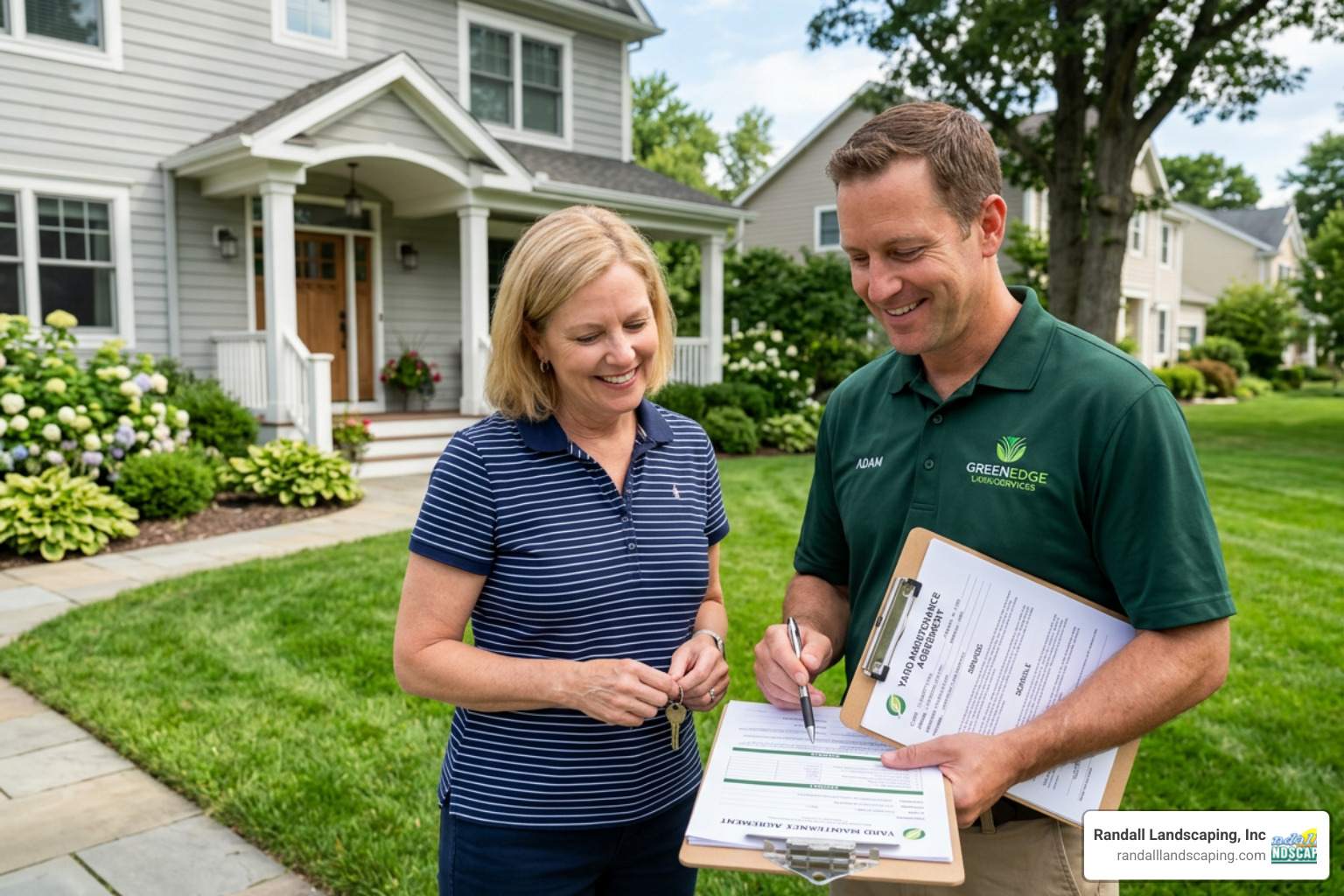
At its core, a yard maintenance contract is more than just a piece of paper; it is a roadmap for your property’s health. In the Merrimack Valley and Southern New Hampshire, weather can be unpredictable. A formal agreement ensures that whether we are dealing with a heatwave in North Andover or an early frost in Pelham, your property remains a priority.
For the client, it provides peace of mind. You aren’t left wondering if the crew will show up or if the weeds in the mulch beds will be pulled. For us, the professionals, it allows for better resource planning. We can invest in top-tier equipment and maintain a consistent, skilled crew because we know our schedule is set. This consistency is what maintains property value over time. A neglected yard can deteriorate rapidly, but a contracted service ensures that small issues are caught before they become expensive problems. For more details on finding local help, check out our guide on lawn-maintenance-near-me.
Defining the 12-Month Service Agreement
Most professional agreements are structured as a 12-month commitment. This isn’t just to “lock you in”—it’s because New England landscaping is a year-round job. While mowing stops in the winter, we are often busy with commercial-landscape-maintenance tasks like policing debris or planning spring renewals.
Standard contracts typically feature an automatic renewal clause. This means the service continues every 12 months unless a 30-day written notice is provided. This “set it and forget it” approach builds a long-term relationship where the crew becomes intimately familiar with the specific quirks of your soil and plant life.
Benefits for Residential and Commercial Clients
Commercial clients, in particular, rely on these contracts for strict budgeting and liability reasons. A commercial-landscape-maintenance agreement ensures that a business park in Salem, NH, or a retail center in Methuen looks professional and remains safe for foot traffic.
Residential clients benefit from the same level of accountability. Knowing that your landscape-maintenance-services are scheduled and budgeted for the entire year eliminates the stress of seasonal “sticker shock.”
Essential Components of a Professional Yard Maintenance Contract
A “handshake deal” might work for a teenager mowing a neighbor’s lawn, but for professional results in places like Boxford or Windham, you need specific legal components. A comprehensive yard maintenance contract should clearly state that the provider is an independent contractor. This protects the property owner from being classified as an “employer” by the IRS, which carries heavy tax and insurance implications.
Key legal elements include:
- Proof of Insurance: The contractor must carry liability and workman’s compensation insurance.
- Property Boundaries: The client warrants that property lines are accurately marked to avoid disputes with neighbors.
- Utility Responsibilities: Clients are generally responsible for marking private lines (like invisible dog fences or satellite cables) and providing access to water and electricity.
Detailed Scope of Services
The “Scope of Work” is the meat of the contract. It should explicitly list every task. Are the flower beds included? Is the debris blown off the driveway? We recommend looking at our landscape-maintenance-services page to see how we categorize these tasks. A standard list often includes:
- Mowing and string trimming (weed whacking)
- Steel-blade edging of sidewalks and driveways
- Turf fertilization and weed control
- Pruning of shrubs and small trees
- Blowing clippings and leaves from hardscapes
Terms, Renewals, and Termination Clauses
Contracts are usually fixed-term (one year) with a biennial price adjustment—often a 3% increase every 24 months—to account for rising fuel and material costs. Termination clauses protect both sides. For example, if a client fails to pay, the contractor can usually stop work after a 7-day default notice. Conversely, the client can terminate for poor performance, provided they give the required 30-day notice.
Standard Services and Seasonal Frequency Schedules
In our region, a “one size fits all” schedule doesn’t work. We adjust our visit frequency based on the biological needs of your grass.
| Service Period | Frequency | Primary Focus |
|---|---|---|
| Peak (April – Oct) | Weekly | Mowing, Edging, Weed Control |
| Off-Peak (Nov – Mar) | Bi-Weekly / Monthly | Leaf Removal, Winterization, Pruning |
| Drought/Slow Growth | As Needed | Avoiding turf damage/scalping |
Peak Season: April through October
During the growing season, our lawn-mowing-salem-nh crews are on-site weekly. We maintain grass at a height of approximately 3 to 4 inches. Cutting too short (scalping) stresses the roots, especially in the summer heat. We also prioritize sharpening mower blades every 10 to 20 mowings. A dull blade tears the grass rather than cutting it, leading to brown tips and disease.
Off-Season: November through March
When the grass goes dormant, the yard maintenance contract transitions to maintenance and protection. This includes “policing” the area for fallen branches, performing final leaf cleanups, and perennial pruning. We also handle essential winterization, such as blowing out irrigation lines before the ground freezes in late October or early November.
Understanding Payment Structures and Billing in a Yard Maintenance Contract
Billing in the landscaping industry is often structured to keep monthly payments predictable, even though the workload varies wildly by month. To handle breaches of contract fairly, many companies use a prorated revenue percentage based on the annual amount. For example:
- April: 12% (Spring cleanup and heavy growth)
- May – August: 11-12% (Peak maintenance)
- September – November: 9% (Fall prep)
- January – February: 3% (Dormant season inspections)
This ensures that if a contract is canceled mid-summer, the billing reflects the actual work performed during those high-labor months. For commercial properties, commercial-landscape-maintenance-contract terms often require net 10 or net 15 payment schedules.
Average Industry Pricing and Billing Cycles
Note: These are average costs based on internet data and not actual costs for Randall Landscaping.
Understanding the market helps you evaluate a yard maintenance contract. Prices vary based on property size and service level, but here are some broad industry ranges:
- Spring Clean-up: $90 to $270+ per man-hour (often with a 6-hour minimum for large properties).
- Weekly Mowing: $60 to $180+ per visit (depending on acreage and weeding requirements).
- Mulch Installation: $135 to $405+ per installed yard (usually includes labor and delivery).
Most professional companies invoice on the 25th of the month for services rendered, with payments due by the 10th or 15th of the following month.
Handling Late Payments and Collections
Late payments are the bane of any service business. Standard contracts usually include a late fee—often around $39 or 2% of the balance per month. If an account goes 60 days past due, services are typically terminated, and the full balance becomes due immediately. In extreme cases, accounts over 90 days are sent to collections, which may incur additional fees (sometimes up to $399 plus a percentage of the balance).
Legal Considerations and Common Pitfalls to Avoid
When signing a yard maintenance contract in Massachusetts or New Hampshire, you must be aware of local regulations. For instance, in some jurisdictions, if a contract with a homeowner exceeds a certain dollar amount (often $1,000 in a single term), it may need to be structured as a formal “Home Improvement Contract” with specific consumer protection language.
Another common pitfall is the warranty. Most contractors offer a “workmanlike manner” guarantee, but plant warranties are usually limited. A 90-day warranty on new plantings is standard, provided the client follows watering instructions. If you don’t have an irrigation system, the responsibility for keeping plants alive falls squarely on you! You can find more legal and facility management insights at Service and Maintenance | Planning & Facilities Management.
Exclusions and Additional Work Authorizations
A good contract is clear about what it doesn’t do. Standard maintenance usually excludes:
- Pruning trees over 10 or 15 feet high (this requires an arborist).
- Repairing damage caused by “Acts of God” (storms, floods).
- Correcting issues caused by client neglect (like over-watering or pet damage).
Any work outside the basic scope should require a written “Additional Work Authorization.” This prevents “scope creep” and ensures you aren’t surprised by the bill. If you are a business owner looking to scale, learning how-to-bid-commercial-landscape-maintenance is a vital skill.
Avoiding Employee Misclassification
To remain compliant with the IRS, the yard maintenance contract should specify that the contractor provides their own equipment, sets their own methods, and maintains their own insurance. This confirms their status as an independent business and protects the client from employment-related liabilities.
Frequently Asked Questions about Your Yard Maintenance Contract
What happens if I need to cancel my yard maintenance contract early?
If you cancel before the 12-month term is up, you are usually responsible for a “breach of contract” fee or a prorated adjustment. Because landscaping costs are front-loaded (think of the massive labor involved in a Spring cleanup), paying a flat monthly fee means you may actually “owe” the contractor for work already performed but not yet fully paid for through the monthly installments.
Can I customize my yard maintenance contract service package?
Absolutely. Many clients in the Merrimack Valley prefer a “hybrid” approach. You might want to handle the weekly mowing yourself but contract us for mulch-installation-blowing and seasonal cleanups. We offer à la carte options where you select services via a digital form, allowing you to build a plan that fits your specific budget and property needs.
How does the yard maintenance contract auto-renewal work?
Unless you provide written notice (typically 30 days before the anniversary date), the contract will automatically roll over for another year. This ensures there is no gap in service. If the contractor plans a price increase, they are usually required to notify you in advance of this renewal period.
Conclusion
A yard maintenance contract is the best way to ensure your property in the Merrimack Valley or Southern New Hampshire receives the high-quality, reliable care it deserves. By setting clear expectations, defining the scope of work, and establishing fair payment terms, both the property owner and the landscaping team can focus on what really matters: a healthy, beautiful outdoor space.
At Randall Landscaping, Inc., we pride ourselves on being 100% reliable. Whether you need a residential refresh or a commercial-landscape-maintenance-contract, we are here to help. Our teams serve communities from Amesbury and Andover to Salem and Windham with a commitment to total customer satisfaction.
Ready to professionalize your property care? Request a Commercial Landscape Maintenance Contract today and let us keep your grass—and your legal assets—green.