
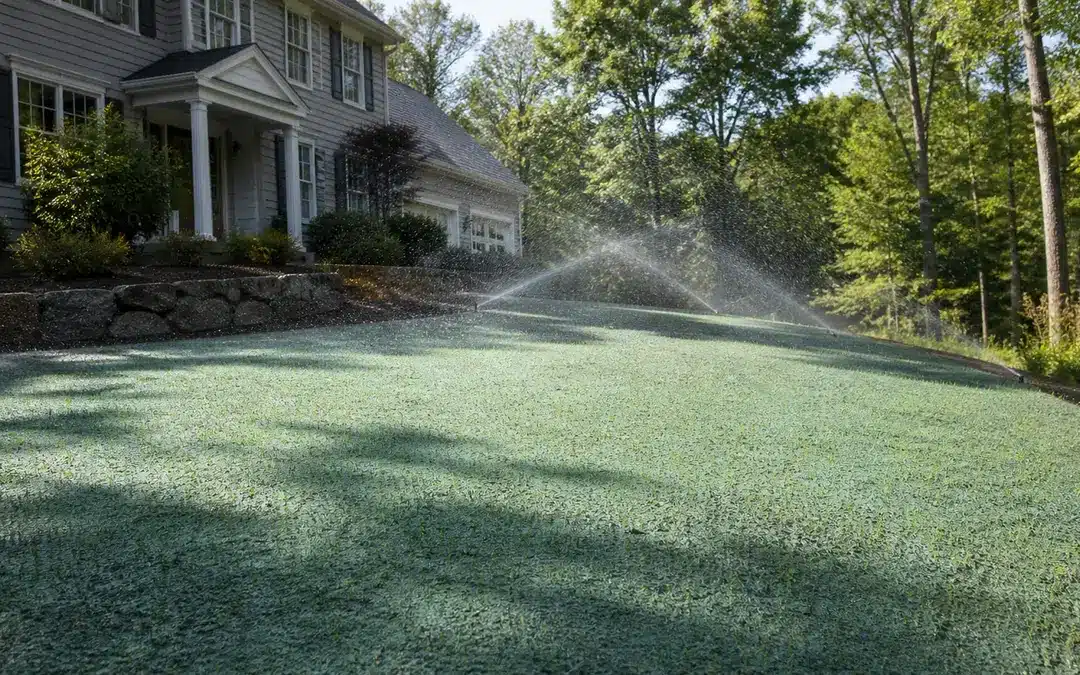
A newly hydroseeded lawn does not need a rigid timer that ignores rain, shade, slope, or soil. Good hydroseeding aftercare keeps the seedbed evenly moist while seedlings emerge, then gradually shifts toward deeper and less frequent watering as roots develop. Keep traffic off the area, use grass height and soil firmness—not a date alone—to decide when to mow, and follow the project-specific instructions provided after installation.
Hydroseeding aftercare: the first month at a glance
Randall Landscaping’s professional hydroseeding service for new lawns notes that grass can begin appearing in several days when soil temperature and moisture cooperate. The calendar is only a reference. Use the lawn’s condition to decide what comes next.
| Stage | What to look for | Watering response | What to avoid |
|---|---|---|---|
| Immediately after application | Slurry and mulch remain evenly in place | Keep the surface consistently moist with gentle coverage | Puddles, runoff, strong spray, pets, and foot traffic |
| Early germination | Fine green shoots appear unevenly across warmer and cooler areas | Continue short, condition-based watering so exposed soil does not dry out | Assuming every part of the yard dries at the same rate |
| Thickening seedlings | More complete coverage and seedlings that stay upright after a light touch | Begin spacing watering farther apart while wetting the developing root zone more deeply | Keeping mature seedlings constantly saturated |
| First-mow readiness | Grass reaches mowing height and the soil can support a lightweight mower without ruts | Let the surface firm before mowing, then resume based on weather and soil moisture | Mowing wet soil or removing too much blade at once |
Water the condition you have, not the clock
University of New Hampshire Extension advises keeping a newly seeded lawn consistently moist from germination through establishment. That can require light watering two or three times in a day, but rain, temperature, wind, sun exposure, and soil drainage can change the need. After roughly three to four weeks, established seedlings can transition to less frequent, deeper watering. See UNH Extension’s new-lawn watering and establishment guidance.
Use three quick checks before running the sprinklers:
- Touch the surface: it should feel damp, not dusty and not muddy.
- Compare zones: sunny slopes, edges near pavement, and open windy areas may dry before shaded or low areas.
- Watch the water: stop if it begins to pool, carry mulch downhill, or leave a glossy saturated surface.
A single long watering can wash seed and mulch from a slope. Repeated watering when the soil is already wet can also create weak conditions. The practical goal is even moisture with no movement of the seedbed.
Know when the lawn is ready for its first mowing
Do not mow only because a certain number of days has passed. UNH Extension recommends mowing new grass once it is about three inches tall, using a sharp blade and removing no more than one-third of the blade at a time. Its broader turf guidance also explains that early mowing encourages density when the new planting has reached the proper height. Review the university’s New Hampshire turf establishment guidance.
Before the first pass:
- Wait until the soil surface is firm enough that a lightweight mower will not leave ruts.
- Use a sharp blade so tender plants are cut instead of pulled.
- Choose a dry period; avoid mowing wet seedlings or saturated soil.
- Turn gently and minimize repeated passes over the same area.
Adjust for Southern New Hampshire conditions
Two sections of the same Southern New Hampshire yard can need different care. A south-facing bank may lose moisture quickly, while a shaded low spot may stay wet after rain. Compacted soil may shed water across the surface; looser prepared soil may accept it more readily. Treat these as separate watering zones instead of forcing one run time across the entire property.
After a soaking rain, pause irrigation and recheck the seedbed. During a warm, windy stretch, inspect exposed areas more often. When cool, overcast weather slows drying, shorten or skip a cycle rather than saturating the soil. These adjustments protect the seed placement while helping roots move beyond the surface layer.
Troubleshoot early warning signs
| What you see | Likely issue to check | Reasonable next step |
|---|---|---|
| Puddles or shiny wet soil | Too much water, poor infiltration, or an uneven grade | Pause watering, let the surface drain, and use shorter cycles |
| Mulch moving down a slope | Spray is too strong or water is running before soaking in | Reduce flow, shorten the cycle, and avoid directing spray downhill |
| Dry edges beside pavement | Heat and wind are drying that zone faster | Give the edge separate gentle coverage instead of overwatering the full lawn |
| Footprints or mower ruts remain | Soil is too wet or roots are not ready for traffic | Keep traffic off and delay mowing until the surface firms |
| Bare channels or large washed areas | Runoff or stormwater may have displaced the application | Photograph the area and ask the installer whether repair is needed |
Do not automatically add seed, fertilizer, or weed control to a struggling patch. The cause may be moisture, washout, compaction, shade, or another site condition. A targeted correction starts with identifying the cause.
A practical first-month checklist
- Keep the seedbed moist without puddles or runoff.
- Check sunny, shaded, sloped, and paved-edge zones separately.
- Count rainfall before adding irrigation.
- Keep people, pets, and vehicles off tender seedlings.
- Transition gradually toward deeper, less frequent watering as the stand establishes.
- Mow by height and soil readiness with a sharp, lightweight mower.
- Document washout, standing water, or persistent bare areas before making a repair.
Plan hydroseeding care before installation day
The best aftercare plan accounts for sprinkler coverage, slopes, shade, drainage, and who will monitor the lawn each day. If you are planning a new lawn in Southern New Hampshire or the Merrimack Valley, request an estimate from Randall Landscaping and discuss the site-specific care plan before work begins.