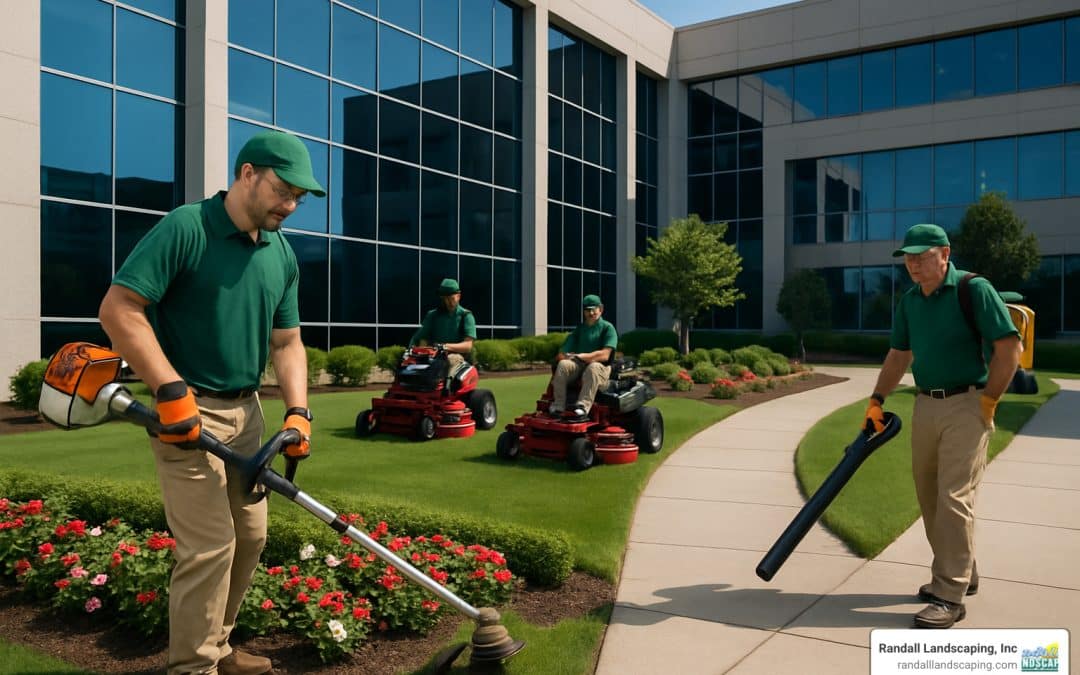
Building a Foundation for Beautiful Commercial Grounds
A commercial landscape maintenance contract is a legally binding agreement between a property owner and a landscape service provider that outlines specific maintenance services, frequencies, responsibilities, and payment terms. Here’s what you need to know:
Key Components of a Commercial Landscape Maintenance Contract:
- Scope of work (mowing, pruning, fertilization, etc.)
- Service frequency and schedule
- Pricing and payment terms
- Contract duration and renewal terms
- Insurance and liability provisions
- Communication protocols and reporting
No two landscape maintenance contracts are the same — so how do you know yours is right for you?
For commercial property owners and managers, a well-crafted landscape maintenance contract provides more than just beautiful grounds — it delivers peace of mind, budget predictability, and protection from liability. For service providers, these contracts ensure steady revenue streams and clearer expectations.
Commercial contracts differ significantly from residential agreements in both scale and complexity. While residential work might be performed on a handshake or simple invoice basis, commercial properties require comprehensive documentation that addresses everything from seasonal service adjustments to dispute resolution processes.
The best companies in the landscape industry retain at least 90% of their commercial contracts year over year, demonstrating the value of building strong relationships founded on clear agreements and consistent service delivery.
I’m Tommy Randall, owner of Randall Landscaping, Inc., and after nearly two decades of drafting and fulfilling commercial landscape maintenance contracts throughout Massachusetts and New Hampshire, I’ve learned that clarity and transparency are the cornerstones of successful landscape partnerships.
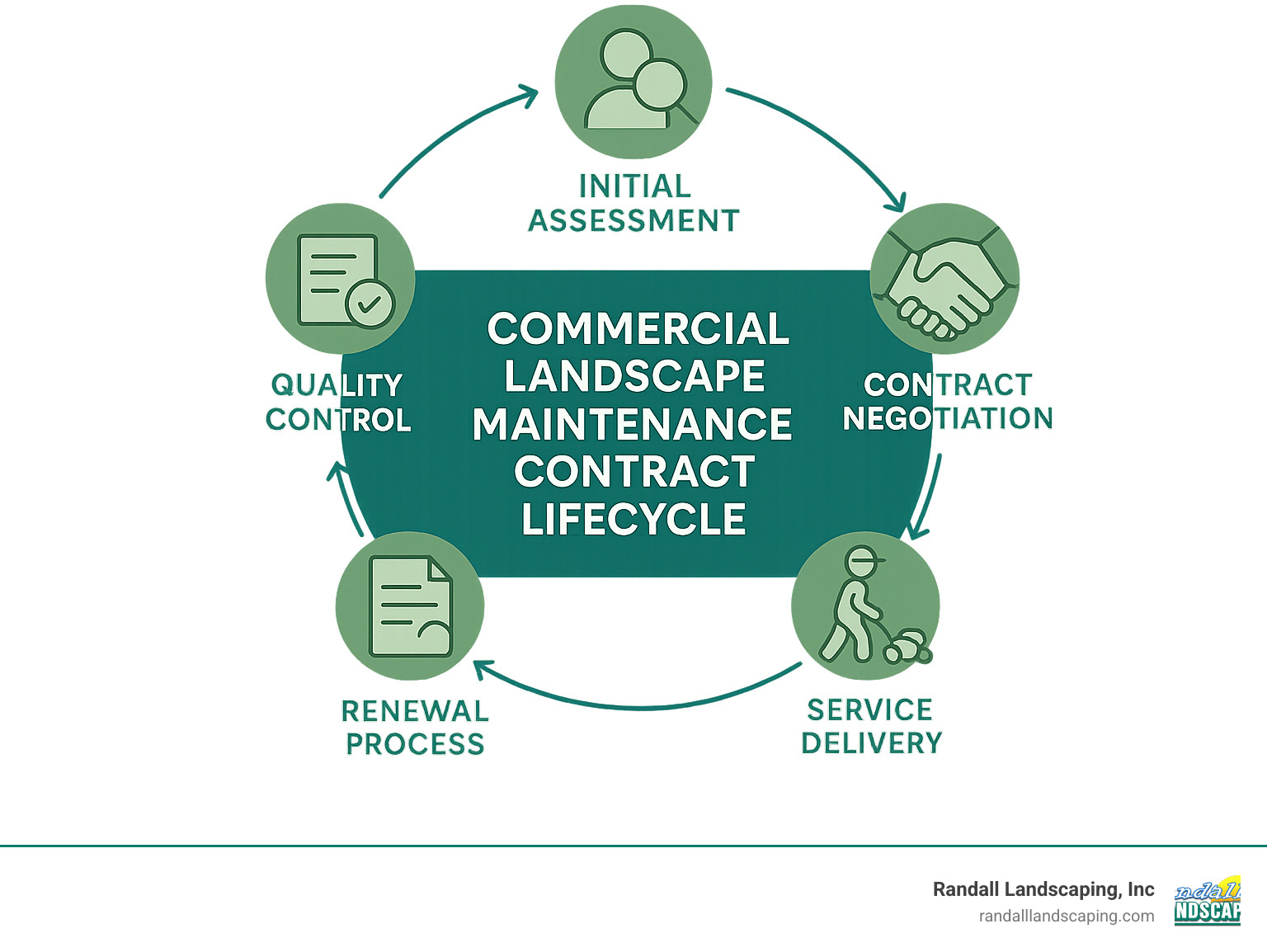
Commercial landscape maintenance contract terms simplified:
- commercial landscape maintenance cost
- how to bid commercial landscape maintenance
- commercial grounds maintenance
Why Commercial Contracts Beat Handshake Deals
When it comes to maintaining commercial properties, handshake deals simply don’t cut it. A formal commercial landscape maintenance contract provides essential protections for both parties while establishing clear expectations from day one.
The landscaping industry thrives on consistency and reliability — especially for commercial properties. Unlike residential services where flexibility might work, commercial landscapes demand predictable, scheduled maintenance to maintain their professional appearance year-round. Without a written agreement, this consistency often falls apart when seasons change or challenges arise.
What’s remarkable is how the numbers tell the story: the most successful landscape companies maintain at least a 90% contract retention rate year over year. This impressive statistic isn’t achieved through casual agreements or verbal promises — it comes from well-structured contracts that build lasting relationships between property managers and their landscape partners.

Commercial vs. Residential at a Glance
| Feature | Commercial Contracts | Residential Services |
|---|---|---|
| Scope | Comprehensive (mowing, pruning, fertilization, irrigation, seasonal color, snow removal) | Often limited (basic mowing, occasional pruning) |
| Crew Size | Larger teams with specialized equipment | Smaller crews, sometimes just 1-2 people |
| Term Length | Typically 12 months with renewal options | Often month-to-month or seasonal |
| Insurance Requirements | $1M-$3M liability coverage, workers’ comp mandatory | Lower coverage levels, sometimes optional |
| Decision Makers | Property managers, boards, facility managers | Homeowners |
| Billing Structure | Monthly, often with annual commitments | Per-service or monthly during growing season |
| Service Frequency | Performance-based, not hourly | Often hourly or per-visit |
Benefits for Property Managers
For property managers, a solid commercial landscape maintenance contract isn’t just paperwork — it’s peace of mind.
Curb appeal becomes a constant rather than a concern. When your landscape partner visits on a regular schedule defined in your contract, your property consistently makes that crucial first impression on visitors, tenants, and clients.
The liability shield that comes with a proper contract can’t be overstated. When responsibilities are clearly defined, you’re protected from potential claims related to landscape activities. For example, if someone trips on an unmaintained walkway, your contract specifies exactly who bears responsibility.
Budget predictability might be the most appreciated benefit I hear from our clients. One property manager in North Andover told me: “Having a detailed contract in place means I never have to worry about whether the grounds will look presentable for prospective tenants. It’s one less thing on my plate — and one line item in my budget I can actually count on.”
Benefits for Service Providers
From our perspective as landscape professionals, commercial landscape maintenance contracts provide the foundation for business stability and growth.
Recurring revenue allows us to plan for the future. When we know we’ll be servicing the same properties throughout the year, we can invest in better equipment, hire the right team members, and deliver more consistent results.
Capacity planning becomes possible when we have contracts in place. We can schedule our crews efficiently, allocate equipment where it’s needed, and respond quickly to special requests because we understand our baseline commitments.
The 90% retention benchmark mentioned earlier doesn’t happen by accident. It comes from the relationship building that occurs when landscape professionals work with the same properties year after year. We learn your preferences, understand your priorities, and become partners in maintaining your property’s image.
At Randall Landscaping, we’ve found our strongest commercial relationships are built on clear, comprehensive contracts that protect both parties while establishing realistic expectations. When everyone understands what’s included, when it will be done, and how success is measured, the relationship thrives — and so do your grounds.
Understanding Your Commercial Landscape Maintenance Contract
When you’re managing commercial property, your landscape maintenance contract isn’t just paperwork — it’s the foundation of your entire service relationship. Think of it as the roadmap that guides both you and your landscape provider through all four seasons.
Key Clauses Every Contract Needs
A solid commercial landscape maintenance contract starts with crystal-clear language about what’s being delivered. Vague promises like “maintain the grounds” simply won’t cut it. Instead, your agreement should spell out specifics like “mow turf areas to a height of 2.5-3 inches weekly during growing season” or “apply pre-emergent herbicide in early spring to all bed areas.”
The term and renewal section is equally important — most contracts run for 12 months with language about automatic renewal to prevent service gaps. For example: “This agreement automatically renews for an equal term unless either party provides written notice at least 30 days before the current term ends.”
Change orders might seem like fine print, but they’re actually crucial for both parties. This section establishes how to request and approve work beyond the original scope, preventing those awkward “I thought that was included” conversations later.
Payment terms should leave no room for confusion, outlining monthly amounts, due dates (typically net 10 or net 30 days), and any late payment consequences — usually 1.5-2% monthly on overdue balances.
Don’t overlook the right-to-correct clause. This gives your landscape partner a reasonable window (usually 30 days) to address any service issues before you can terminate the contract. As one of our Methuen clients noted: “I initially thought this only protected the contractor, but now I see it prevents hasty decisions and gives our partnership breathing room when challenges arise.”
Services Included in a Commercial Landscape Maintenance Contract
Your commercial landscape maintenance contract should clearly outline all included services. Most comprehensive agreements cover:
Mowing and trimming form the backbone of most contracts, typically scheduled 38-42 times annually depending on your climate. This includes line trimming around obstacles and blowing debris from walkways and parking areas.
Bed care encompasses regular weeding, crisp edging, seasonal mulch application, and thorough leaf removal from planting beds. Pruning services maintain the shape and health of your shrubs and small ornamental trees throughout the year.
Fertilization and weed control applications follow a strategic schedule to promote lush, healthy turf while keeping unwanted vegetation at bay. Irrigation management often includes system startup, regular programming adjustments, winterization, and sometimes basic repairs.
Many properties also include seasonal color rotations, with fresh annual flowers installed and maintained in high-visibility areas. Fall cleanup services ensure fallen leaves don’t damage turf or create liability issues on walkways.
Some contracts bundle in snow removal services, though these are often covered under a separate but related winter agreement. Regular trash portering — collecting visible litter from landscape areas — rounds out most comprehensive service packages.
For a deeper dive into our complete service offerings, visit our Commercial Landscaping page.
Pricing a Commercial Landscape Maintenance Contract
When it comes to pricing, commercial landscape maintenance contracts follow a standard industry formula: Labor + Materials + Overhead + Profit = Contract Price.
Most properties use one of three pricing structures: a fixed monthly fee that remains consistent year-round; seasonal variation with higher payments during peak growing months (April-October) and lower payments in dormant periods; or an a la carte approach with base services plus optional add-ons like mulching or seasonal color.
Based on publicly available internet data, commercial landscape maintenance typically costs between $250 and $10,000+ per acre annually. This wide range reflects differences in service intensity, property complexity, and regional labor markets. These figures represent industry averages and not Randall Landscaping’s specific pricing.
For more detailed cost information, check out our Commercial Landscape Maintenance Cost page.
Legal & Insurance Must-Haves
The protection section of your commercial landscape maintenance contract deserves careful attention. At minimum, your landscape contractor should carry $1 million per occurrence and $3 million aggregate commercial general liability coverage, plus comprehensive workers’ compensation insurance.
Request additional insured status on their policy — this simple step provides important protection for property owners. If your contract includes chemical applications, verify that the contractor holds all required state pesticide licenses.
A solid indemnification clause protects both parties from claims arising from the other’s negligence. And don’t forget a compliance statement confirming all services will be performed according to local, state, and federal regulations.
At Randall Landscaping, we maintain comprehensive insurance coverage and all required certifications for the Merrimack Valley and Southern New Hampshire regions we proudly serve.
External Templates & Guides
While every property deserves a customized agreement, reviewing sample documents can provide helpful perspective. The sample landscape contract PDF from Chicora Foundation offers a comprehensive starting point, though we always recommend having your final contract reviewed by legal counsel before signing.
Templates are just starting points — your final commercial landscape maintenance contract should reflect your property’s unique needs and the specific services your landscape provider will deliver throughout the year.
Winning, Pricing & Renewing Contracts Like a Pro
Whether you’re a property manager looking for a reliable landscape partner or a service provider wanting to grow your commercial client base, understanding the ins and outs of the contract process can make all the difference.

How to Find Opportunities
For landscape professionals, finding quality commercial landscape maintenance contract opportunities isn’t about luck — it’s about strategy and relationships.
Building a network is absolutely essential. The most successful contractors I’ve seen leverage their existing client relationships for referrals. There’s nothing more powerful than a happy property manager telling their colleague, “You’ve got to call my landscape team.”
Industry groups like CREW (Commercial Real Estate Women) and BOMA (Building Owners and Managers Association) offer fantastic networking opportunities. At Randall Landscaping, we’ve formed some of our most valuable partnerships through these professional communities.
Sometimes finding opportunities means good old-fashioned legwork. Driving through commercial areas to identify properties with landscape needs can uncover hidden gems. And when you do reach out, try to get a warm introduction rather than making cold calls — it makes all the difference in how you’re received.
For property managers, the search often starts with peer recommendations. Nothing beats the reassurance of hearing another manager say, “This company has kept our property looking spectacular for years.”
Want to learn more about finding the right opportunities? Visit our How to Get Commercial Landscape Contracts page for deeper insights.
Building a Competitive Bid
Creating a winning bid for a commercial landscape maintenance contract requires precision and attention to detail. It’s not just about offering the lowest price — it’s about demonstrating value.
Start with accurate measurements. I can’t stress this enough: you need to know exactly what you’re working with. Measure all turf areas, planting beds, and hardscapes carefully. This creates the foundation for your entire estimate.
Your labor calculations should reflect reality. Account for the time it takes to properly service each area of the property based on its specific characteristics. That steep hillside will take longer to mow safely than flat areas, and your bid should reflect that.
Equipment costs, material expenses, overhead allocation, and a reasonable profit margin (typically 15-30%) all need to be factored in. Underbidding might win you the contract today, but it creates problems down the road when you can’t deliver quality at that price point.
A professional proposal makes a huge difference. Include a clean cover page with your company logo and property images, detailed scope descriptions, clear service frequencies, and testimonials from similar properties. Show them you understand their specific needs.
For a deeper dive into creating winning bids, check out our guide on How to Bid Commercial Landscape Maintenance.
Client Retention & Auto-Renewal Best Practices
The landscape industry’s top performers maintain at least 90% contract retention year over year. This impressive statistic doesn’t happen by accident — it’s the result of intentional relationship building.
Owner involvement makes a tremendous difference. At Randall Landscaping, I personally stay involved with our key commercial accounts. Clients appreciate knowing they can reach someone with decision-making authority when needed.
Before renewal time, we conduct thorough property audits to identify any issues that need addressing. This proactive approach shows clients we’re thinking about their property’s future, not just collecting the next check.
Regular performance reporting keeps everyone on the same page. When clients can see documentation of services performed, they develop greater trust in the relationship.
Smart auto-renewal language in your contract provides continuity for both parties. We typically include terms that extend service automatically unless either party provides 30-day written notice before the contract end date.
When price adjustments become necessary, transparency is key. One of our long-term clients in Andover told me, “I actually don’t mind reasonable price increases when you explain exactly what’s driving them — whether it’s rising insurance costs or labor rates.”
Common Pitfalls to Avoid
After nearly two decades in this business, I’ve seen plenty of commercial landscape maintenance contract relationships go sideways. Here are the mistakes to watch for:
“Buying” jobs with unrealistically low bids is a recipe for disaster. When contractors drastically underbid, they simply can’t deliver quality service at that price, leading to disappointment on both sides.
Vague specifications create misunderstandings. Terms like “as needed” or “regular service” mean different things to different people. Be specific about frequencies, heights, and standards.
Mixing crews between residential and commercial properties often leads to inconsistent service. Commercial work requires a different mindset and approach — dedicated commercial crews deliver better results.
Don’t overlook payment terms. Include language that allows work to pause if invoices remain unpaid beyond a certain period. This protects service providers while giving property managers clear expectations.
Weather contingencies need addressing in your contract. New England weather is unpredictable — your agreement should clarify how weather disruptions affect scheduling and billing to avoid misunderstandings.
At Randall Landscaping, we’ve learned these lessons through years of serving commercial clients throughout the Merrimack Valley and Southern New Hampshire. Our approach focuses on clarity, communication, and consistency — the three Cs that keep contracts running smoothly year after year.
Setting Scope, Schedule & Performance Metrics
The heart of any commercial landscape maintenance contract lies in clearly defined expectations. What will be done, when it will happen, and how success will be measured are the three pillars that support a successful partnership between property managers and landscape professionals.
Defining Frequency & Seasonality
Commercial landscape maintenance isn’t a uniform service throughout the year. Mother Nature dictates different needs as seasons change, especially in New England where we experience dramatic seasonal shifts.
During peak growing seasons in spring and summer, your property needs more frequent attention — weekly mowing, regular pruning, and consistent bed maintenance keep everything looking sharp. In contrast, dormant winter months require different types of care like snow management and winter pruning.
Properties in the Merrimack Valley and Southern New Hampshire typically require 38-42 mowings annually, though this benchmark can vary based on microclimate conditions. Some sheltered, sunny areas might need more frequent cutting than exposed, shadier spots on the same property.
A well-structured commercial landscape maintenance contract includes a detailed calendar showing service timing throughout the year. For example:
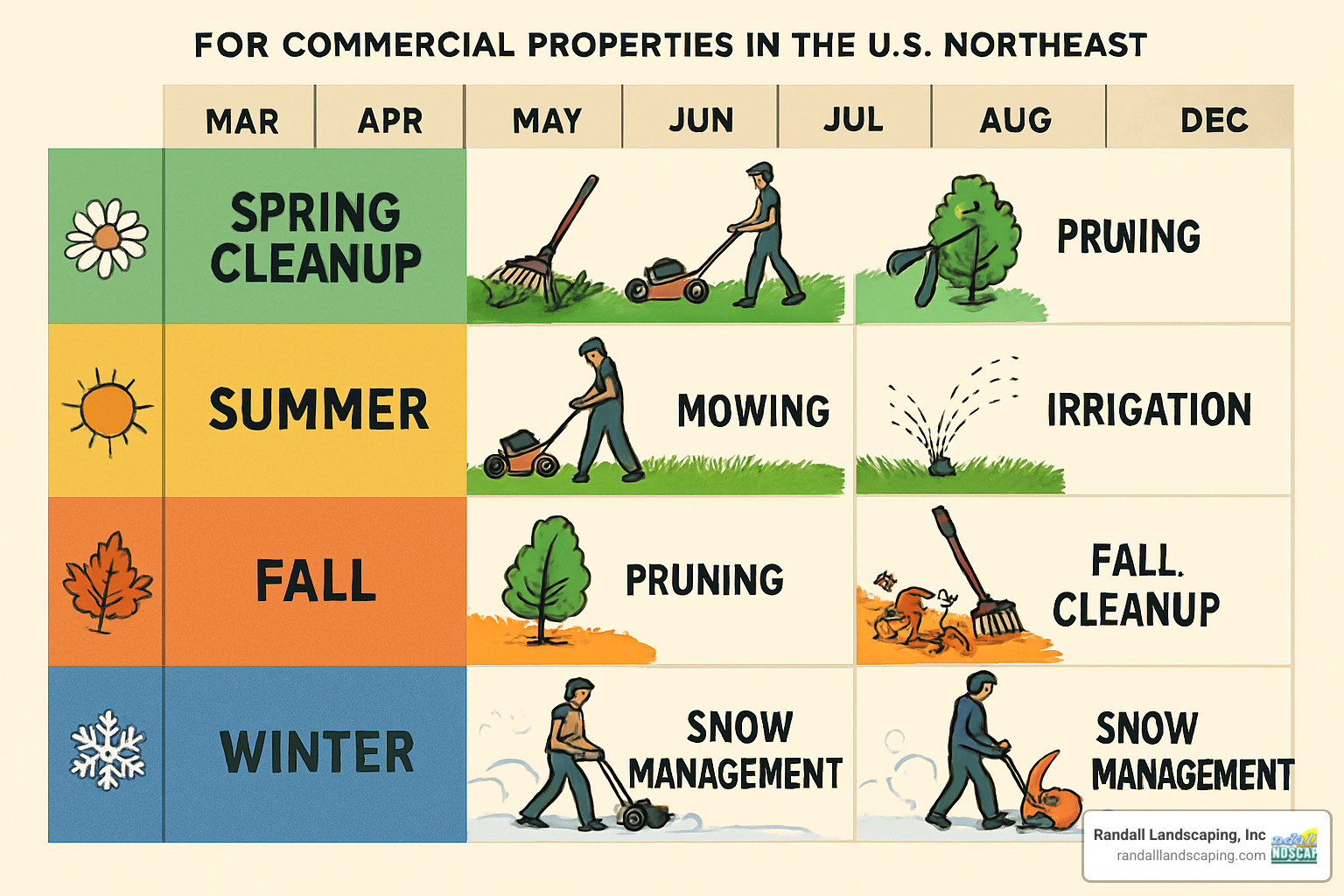
“Having a clear seasonal calendar in our contract eliminates confusion,” shares one of our Haverhill property managers. “We know exactly when to expect spring cleanup, when mulch will be applied, and when the irrigation system will be winterized — no surprises, just predictable care.”
Performance-Based vs. Hour-Based Models
Modern commercial contracts have largely shifted from hour-based to performance-based models, focusing on outcomes rather than time spent. This approach benefits both parties in several ways:
Quality becomes the priority, not just completing tasks. When your contract specifies that “turf will be maintained between 2.5-3 inches” rather than “mowing will occur weekly,” the focus shifts to the result, not just checking a box.
Efficiency is encouraged since contractors are motivated to work smartly while maintaining quality standards. This often leads to innovation in service delivery and equipment usage.
Seasonal flexibility happens naturally without constant contract modifications. As growing conditions change throughout the season, service intensity adjusts accordingly.
Key performance indicators might include neat shrub shaping, weed-free beds, proper turf height, functioning irrigation, and debris-free hardscapes. These measurable outcomes provide clear benchmarks for success.
As one of our Salem, NH clients explained: “I don’t care how long it takes to mow the property — I care that it always looks well-maintained for our customers.”
Sustainability & Regulatory Trends
Today’s commercial landscape maintenance contracts increasingly address environmental concerns and evolving regulations. This isn’t just good citizenship — it’s smart business as regulations continue to tighten.
Pesticide restrictions are becoming more common nationwide. Many municipalities are implementing bans or limitations on certain landscape chemicals. For example, Montgomery County, Maryland banned certain lawn pesticides on private lawns in 2019, and similar trends are appearing in New England communities.
Water conservation has become a priority as drought conditions become more frequent. Smart irrigation controls, rain sensors, and drought-tolerant landscaping strategies are now standard elements in forward-thinking contracts.
Native plant requirements are increasingly being written into local codes. Native species typically require less water, fewer chemicals, and provide better habitat for local wildlife — a win-win for property aesthetics and environmental stewardship.
Green waste management specifications for composting or recycling landscape debris are becoming standard in many contracts, reducing landfill impact and sometimes generating valuable mulch that can be reused on site.
Electric equipment requirements are emerging in many communities, driven by noise ordinances and air quality concerns. Battery-powered blowers, trimmers, and even mowers are quieter and produce zero emissions at the point of use.
At Randall Landscaping, we stay current with evolving regulations throughout Massachusetts and New Hampshire to ensure our contracts and practices remain compliant. We believe that sustainable practices aren’t just good for the planet — they’re good for your property’s long-term health and value.
Handling Changes, Disputes & Future-Proofing
Every commercial landscape maintenance contract will face changes and challenges over time — that’s just the nature of long-term partnerships. The key is having clear mechanisms in place to handle these inevitable bumps in the road.
Modifying Scope Without Chaos
Change happens. Your clients might decide they want additional services, or you might need to adjust how you maintain their property. What matters is handling these changes smoothly.
A well-structured commercial landscape maintenance contract should include a formal change order process. This means any modification gets documented in writing and signed by both parties — no verbal agreements that can lead to misunderstandings later.
We’ve found that using standardized Additional Work Authorization forms makes this process much more straightforward. These forms clearly outline what extra work will be done, how much it will cost, and when it will happen.
“Having a clear process for adding spring mulch and fall cleanups to our base contract has eliminated confusion and made budgeting much easier,” one of our clients in Dracut recently told me.
Digital signature options have been a game-changer for us at Randall Landscaping. Being able to get quick electronic approvals means we can respond to client needs faster without sacrificing documentation.
For pricing add-on services, we recommend a cost-plus structure that transparently shows labor costs, materials, and a reasonable markup. This approach builds trust with clients who appreciate knowing exactly what they’re paying for.
Dispute Resolution & Termination
Even in the best relationships, disagreements happen. Your contract needs to address how you’ll handle them.
Start with clear payment terms. Our contracts specify the consequences for late payments, including a 1.5% monthly interest rate on overdue balances. We also include language about when service may be suspended due to non-payment — typically after 60 days.
Quality concerns need a formal reporting process. We include an escalation ladder that starts with the account manager and moves up to ownership if needed. This gives everyone a roadmap for resolving issues.
At Randall Landscaping, we include a 30-day right-to-correct clause in all our contracts. This gives us the opportunity to address any service concerns before termination becomes an option. It’s fair to both parties and prevents hasty decisions during temporary rough patches.
Termination rights should be clearly spelled out, including required notice periods (we recommend 30 days at minimum). And don’t forget force majeure provisions that address how uncontrollable events like natural disasters affect your obligations.
Emerging Trends Impacting Contracts
The landscape industry continues to evolve, and forward-thinking commercial landscape maintenance contracts now address several emerging trends.
Green certifications are increasingly important to commercial clients. Many contracts now include requirements for sustainable practices and industry certifications that demonstrate environmental responsibility.
Technology integration has transformed how we document and deliver services. Modern contracts should address the use of landscape management software, GPS tracking for service verification, and digital reporting tools.
Regular data reporting has become an expectation rather than a luxury. Clients want documentation of services performed and performance metrics that demonstrate value.
Climate adaptation language is increasingly common as weather patterns become more extreme. Contracts now often include provisions for how drought, excessive rain, or other weather events impact service schedules and responsibilities.
Labor considerations can’t be ignored in today’s market. Smart contracts acknowledge workforce challenges and include contingency planning for maintaining service levels.
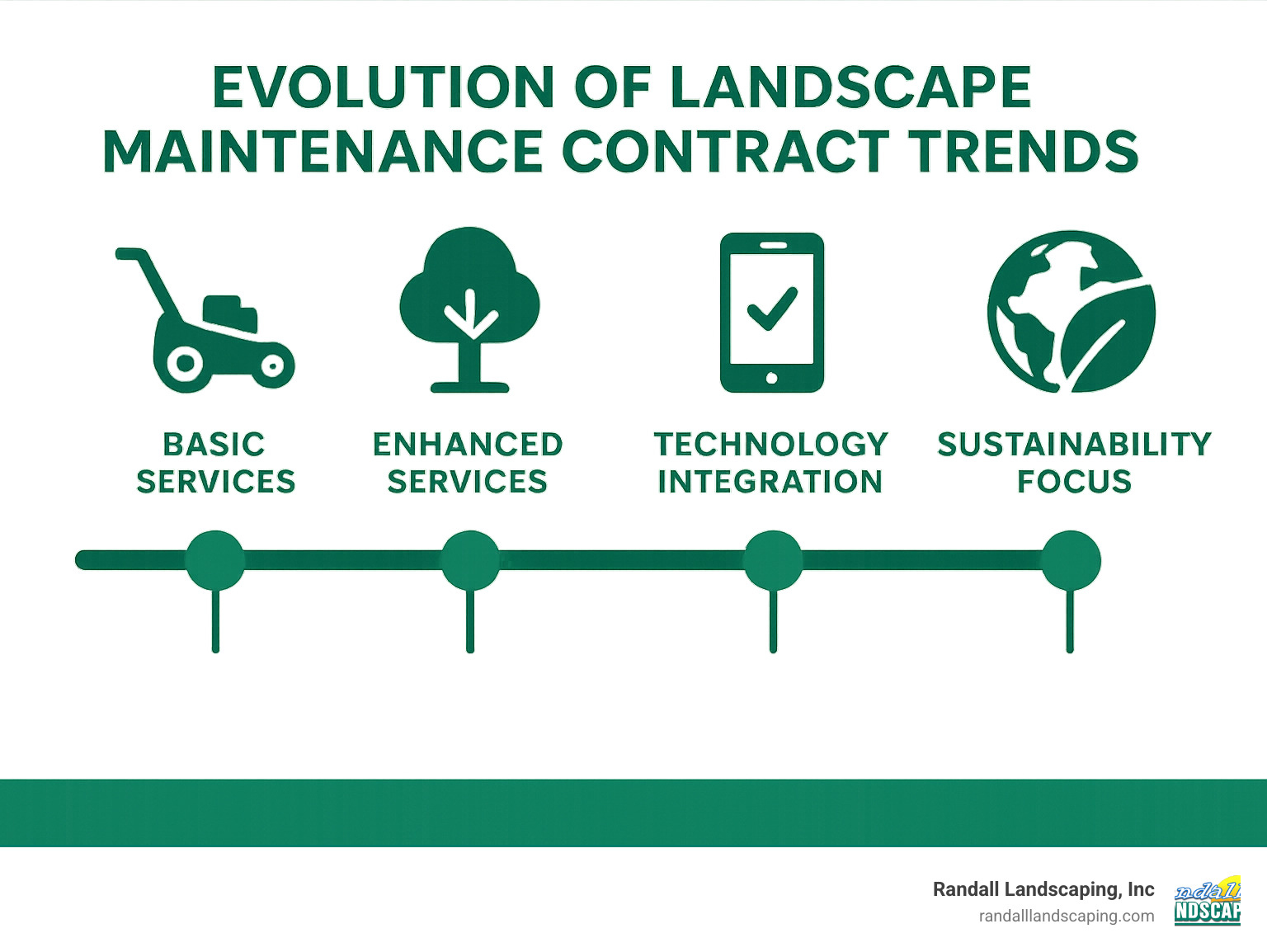
The best commercial landscape maintenance contracts aren’t rigid documents — they’re living agreements that can adapt to changing needs while providing structure and clarity. By anticipating changes and building in mechanisms to handle them, you create partnerships that can weather any storm.
Frequently Asked Questions about Commercial Landscape Maintenance Contracts
What services are usually covered in a commercial landscape maintenance contract?
When you’re investing in a commercial landscape maintenance contract, you want to know exactly what you’re getting. Most standard contracts include the essentials needed to keep your property looking its best year-round.
The core services typically include regular mowing (usually 38-42 times annually in our New England climate), edging and trimming around walkways and buildings, and thorough bed maintenance to keep weeds at bay. Your contract should also cover shrub and small tree pruning to maintain both appearance and plant health, along with strategic fertilization and weed control applications at the right times of year.
Seasonal transitions are covered through spring and fall cleanups, with comprehensive leaf removal during autumn months. Basic irrigation management — ensuring your watering systems work efficiently — rounds out the standard package.
Many of our clients at Randall Landscaping also opt for additional services that truly lift their properties. Seasonal color installations bring vibrant flowers to key areas, while dedicated snow and ice management (usually under a separate winter contract) keeps properties safe during harsh New England winters. Some properties benefit from regular trash removal services, specialized tree care beyond basic pruning, or landscape improvement projects.
“The most important thing,” as one of our Andover property managers told me, “is having everything clearly spelled out. I need to know exactly what’s included and how often it’s happening so there are no surprises.”
How should pricing and payment terms be structured?
When it comes to paying for your commercial landscape maintenance contract, several approaches work well depending on your budgeting preferences.
Many commercial clients prefer equal monthly payments, where the annual contract value is simply divided into 12 identical installments. This approach makes budgeting predictable despite the natural seasonal variations in service intensity. As one property manager in North Andover told me, “I’d rather pay the same amount each month than try to explain to my board why costs spike in summer.”
Other properties opt for seasonal variation in their payment structure, with higher payments during the active growing season (typically April through October) and reduced payments during dormant winter months. This approach more closely aligns payments with service delivery.
A third common option is the base-plus-add-ons model, where you pay for a core maintenance package while separately billing optional services like mulching or seasonal color installations.
Regardless of structure, your contract should clearly outline payment terms including due dates (typically net 10, 15, or 30 days after invoice), any late payment penalties (industry standard is 1.5-2% monthly), accepted payment methods, and your billing cycle.
Based on publicly available internet data, annual commercial maintenance costs range widely from $250 to $10,000+ per acre depending on service level, property complexity, and regional factors. These figures represent industry averages and not Randall Landscaping’s specific pricing.
What insurance coverage is mandatory for commercial landscape work?
Insurance requirements might seem like fine print, but they’re actually one of the most important protections in your commercial landscape maintenance contract. Working with an adequately insured contractor is non-negotiable.
At minimum, your landscape contractor should maintain comprehensive Commercial General Liability Insurance — typically $1 million per occurrence and $3 million aggregate. This protects against property damage or injuries that might occur during service delivery. Workers’ Compensation Insurance is equally important, covering all employees working on your property and meeting state requirements for workplace injury protection.
Since landscape crews arrive with vehicles and equipment, Automobile Liability Insurance (typically $1 million minimum) is essential coverage for any incidents involving service vehicles. Your contract should also specify that you’ll be named as an additional insured on the contractor’s policy through an Additional Insured Endorsement, extending their coverage to protect your interests.
Many quality landscape contractors also carry Umbrella Coverage, providing additional liability protection beyond their primary policies for extra peace of mind.
“Always request certificates of insurance before work begins,” advises our operations manager at Randall Landscaping. “And make sure your contract requires updated certificates whenever policies renew.”
At Randall Landscaping, we maintain comprehensive insurance coverage exceeding industry standards for all our commercial work throughout the Merrimack Valley and Southern New Hampshire. We believe that proper insurance isn’t just a business requirement — it’s part of our commitment to responsible service and client protection.
Conclusion
Stepping back and looking at the big picture, a well-crafted commercial landscape maintenance contract delivers so much more than just attractive grounds. It creates a foundation of trust, clarity, and mutual success that benefits everyone involved.
Throughout my years in the landscape industry, I’ve seen how the strongest commercial relationships are built on a handful of essential elements. Clear expectations come first — when both parties understand exactly what services will be performed, how often, and to what standard, we eliminate the misunderstandings that too often damage business relationships.
Fair, transparent pricing is equally important. At Randall Landscaping, we believe in honest cost structures that reflect the true value of professional service without hidden fees or surprises. This transparency builds trust from day one.
Communication makes all the difference in long-term satisfaction. The best contracts aren’t filed away and forgotten — they’re living documents supported by regular reporting, open dialogue, and responsive adjustments as your property’s needs evolve. One property manager told me recently, “What I value most is knowing exactly who to call when something comes up, and knowing they’ll actually respond.”
The partnership mindset transforms a basic service agreement into something more valuable. When we view our relationship as collaborative rather than transactional, we’re able to anticipate needs, suggest improvements, and work together toward common goals. This approach has helped us maintain our impressive client retention rate year after year.
Finally, we believe in continuous improvement. Regular reviews, performance assessments, and refinements to your contract ensure that our service evolves alongside your property’s changing needs and landscape industry innovations.
At Randall Landscaping, Inc., we’ve spent years refining our approach to commercial landscape maintenance contracts throughout the Merrimack Valley and Southern New Hampshire. Our commitment to 100% reliability and customer satisfaction begins with contracts that set clear expectations and ends with beautiful, well-maintained properties that improve your organization’s image and value.
Each property we serve receives a dedicated account manager who serves as your single point of contact, ensuring consistent communication and personalized attention to your landscape needs. This relationship-focused approach means you’ll never have to wonder who to call or explain your property’s requirements to multiple people.
For more information about our commercial landscape services and how we can help maintain your property to the highest standards, visit our Commercial Landscaping page or contact us today.
When it comes to commercial landscape maintenance, the grass truly is greener with a solid contract in place — and the right partner to fulfill it.