Understanding the Investment: Commercial Landscape Maintenance Cost
Commercial landscape maintenance cost typically ranges from $800 to $1,600 per acre monthly for full-service packages, with basic mowing services costing $25 to $150 per acre depending on property size. Hourly rates average $40 to $80 per worker, while annual maintenance can range from $2,000 for small properties to $50,000+ for large commercial campuses.
| Service Type | Average Cost Range |
|---|---|
| Mowing (under 5 acres) | $50-$150 per acre |
| Mowing (5+ acres) | $25-$60 per acre |
| Full-Service Monthly | $800-$1,600 per acre |
| Hourly Labor Rate | $40-$80 per worker |
When it comes to maintaining commercial properties, understanding your landscape maintenance budget isn’t just about cutting grass—it’s about protecting your investment, enhancing your business image, and creating positive first impressions for clients and employees.
Property managers and business owners often struggle to budget accurately for landscape maintenance because costs vary widely based on multiple factors. Size, location, service frequency, property complexity, and seasonal requirements all play significant roles in determining your bottom line.
I’m Tommy Randall, owner of Randall Landscaping, Inc., and with over 18 years of experience managing commercial landscape maintenance costs for businesses throughout Massachusetts and New Hampshire, I’ve helped countless property managers develop cost-effective maintenance strategies that deliver both visual impact and budget predictability.
Commercial landscape maintenance cost vocabulary:
– what is commercial landscaping
– does commercial landscaping increase your property value
– how to bid commercial landscape maintenance
Why This Guide Matters
As decision-makers responsible for commercial properties, you face a challenging balancing act: maintaining impeccable grounds while controlling costs. This guide aims to provide clarity on commercial landscape maintenance costs, helping you understand not just what you’re paying for, but why—and how to maximize your return on investment.
“The true cost of landscape maintenance isn’t found in a single invoice,” says Tommy Randall. “It’s measured in tenant satisfaction, property value appreciation, and the absence of expensive emergency repairs.”
Whether you manage a small office building in Salem, a sprawling corporate campus in Andover, or a retail center in Methuen, understanding these costs will help you make informed decisions and allocate resources effectively.
What Is Commercial Landscape Maintenance & What Does It Include?
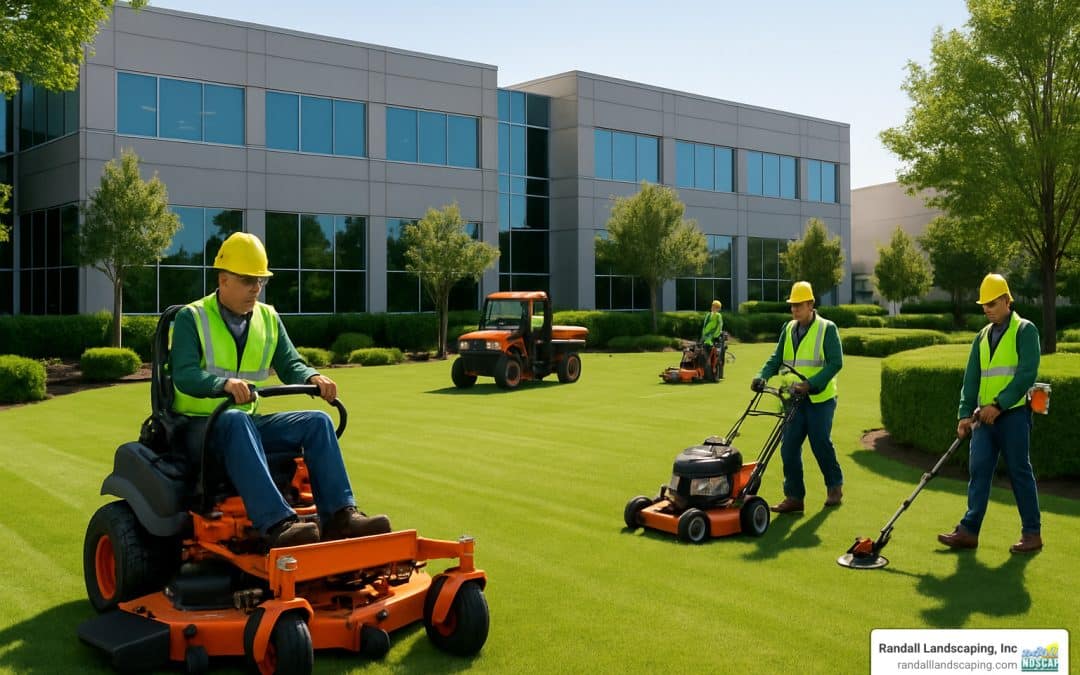
When you look at a well-maintained corporate property, what you’re seeing isn’t just regular lawn mowing—it’s the result of a comprehensive commercial landscape maintenance program designed specifically for business environments.
Commercial landscape maintenance goes far beyond what’s typically needed for homes. Your business property faces higher foot traffic, requires more sophisticated care systems, and must meet stricter safety standards to protect visitors and employees alike.
At Randall Landscaping, we’ve found that most commercial clients need a year-round approach that adapts to New England’s distinct seasonal changes. A complete program typically wraps several essential services into one cohesive package.
Your core lawn care forms the foundation—regular mowing and edging keep things looking sharp, while strategic fertilization, aeration, and overseeding maintain that lush, healthy appearance that makes such a powerful first impression on clients. Effective weed control prevents unwanted plants from diminishing your property’s professional appearance.
Tree and shrub management is equally crucial for commercial spaces. Regular pruning not only maintains an attractive appearance but also prevents safety hazards from overgrown branches. Seasonal fertilization and targeted pest management keep your woody plants healthy and thriving year after year.
Here in the Merrimack Valley, your irrigation system requires special attention. We typically perform spring startup services, regular programming adjustments as weather patterns change, routine inspections to catch small issues before they become major problems, timely repairs, and proper winterization to prevent costly freeze damage.
Integrated pest management has become increasingly important for commercial properties. This systematic approach involves monitoring for insects, diseases, and invasive species, then treating problems with the most environmentally responsible methods possible.
The dramatic seasonal changes in Southern New Hampshire demand specialized seasonal clean-ups—from clearing winter debris in spring to managing fallen leaves in autumn and preparing vulnerable plants for winter’s harsh conditions.
For many of our commercial clients, snow and ice management becomes critical during winter months. Prompt plowing, careful shoveling, strategic deicing, and efficient snow removal keep your business accessible and safe during challenging weather.
Don’t overlook your hardscape areas either. Regular maintenance of walkways, parking lots, and paved surfaces—including pressure washing, sweeping, and debris removal—extends their lifespan while enhancing your property’s overall appearance.
More info about Commercial Landscaping
Understanding Commercial Landscape Maintenance Cost
The national average for commercial landscape maintenance cost hovers around $9,000 annually, but this number can be misleading. In reality, we’ve seen tremendous variation based on property specifics. Some small commercial properties might spend as little as $2,000 per year, while large corporate campuses with extensive landscaping features often invest well over $50,000 annually to maintain their outdoor spaces.
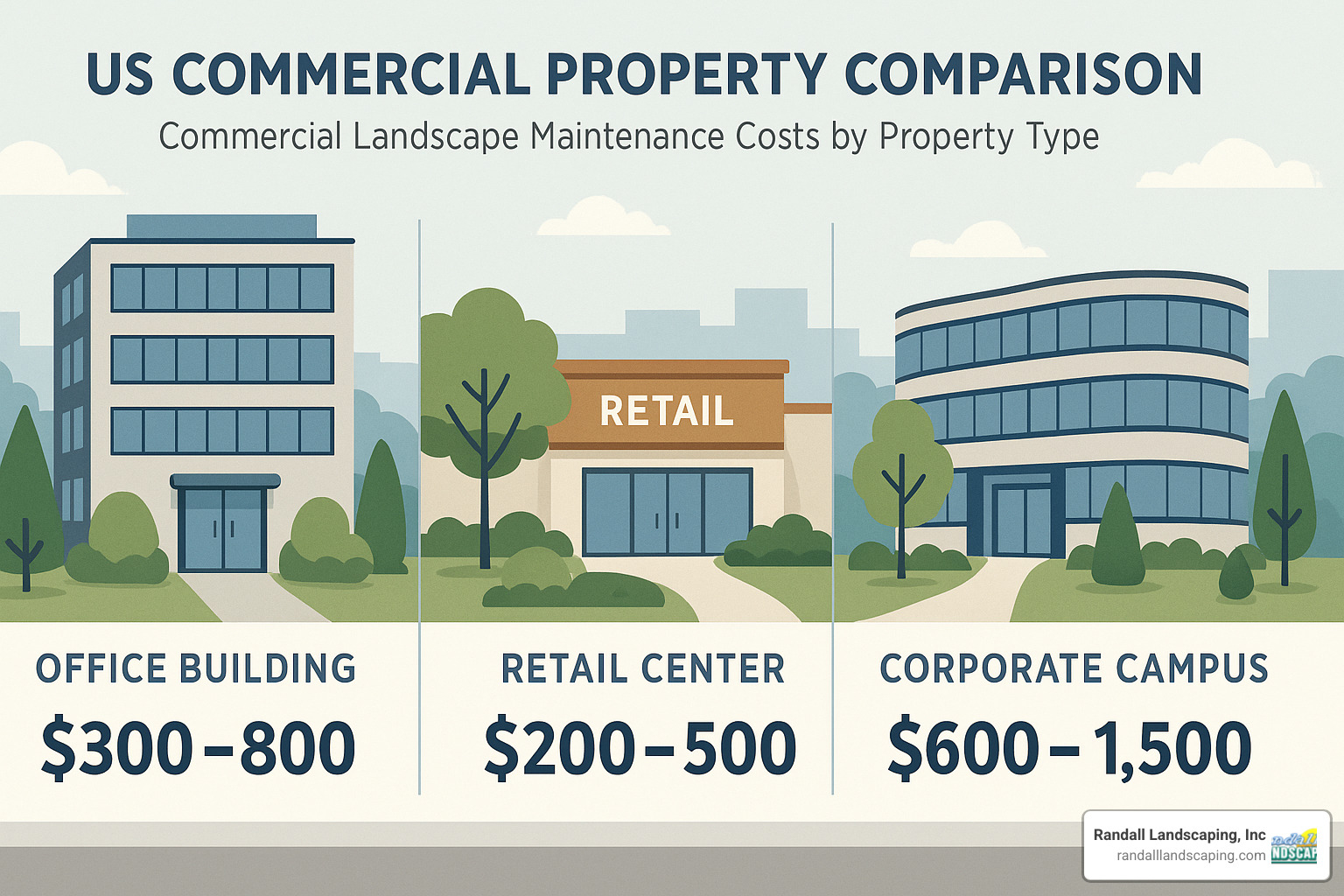
Average Commercial Landscape Maintenance Cost Breakdown
When property managers ask me about typical costs, I always emphasize that every property is unique. However, based on internet data (not Randall Landscaping quotes), here’s what you might expect:
Basic mowing and trimming typically runs $25-$150 per acre. The larger your property, the lower your per-acre rate will be – that’s the beauty of economies of scale in landscaping.
Labor costs generally range from $40-$80 per hour per worker. This varies significantly by region and the skill level required for your property’s needs.
Full-service monthly packages that include mowing, trimming, fertilization, and basic pest control typically range from $800-$1,600 per acre.
Annual maintenance contracts can run anywhere from $2,000 for a small office building to $50,000+ for extensive commercial campuses with complex landscaping features.
According to the Bureau of Labor Statistics, grounds maintenance workers earn a median hourly wage of $22.37, while skilled specialists like tree trimmers and pruners average $25.41 per hour. Your maintenance costs reflect these labor expenses plus equipment, materials, company overhead, and a reasonable profit margin.
Here in the Merrimack Valley and Southern New Hampshire, we typically see rates running slightly above the national average. This is primarily due to our compressed growing season (which concentrates work into fewer months) and the region’s higher overall labor costs.
Scientific research on labor wages
Pricing Models: Per Acre vs Per Hour vs Monthly Contract
When it comes to structuring commercial landscape maintenance costs, you’ll typically encounter three main approaches:
Per-Acre Pricing works beautifully for large, open properties with fairly uniform needs. It’s straightforward to calculate and budget for, and naturally scales with your property size. The downside? This model might not adequately account for unique landscape features or areas of complexity that require extra attention.
Hourly Rates provide flexibility for properties with variable or unpredictable needs. You’ll only pay for time actually worked, which can be advantageous for projects with changing conditions. The trade-off is less budget predictability and the potential for inefficiency if work isn’t closely monitored.
Monthly/Annual Contracts offer the most comprehensive approach for properties requiring consistent care. These arrangements provide excellent budget predictability, often include bundled service discounts, and typically come with priority scheduling during busy periods. The potential drawback is that standard packages might include services you don’t need, though a good provider will customize accordingly.
| Pricing Model | Best For | Typical Cost Range | Pros | Cons |
|---|---|---|---|---|
| Per Acre | Large, uniform properties | $25-$150/acre | Simple calculation, economies of scale | Doesn’t account for complexity |
| Hourly Rate | Variable scope projects | $40-$80/hour/worker | Pay only for work performed | Less predictable costs |
| Monthly Contract | Comprehensive care needs | $800-$1,600/acre/month | Budget certainty, bundled discounts | Less flexibility |
In my experience working with commercial clients throughout the Merrimack Valley area, monthly or annual contracts typically provide the best balance of service reliability and budget predictability. That said, at Randall Landscaping, we understand that each property has unique needs – we’ll always tailor our approach to what makes the most sense for your specific situation.
Factors That Influence Your Commercial Landscape Budget
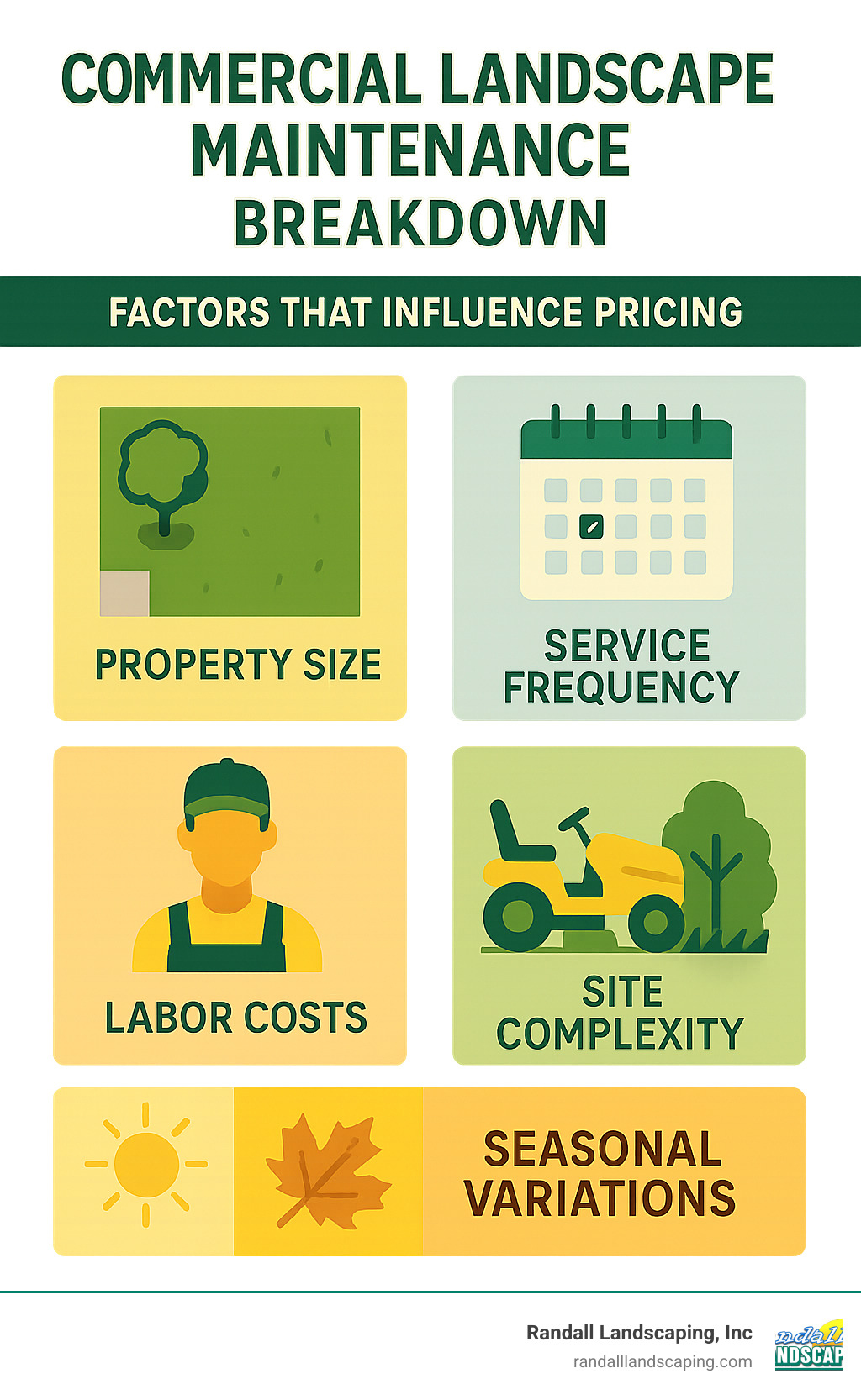
When planning your commercial landscape maintenance cost, understanding what drives those numbers helps you make smarter decisions about where to invest and where you might find savings without sacrificing quality.
Property Size and Layout Complexity
While it’s true that larger properties generally cost more overall, they often benefit from better economies of scale. For instance, a sprawling 10-acre corporate campus might pay just $25-$60 per acre for mowing services, while a smaller 1-acre office complex could pay $50-$150 per acre for the same service.
But size isn’t everything. The complexity of your property’s layout plays a huge role too. Those beautiful decorative garden beds surrounding your building entrance? The intricate landscaping that impresses visitors? These features require more labor-intensive hand work rather than efficient machine mowing, driving up your maintenance costs.
“We often see clients focus solely on acreage when budgeting,” Tommy Randall explains, “but a smaller property with complex landscaping features can actually cost more to maintain than a larger, simpler site.”
Terrain and Accessibility Challenges
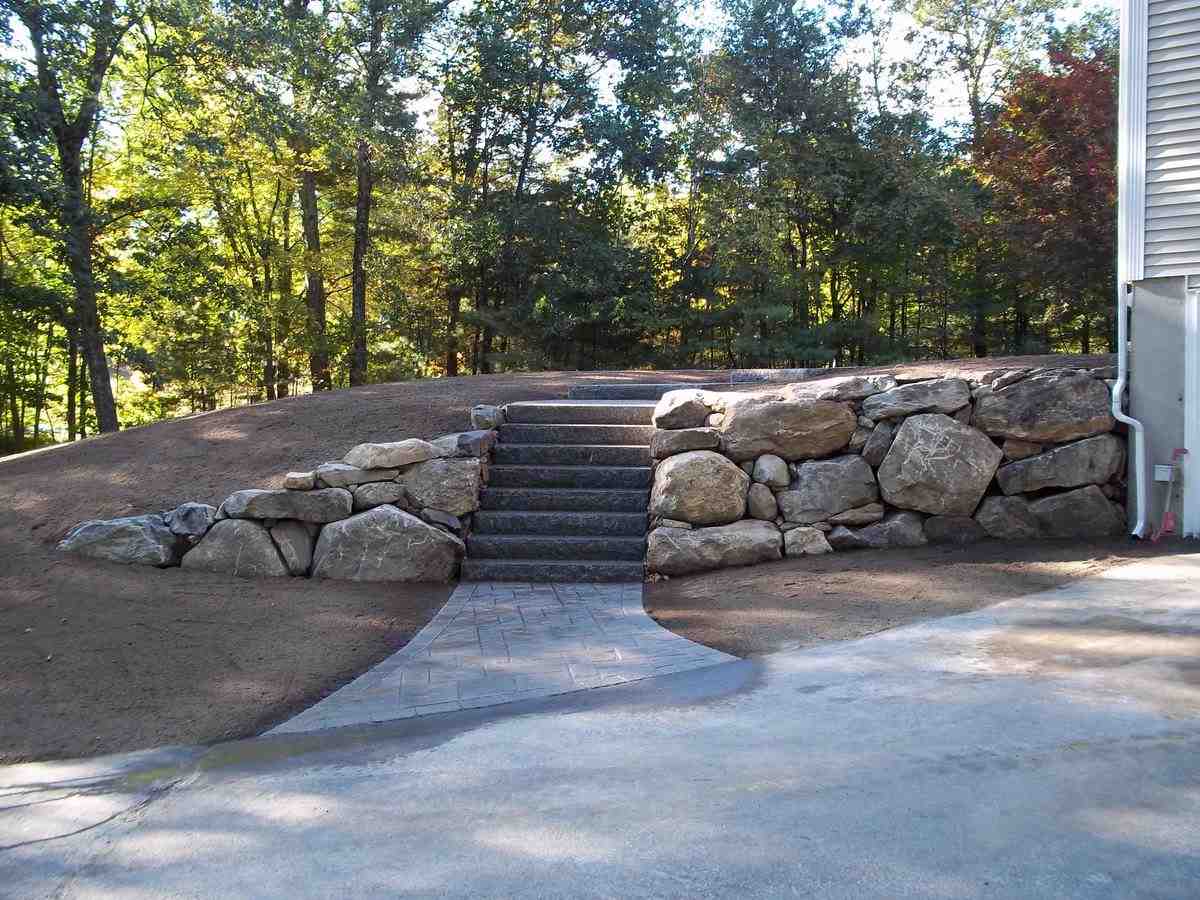
Properties with slopes and hills, common in areas like Windham and Salem, NH, present unique challenges. One of our North Andover clients has a corporate headquarters with a 30-degree slope that requires triple the labor hours compared to a flat property of the same size. This dramatic difference reflects the specialized equipment and extra care needed for sloped terrain.
Accessibility issues can also inflate your commercial landscape maintenance cost. Limited access points, security protocols at medical facilities, or restricted work hours around schools can all create operational inefficiencies that translate to higher costs. When crews can’t bring equipment directly to work areas or must coordinate around specific schedules, the hours add up quickly.
Plant Selection and Irrigation Needs
Your choice of landscaping plants significantly impacts long-term maintenance costs. Native New England plants typically require less babysitting than exotic varieties that aren’t naturally adapted to our climate. Properties featuring primarily native shrubs and perennials can save 15-30% on maintenance costs compared to those showcasing extensive annual flower displays or non-native species that demand special attention.
Smart irrigation is another factor worth considering. While irrigation systems represent an upfront investment, they typically reduce long-term maintenance costs by ensuring efficient water usage and healthier plants. However, don’t forget to budget for their upkeep—system checks and repairs can add $1,000-$7,000 annually to your maintenance expenses, depending on the size and complexity of your system.
Local Regulations and Seasonal Factors
Municipal regulations vary significantly across the Merrimack Valley. Towns like Andover, North Reading, and Boxford may restrict maintenance activities such as leaf blowing, chemical applications, or noise-generating work during certain hours. These local rules can extend project timelines and increase labor costs.
The distinct New England seasons create another layer of complexity. Unlike warmer regions, our properties require different care throughout the year. Winter snow removal services—essential throughout the Merrimack Valley—add a significant component to annual maintenance budgets that businesses in milder climates don’t face.
Understanding these factors helps you develop a realistic budget and identify where adjustments might make sense for your specific property needs.
Typical Costs for Core Maintenance Services
Let’s talk real numbers. While every commercial property has its own unique needs, these average costs will give you a solid starting point for your budget planning. These figures are based on internet research data, not actual Randall Landscaping quotes.
Mowing and Edging forms the backbone of most maintenance programs. For smaller properties under 5 acres, expect to pay between $50-$150 per acre per visit. Larger properties over 5 acres benefit from economies of scale, with rates typically dropping to $25-$60 per acre per visit. Here in New England, our growing season usually demands 25-30 visits annually, concentrated from April through October.
Your lawn’s health depends on proper Fertilization and Weed Control. A basic program runs about $220-$440 per acre annually, while premium organic programs (which we’re seeing more demand for lately) range from $330-$660 per acre annually. Most commercial properties benefit from 4-6 targeted applications throughout the year.
To combat soil compaction in high-traffic areas, Aeration and Overseeding are essential. Aeration services typically cost $100-$350 per acre, while overseeding adds another $150-$450 per acre. Most of our Merrimack Valley clients schedule these services once a year, typically in the fall when conditions are ideal for seed germination.
When thatch buildup exceeds half an inch, Dethatching becomes necessary at $400-$1,000 per acre. Most properties need this service every 1-2 years, though this varies based on grass type and soil conditions.
Tree and Shrub Care prices reflect the significant value these landscape elements add to your property. Professional pruning ranges from $200-$900 per tree depending on size and accessibility. Commercial properties with numerous shrubs can expect to invest $300-$800 per trimming visit. Most woody plants benefit from attention 1-2 times annually, though flowering varieties may require more specialized timing.
Fresh Mulching does wonders for aesthetics while suppressing weeds and retaining moisture. At $65-$100 per cubic yard installed, this spring ritual refreshes your landscape’s appearance while reducing other maintenance needs.
Irrigation System Maintenance isn’t optional in our climate – it’s essential for protecting your investment. Spring startup ($100-$300) and fall winterization ($100-$300) bookend the season, with occasional repair visits ($100-$400) as needed. At minimum, your system needs professional attention twice annually, plus regular inspections during peak season.
When winter arrives, Snow Removal becomes critical for safety and accessibility. Plowing costs range from $50-$203 per visit depending on lot size and complexity. Sidewalk clearing adds another $25-$75 per visit, while salt/ice melt application runs $40-$150 per application. In the Merrimack Valley, we typically see 10-15 snow events annually that require professional attention.
Latest research on service pricing
Our unique New England climate creates specific maintenance rhythms that impact your budget. Heavy spring cleanup after winter storm damage, intensive fall leaf management from our abundant deciduous trees, and comprehensive snow management all factor into annual maintenance costs for local businesses. The good news? An experienced local provider understands these regional challenges and can help you plan accordingly.
“What surprises many new commercial clients,” notes Tommy Randall, “isn’t the cost of regular maintenance, but the expense of rehabilitating a neglected property. Consistent care almost always costs less in the long run.”
Seasonal Impact & Cost-Saving Strategies
The changing seasons in New England create a natural rhythm for landscape maintenance – and understanding this cycle helps you manage your commercial landscape maintenance cost more effectively. Each season brings unique needs and opportunities to save while keeping your property looking its best.
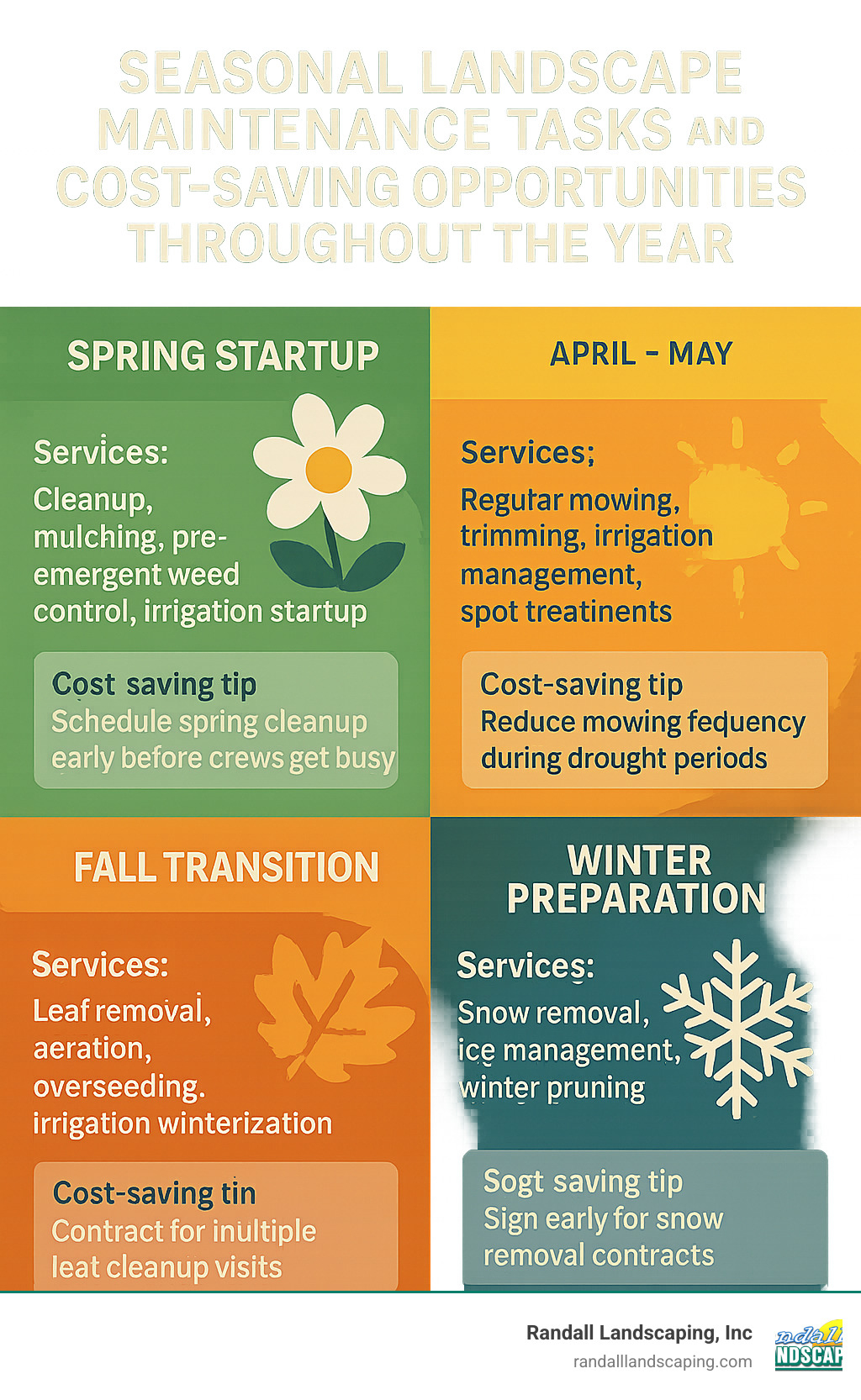
Spring Startup (March-May) kicks everything into high gear with cleanup, mulching, pre-emergent weed control, and irrigation startup. One smart way to save during this busy time? Schedule your spring cleanup early. Not only will you beat the rush, but you might also lock in better rates before the peak season demand drives prices up.
Summer Maintenance (June-August) focuses on regular mowing, trimming, irrigation management, and spot treatments for weeds or pests. During drought periods, consider scaling back mowing frequency – grass grows slower when it’s dry, and fewer cuts mean lower costs. Smart irrigation controllers are another summer saver, reducing water usage by 30-50% by automatically adjusting to weather conditions.
Fall Transition (September-November) brings leaf removal, aeration, overseeding, and irrigation winterization. Here’s a tip many property managers miss: instead of waiting for one major leaf cleanup (which can be expensive and leave your property vulnerable to damage), schedule multiple smaller cleanups. This approach often costs less overall and prevents the problems caused by heavy leaf coverage.
Winter Preparation (December-February) centers on snow removal, ice management, and winter pruning. The simplest way to save? Sign early for snow removal contracts. Many providers, including Randall Landscaping, offer pre-season discounts to clients who lock in their winter services before the first snowflake falls.
Beyond these seasonal strategies, there are several year-round approaches to optimize your landscape budget:
Native plant selection makes a tremendous difference in maintenance requirements. Plants that naturally thrive in New England, like Black-Eyed Susans, New England Aster, and Inkberry Holly, need less water, fertilizer, and care. They’ve evolved to handle our climate’s challenges, from summer heat to winter cold.
Smart irrigation technology represents one of the best investments for commercial properties. When we upgraded a client’s system in Andover to weather-based controllers, their water bills dropped by 40% – paying for the technology in less than two seasons.
Efficient lighting solutions like LED or solar fixtures can reduce energy costs by up to 80% while lasting years longer than traditional options. The upfront investment typically pays for itself within 12-18 months.
Group maintenance coordination creates economies of scale. If you manage multiple properties or can sync schedules with neighboring businesses, you may qualify for volume discounts. Business parks and shopping centers that coordinate service timing often see savings of 10-15%.
Preventative care emphasis is perhaps the most important strategy. As Tommy Randall often tells clients, “The most expensive landscape maintenance is the maintenance you skip.” We’ve seen this play out countless times – routine tree pruning costing $200-$900 prevents emergency removal after storm damage that might run $1,000-$5,000.
The right approach to seasonal maintenance doesn’t just save money – it creates a more resilient, beautiful landscape that improves your property’s value year-round. By working with the natural cycles rather than against them, you’ll find your commercial landscape maintenance cost becomes more predictable and manageable.
Estimating & Budgeting: From Site Walk-Through to Signed Contract
Getting an accurate handle on your commercial landscape maintenance cost doesn’t have to feel like solving a complex puzzle. Let me walk you through our straightforward process that takes you from initial assessment to a clear, detailed contract.
Step 1: Property Assessment and Mapping
We begin with a thorough walk-through of your property. This isn’t just a quick glance—we’re creating a detailed boundary map that captures every landscape feature that needs attention.
“Most budget surprises come from overlooked areas,” Tommy Randall often tells clients during initial consultations. “That’s why we measure everything—from turf areas to planting beds to hardscapes.”
During this assessment, we calculate the total square footage of each maintained area, identify special features like water elements or specialty gardens, and note any access challenges that might affect service delivery. Those loading docks at your Andover warehouse? The security gate at your Salem office park? We factor all these details into your estimate.
Step 2: Service Scope Definition
Next, we’ll work with you to determine exactly what services you need and how often. Do your lawn areas need weekly mowing during peak season? Monthly fertilization? What about those maple trees lining your entrance—how often should they be pruned?
We’ll also identify seasonal services specific to our New England climate—spring cleanup after winter’s mess, fall leaf management when those beautiful trees drop their foliage, and snow removal services to keep your property safe during winter months.
Beyond basic maintenance, we’ll discuss any improvement goals you have for the property. Maybe you’re looking to improve curb appeal or address drainage issues that have been causing problems. Setting clear quality expectations now saves headaches later.
Step 3: Request for Proposal (RFP) Development
For larger commercial properties, creating a formal RFP helps ensure you get comparable bids. We can help you develop a detailed document that outlines all services, frequencies, and expectations—complete with property maps and any special requirements.
We recommend requesting itemized bids rather than just bottom-line numbers. This transparency allows you to compare services across providers and make adjustments to meet your budget without sacrificing critical maintenance.
Don’t forget to ask for references from similar commercial properties—a landscaper who maintains residential homes might not have the equipment or expertise for your office complex or retail center.
Step 4: Bid Evaluation
When those proposals come in, look beyond the bottom line. Compare line-item costs and service frequencies—is one company offering monthly bed maintenance while another includes it bi-weekly? These differences matter.
“The lowest bid rarely delivers the best value,” Tommy notes. “We’ve picked up many clients who learned this lesson the hard way.”
Verify that each bidder carries proper insurance and licensing. For commercial properties in Massachusetts and New Hampshire, this includes general liability insurance, workers’ compensation, and appropriate pesticide applicator licenses if chemical treatments are included.
Step 5: Contract Negotiation
Once you’ve selected your provider, it’s time to nail down the details. Clarify payment schedules—do you prefer monthly, quarterly, or annual billing? Define what constitutes acceptable quality and how performance will be measured.
Establish communication protocols for regular updates and emergency response procedures. (That unexpected June storm that drops branches everywhere? You’ll want to know who to call and how quickly they’ll respond.)
Many commercial clients find value in negotiating multi-year terms. At Randall Landscaping, we often offer modest discounts for 2-3 year commitments, which provides budget stability for you and planning certainty for us.
Our proposals break down costs by service area and frequency, giving you the flexibility to adjust scope without sacrificing critical maintenance. If your budget tightens, we can help you identify where to trim without creating bigger problems down the road.
“Transparency builds trust,” says Tommy Randall. “We want you to understand exactly what your commercial landscape maintenance cost covers, so there are never any unwelcome surprises.”
Ready to get started with your personalized commercial landscape assessment? We serve the entire Merrimack Valley and Southern New Hampshire region with pride.
Frequently Asked Questions about Commercial Landscape Maintenance Cost
How does property size change commercial landscape maintenance cost?
Property size is the most significant cost driver, but the relationship isn’t strictly linear. Commercial landscape maintenance costs generally decrease per acre as your property gets larger, thanks to economies of scale.
Think of it this way – based on internet data (not Randall Landscaping quotes): a 1-acre office property might cost $50-$150 per acre for mowing, while a 10-acre corporate campus might only cost $25-$60 per acre for the same service.
Why the difference? When maintaining larger properties, the setup time, travel expenses, and equipment transportation costs get spread across more billable acres. Plus, larger open spaces allow our crews to use bigger, more efficient equipment that simply can’t be deployed on smaller sites.
That said, if your large property features diverse landscape elements – like intricate gardens, water features, and varied terrain – you might not see continuous cost reductions as size increases. In these cases, complexity can offset some of those economies of scale.
What’s included in a full-service maintenance contract?
When you sign up for a full-service commercial landscape maintenance contract, you’re essentially getting peace of mind that your property will look its best year-round. These contracts typically include a comprehensive package of services.
For your lawn areas, expect regular mowing (typically weekly during peak growing season), edging and string trimming along walkways and buildings, a complete fertilization program with 4-6 applications annually, weed control in turf areas, and basic pest management to keep your grass healthy.
Your trees and shrubs will receive seasonal pruning to maintain their shape and health, fertilization as needed, basic monitoring for pests and diseases with appropriate treatments, and removal of any dead or damaged limbs that could create hazards.
The contract also covers important seasonal tasks that keep your property looking fresh through New England’s changing seasons: spring cleanup and bed preparation, multiple fall leaf removal visits, winter preparation for plants and irrigation systems, and typically one annual mulch application to keep beds looking neat while suppressing weeds.
One of the most valuable aspects is regular inspections – our teams check irrigation systems, assess plant health, conduct property walk-throughs with you or your representatives, and identify potential issues before they become expensive problems.
What’s typically excluded (and would require additional fees) are major tree work or removals, substantial irrigation repairs beyond basic maintenance, new plantings or landscape renovations, snow and ice management (usually contracted separately), and hardscape repairs or power washing.
“The right maintenance contract should feel like a partnership,” says Tommy Randall. “We work with clients to create agreements that reflect their specific property needs and budget priorities.”
How can I lower costs without hurting curb appeal?
Balancing budget constraints with aesthetic requirements is something we help clients with every day. There are several proven strategies to reduce your commercial landscape maintenance costs while keeping your property looking impressive.
Accept native plants that thrive naturally in our New England climate. These species require less water, fertilizer, and pest management because they’ve evolved to handle local conditions. Converting just a quarter of your ornamental beds to native plantings can reduce maintenance hours by 15-20%. We helped several office parks in North Andover make this transition, and not only did they cut maintenance costs by about 30%, but they also saw increased wildlife activity that employees absolutely love.
Upgrade your irrigation approach by switching to drip systems in planting beds and installing smart controllers. These technologies can reduce water usage by 30-50%, lowering both your utility bills and the labor hours needed for irrigation management. One medical facility client in Methuen saw their summer water bills drop by nearly 40% after making these changes.
Consider consolidating your service providers rather than using different companies for maintenance, improvements, and snow management. Using one trusted partner for all landscape services often results in package discounts of 10-15% compared to hiring separate specialists. Plus, you’ll have just one point of contact who understands your property’s complete needs.
Strategically reduce high-maintenance turf areas by converting remote or difficult-to-mow sections to low-maintenance groundcovers or native meadows. This approach reduces mowing hours while actually adding visual interest to your property. A retail center in Salem transformed their steep roadside slopes from turf to flowering native grasses, reducing their maintenance costs by 18% while creating a distinctive look that attracts attention.
Optimize your service schedule to align with your provider’s existing route in your area. This simple change can sometimes yield 5-10% discounts due to reduced travel time and improved crew efficiency. We’re always happy to discuss how scheduling adjustments might benefit both your budget and our operational flow.
The goal isn’t to cut corners, but to make smarter choices that maintain your property’s professional appearance while reducing unnecessary maintenance costs. At Randall Landscaping, we’re experts at finding that perfect balance for commercial properties throughout the Merrimack Valley and Southern New Hampshire.
Conclusion
Understanding commercial landscape maintenance costs is essential for effective property management and budgeting. While national averages provide a starting point, your specific costs will depend on your property’s unique characteristics, service requirements, and regional factors.
Here in the Merrimack Valley and Southern New Hampshire, commercial property managers face distinct challenges—from our dramatic seasonal transitions to the patchwork of municipal regulations across towns. Working with a knowledgeable local provider like Randall Landscaping gives you access to region-specific expertise that national chains simply can’t match.
I’ve seen how properly maintained landscapes transform businesses—not just visually, but financially. Well-kept grounds attract better tenants, command higher rents, and require fewer costly emergency interventions. As Tommy likes to say, “The most expensive landscape is often the neglected one. Regular, thoughtful maintenance prevents costly rehabilitations and protects your property’s value year after year.”
Landscape maintenance shouldn’t be viewed merely as an expense on your balance sheet—it’s an investment in your property’s long-term value, your organization’s professional image, and the daily experience of everyone who visits your space. When clients or employees approach your building, your landscape silently communicates your company’s attention to detail and commitment to quality.
At Randall Landscaping, Inc., we’ve built our reputation on delivering quality work with 100% reliability. Our transparent pricing approach means no hidden fees or surprise charges. We provide detailed, itemized proposals so you understand exactly what you’re paying for, and our commitment to customer satisfaction has made us a trusted partner for commercial properties throughout the region.
Ready to optimize your commercial landscape maintenance program? Let’s talk about how we can help you balance curb appeal with budget reality. Contact us today for a comprehensive property assessment and customized maintenance proposal custom to your specific needs.
More info about Commercial Landscaping