What Determines the Price to Lay Mulch for Your Property?
The price to lay mulch typically ranges from $50 to $325+ per cubic yard for professional installation, depending on mulch type, labor, delivery, and project size. On a per-square-foot basis, expect to pay between $0.65 and $4.00. Here’s what influences your total cost:
- Mulch material: $30-$135 per cubic yard (wood chips, bark) or $80-$250+ per cubic yard (rubber, stone)
- Professional labor: $20-$65 per cubic yard
- Delivery fees: $70-$220+ per load
- Add-on services: Old mulch removal ($20-$75/yard), landscape fabric ($0.40-$1.25/sq ft), edging ($1-$5/linear foot)
These are average costs based on national internet data and not specific quotes for any single company.
Mulch does more than make your property look polished. It suppresses weeds, retains soil moisture, regulates temperature, and protects plant roots. But understanding what you’ll actually pay requires breaking down the variables—from the type of mulch you choose to whether you need bed preparation or delivery.
As Tommy Randall, owner of Randall Landscaping since 2006, I’ve helped hundreds of homeowners in Massachusetts and New Hampshire understand the true price to lay mulch and make smart decisions for their yards. Whether you’re comparing DIY costs to professional services or choosing between bark and rubber mulch, this guide walks you through every factor that affects your final bill.
Understanding Mulch Installation Costs
When you’re considering a landscaping project, understanding the average price to lay mulch is often a starting point. While the national average for professional mulch installation currently ranges from $35 to $120 per cubic yard, remember that this is a broad range. For a more comprehensive look, including materials and labor, homeowners often see costs between $75 and $325 for a standard yard. This figure can even exceed $800 for larger or more complex projects. These are national averages based on internet data, not specific quotes from our company, and actual costs for your property in the Merrimack Valley or Southern New Hampshire may vary.
The overall cost is typically broken down into the price of the mulch material itself and the labor required for its installation. A cubic yard of mulch, which measures 3 feet by 3 feet by 3 feet (or 27 cubic feet), can cover a significant area. For instance, at a recommended depth of 2 inches, one cubic yard can cover approximately 162 square feet. If you prefer a 3-inch depth, it will cover about 108 square feet. Knowing these measurements helps us accurately calculate the volume needed for your garden beds.
For a deeper dive into how mulching can transform your landscape, explore our Mulch Installations – Complete Guide.
Average Cost Per Cubic Yard
The cost of mulch can be calculated in a few ways, but the cubic yard is the standard unit for bulk purchases and professional installation quotes. As mentioned, the national average for professional mulch installation, including both materials and labor, can range from $35 to $110 per cubic yard installed, but can go up to $325 or more depending on the type of mulch and complexity of the job.
If you’re only considering the material cost, bulk mulch typically runs from $30 to $135 per cubic yard. The type of mulch you choose will significantly impact this figure, with some specialty options pushing the higher end.
When it comes to professional installation, labor usually adds an extra $20 to $65 per cubic yard to the material cost. This covers the physical work of spreading, leveling, and ensuring an even application. For larger projects, purchasing mulch in bulk is almost always the most cost-effective option, as it often comes with volume discounts, potentially saving you 15% to 30% compared to buying individual bags.
Consider how we can improve your property with beautiful, functional mulch by visiting our page on Garden Bed Mulching.
Average Cost Per Square Foot
While cubic yards are common for bulk, many homeowners find it easier to visualize costs per square foot. On average, the estimated cost to install mulch starts at $0.67 to $1.31 per square foot, but can reach $4.00 or more per square foot for complex projects or premium materials.
To calculate your needs, measure the length and width of your garden beds in feet. Multiply these two numbers to get the total square footage. Then, consider the desired mulch depth. For most applications, a depth of 2 to 3 inches is ideal. Less than 2 inches may not provide adequate weed suppression or moisture retention, while more than 3 inches can suffocate plants and create a haven for pests.
For a precise estimate custom to your specific project, we recommend using an online tool like the Cost to Install Mulch – 2025 Cost Calculator (Customizable).
How Mulch Type and Quality Impact Your Budget
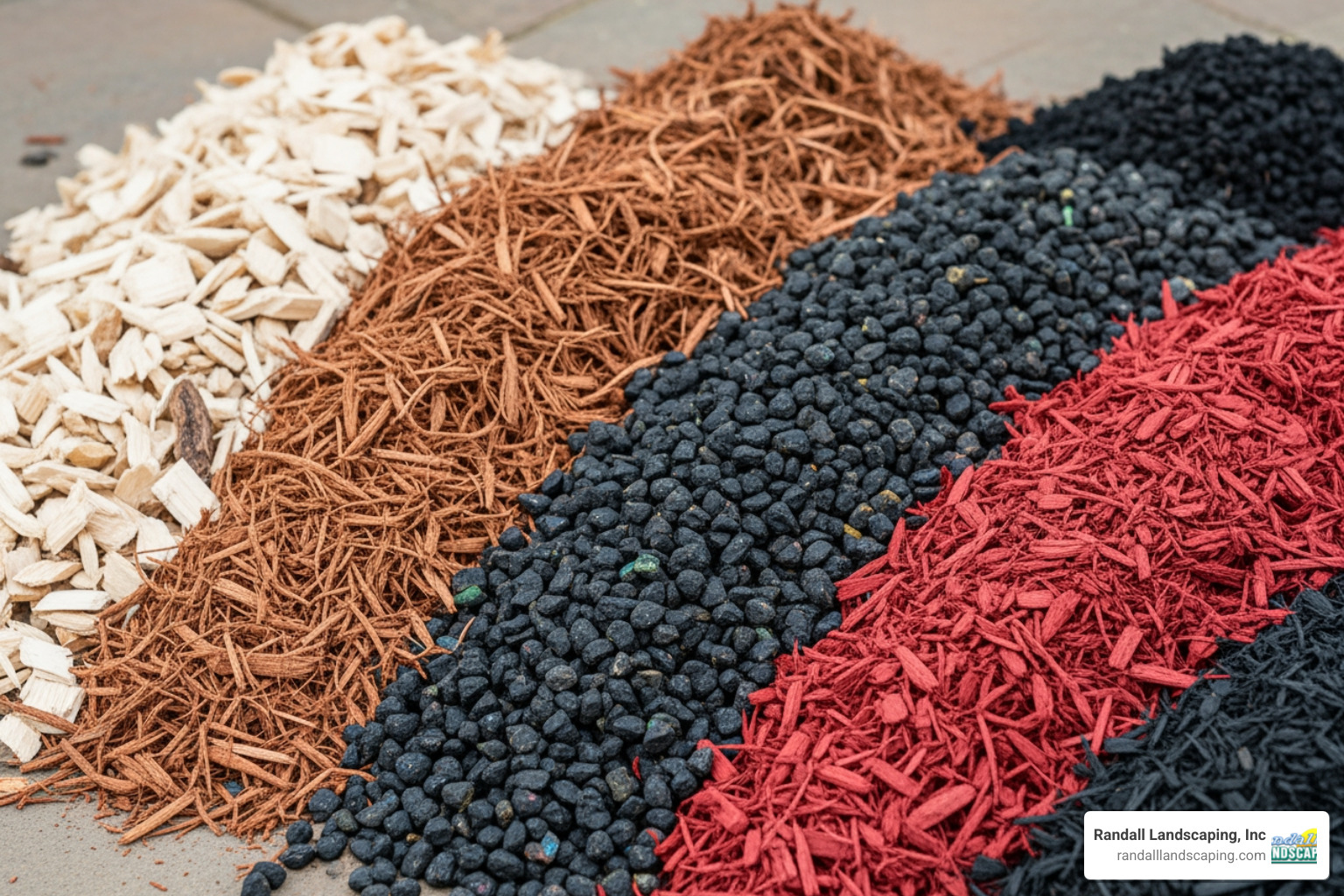
The type of mulch you select is one of the most significant factors influencing the overall price to lay mulch. Different materials offer varying benefits, aesthetics, and lifespans, all of which contribute to their cost. The following prices are based on national averages from internet data and are not quotes from our company. Whether you opt for organic, inorganic, or a specialty colored mulch, each has its own price point and advantages.
Organic vs. Inorganic Mulch Costs
Organic mulches are derived from natural sources and decompose over time, enriching your soil. Common organic options include:
- Wood chips: Often made from various tree species, costing around $24 to $150 per cubic yard.
- Shredded bark: Including pine bark, cedar, and cypress, ranging from $30 to $115 per cubic yard.
- Pine needles: A popular choice, especially for acid-loving plants, typically costing about $50 to $160 per cubic yard.
- Straw: An economical option, particularly for vegetable gardens, priced around $35 to $110 per cubic yard.
These mulches offer excellent soil improvement benefits as they break down, releasing nutrients and improving soil structure.
Inorganic mulches are non-biodegradable and tend to be more decorative and long-lasting. They include:
- Rubber mulch: Made from recycled tires, known for its durability and use in playgrounds, costing $90 to $280 per cubic yard.
- Stone and gravel: While not strictly mulch, these are often used in similar applications for drainage and aesthetics, with prices varying widely.
While inorganic mulches offer superior durability, they don’t contribute to soil health. The choice often depends on your landscape’s specific needs and aesthetic goals. If you’re looking for environmentally friendly options, we have more information on Eco-Friendly Mulch Options.
The Cost of Colored and Specialty Mulches
Colored mulches, typically available in red, black, brown, or gold, are often dyed wood chips. These can add a vibrant touch to your landscape, with prices ranging from $35 to $150 per cubic yard. While some homeowners express concerns about the safety of colored mulch, research from UMass Amherst indicates that most colored mulches use iron oxide or carbon-based dyes and are generally safe for landscape use. We always recommend choosing products that carry Mulch and Soil Council (MSC) certification to ensure they are free from harmful contaminants.
Specialty mulches like pure cedar or cypress tend to be on the higher end of the price spectrum due to their unique properties, such as natural insect repellency or distinct aroma. Cedar mulch can cost around $100 to $300 per cubic yard, while cypress mulch might be $110 to $340 per cubic yard.
Here’s a quick comparison of common mulch types:
| Mulch Type | Average Cost/Yard (Material Only) | Lifespan | Key Benefits |
|---|---|---|---|
| Wood Chips | $24 – $150 | 1-3 years | Improves soil, suppresses weeds, retains moisture, affordable. |
| Pine Bark | $30 – $100 | 2-4 years | Acidifies soil, retains moisture, attractive, slow decomposition. |
| Shredded Hardwood | $40 – $125 | 2-3 years | Good soil enrichment, interlocks well on slopes, retains moisture. |
| Hemlock Blend | $43 – $135 | 2-3 years | Natural reddish hue, good moisture retention, often color-improved. |
| Black Mulch (Dyed) | $40 – $150 | 1-2 years | High contrast, improves plant colors, absorbs heat. |
| Red Mulch (Dyed) | $35 – $110 | 1-2 years | Vibrant color, improves green foliage, absorbs heat. |
| Cedar Mulch | $100 – $300 | 3-5 years | Natural insect repellent, pleasant aroma, attractive. |
| Cypress Mulch | $110 – $340 | 3-5 years | Slow decomposition, moisture retention, often fragrant. |
| Pine Needles | $50 – $160 | 2-4 years | Ideal for acid-loving plants, lightweight, good for slopes, unique texture. |
| Straw Mulch | $35 – $110 | 6-12 months | Economical, good for vegetable gardens, insulates soil, reduces splash. |
| Rubber Mulch | $90 – $280 | 7-12+ years | Extremely durable, playground safe, wide range of colors, does not decompose. |
Key Factors That Influence the Total Price to Lay Mulch
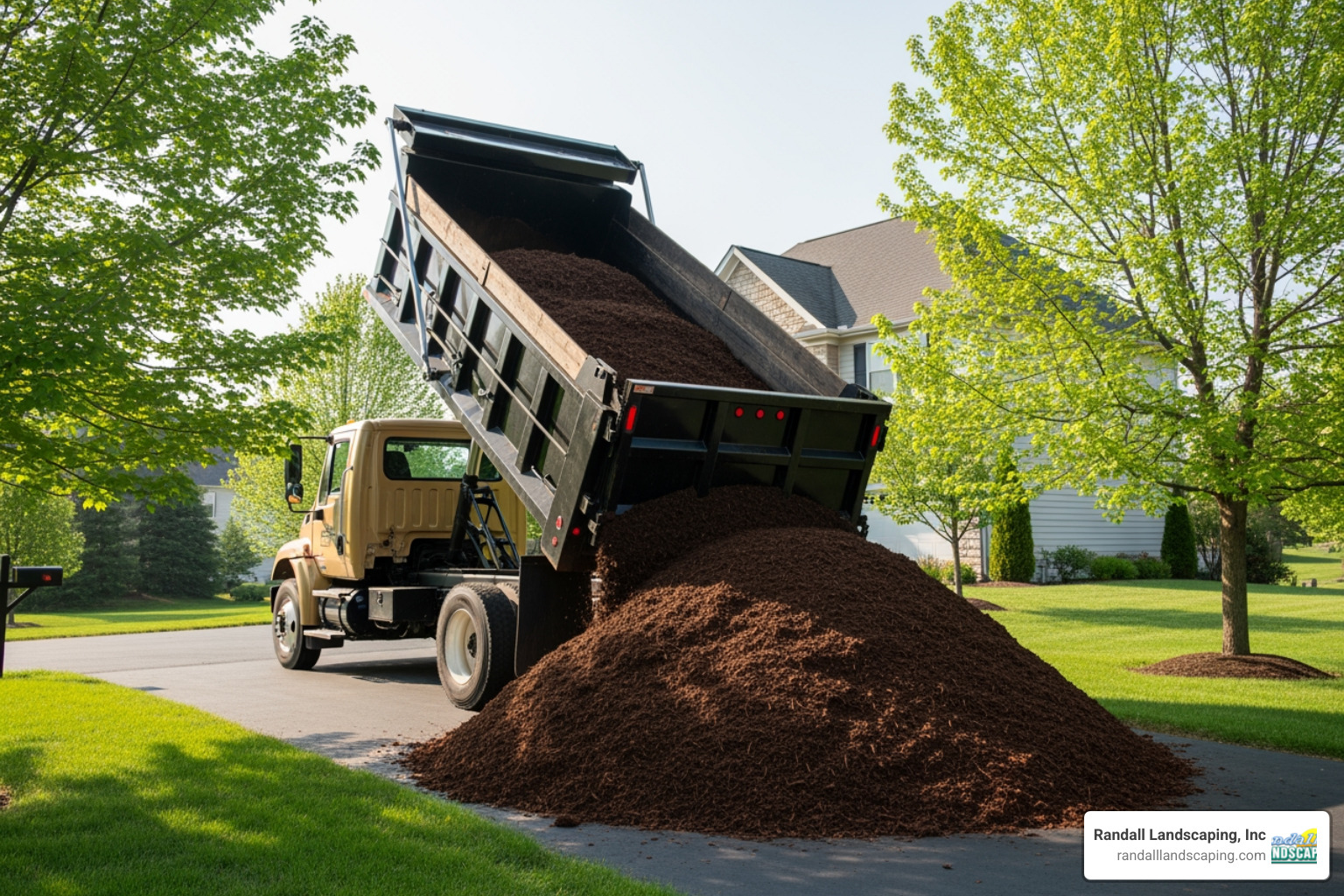
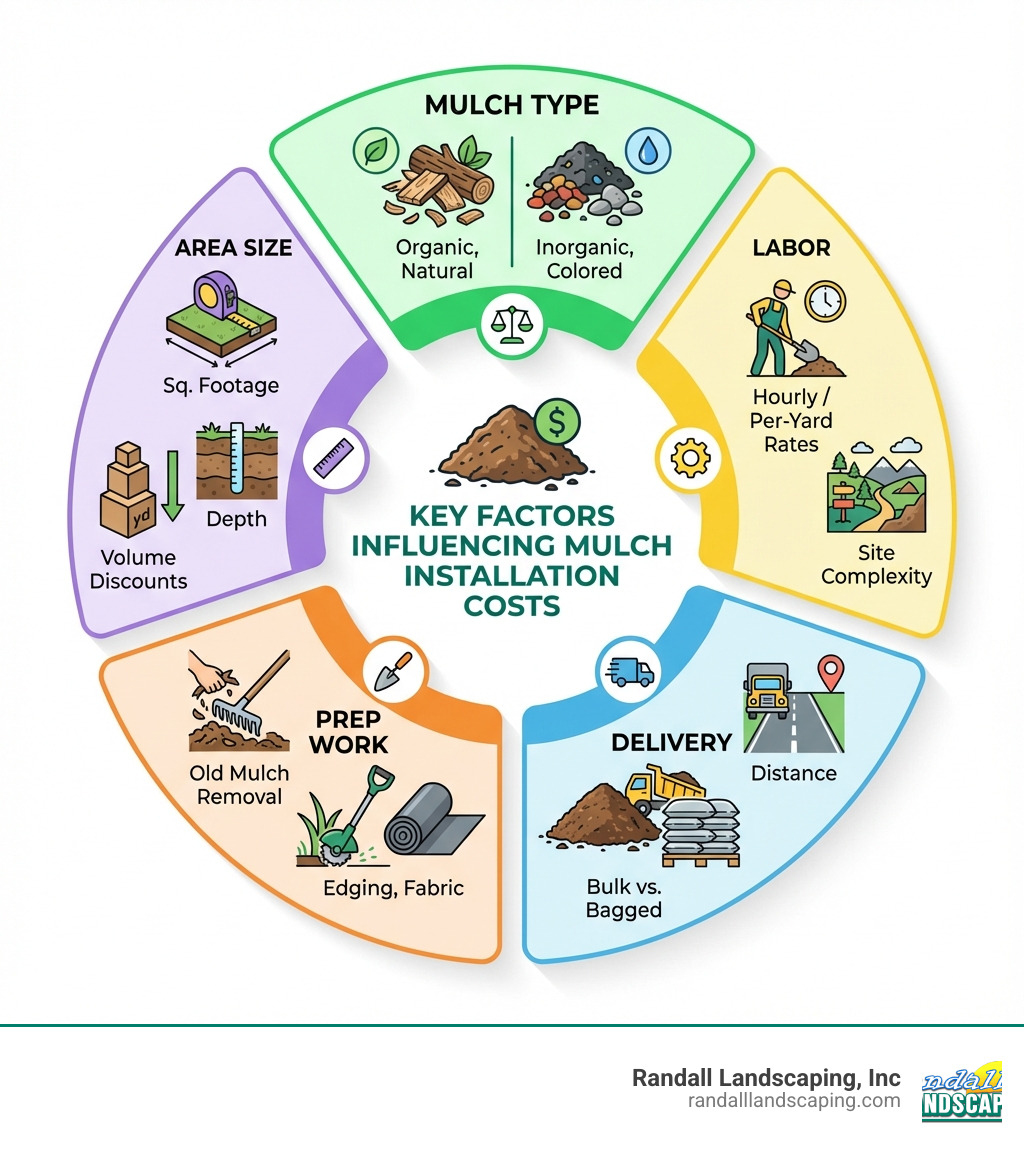
Beyond the type of mulch, several other critical factors influence the final price to lay mulch for your property in the Merrimack Valley or Southern New Hampshire. These include labor rates, delivery fees, and the overall size and complexity of your project. The following price ranges are based on national averages from internet data and are not specific quotes from our company. Understanding these variables helps us provide an accurate estimate and helps you budget effectively.
Labor Rates and Job Complexity
Labor is a significant component of the price to lay mulch. Professional landscapers typically charge in one of two ways:
- Hourly rates: Often ranging from $35 to $110 per hour per person.
- Per-cubic-yard rates: Usually between $20 and $65 per cubic yard for installation.
The complexity of your job can greatly affect labor costs. Factors like site accessibility, which includes how close a delivery truck can get to your beds, or the presence of steep slopes and uneven terrain, can increase the time and effort required, thus raising the labor cost. For instance, beds far from the street or those on challenging inclines may require more manual labor or specialized equipment.
For larger areas or hard-to-reach spots, mulch blowing services can be a highly efficient option, typically costing between $38 and $120 per cubic yard. This method uses specialized equipment to blow mulch into place, saving significant time and labor compared to hand spreading.
We pride ourselves on providing comprehensive services, including detailed Mulch and Edging Services to ensure a perfect finish.
Delivery Fees and Bulk vs. Bagged Mulch
Getting the mulch to your property is another cost consideration. Delivery fees for bulk mulch generally range from $70 to $220, often as a flat rate that covers multiple cubic yards. This cost can vary based on your distance from the supplier.
When it comes to purchasing the mulch itself, you have two main options:
- Bagged mulch: Typically costs $2 to $13 per bag. Each 2-cubic-foot bag covers approximately 10 square feet at a 2-inch depth.
- Bulk mulch: As discussed, this costs $30 to $135 per cubic yard.
For smaller projects (1-2 cubic yards), bagged mulch might seem convenient. However, for anything larger, bulk mulch is almost always more cost-effective. Buying a cubic yard’s worth of bagged mulch can be up to 35% more expensive than purchasing the same amount in bulk. For example, if a 2-cubic-foot bag costs $4, you would need about 13-14 bags to equal one cubic yard, totaling $52-$56 for material. A bulk cubic yard might only cost $30-$40.
We offer convenient delivery services to ensure your mulch arrives precisely when and where you need it. Learn more about our Mulch Delivery Cost and options.
DIY vs. Professional Mulch Installation
Deciding whether to tackle mulching yourself or hire professionals is a key part of determining your overall price to lay mulch. Both options have their merits, and the best choice often depends on your budget, time, physical capability, and desired outcome.
Calculating Your DIY Mulching Costs
If you choose the DIY route, your primary costs will be the mulch material itself, which, as we’ve seen, can range from $30 to $135 per cubic yard for bulk or $2 to $13 per bag. However, don’t forget to factor in tools. The following tool costs are based on national averages and can vary widely. If you don’t already own them, you might need to purchase or rent items like a wheelbarrow ($50-$150 to buy, $25-$80 daily to rent), a garden rake ($15-$50), or a pitchfork ($20-$65). A truck rental for picking up bulk mulch could add $75-$230 per day plus mileage.
The “hidden” costs of DIY often include your personal time and physical effort. Spreading mulch can be strenuous work. For 1-2 cubic yards, you might spend 3-5 hours, but for 6+ cubic yards, it could easily consume an entire weekend or more. As one homeowner in our area once remarked, “My body reminded me for days that I’m not 25 anymore!” Improper installation can also lead to weeds, uneven coverage, or mulch washing away, potentially costing more to fix later. While we all love a good DIY project, sometimes the value of your time and back is worth more than the savings.
Proper mulching is also a fantastic way to control weeds. Find more tips on Mulch for Weed Control.
Understanding the Value of a Professional Service
While professional installation incurs a higher upfront price to lay mulch, it often offers significant value, especially for larger or more complex projects. Here’s why many homeowners in Andover, Windham, and beyond choose us:
- Expertise in application depth: Professionals ensure the correct 2-3 inch depth for optimal weed suppression and moisture retention, without suffocating plants or creating pest issues.
- Plant safety: We know how to apply mulch without piling it too high against plant stems (“mulch volcanoes”), which can harm shrubs and trees.
- Bed preparation: Our services often include crucial prep work like weed removal and defining bed edges, ensuring a clean slate for your new mulch.
- Efficiency and speed: A professional crew, often with specialized equipment like mulch blowers, can complete large jobs quickly and efficiently, saving you valuable weekend time.
- Guaranteed clean look: We ensure a uniform, aesthetically pleasing application that improves your property’s curb appeal.
- Time and effort saved: For many, the premium for professional installation is worth it to avoid the physical strain and to spend their leisure time enjoying their outdoor spaces rather than working in them.
For a flawless and lasting result, consider our expert Landscape Mulch Installation services.
Budgeting for Additional and Ongoing Mulch Costs
When planning your mulching project, it’s easy to focus solely on the initial price to lay mulch. However, a comprehensive budget should also account for potential add-on services and the ongoing costs of maintenance and replenishment.
The Price to Lay Mulch with Add-On Services
Sometimes, a simple mulch application isn’t enough. You might require additional services that will affect the total cost. Please note that the following prices are national averages based on internet data and are not quotes from our company:
- Old mulch removal: If your existing mulch is too thick, moldy, or you’re changing types, removal might be necessary. This can cost $20 to $75 per cubic yard, plus an additional $50 to $150 in disposal fees. Hourly rates for removal can range from $50 to $150.
- Weed barrier fabric: To maximize weed suppression, many opt to install landscape fabric underneath the mulch. The fabric material itself can cost anywhere from $0.05 to $0.85 per square foot, with typical landscape cloth falling between $0.12 and $0.50 per square foot. Installation labor adds to this.
- Landscape edging: Defining the borders of your garden beds with edging not only looks clean but also prevents mulch from spilling onto your lawn. Basic edging refresh can cost $0.50 to $1.50 per linear foot, while new edge installation might be $1.50 to $5.00 per linear foot. Decorative or hardscape edging can range from $5 to $30+ per linear foot.
These additional services can significantly improve the longevity and appearance of your mulched areas. We offer these services in towns like North Andover, MA, and can provide a detailed quote. Find out more about our services for Mulch Installation in North Andover, MA.
Long-Term Maintenance and Replenishment
Mulch isn’t a one-and-done solution, especially organic varieties. It breaks down over time, improving your soil but also requiring replenishment. This leads to ongoing costs:
- Annual top-offs: For organic mulches, an annual “top-off” with a fresh 1-inch layer is often recommended to maintain its benefits and appearance. This usually costs $30 to $95 per cubic yard.
- Full replacement: Organic mulches typically need a complete replacement every 2-3 years. If the old mulch is heavily decomposed, moldy, or has formed a water-resistant mat, a full replacement with removal might be necessary, costing $50 to $160 per cubic yard.
- Organic mulch decomposition: This process is what makes organic mulch so beneficial for soil health, but it means you’ll need to reapply more frequently than with inorganic options like rubber mulch, which can last 7-12+ years.
Think of annual mulch top-ups like car maintenance—a small investment to protect a larger one and keep things looking great. Properly maintained mulch also helps retain soil moisture, a benefit you can read more about on our Moisture Retaining Mulch page.
Frequently Asked Questions about Mulch Installation Costs
How much mulch do I need for my project?
Calculating the right amount of mulch is crucial to avoid overbuying or running short. Here’s a simple way to estimate:
- Measure the area: Determine the length and width of each garden bed in feet. Multiply these numbers to get the total square footage.
- Choose your depth: The recommended depth for most mulch applications is 2 to 3 inches.
- Use the formula: (Length × Width × Desired Depth in inches) ÷ 324 = Cubic Yards needed.
For example, for a 100 sq ft bed at 3 inches deep: (100 × 3) ÷ 324 = 0.92 cubic yards. You would round up to 1 cubic yard.
Online calculators are also readily available to help you quickly determine the exact amount you need.
When is the best time of year to lay mulch?
The ideal time to lay mulch is generally in spring or fall.
- Spring: Applying mulch in early to mid-spring (after the last frost but before intense heat) helps suppress weeds that emerge with warmer weather and retains the moisture from spring rains, preparing your plants for summer.
- Fall: Mulching in the fall insulates plant roots from freezing temperatures, protecting them through winter. It also helps moderate soil temperature fluctuations.
- Avoiding extreme heat: While mulch can be applied anytime, doing so during the peak of summer’s extreme heat can be more physically demanding and may not allow the mulch to settle as effectively.
Is it cheaper to have mulch delivered or pick it up myself?
This depends largely on the quantity of mulch you need and your resources.
- For small projects: If you only need a few bags (1-2 cubic yards equivalent), picking them up yourself from a local garden center in Plaistow, Dracut, or Georgetown might be cheaper than paying a delivery fee, especially if you have a suitable vehicle.
- For large projects: For anything over 2 cubic yards, having bulk mulch delivered is almost always more cost-effective. The delivery fee (which can range from $70 to $220+ based on national averages) covers multiple cubic yards, making the per-yard cost significantly lower than buying many individual bags. Plus, you save yourself the physical labor, multiple trips, and potential wear and tear on your vehicle. Factoring in your time and fuel, delivery often becomes the smarter choice for substantial landscaping work.
Conclusion
Understanding the price to lay mulch involves more than just the cost of the material. We’ve explored how factors like mulch type, labor rates, delivery fees, and additional services all play a role in your final investment. From the initial material purchase to ongoing replenishment, making informed decisions ensures your landscape project not only looks great but also provides lasting benefits.
Mulch is a powerful investment in your property’s curb appeal, plant health, and overall garden vitality. While DIY can save on labor, the value of professional installation—with its efficiency, expertise, and guaranteed flawless finish—often outweighs the upfront cost, especially for homeowners in the Merrimack Valley and Southern New Hampshire who appreciate quality and reliability.
Ready to transform your landscape with perfectly applied mulch? For a professional assessment of your property and a detailed quote custom to your needs, we invite you to contact us. At Randall Landscaping, we bring years of local experience and a commitment to the kind of attentive, detail-oriented service that turns clients into long-term partners. Let us help you make the most of your mulch investment this season.
Get a professional quote for your landscape mulch installation