Why Your Leaning Wall Needs More Than a Quick Fix
Helical anchors retaining wall repair is an engineered solution using steel anchors to stabilize failing walls by transferring loads to stable soil deep underground. This permanent repair can handle immense loads and often eliminates the need for a full wall replacement.
Quick Answer for Retaining Wall Repair:
- What it is: Steel anchors with spiral plates installed through your wall into stable soil.
- When to use: For walls bowing more than 2-3 inches, cracking, or leaning.
- Key benefits: Minimal excavation, immediate support, and all-weather installation.
- Cost range: $1,800-$6,000+ per anchor (based on internet averages, not Randall Landscaping pricing).
- Timeline: Most single-wall repairs are done in under 3 days.
When your retaining wall bows, cracks, or leans, it’s a serious structural problem caused by excessive soil pressure. While traditional repairs mean massive excavation, helical tiebacks anchor deep into stable soil, providing immediate support without destroying your yard. “Helical tiebacks are reusable and save labor, keeping crews, equipment, and costs minimal,” according to industry research.
I’m Tommy Randall, owner of Randall Landscaping. Since 2006, my team has provided expert landscape and hardscape solutions, including helical anchors retaining wall repair, to homeowners in Massachusetts and New Hampshire. We use engineered wall stabilization to restore safety and curb appeal to your property.
Is Your Retaining Wall Failing? Key Warning Signs to Watch For
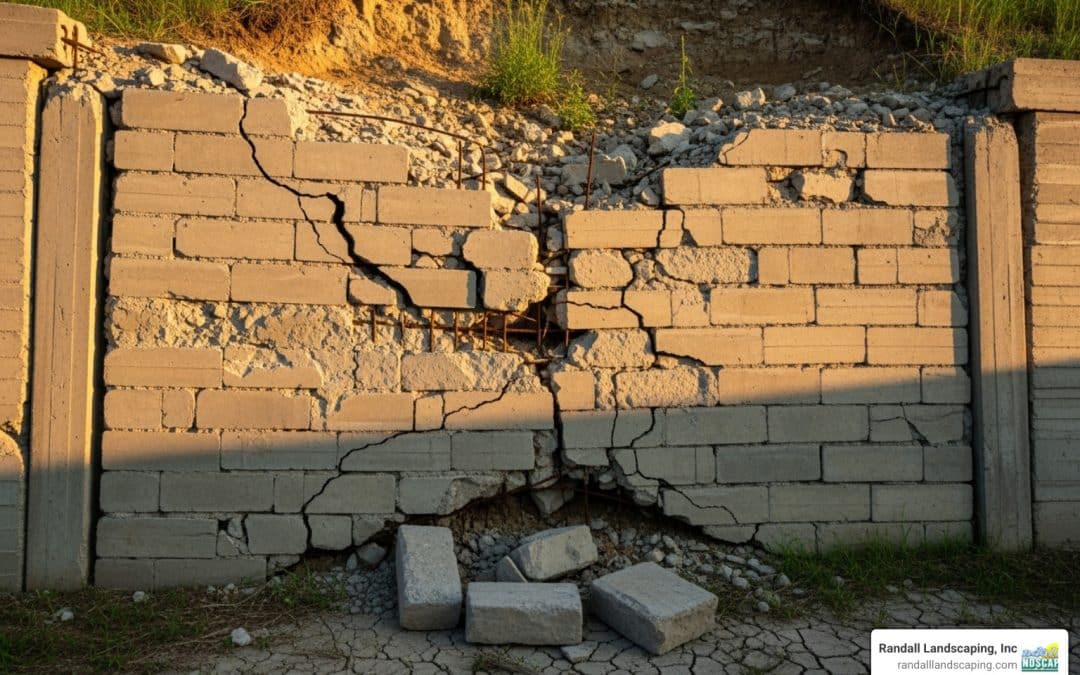
Your retaining wall holds back tons of soil, and when it fails, the signs are clear. The most obvious red flag is a wall that is leaning or tilting. Even a slight lean indicates the wall is losing its battle against soil pressure.
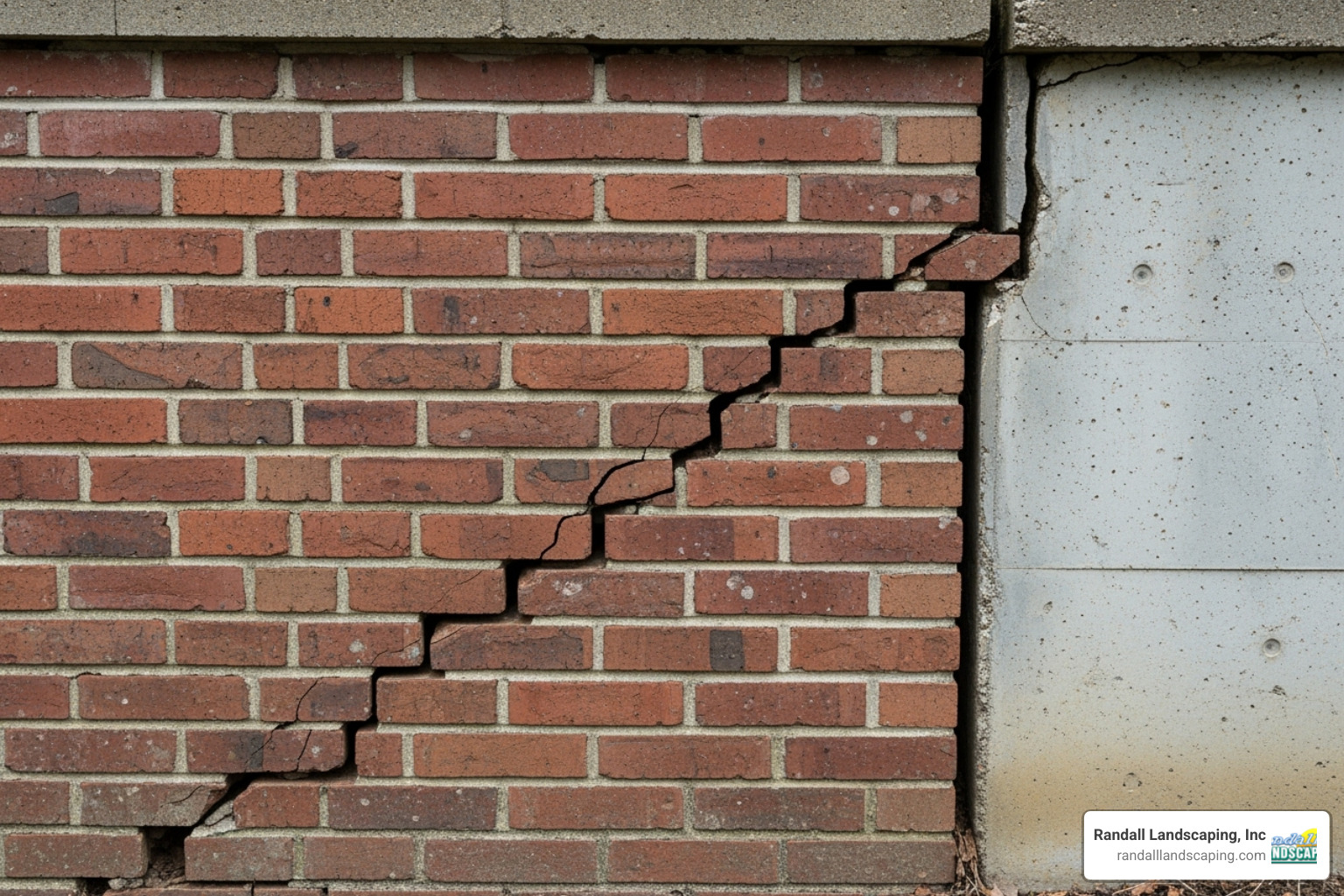
Bowing or bulging is another telltale sign, where the wall develops a curve as the soil pushes it outward. Cracks also tell a story: horizontal cracks signal serious stress, while stair-step cracks in block or stone walls show the wall is shifting and settling unevenly. Also, watch for separation from adjacent walls or structures, as these gaps indicate real-time movement.
Poor drainage is often the root cause. Water pooling at the wall’s base or soggy soil behind it means the drainage system has failed. “Water accumulation at the base of a wall may indicate poor drainage, increasing soil pressure,” and this extra weight puts tremendous stress on the structure.
Common causes behind these signs include:
- Problematic soils (like expansive clay)
- Poor original construction or improper backfill
- Shallow or weak footings
- Wood rot in timber walls
- Failed drainage systems
- Missing reinforcement (rebar or geogrid)
Don’t wait if you see these signs. Early intervention with helical anchors retaining wall repair can prevent more expensive problems. For more on quality construction, see our guide on hardscape retaining walls.
Understanding Helical Tiebacks: The Science of Wall Stabilization
Helical anchors retaining wall repair is an engineered solution that addresses the root cause of wall failure: unstable soil. Think of a helical tieback as a giant steel screw that bores deep into the ground until it reaches solid, stable soil layers.
The genius is in its load transfer mechanism. A helical anchor is a bearing device, not a friction device. The spiral plates (helices) transfer the immense pressure from the failing wall to the stable soil deep underground. This deep soil anchoring provides support that is unaffected by surface water or freeze-thaw cycles. The anchor connects to your wall, pulling it back toward alignment and preventing future movement, offering a permanent solution without the massive excavation of traditional methods.
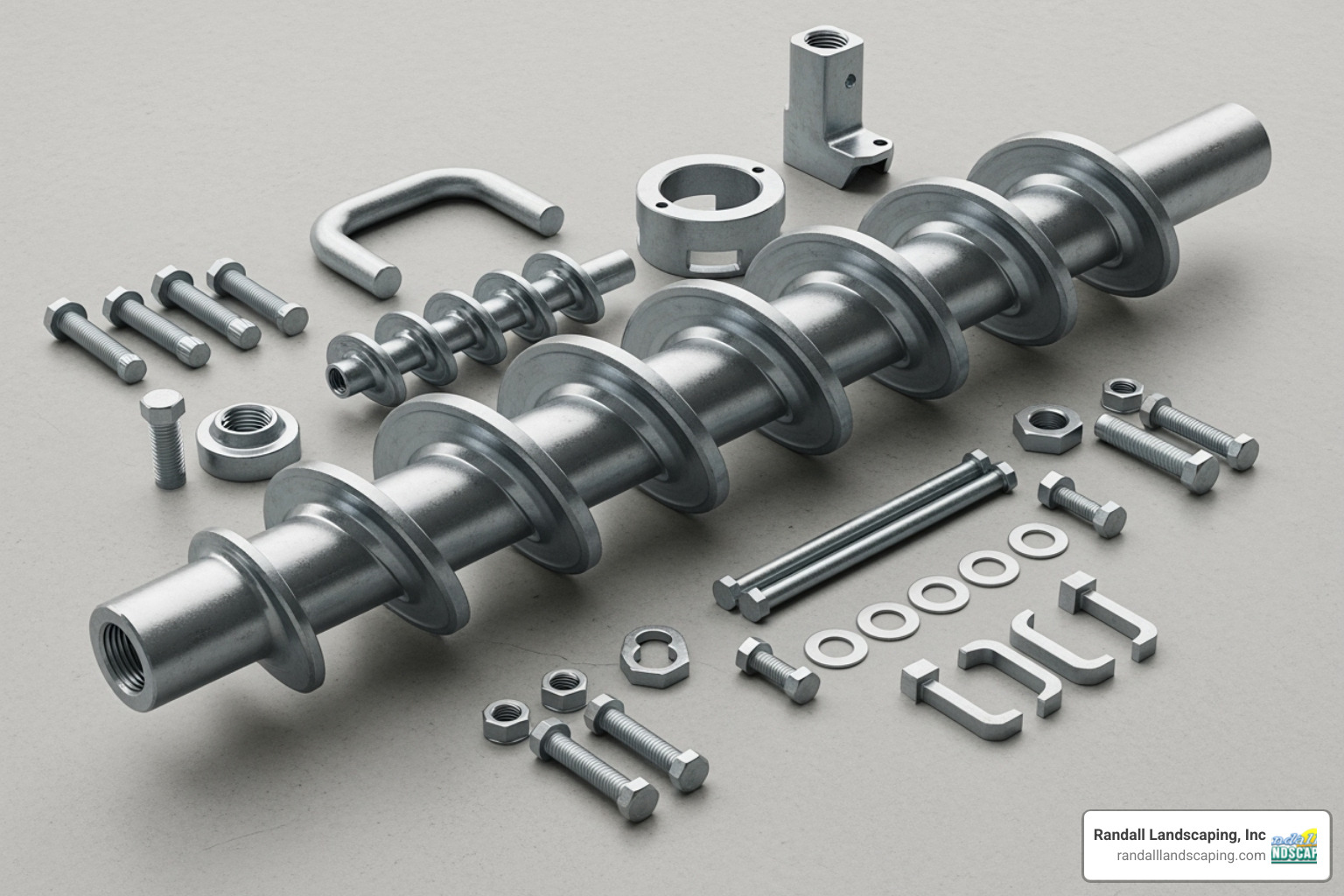
Key Components of a Helical Anchor System
A helical anchor system has five key parts:
- Helical Plates (Helices): Spiral plates (8″ to 14″ diameter) that screw into the soil and provide bearing capacity.
- Galvanized Steel Shaft: The high-strength steel backbone (1.5″ or 1.75″ square) that resists twisting and pulling forces.
- Wall Bracket: A heavy-duty steel plate that distributes the anchor’s force across the wall.
- Threaded Rod & Secure Nut: These connect the anchor to the bracket and are tightened to apply tension, pulling the wall back into place.
For more on our durable hardscaping, see More info about our quality retaining walls.
The Primary Benefits of Using Helical Tiebacks
- Minimal Excavation: Preserves your lawn and landscaping.
- Immediate Load-Bearing: The wall is stabilized as soon as the anchors are installed. No waiting for concrete to cure.
- All-Weather Installation: Work can proceed in most weather conditions, keeping your project on schedule.
- Measurable Capacity: We monitor installation torque to verify the load capacity of each anchor.
- Low Vibration: The screwing action is quiet and won’t disturb your property or neighbors.
- Limited Access Areas: Portable equipment allows installation in tight spaces.
These benefits make helical anchors a faster, less disruptive, and more reliable solution. Learn more about our work at More info about our residential retaining walls.
The Installation Process: A Step-by-Step Guide to Helical Anchors Retaining Wall Repair
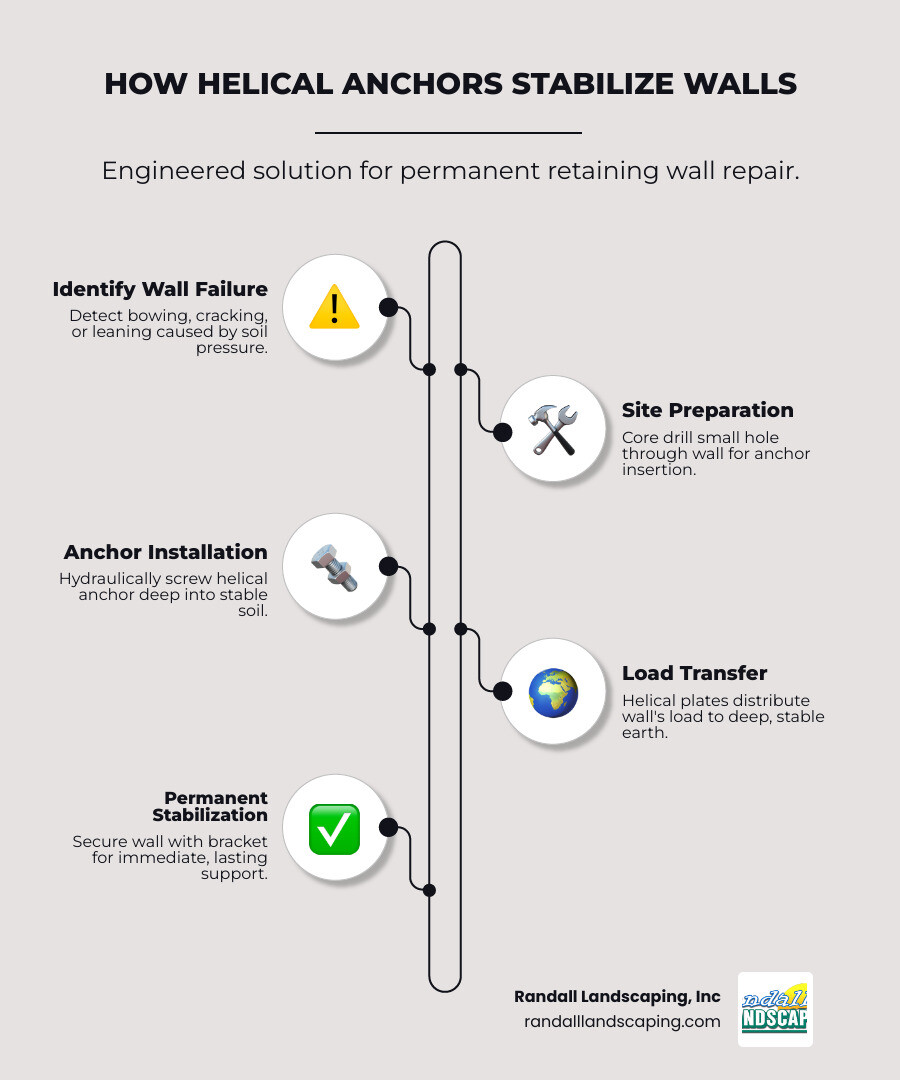
The helical anchors retaining wall repair process is a precise, engineered procedure to guarantee a lasting fix.
It starts with a site assessment, where our team and a qualified engineer examine the wall failure, soil conditions, and potential obstacles like utility lines. This leads to a custom repair plan specifying the number, location, and depth of the anchors.
The installation begins with core drilling small (3-inch) holes through the wall for the anchor shafts. Next is the hydraulic installation, where we use specialized rotary equipment to screw the helical anchors deep into the ground behind the wall at a downward angle, reaching stable soil. Throughout this phase, we perform continuous torque monitoring. The resistance (torque) measured as the anchor is driven directly correlates to its load-bearing capacity. We drive each anchor until it reaches the target torque specified by the engineer.
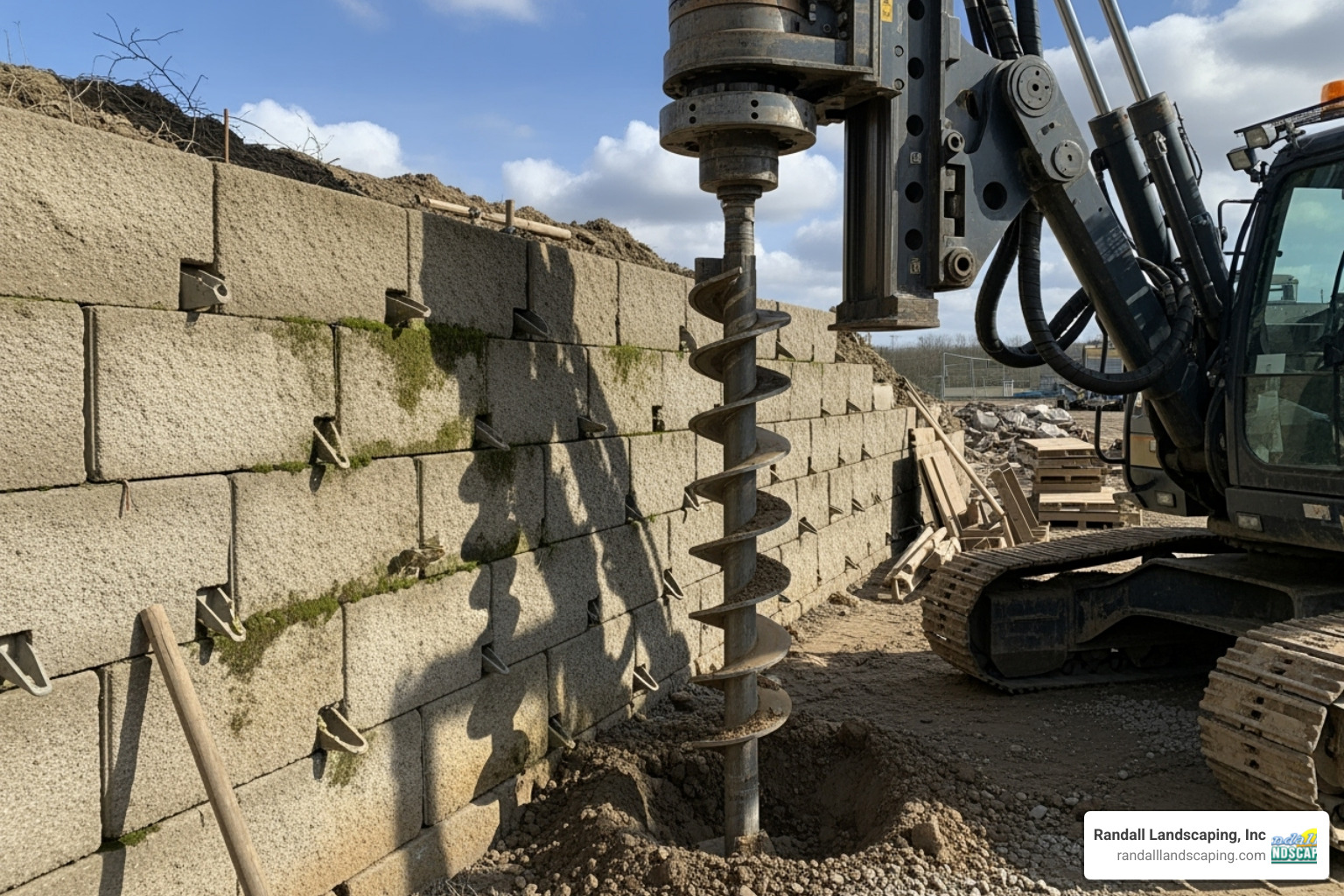
Finally, we attach the anchors to the wall with heavy-duty brackets and tension the system, which can pull a bowing wall back toward its original position and provide permanent support.
How Anchor Capacity is Verified
We verify each anchor’s strength during installation using the torque-to-capacity relationship. The torque reading, combined with a soil-specific conversion factor (the K-value), tells us the anchor’s ultimate load capacity. This is a core engineering principle that ensures every anchor meets or exceeds the design requirements for your wall, with a factor of safety built-in. For more on our standards, visit More info about retaining wall construction contractors.
Why Professional Helical Anchors Retaining Wall Repair is Crucial
This is not a DIY project. It requires specialized equipment like hydraulic drills and torque monitors. More importantly, it demands deep structural engineering knowledge to design a repair that will actually work. An expert must calculate soil pressures and determine the correct anchor type, size, and spacing.
Ensuring proper depth and torque is critical; too shallow and the anchor fails, too much torque and the anchor can be damaged. Professionals are also trained in safety protocols for working with heavy machinery around a compromised structure. When you hire a reputable contractor, you get building code-approved systems and warranties. We always recommend you Verify your contractor with the Better Business Bureau to ensure they have the proper credentials. Your property’s safety and value are too important to risk on anything less than expert installation.
Helical Anchors vs. Traditional Repairs: A Comparative Look
When your retaining wall is failing, you have options. Helical anchors retaining wall repair stands out from traditional methods by offering a permanent fix with minimal disruption.
| Feature/Method | Helical Anchors | Plate Anchors | Full Wall Replacement |
|---|---|---|---|
| Effectiveness | High. Provides deep, stable support with measurable capacity. Permanent solution. | Moderate to High. Effective for bowing/cracked walls, but depends on soil. | High. A brand-new, engineered structure. |
| Landscape Disturbance | Minimal. Installed with small equipment, often from inside, little to no excavation. | Moderate. Requires excavation ~10 ft away from the wall to bury the anchor plate. | Extensive. Complete demolition and removal of old wall, significant excavation. |
| Installation Time | Fast. Most single walls repaired in < 3 days. Immediate load transfer. | Moderate. Installation faster than replacement, but still involves excavation. | Slow. Days to weeks for demolition, new construction, and curing. |
| Cost (per anchor/ft) | Medium-High (see disclaimer below). | Low-Medium (generally more economical than helical). | Very High. Most expensive option due to labor, materials, and disposal. |
| Access | Excellent for limited access areas. Portable equipment. | Can be challenging in areas with obstructions (e.g., trees, utilities, neighbors). | Can be challenging if site access is restricted for large machinery. |
| Soil Suitability | Versatile. Effective in a wide range of soil types, including dense soils. | Best in stable, compact soils. Less effective in very loose or rocky soils. | Requires proper soil compaction for new wall foundation. |
| Reusability | Can be removed and reused on future projects (for temporary applications). | Generally not reusable. | Not applicable. |
| Vibration | Little to no vibration. | Minimal. | Can involve significant vibration during demolition and new construction. |
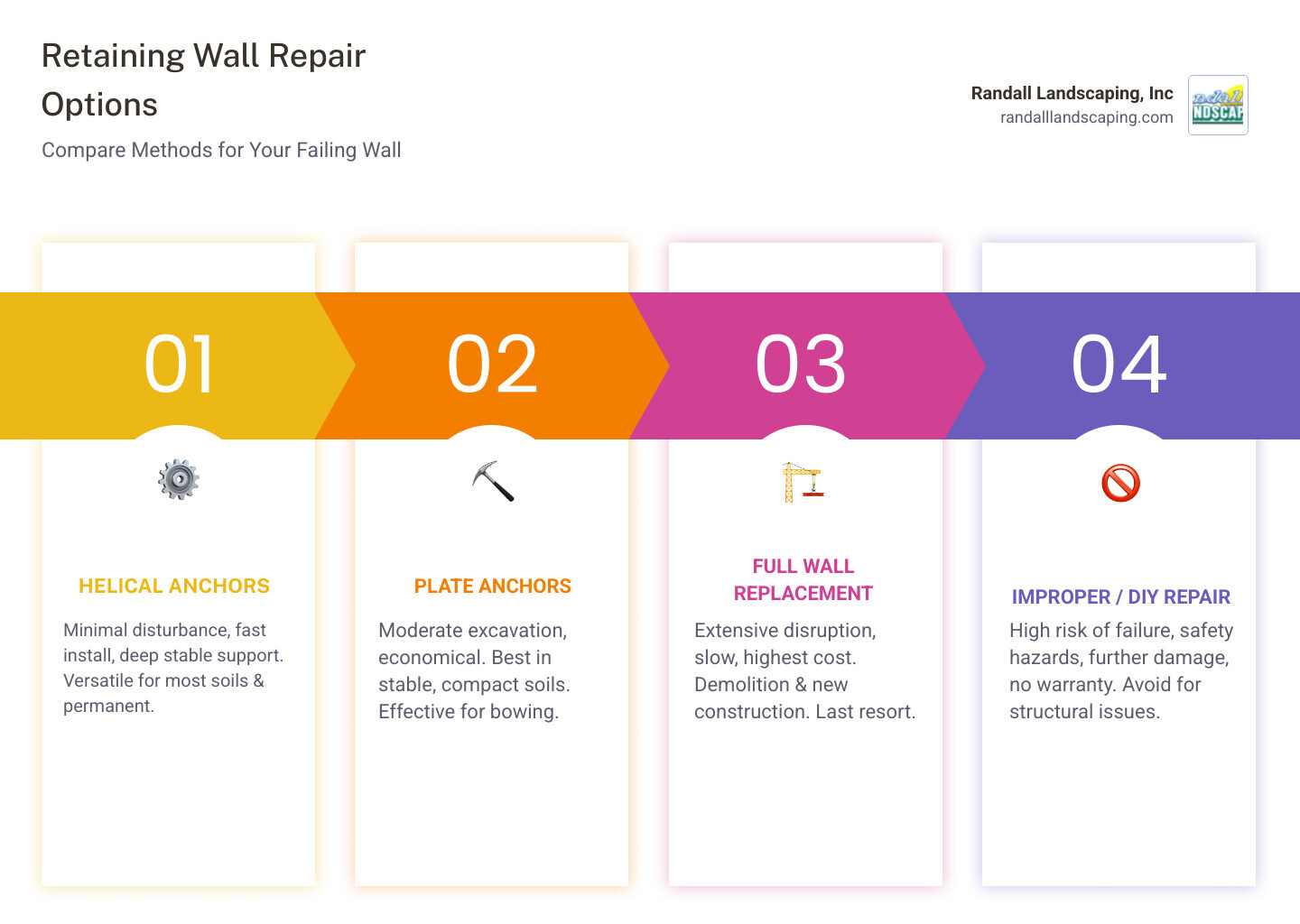
The table shows that helical anchors deliver effectiveness with minimal disruption.
The Difference Between Helical Tiebacks and Other Anchors
- Helical Tiebacks: Hydraulically screwed deep into stable soil. Strength is verified by torque, and there is minimal excavation.
- Plate Anchors: A steel plate is buried 10-15 feet from the wall and connected with a rod. Effective, but requires significant excavation.
- Deadman Anchors: An old-school method of burying heavy concrete blocks behind the wall. Labor-intensive and requires substantial digging.
- Grouted Anchors: Steel tendons are grouted into drilled holes. Strong, but messy and requires time for the grout to cure. Helical tiebacks produce “no spoils or messy grout,” making them cleaner and faster.
For more on wall construction, see our guide on More info about our sandstone retaining wall builders.
Cost-Benefit Analysis for Helical Anchors Retaining Wall Repair
Important Cost Disclaimer: The following are industry averages from online research, not Randall Landscaping, Inc. pricing. Every project requires a custom quote.
Helical tiebacks can range from $1,800 to over $6,000 per anchor, depending on complexity, soil conditions, and access. While this is an investment, it’s often the smartest financial decision.
- Compared to full wall replacement, helical anchors are far more economical. A full replacement involves demolition, debris removal, new materials, and extensive labor, costing tens of thousands more.
- Hidden savings come from minimal landscape restoration and quick installation time.
- Long-term value is the biggest factor. A permanent fix protects your property value and eliminates the need for repeated, temporary repairs.
- Safety is priceless. A properly engineered repair prevents a catastrophic collapse.
When all factors are considered, helical anchors are often the most cost-effective choice. Our More info about our retaining wall builders hiring guide can help you find a qualified professional.
Frequently Asked Questions about Helical Anchor Repairs
It’s natural to have questions about a major repair. Here are answers to the most common concerns we hear about helical anchors retaining wall repair.
How long does the installation take?
One of the biggest advantages is speed. Most single wall projects are completed in less than 3 days. Because the anchors bear the load immediately, there’s no waiting for concrete to cure. This minimal disruption means you get your yard back quickly.
Can helical anchors straighten a severely bowed wall?
Yes, in most cases. The system isn’t just for stabilization; it can actively correct bowing. Through gradual tensioning, we can gently pull the wall back toward its original position. The amount of correction possible depends on the wall’s condition, but for walls bowed over 3 inches, helical tiebacks are an excellent solution for restoring structural integrity and appearance.
Are helical anchors a permanent solution?
Absolutely. This is a long-term fix, not a temporary patch. The anchors are made of galvanized steel to resist corrosion for decades. More importantly, they are anchored in deep, stable soil, far below the surface layers affected by moisture and frost. These are building code approved systems that, when professionally installed, provide permanent support and peace of mind.
Conclusion: Secure Your Landscape with an Expert Repair
Facing a failing retaining wall can be daunting, but you don’t have to resort to a full, disruptive replacement. Helical anchors retaining wall repair offers a permanent, engineered solution that restores stability with minimal impact on your landscape.
We’ve covered how to spot warning signs and how these galvanized steel anchors provide immediate, measurable support by anchoring deep into stable soil. This method avoids massive excavation and lengthy construction, with most repairs completed in under three days. You’re not just getting a quick fix; you’re investing in a solution that protects your property for decades.
At Randall Landscaping, Inc., we’ve provided these expert structural repairs to homeowners across the Merrimack Valley and Southern New Hampshire since 2006. Our commitment to quality work and 100% reliability ensures the job is done right. Whether you’re in Andover, Salem, or another community we serve, our team understands the local soil conditions and challenges.
A failing wall is a threat to your property’s value and safety. Waiting only makes the problem more expensive. The precision of helical anchors, combined with our professional installation, provides the security your landscape deserves.
Don’t let a failing wall become a bigger headache. Contact us for a free estimate on your retaining wall repair and let us help you protect your investment.