Why Learning How to Plant a Lawn from Sod Is Your Best Investment
How to plant a lawn from sod is one of the smartest and fastest ways to transform your yard from bare earth into a lush green oasis. While seeding a lawn is a classic approach, it can take months of patient effort to see a dense, usable turf. Sod, on the other hand, gives you the satisfaction of an instant, beautiful lawn that dramatically boosts your home’s curb appeal in just a few weeks.
Quick Answer – How to Plant a Lawn from Sod:
- Prepare the soil – This foundational step involves clearing all old grass, weeds, rocks, and debris. Then, you’ll need to till or turn the soil to a depth of 4-6 inches to aerate it, followed by grading the area away from your home’s foundation to ensure proper drainage.
- Test and amend soil – A simple soil test kit will reveal your soil’s pH. Most turfgrasses thrive in slightly acidic to neutral soil (6.0-7.5 pH). You can add lime to raise the pH or sulfur to lower it, and mixing in several inches of compost or other organic matter will improve soil structure and fertility.
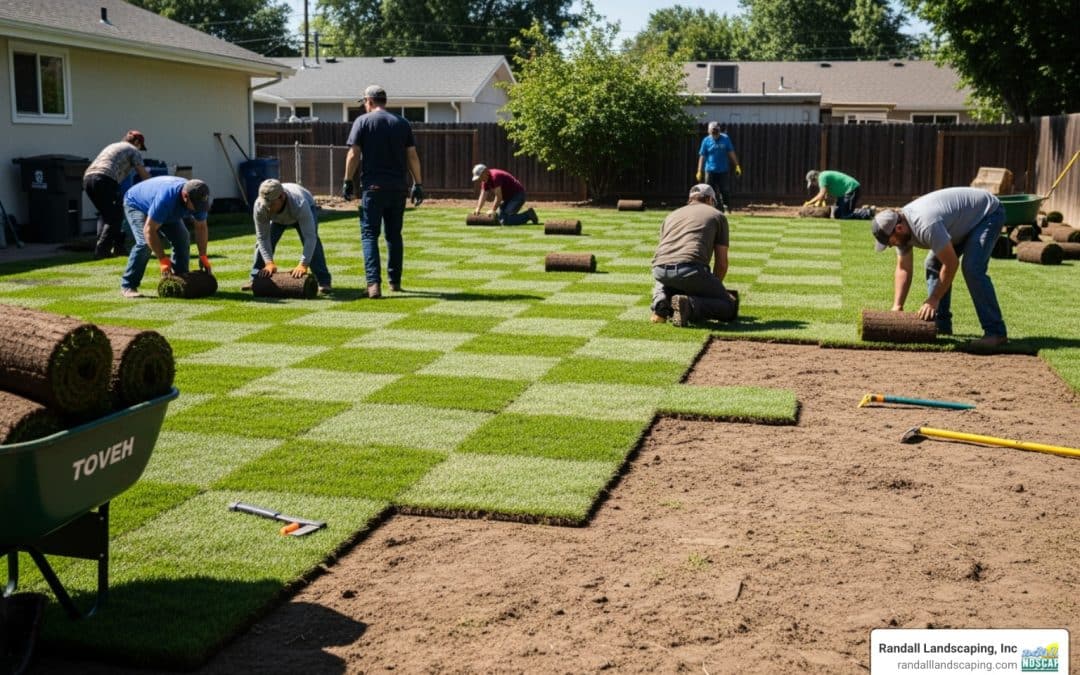
- Lay sod pieces – Start laying sod along a straight, long edge like a driveway or sidewalk. Stagger the seams in a brick-like pattern to avoid aligning them. A tight fit between pieces is crucial to prevent the edges from drying out. Use a utility knife to cut pieces to fit around curves, sprinkler heads, or other obstacles.
- Water immediately – The goal is to saturate the sod and the top inch or two of soil underneath. This initial soaking is the most critical watering your new lawn will receive, as it kickstarts the rooting process and eliminates air pockets.
- Roll and firm – A lawn roller, which you can typically rent, presses the sod firmly against the soil. This crucial step ensures good root-to-soil contact, which is essential for the sod to take root and thrive.
- Maintain consistently – For the first 2-6 weeks, your new sod needs consistent moisture. This means light, frequent watering (often twice a day) to keep the top layer of soil consistently moist but not waterlogged. The goal is to encourage deep, healthy root growth.
The process might seem straightforward, but proper technique makes the difference between a thriving lawn and expensive dead patches. Research shows that sod can take 2 to 6 weeks to establish roots, and installation mistakes during this critical period can cost you hundreds in replacement costs.
Why choose sod over seed? Sod provides instant erosion control on slopes, chokes out most new weeds, and gives you a finished, usable lawn almost immediately. While it costs more upfront – typically $0.31 to $0.82 per square foot for DIY installation – you skip the months of careful watering, reseeding, and protection that new seed requires.
I’m Tommy Randall, owner of Randall Landscaping Business, and I’ve been helping Massachusetts and New Hampshire homeowners master how to plant a lawn from sod since 2006. With nearly two decades of hands-on experience in new lawn installations and hydroseeding across the Merrimack Valley, I’ve seen every mistake (and success) possible in sod installation.

Sod vs. Seed: Which Is Right for Your New Lawn?
Picture this: you’re standing in your yard, dreaming of that perfect green lawn. The big question hits you – should you go with sod or seed? I get this question all the time from homeowners in areas like Andover and Windham, and honestly, both have their place depending on your budget, timeline, and patience.
Sod is basically a mature lawn that someone else grew for you. Think of it as instant gratification in grass form – it’s pre-grown turf that’s been carefully cultivated on a farm for 10 to 24 months, then harvested in strips and rolled up like carpet. When you lay it down, you get an instant green oasis that looks like it’s been there for years.
Grass seed, on the other hand, is exactly what it sounds like – individual seeds you scatter over prepared soil. It’s nature’s way of creating a lawn from scratch, but it requires a significant investment of time and consistent care while those little seeds sprout, grow, and eventually form a dense turf.
The biggest difference? Time and instant impact. Sod gives you that “wow” factor immediately, while seeding is more like watching paint dry – rewarding in the end, but you’ll be waiting months to see the full results.
Here’s how they stack up against each other:
| Feature | Sod | Seed |
|---|---|---|
| Establishment Time | Instant lawn, 2-6 weeks to root | 2-4 months for full establishment |
| Initial Cost | $0.31-$0.82 per sq ft (DIY) | $0.06-$0.20 per sq ft |
| Labor Intensity | High – heavy lifting and precise installation | Moderate – spreading and watering |
| Erosion Control | Immediate soil stabilization | Vulnerable until grass establishes |
| Weed Prevention | Fewer weeds initially | More weed competition during growth |
| Grass Variety | Limited to what’s available locally | Wide selection of grass types |
Note: These are average costs based on internet data and not actual costs for Randall Landscaping.
Beyond the numbers, think about your lifestyle. Do you have children or pets eager to play in the yard? A seeded lawn will be off-limits for months to allow delicate seedlings to grow without being trampled. With sod, you can typically allow light foot traffic in just a couple of weeks. Also, consider your local environment. Here in the Merrimack Valley and Southern New Hampshire, sod farms primarily cultivate cool-season grasses like Kentucky Bluegrass and Tall Fescue blends, which are proven to thrive in our specific climate. While seed offers a wider theoretical selection, choosing a locally grown sod ensures you’re getting a turf variety that is already adapted to our regional weather patterns, soil types, and potential diseases.
The cost difference is pretty significant upfront. Seed might seem like the budget-friendly choice, but remember – you’ll need multiple rounds of watering, potential reseeding, and months of careful maintenance. Sometimes that “cheaper” option ends up costing more in time and frustration.
If you’re dealing with slopes or erosion-prone areas, sod is your friend. It holds soil in place immediately, while seeded areas can wash away with the first heavy rain. For busy homeowners who want results now, sod is often worth the extra investment.
For those curious about other options, hydroseeding offers a middle ground between traditional seeding and sod installation.
Advantages and Disadvantages of Sod
Let’s be honest about sod – it’s not perfect, but it sure comes close for many situations.
The good news first: Sod gives you instant results that’ll make your neighbors jealous. It’s a dramatic change that happens in a single day, taking your property from a construction zone to a finished landscape. This immediate aesthetic boost is a major psychological win for homeowners. You also get immediate soil stabilization, which is huge if you’re dealing with slopes or areas prone to erosion. Plus, you’ll face fewer weeds initially since the dense, mature grass can outcompete most weed seeds trying to establish.
There’s also real economic value here. Studies show that a well-maintained lawn can add significant value to your property – we’re talking thousands in economic value for a quality lawn installation.
Now for the reality check: Sod comes with a higher initial cost that can make your wallet wince. It’s also incredibly labor-intensive – each roll of sod can weigh between 30 and 45 pounds, and you’ll be lifting, carrying, and placing hundreds of them for an average-sized lawn. It’s a full-body workout that requires careful bending and precise placement to avoid injury and ensure a professional-looking result. You’ll also have limited grass type selection compared to seed, since you’re stuck with whatever varieties your local sod farm grows. Finally, the installation window is tight – you’ve got about 24 hours from delivery to get that sod in the ground, or it starts deteriorating. No weekend procrastination allowed.
Cost Comparison: Sodding vs. Seeding
Let’s talk numbers, because that’s usually what it comes down to for most homeowners.
Sod typically runs $0.31 to $0.82 per square foot for DIY installation, though premium varieties can push that range to $1.50 per square foot or higher. For a typical 1,000 square foot lawn, you’re looking at $310 to $1,500 in materials alone. Beyond the sod itself, you might need to rent equipment like a sod cutter to remove an old lawn or a lawn roller to ensure good soil contact, which can add to the total project cost.
Seed is much gentler on the budget at $0.06 to $0.20 per square foot for materials. That same 1,000 square foot lawn might only cost $60 to $200 in seed. Sounds great, right? But that’s just for the seed itself. You also need to factor in the cost of starter fertilizer, topsoil or compost to amend the soil, and potentially a layer of straw or mulch to protect the seeds from birds and prevent them from washing away. Your water bill will also be significantly higher for a longer period as you nurse the seedlings along.
But here’s where it gets tricky. Installation labor costs can flip this equation. Professional sod installation typically runs $0.50 to $2.00 per square foot, while seeding might cost $0.10 to $0.50 per square foot for professional application.
These are average estimates based on internet research and don’t reflect actual Randall Landscaping pricing.
Long-term expenses tell a different story too. Seeded lawns often require one or more rounds of overseeding to fill in thin or bare patches that didn’t germinate properly. They are also more susceptible to weed invasion during the long establishment period, which may require additional herbicide applications. A failed seeding attempt due to a sudden storm, heatwave, or improper watering means you’re back to square one, having lost both time and money. While sod has a higher upfront cost, its reliability and faster establishment can often make it the more cost-effective choice in the long run when you consider all the variables.
When you’re ready to explore professional installation, our new lawn installation services can help you weigh all these factors for your specific situation.