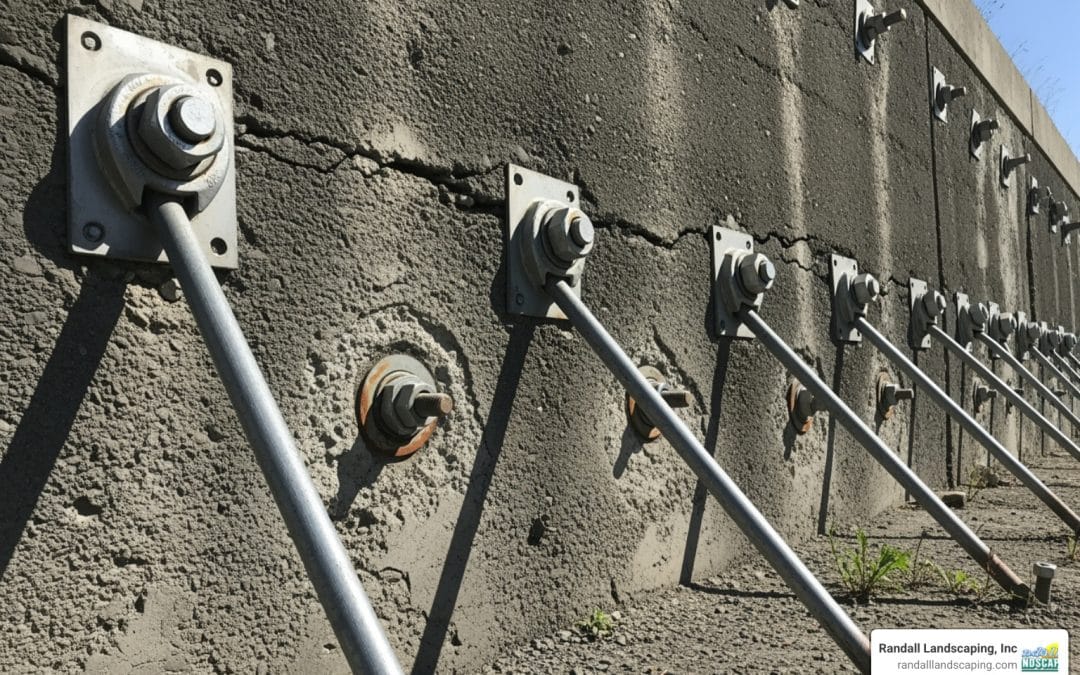
Why Retaining Wall Stability Matters
Retaining wall anchors are specialized systems designed to stabilize and reinforce walls that are bowing, leaning, or failing due to soil pressure. These systems work by transferring lateral forces from the wall to stable soil behind it, preventing collapse and restoring structural integrity.
Quick Answer – Types of Retaining Wall Anchors:
- Helical Tieback Anchors – Screw-like design, capacities up to 200,000 lbs, installed with hydraulic equipment
- Plate Anchors (Deadman) – Large steel plates connected by threaded rods, ideal for severe bowing
- Grouted Anchors/Soil Nails – Shorter anchors grouted into soil, best for surface stability
- Ground Anchors – Horizontal installation for deep reinforcement behind retaining walls
When foundation walls begin to bow, tilt, or crack, it’s a clear warning sign that your home’s structural stability is at risk. Pressure from saturated soil can exceed a wall’s capacity, leading to costly damage or collapse. Retaining wall anchors transform this destructive force into stabilizing tension, creating a lifeline between your failing wall and solid ground.
As Tommy Randall, owner of Randall Landscaping Business, I’ve seen how proper anchor systems can save homeowners thousands in structural repairs over my 18 years in the industry. Our team has successfully installed retaining wall anchors throughout Massachusetts and New Hampshire, helping protect properties from the unique soil challenges our region presents.
What is the Primary Purpose of Retaining Wall Anchors?
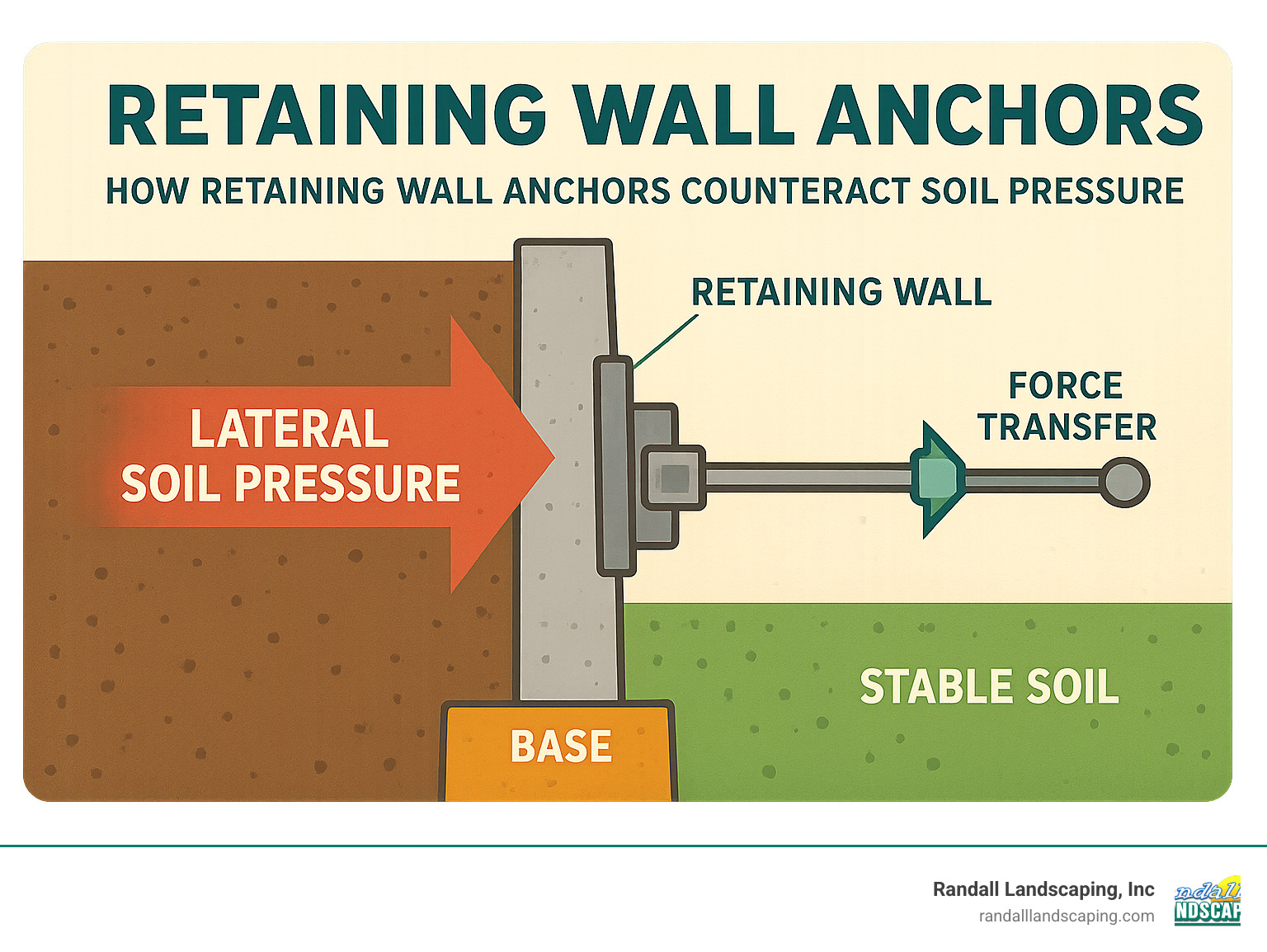
The primary purpose of retaining wall anchors is to stabilize and reinforce existing walls under stress from soil and water pressure. They ensure walls can withstand environmental challenges, preventing soil erosion, potential landslides, and costly failures. By connecting the wall to solid ground, they directly counteract the sideways push of shifting soil, which stops dangerous bowing or leaning and provides a crucial layer of safety and peace of mind.
How Do Anchors Stabilize a Wall?
Retaining wall anchors work by converting lateral pressure from shifting soil into a stabilizing tension. Imagine a tug-of-war: the soil is pulling one way, and the anchor system pulls the other, creating a balance that keeps your wall firmly in place. This is achieved by extending a rod or cable from the wall deep into stable soil or rock. The anchor component, often a plate or a helical screw, is embedded in this stable ground to provide resistance.
When soil pushes against the wall, the force is transferred through the rod to the anchor. This creates a powerful tension force that pulls back, resisting movement and boosting the wall’s stability. For more information on building walls that stand the test of time, check out our insights on quality retaining walls. For an independent overview of how these systems work, see Ground anchor.
Understanding the Different Types of Retaining Wall Anchors
When reinforcing a retaining wall, there isn’t a one-size-fits-all solution. Different types of retaining wall anchors address specific challenges related to soil conditions, wall materials, and the level of distress. Understanding these earth retention systems is key to selecting the right approach. Geotechnical experts assess the required load capacity and how each anchor type will interact with your wall material, whether it’s concrete, timber, or stone.
Helical Tieback Anchors
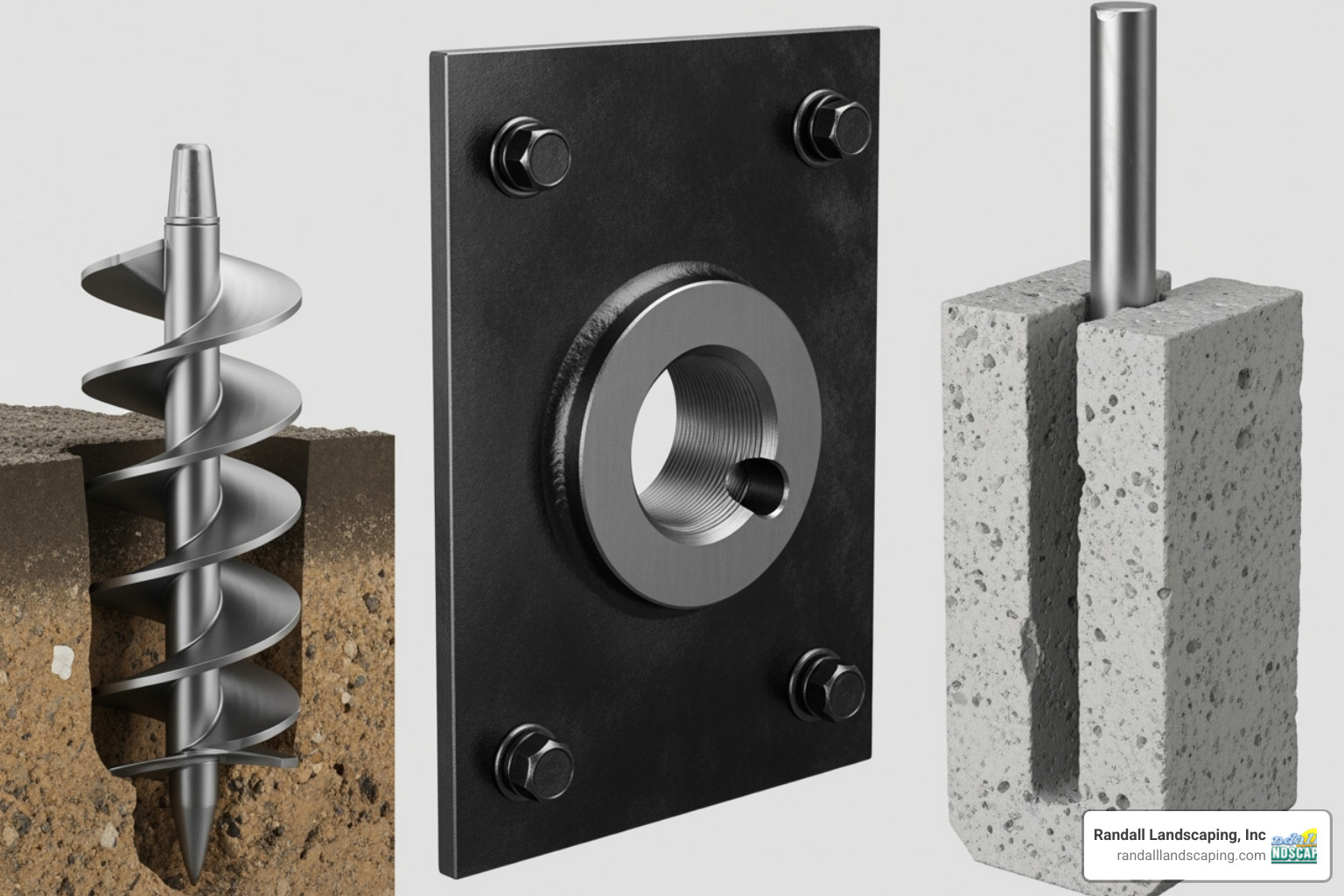
Helical tieback anchors are like giant screws drilled deep into the earth. Their screw-like design allows for efficient installation with minimal soil disturbance using hydraulic rotary drilling equipment, resulting in less mess and a quicker process. A key advantage is their high load capacity, sometimes up to 200,000 lbs. per anchor. Their holding power is correlated to installation torque, allowing for immediate tensioning and load testing without waiting for grout to cure.
The helical blade diameter is chosen based on soil type. In softer clay, a larger 5-inch blade maximizes load capacity. In denser, sandy soils, a smaller 3-1/4 inch blade is often sufficient. If you’re planning a new retaining wall project, our team can help with all aspects of landscape wall construction.
Plate Anchors (Deadman Anchors)
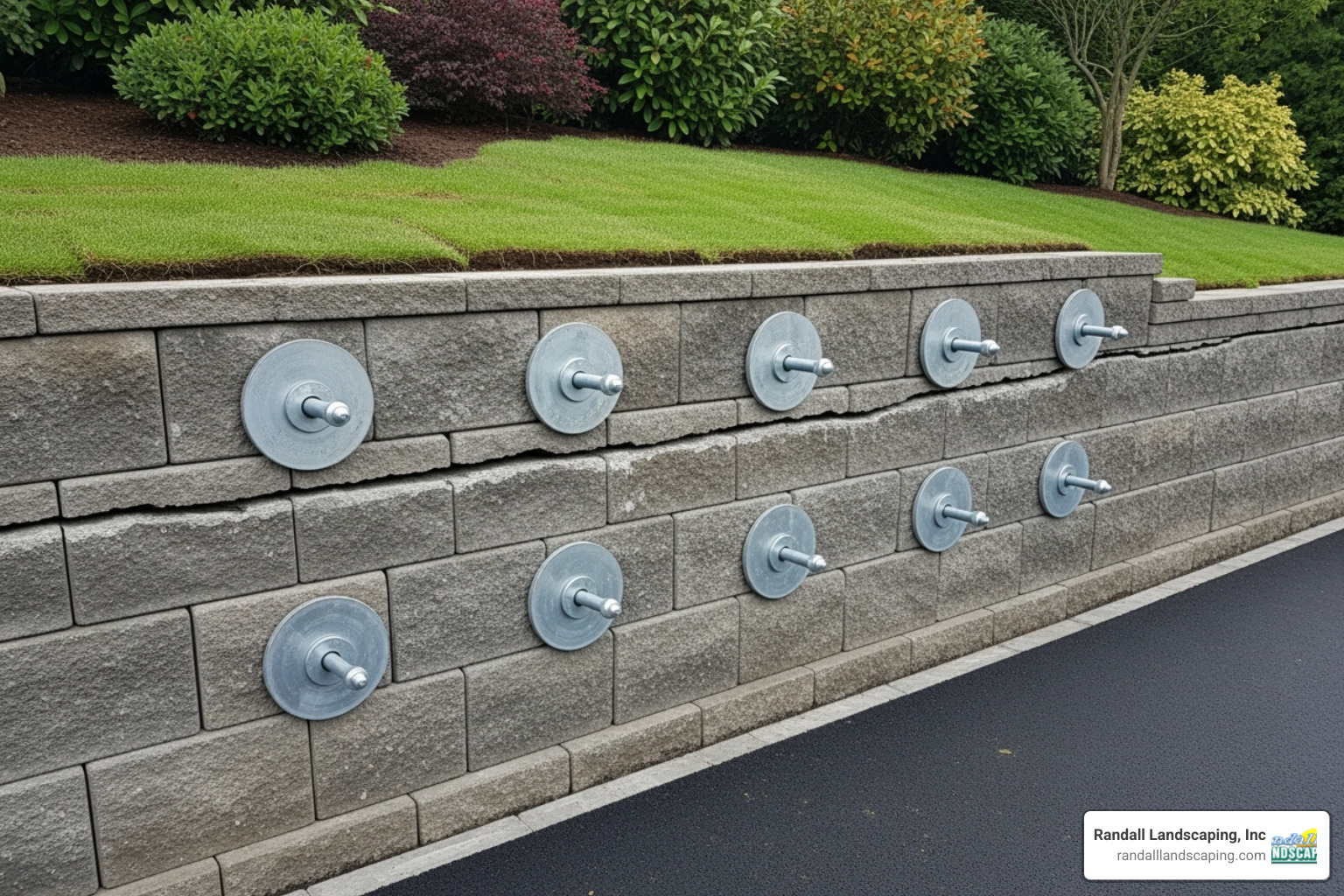
Plate anchors, or “deadman anchors,” are a robust solution for distressed retaining walls. This system uses a large steel plate buried in stable soil some distance from the wall. This “deadman” anchor provides resistance and is connected to an interior steel wall plate via a strong threaded rod. When the wall leans, the rod pulls against the buried anchor, counteracting the pressure.
Plate anchors are effective for walls with severe bowing. A key benefit of these systems is the ability for periodic retightening of the threaded rod. This gradual tightening can help recover the wall’s inward movement, potentially improving its alignment over time. While installation requires excavation, the long-term stability they provide makes them a valuable choice.
Grouted Anchors & Soil Nails
Grouted anchors and soil nails are methods used to stabilize walls and slopes, often for surface stability or temporary shoring.
Soil nails are shorter anchors inserted into the ground. Steel bars are placed in drilled holes and secured with grout. Once cured, the soil nail integrates with the soil mass, enhancing its stability. They are often used for temporary shoring or to stabilize unstable ground permanently.
Grouted anchors are a broader category where a steel tendon is drilled into the ground and grouted in place. Unlike soil nails that reinforce the soil mass, grouted anchors can connect directly to a structure like a retaining wall to provide pull-back resistance. They can be engineered for both temporary and permanent applications with advanced corrosion protection.
[TABLE] Comparing Anchor Types
Choosing the right retaining wall anchor system is a critical decision that depends on a variety of factors, from soil conditions to the specific needs of your wall. Here’s a quick comparison to help illustrate the differences:
| Anchor Type | Installation Method | Best Use Case | Soil Type Suitability | Cost-Effectiveness |
|---|---|---|---|---|
| Helical Tieback | Drilled with hydraulic rotary equipment, minimal excavation | High-capacity stabilization, immediate load testing | Versatile, but blade size optimized for clay vs. sandy soil | Efficient, less labor/spoil cleanup, reusable |
| Plate (Deadman) | Exterior plate buried via excavation, rod through wall | Severe bowing/leaning, periodic wall straightening | Wide range, requires stable soil for anchor plate | Moderate, excavation adds to cost, long-term stability |
| Grouted / Soil Nail | Drilled, steel bar inserted, then grouted | Slope stabilization, surface reinforcement, temporary shoring | Wide range, effectiveness depends on grout bond with soil | Variable, can be cost-effective for smaller repairs |
Key Considerations for Installation and Repair
When it comes to installing retaining wall anchors, proper planning makes all the difference between a job well done and a costly mistake. A thorough geotechnical analysis helps us understand the soil composition, water table levels, and any hidden challenges lurking beneath the surface. Professional consultation is essential for ensuring your investment delivers lasting results.
Safety protocols guide every step of our process. Working with heavy equipment, drilling into unknown soil conditions, and handling high-tension systems requires expertise and caution. It’s not the kind of project where “close enough” is acceptable.
Signs Your Retaining Wall Needs Anchors
Retaining walls show clear signs when they are under stress and need support. Be aware of these common warning signals:
- Leaning or tilting: A wall that is no longer vertical is a clear sign of failure and should be addressed immediately.
- Bowing or bulging: A visible curve in the middle of the wall indicates it is struggling to handle the pressure behind it.
- Cracks: Horizontal cracks signal serious lateral pressure, while stair-step cracks in masonry often point to settlement issues.
- Gaps between the wall and soil: This indicates the wall is shifting away from the earth it is meant to retain.
- Water accumulation: Water pooling at the base suggests poor drainage, which dramatically increases soil pressure.
If you spot any of these signs, early intervention with retaining wall anchors can prevent a small repair from becoming a full reconstruction. Learn more in our guide on repairing retaining walls.
Key Factors in Selecting Retaining Wall Anchors
Choosing the right retaining wall anchors requires balancing engineering, site conditions, and budget.
- Soil type is the most critical factor. Clay soil, common in our service area, expands and shrinks with moisture, creating constant pressure. Larger helical blades (e.g., 5 inches) are often needed. Sandy or granular soils provide better friction, where smaller blades (e.g., 3-1/4 inches) may suffice. Field tests show that an anchor holding 1,244 pounds in clay might hold 4,000 pounds in sand, but increasing the blade size in clay can boost its capacity to 5,500 pounds.
- Wall height is also a major factor, as taller walls experience exponentially more pressure.
- Surcharge loads, such as a driveway or patio on the soil behind the wall, add significant weight that the anchor system must support.
- Budget is a consideration, but effectiveness and long-term stability should be prioritized over initial cost.
The Typical Installation Process for Retaining Wall Anchors
Installing retaining wall anchors is a precise process that requires specialized equipment and is not a DIY project. The typical steps include:
- Site Preparation: This involves detailed assessments, geotechnical analysis, and locating underground utilities to ensure proper anchor placement.
- Drilling or Excavation: For helical anchors, hydraulic equipment screws the anchor into stable soil with minimal disruption. Plate anchors require more excavation to bury the anchor plates at a calculated distance from the wall.
- Anchor Placement: Each anchor is carefully embedded at the correct depth, angle, and position to provide the necessary resistance. For helical anchors, installation torque is monitored to confirm capacity.
- Connection: High-strength steel rods are passed through the retaining wall to link it to the buried anchor. Wall plates are installed, and the system is tensioned according to engineering specifications.
- Final Adjustments: The system is calibrated, and excavated areas are restored.
This methodical approach ensures your retaining wall anchors provide maximum support for decades. For more about our services, visit our page on retaining wall construction contractors.
Costs, Maintenance, and Safety
Investing in retaining wall anchors is an investment in your property’s future. While there is an upfront cost, it is a fraction of what you would spend rebuilding a collapsed wall and repairing the resulting damage.
What are the Typical Costs?
The cost of retaining wall anchors varies widely based on project complexity. Based on internet data and industry averages, costs can range from $1,000 to over $5,000+ per anchor. Please note these are general estimates and not direct quotes for our services at Randall Landscaping.
The final price is influenced by several factors beyond the material costs:
- Installation labor by specialized crews makes up a significant portion of the investment.
- Equipment fees for heavy hydraulic drilling machinery are substantial.
- Geotechnical report costs may be necessary for complex projects to ensure a proper design.
- Permit fees may be required by local building codes.
While the upfront investment can seem significant, it is minor compared to the cost of a complete wall failure.
Maintenance and Inspection Requirements
Properly installed retaining wall anchors are low-maintenance, but annual inspections are recommended to ensure they continue to perform at their best. During a check-up, we look for:
- Wall movement: Even small changes in bowing, leaning, or new cracks can signal an issue.
- Corrosion: Exposed metal components are checked for rust, though most quality anchors are galvanized to resist it.
- Proper drainage: Weep holes and drainage pipes must be kept clear to prevent water buildup and excess pressure.
- Component tightening: For plate anchor systems, periodic retightening can help straighten a wall over time.
Safety and When to Call a Professional
Installing retaining wall anchors is not a DIY project. The risk of a catastrophic wall collapse during a repair attempt is real and dangerous. A failing wall is inherently unstable, and one wrong move can have severe consequences.
Professional installation is essential due to:
- Specialized equipment: Hydraulic drills and tensioning tools require trained operators.
- Engineering knowledge: Determining the correct anchor type, size, and placement requires understanding soil mechanics and structural loads.
- Building codes: Most structural repairs must comply with local regulations and may require permits.
We follow strict safety protocols on every job. Your safety and property’s stability are worth the investment in professional expertise. It is always recommended to hire a professional for assessment and installation. Learn more about our residential retaining walls services.
Frequently Asked Questions about Retaining Wall Anchors
When homeowners first learn about retaining wall anchors, they naturally have questions. Here are answers to the most common ones we encounter.
What is the difference between a tieback and an anchor?
People often use these terms interchangeably, but they refer to two distinct parts of the system. The tieback is the horizontal element (like a steel rod or cable) that connects the wall to a stable point. It transfers the lateral pressure. The anchor is the component at the end of the tieback, embedded deep in stable soil or rock, that provides the resistance. Together, they form a “tieback anchor system.”
How long do retaining wall anchors last?
When installed correctly with high-quality, corrosion-resistant materials like galvanized steel, retaining wall anchors are a permanent solution. They are designed to last for the life of the structure, often 50 years or more. Some systems are even engineered for a service life of over 100 years, making them a smart, long-term investment in your property.
Can anchors straighten a bowing wall?
Yes, in many cases, anchors can help straighten a bowing wall. Systems like plate anchors are specifically designed to be periodically tightened after installation. This process applies gradual, controlled pressure to the wall. Over time, consistent retightening can often recover much of the inward movement, helping to restore the wall closer to its original vertical position. This is not an overnight fix but a patient, engineered process.
Secure Your Property with Expert Wall Repair
When it comes to your property’s safety and value, retaining wall anchors offer benefits that extend far beyond just holding up a wall. These powerful systems provide structural safety by preventing catastrophic wall collapse, while also protecting your property value by maintaining the integrity of your landscape and foundation areas. Most importantly, they deliver that invaluable peace of mind that comes from knowing your family and investment are secure.
The change that properly installed retaining wall anchors bring to a failing wall is remarkable. They restore structural integrity, eliminate the constant worry about soil erosion or landslides, and create long-term stability with surprisingly low maintenance requirements. It’s like giving your retaining wall a new lease on life!
However, the importance of professional assessment and installation cannot be overstated for ensuring the long-term stability of your retaining walls. This isn’t the time to cut corners or attempt a DIY approach. The specialized equipment, engineering knowledge, and safety protocols required make professional installation not just recommended, but essential.
For homeowners in the Merrimack Valley and Southern New Hampshire, the team at Randall Landscaping, Inc. provides expert evaluation and reliable solutions for all your landscape construction needs. With our commitment to quality work and 100% reliability, we understand the unique soil challenges our region presents. Over my 18 years in this business, I’ve seen how the right anchor system, properly installed, can transform a homeowner’s biggest worry into their most reliable asset.
Don’t let a bowing or leaning retaining wall rob you of another peaceful night’s sleep. The signs we’ve discussed—the cracks, the tilting, the water accumulation—they’re your wall’s way of asking for help. Contact us today to schedule a consultation for your retaining wall repair and take the first step toward securing your property with confidence. Your future self will thank you for acting now rather than waiting for a small problem to become a costly catastrophe.