
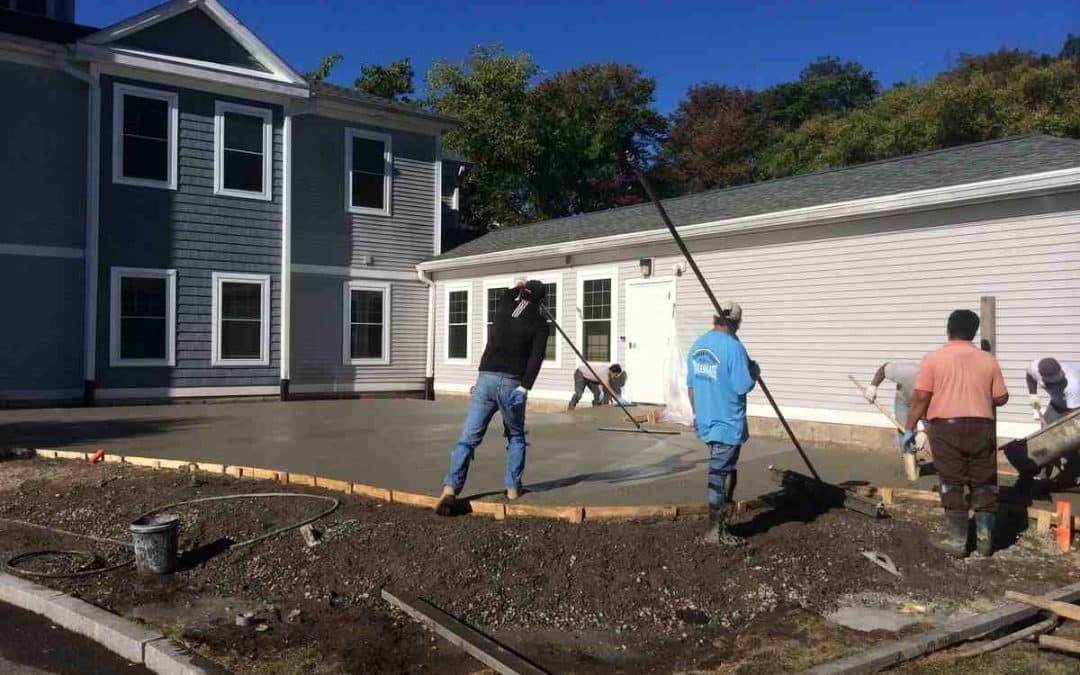
The Technical Precision of Professional Patio Installation
Professional patio installation is the process of designing and building an outdoor patio using proper site preparation, quality materials, and proven techniques — carried out by trained contractors rather than as a DIY project.
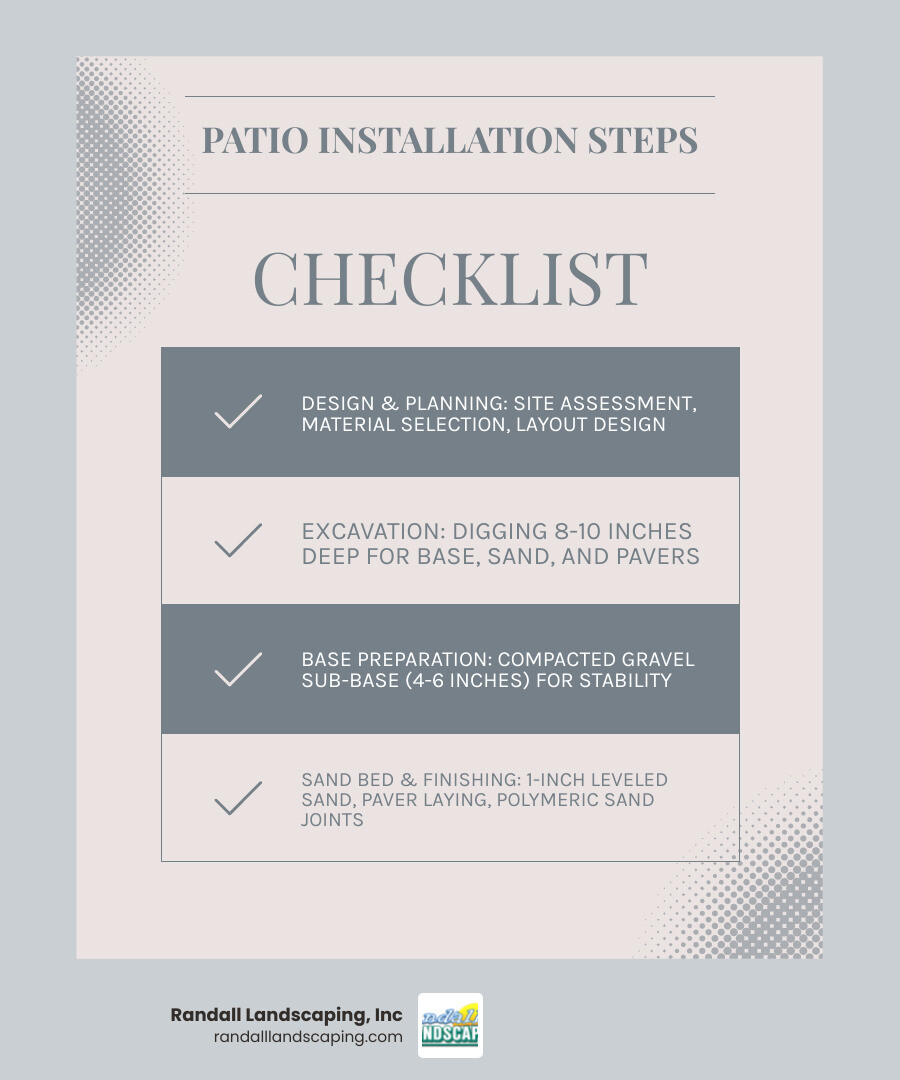
Here’s what professional patio installation typically involves:
| Step | What Happens |
|---|---|
| Design & planning | Site assessment, material selection, layout design |
| Excavation | Digging 8-10 inches deep for base, sand, and pavers |
| Base preparation | Compacted gravel sub-base (4-6 inches) for stability |
| Sand bed | 1-inch leveled sand layer for paver placement |
| Paver installation | Laying, cutting, and edging pavers to pattern |
| Finishing | Polymeric sand in joints, final compaction, sealing |
The difference between a patio that lasts 30-50 years and one that cracks, shifts, or floods after the first winter often comes down to one thing: who built it and how. We follow industry standards set by organizations like the Interlocking Concrete Pavement Institute to ensure every installation meets rigorous structural requirements.
Many homeowners underestimate what goes into a durable patio. What looks like a simple weekend project actually requires precise grading, proper drainage, deep base compaction, and material knowledge that takes years to develop. Skip any one of those steps, and you’re looking at costly repairs down the road.
A well-built patio also isn’t just functional — it’s one of the best investments you can make in your home, typically returning 30-60% in immediate home value increase according to industry data.
I’m Tommy Randall, owner of Randall Landscaping, Inc., and with nearly two decades of hands-on experience delivering professional patio installation across Massachusetts and Southern New Hampshire, I’ve seen what separates a patio that lasts from one that fails. Let’s break down exactly why hiring a professional makes all the difference.
Easy professional patio installation word list:
When we talk about professional patio installation, we aren’t just talking about laying pretty stones in a pattern. We are talking about engineering. In the Merrimack Valley and Southern New Hampshire, our soil goes through brutal freeze-thaw cycles every year. If your patio isn’t engineered to handle that movement, it will look like a roller coaster by the time the snow melts in April.
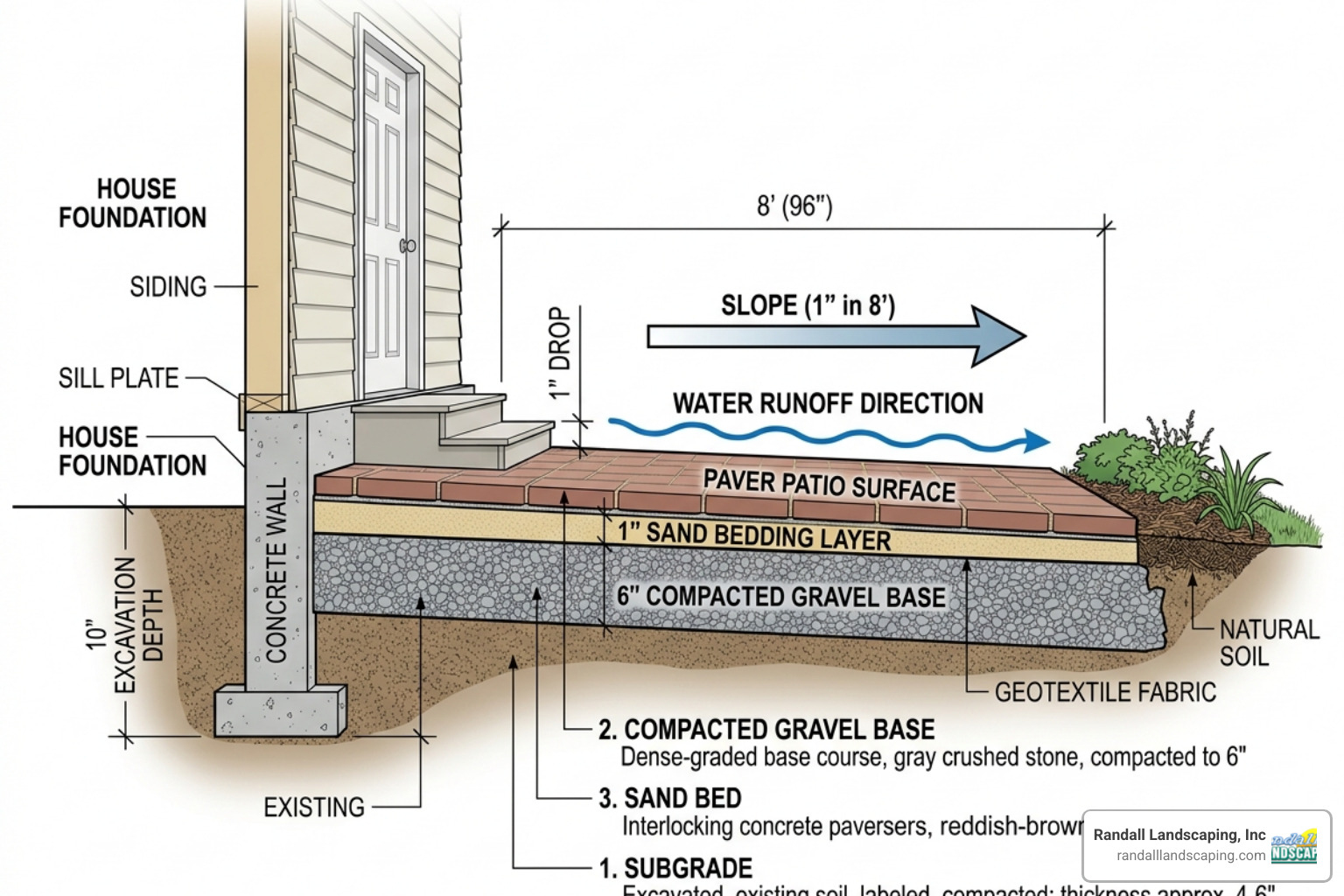
The process begins long before the first paver is set. It starts with a comprehensive site assessment. We evaluate the soil type—is it heavy clay that holds water, or sandy soil that drains well? We look at existing vegetation and obstacles like tree roots or utility lines. Most importantly, we determine the required excavation depth. For a standard paver patio, we typically dig 8 to 10 inches deep. This allows us to install a 4-to-6-inch compacted gravel base, a 1-inch sand setting bed, and the pavers themselves.
Proper hardscaping is about building a foundation that stays put. While a DIYer might get tired after digging four inches and call it “good enough,” a professional knows that the sub-base is what actually carries the load. Without that depth, your patio will settle unevenly, creating trip hazards and pooling water.
Mastering Slope and Grading for Water Runoff
One of the biggest mistakes we see in amateur projects is a lack of proper grading. If a patio is perfectly level, it’s actually wrong. Water needs a place to go, and you definitely don’t want it sitting against your home’s foundation.
During a professional patio installation, we use laser levels to ensure a precise slope. The industry standard is a 1-inch drop for every 8 feet of distance away from the house (or about a 1/4 inch per foot). This subtle grade is invisible to the naked eye—your table and chairs won’t feel tilted—but it is enough to ensure that heavy New England rainstorms shed off the surface and into the surrounding landscape or drainage systems.
Why Base Compaction is the Secret to Longevity
If excavation is the “body” of the project, compaction is the “soul.” You can have the most expensive Italian porcelain pavers in the world, but if the gravel base underneath isn’t compacted correctly, they will shift.
We use heavy-duty mechanical plate compactors to compress the sub-grade and the gravel base in “lifts” or layers. We don’t just dump six inches of gravel and run the machine over the top; we add two inches, wet it slightly to help the particles lock together, and compact it until it’s rock-hard. Then we repeat the process. This creates a structural integrity that can withstand thousands of pounds of pressure.
The American deck and patio construction sector currently provides employment for more than 10,000 individuals, and the most experienced among them will tell you that skipping compaction is the fastest way to ruin a reputation. We often use geotextile fabrics between the soil and the gravel base to prevent the layers from mixing over time, which further ensures that your patios and walkway installations remain stable for decades.
Choosing the Right Materials for Your Landscape
Selecting the right material is a balance of aesthetics, budget, and intended use. In our service areas like Andover and Boxford, homeowners often choose materials that complement the historic or traditional architecture of the region.
- Concrete Pavers: These are the workhorses of the industry. Modern manufacturing allows for incredible variety in color, shape, and texture. They are uniform in thickness, which makes for a very smooth surface, and they are designed to handle the salt and snow of New Hampshire winters.
- Natural Stone (Bluestone/Flagstone): For many, natural stone is the gold standard for beauty. Whether it’s “thermal” bluestone (cut into precise rectangles) or “irregular” flagstone (natural, jagged shapes), stone offers a timeless look. It is labor-intensive to install because each piece varies in thickness and must be hand-set.
- Clay Brick: Brick offers a classic, “Old World” charm. It is incredibly durable and color-fast—the red you see today will be the same red fifty years from now.
| Material | Durability | Maintenance | Relative Cost |
|---|---|---|---|
| Concrete Pavers | High | Low | Moderate |
| Natural Stone | Very High | Moderate | High |
| Clay Brick | High | Low | Moderate/High |
| Stamped Concrete | Moderate | High (Sealing) | Low/Moderate |
For more inspiration, check out our guide on custom paver patio designs.
The Role of Polymeric Sand in Professional Patio Installation
Once the pavers are laid, the “joints” (the spaces between them) must be filled. In the old days, people used regular play sand. The problem? Rain washes it out, ants build hills in it, and weeds grow through it.
In a professional patio installation, we use polymeric sand. This is a high-tech mix of graded sand and binder agents (polymers). When we sweep it into the joints and mist it with water, it hardens into a flexible, glass-like bond.
- Weed Prevention: It creates a barrier that seeds cannot penetrate.
- Ant Prevention: It’s too hard for insects to tunnel through.
- Washout Protection: It won’t wash away during a downpour.
- Flexibility: Crucially for our climate, it stays slightly flexible, allowing the patio to “breathe” during freeze-thaw cycles without cracking the joints.
Essential Tools and Equipment for High-End Finishes
A DIYer usually shows up with a shovel, a wheelbarrow, and a hand-me-down level. A professional crew arrives with a mobile workshop. To get those crisp, clean lines you see in magazines, we use gas-powered masonry saws with diamond blades. This allows us to cut pavers to fit perfectly around curves or against the house.
We also use screeding tools—usually long aluminum pipes or specialized tracks—to level the sand bed to within a fraction of an inch. If the sand bed isn’t perfectly flat, the pavers will “click” or wobble when you walk on them. We also install professional-grade edge restraints (usually heavy-duty plastic or aluminum spikes) to prevent the perimeter pavers from “creeping” outward over time.
Professional vs. DIY: Quality, Costs, and ROI
Let’s talk about the elephant in the room: the cost. It’s tempting to think you’re “saving” money by doing it yourself over a few weekends. But when you factor in tool rentals, material delivery fees, the cost of your own time, and the potential cost of fixing mistakes, the gap closes quickly.
Pricing Disclaimer: The following figures are average costs based on internet data and are not actual costs for Randall Landscaping, Inc. Every site is unique and requires a custom quote.
Nationwide, quality patio installations typically range from $15 to $50 per square foot, but for high-end materials like natural stone or complex multi-level designs, costs can reach $150 per square foot or more. Factors that influence this include:
- Site Accessibility: Can we get a Bobcat into the backyard, or do we have to move 20 tons of gravel by hand?
- Soil Conditions: Does the site require extra drainage or soil stabilization?
- Material Choice: Basic concrete pavers are more affordable than imported travertine or bluestone.
Despite the upfront cost, the ROI is significant. A professionally installed patio is a “permanent” improvement. Unlike a wooden deck that might rot or require staining every two years, a stone or paver patio can last 30 to 50 years with minimal care. This longevity is why buyers are willing to pay a premium for homes with established patio paver installation services already completed.
Avoiding Common DIY Installation Mistakes
We often get calls to “fix” a patio that a homeowner started but couldn’t finish, or one that was built a year ago and is already failing. Here are the most common pitfalls:
- The “Short-Cut” Base: Skipping the gravel base and laying pavers directly on dirt or a thin layer of sand. The first rain will turn this into a muddy mess.
- Ignoring the HOA: In many of our local communities, like North Reading or Georgetown, 85% of projects require HOA approval. We handle the paperwork and permits to ensure your project is legal and won’t result in fines.
- Poor Edging: Without a solid edge restraint, the outer pavers will eventually migrate into the grass, causing the entire patio to “unravel” from the outside in.
- Soil Testing Neglect: Not all dirt is created equal. Some soils require a deeper base or specialized “crusher run” to provide a stable foundation.
Maximizing Functionality with Custom Design Features
A professional doesn’t just build a square; we build a destination. During the landscape design phase, we consider how you actually live.
- Flow and Traffic: Where is the grill going? Is there enough room to pull out a chair without falling off the edge?
- Multi-Level Layouts: If your yard slopes, we can build a raised patio with retaining walls to create flat, usable “rooms” in your yard.
- Integrated Features: We can build in fire pits, outdoor kitchens, or seating walls (usually 18-24 inches tall) that provide extra places for guests to sit without cluttering the space with furniture.
- Lighting: Integrating low-voltage LED lighting into the steps and walls ensures the space is safe and beautiful after the sun goes down.
Frequently Asked Questions about Professional Patio Installation
How long does a professional patio installation typically take?
For a standard residential patio (around 400-600 square feet), the physical build typically takes 3 to 7 days. However, the “total” timeline from the first phone call to your first barbecue is usually longer.
- Design & Permitting: This can take 2-4 weeks depending on your town’s requirements and HOA speed.
- Weather: We can’t compact a base if it’s a mud pit from a week of rain.
- Lead Times: High-quality contractors in the Merrimack Valley are often booked 4-8 weeks in advance, so it’s best to plan your spring patio in the winter!
Do I need permits or HOA approval for a new patio?
In many areas of Southern NH and MA, patios are classified as “landscaping,” which often means fewer permits than a raised deck. However, there are exceptions. If your patio requires a retaining wall over 4 feet, or if you are adding gas lines for a fire pit or kitchen, you will almost certainly need a permit.
As for HOAs, they almost always want to see a plan. We provide the 3D renderings and material specs that HOAs need to give a “thumbs up.” Dealing with these regulations is a standard part of our patio construction company services.
What maintenance is required for different patio materials?
One of the best things about a professional patio installation is the low maintenance.
- Pavers: Sweep them occasionally. Every 3-5 years, you may want to power wash the surface and top off the polymeric sand if it has settled.
- Sealing: While not strictly required, applying a sealer can protect against oil stains from the grill and make the colors “pop” (the “wet look”).
- Longevity: A well-built stone or concrete patio should last 30 to 50 years. Compare that to a wood deck, which usually needs significant repair or replacement after 15-20 years.
Conclusion
At the end of the day, your home is likely your biggest asset. Why gamble its value and your own safety on a “weekend warrior” project that might not survive the first frost?
At Randall Landscaping, Inc., we’ve built our reputation on two things: quality work and 100% reliability. We serve homeowners throughout the Merrimack Valley and Southern New Hampshire—from the historic neighborhoods of Amesbury and Boxford to the growing communities in Pelham and Windham. We don’t just “lay bricks”; we create the backdrop for your family’s future memories.
Whether you are looking for a simple spot for a morning coffee or a grand multi-level entertaining space with a custom fire feature, we have the tools, the team, and the nearly two decades of local experience to do it right the first time.
Ready to transform your backyard from a patch of grass into a luxury retreat? Let’s get to work. Start your patio design in Andover, MA or contact us today for a consultation in any of our service areas.