
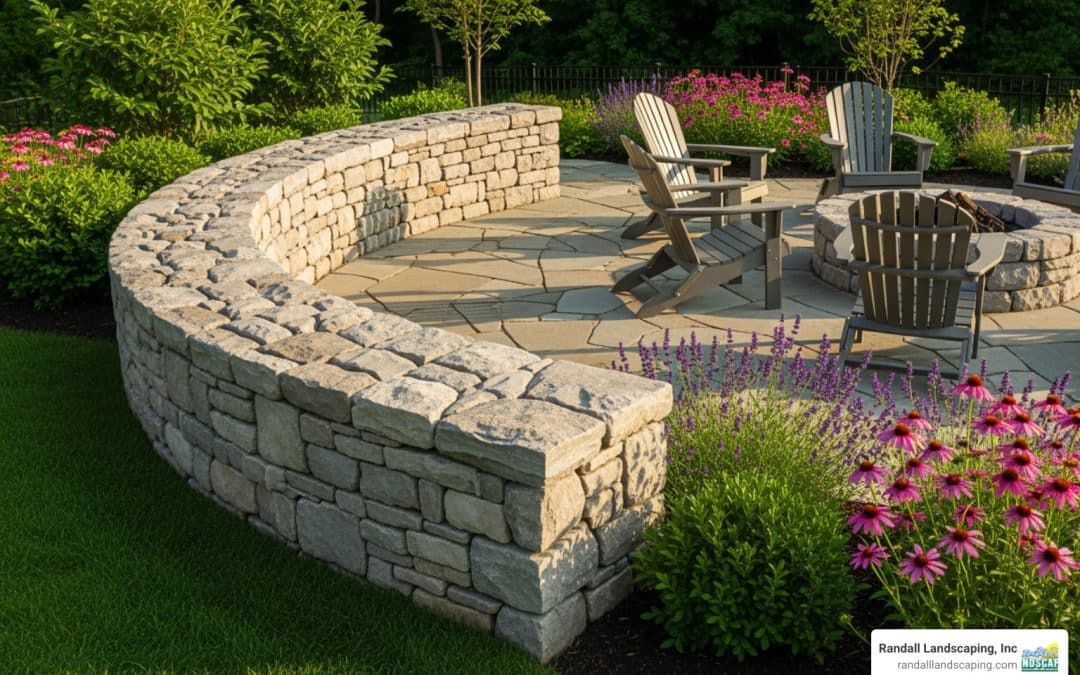
More Than Just a Wall
A freestanding retaining wall is a stand-alone structure built not to hold back soil, but to define spaces, add visual interest, and create functional features like built-in seating. Key characteristics include:
- Purpose: Defines landscape spaces, provides privacy, and adds aesthetic appeal
- Construction: Built on flat ground with texture on multiple sides
- Height: Typically stable up to 3-6 feet without reinforcement
- Soil Pressure: None—it stands freely
- Installation: Uses interlocking blocks, masonry adhesive, and gravity for stability
While many homeowners think of plants or patios, freestanding walls are a powerful hardscape feature that can transform a yard’s look and function. They create outdoor rooms, define property lines, frame entertainment areas, and provide built-in seating. Unlike retaining walls that battle soil pressure, these walls are built on level ground for aesthetic and functional purposes.
A well-built freestanding wall can boost property value by solving practical problems like adding privacy or blocking wind. However, understanding the different wall types is crucial for a successful project. I’m Tommy Randall, owner of Randall Landscaping Business. Since 2006, I’ve designed and installed hardscape features throughout Massachusetts and New Hampshire, learning that the right materials and construction methods are key to a wall’s longevity and performance.
Freestanding vs. Retaining vs. Garden Walls: What’s the Difference?
You’ve likely heard the terms “retaining wall,” “garden wall,” and “freestanding wall” used interchangeably, but they serve very different functions. Mixing them up can lead to costly mistakes or a wall that fails to meet your needs. At Randall Landscaping, we help homeowners distinguish between them. Think of it this way: a retaining wall is a structural workhorse, a garden wall is a decorative frame, and a freestanding retaining wall is a versatile, double-sided room divider.
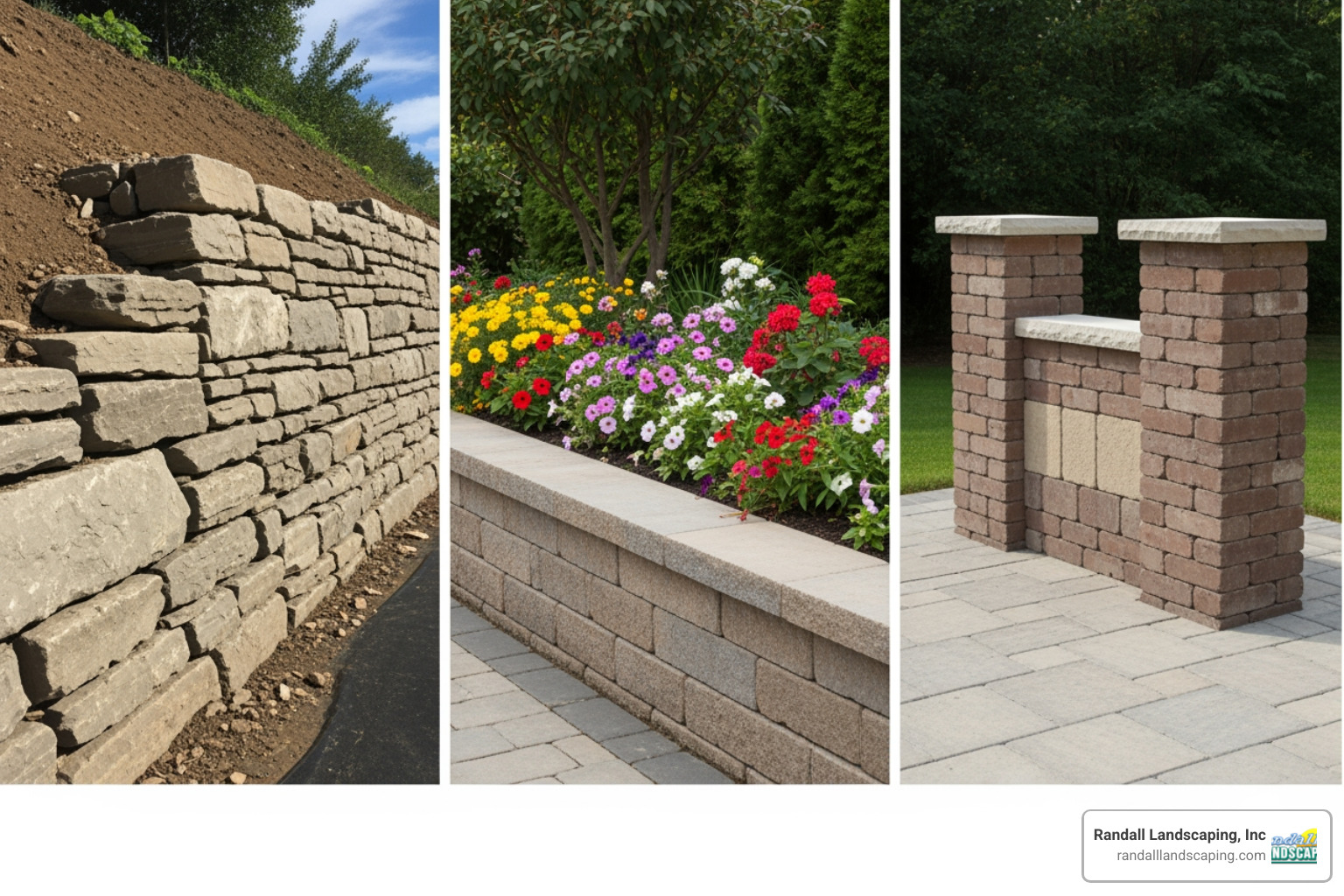
Let’s break down the key differences:
| Feature | Freestanding Wall | Garden Wall | Retaining Wall |
|---|---|---|---|
| Purpose | Defines spaces, privacy, aesthetics, seating | Decorative border, plant bed division | Holds back soil, manages slopes, prevents erosion |
| Construction | Double-sided finish, built on flat ground, no soil load | Single-sided (often), decorative, not for heavy soil load | Structural, footings, drainage, withstands lateral soil pressure |
| Typical Height | Up to 3-6 feet (often needing reinforcement for taller) | 18-24 inches (under 3 feet) | Over 3 feet (can be 50+ feet with reinforcement) |
| Finish | Aesthetic texture on multiple faces | Often one-sided aesthetic, self-caping | Often one-sided aesthetic, requires capping/coping |
Understanding these differences is key. For more details on wall constructions, see our page on landscape wall construction.
The Role of a True Retaining Wall
A true retaining wall is a heavyweight structure built for one job: holding back soil and managing elevation changes. These walls face immense lateral pressure from the earth, especially when wet. This requires robust construction, including deep footings, proper drainage systems, and sometimes engineering for taller structures. Drainage is absolutely critical to prevent water pressure buildup, a common cause of failure. For challenging sites, we may use solutions like helical anchors for retaining walls for added reinforcement.
The Purpose of a Garden Wall
Garden walls are decorative and low-key, used for decoration and definition. You’ll see them bordering flower beds or vegetable gardens. Typically standing 18 to 24 inches high, they aren’t built to handle soil pressure. They add charm, contain mulch, and give planting areas clean edges without needing to be structural powerhouses.
The Versatility of a Freestanding Wall
A freestanding retaining wall (despite its name) doesn’t retain soil. Built on flat ground, it’s incredibly versatile for creating functional and beautiful spaces. These walls can define outdoor rooms, separate a patio from the lawn, or add architectural interest. A key feature is their aesthetic finish on multiple sides, as they are meant to be seen from all angles. They can be built up to three feet without reinforcement, and up to six feet with proper techniques, making them perfect for built-in seating. Without soil pressure, they offer design freedom for curves and patterns not possible with retaining walls. For more ideas, visit our page on residential retaining walls.
Understanding the Structural Design of a Freestanding Retaining Wall
Even though a freestanding retaining wall doesn’t hold back earth, it still requires thoughtful structural design. The name is confusing, as these walls don’t retain soil, but they must be structurally sound to resist forces like wind or someone leaning against them. The primary goals are to prevent overturning (tipping over) and sliding (shifting horizontally).
For most freestanding walls up to 3 feet tall, gravity and mass are sufficient. The weight of properly stacked blocks provides enough resistance. This is why quality materials and correct installation are so important—the wall’s stability relies on its own weight and the friction between blocks. As walls approach the 3 to 6-foot range, some systems require additional support like internal reinforcement to counter the increased overturning risk.
The importance of a solid base cannot be overstated. A wall is only as stable as its foundation. The principles of using friction and careful placement, documented for centuries by groups like the Dry Stone Conservancy, are improved in modern systems with mechanical connections and adhesives.
How Stability is Achieved
A stable freestanding wall is achieved through a proven process:
- Compacted Gravel Base: We excavate a trench and fill it with compacted gravel to create a stable, level foundation that distributes weight and allows for drainage.
- Leveling Pad: A thin layer of crushed stone or concrete provides a perfectly level surface for the first course of blocks. An unlevel first row compromises the entire wall.
- Interlocking Blocks: Most modern blocks have lips or pins that mechanically connect each course, helping the wall act as a single unit.
- Masonry Adhesive: For taller walls, we use high-quality adhesive between courses. This chemical bond creates a cohesive structure, and we follow manufacturer specifications to ensure optimal performance.
- Wall’s Own Weight: The combined mass of the blocks, interlocked and bonded, provides the fundamental resistance to external forces.
For taller walls or those in high-wind areas, we may add reinforcement like rebar and grout.
Why It’s Different from Cantilever or Counterfort Walls
It’s helpful to know what a freestanding wall isn’t. Terms like cantilever and counterfort refer to engineered structures designed for massive soil pressure.
- Cantilever walls are L-shaped reinforced concrete structures that use the weight of the backfill soil on their footing to resist overturning.
- Counterfort walls are for even taller applications and use triangular buttresses (counterforts) for additional support against enormous soil pressure.
A freestanding wall has a much simpler job. Built on flat ground without soil pressure, its design priorities are aesthetic appeal and spatial definition, not fighting tons of earth.
Choosing the Right Materials and Style
The material you choose for your freestanding retaining wall defines its look, longevity, and feel. In the Merrimack Valley and Southern New Hampshire, a wall should complement your home’s style while withstanding our harsh freeze-thaw cycles. We help clients select materials based on aesthetics, maintenance, and budget to build a wall that looks amazing for decades. This commitment to durability is central to our approach to quality retaining walls.
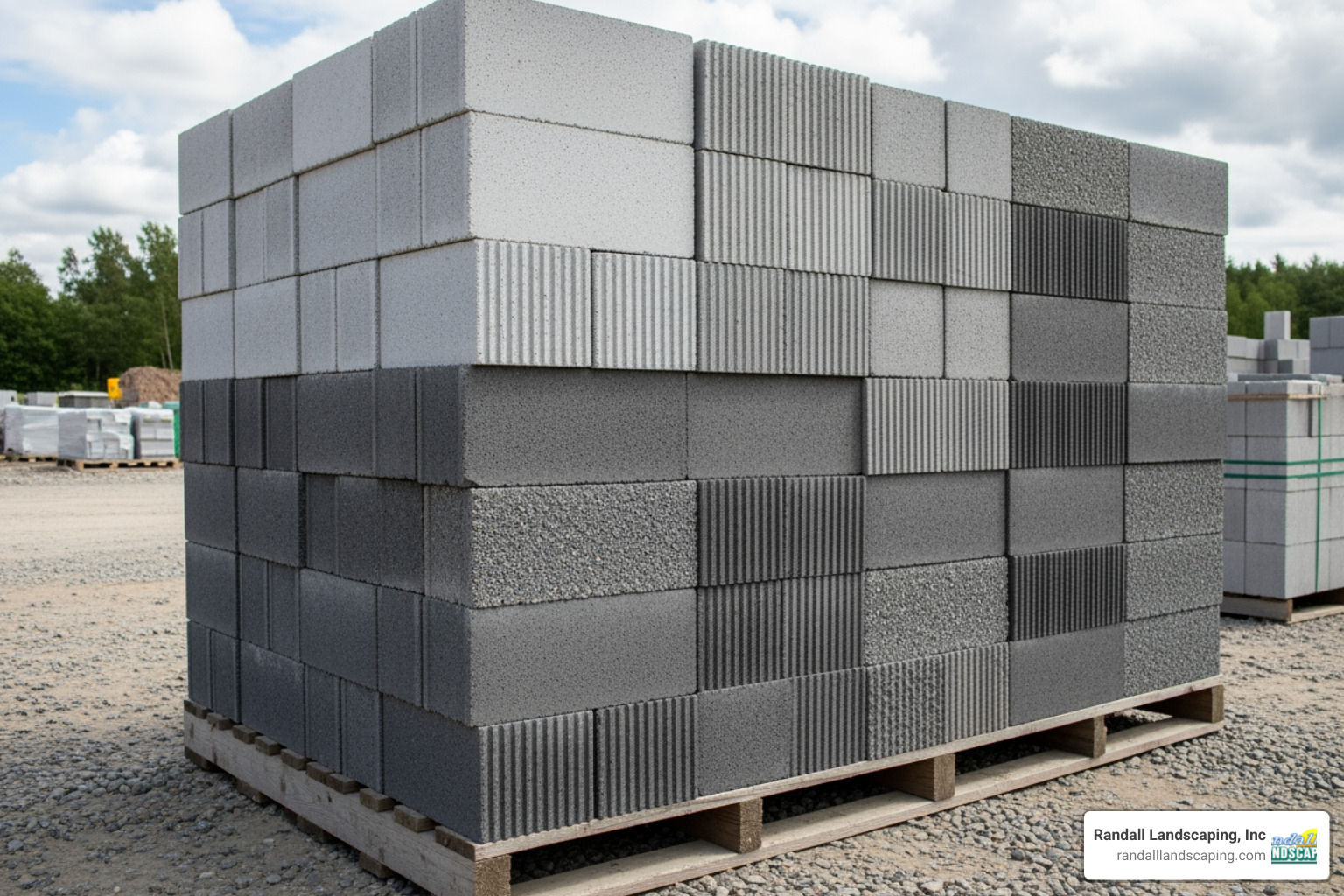
Concrete Wall Blocks
For versatility and value, concrete wall blocks are an excellent choice for freestanding walls. Modern blocks are far from the boring gray rectangles of the past. Today’s modular systems offer incredible design flexibility, with multi-piece designs that can create a random, natural look or a clean, uniform pattern.
The variety is impressive, with colors ranging from earth tones like Brownstone and Charcoal Brown to lighter Greystone and Tan. Textures can be smooth and contemporary or tumbled to mimic aged stone. Durability is a key advantage. These engineered wet-cast products are designed to handle New England’s climate with minimal maintenance.
Cost-wise, concrete blocks fit most budgets. Based on internet research, individual blocks can range from $1.78 to $9.47, while pallets might run from $959.00 to over $2,500 for premium styles. These are average costs and not actual quotes from Randall Landscaping; we provide custom quotes for each project. While DIY is possible for small walls, professional installation ensures proper base preparation and alignment for long-term stability.
Natural Stone
For a truly unique and timeless look, we recommend natural stone. Each stone has its own character, color, and texture that cannot be replicated. Natural stone walls offer a sense of permanence and authenticity. The dry-stack method relies on skilled placement, friction, and weight, creating a wall with old-world character. Mortared stone offers a more formal, rigid structure. Stone is incredibly durable, lasting for centuries with virtually no maintenance. As sandstone retaining wall builders know, different stone types create distinct feelings. The main tradeoff is cost; the material and specialized labor represent a significant investment, but one that pays off in unparalleled beauty and longevity.
Finishing Touches: Wall Caps
Wall caps (or coping) are the essential finishing touch for any freestanding wall. They serve three key purposes:
- Protection: Caps shed water away from the wall’s core, preventing damage from freeze-thaw cycles.
- Appearance: They provide a polished, finished look, changing a stack of blocks into an architectural feature.
- Function: For walls used as seating, wide, smooth caps provide a comfortable surface.
You can match caps to your wall for a cohesive look or use contrasting colors and materials to add definition.
Key Steps for Installation and Long-Term Care
Installing a freestanding retaining wall correctly is key to creating a lasting feature. While some small garden borders can be DIY projects, any significant wall benefits from professional expertise. The difference between a wall that lasts thirty years and one that leans after one winter is often the unseen prep work.
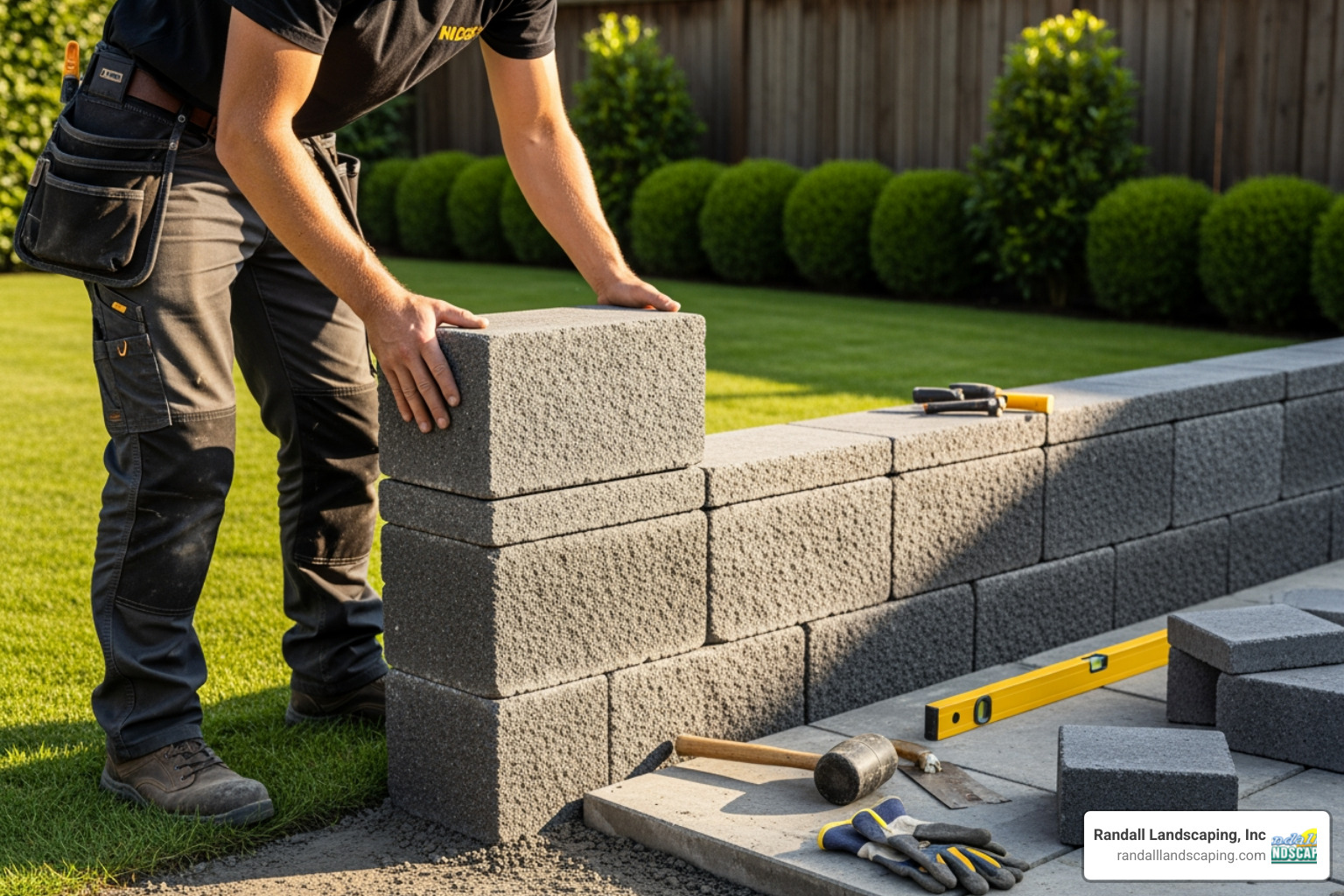
At Randall Landscaping, we’ve installed hundreds of walls in the Merrimack Valley and Southern New Hampshire since 2006. As trusted retaining wall builders near you, we understand the science behind a durable wall.
The Installation Process at a Glance
A lasting freestanding wall requires attention to detail at every stage.
- Excavation and Base Preparation: This is the most critical step. We dig a trench below the frost line, lay geotextile fabric, and build a compacted gravel base. A perfectly flat leveling pad of crushed stone or concrete is prepared on top.
- First Course Installation: We carefully place the first row of blocks, ensuring they are perfectly level in all directions. This course is often partially buried for extra stability.
- Stacking and Securing Subsequent Courses: We stack blocks in a staggered running bond pattern for strength. On walls over two feet, we apply masonry adhesive between courses to bond the blocks into a solid unit, following manufacturer guidelines. Taller walls may get additional reinforcement.
- Backfilling: If the design includes planters, we backfill carefully with gravel for drainage near the wall and topsoil for plants, compacting in layers to prevent settling.
- Placing Wall Caps: The final step is securing caps with masonry adhesive. This protects the wall from weather and provides a polished, functional finish, especially for seating walls.
Maintenance Tips for Your Freestanding Retaining Wall
A well-built freestanding wall is low-maintenance, but ignoring small issues can lead to big problems.
- Regular Inspection: Seasonally check for loose or shifting blocks and cracks. Early detection makes for simple fixes.
- Cleaning: Use a stiff brush and mild detergent to remove dirt, moss, or algae that can trap moisture. White mineral deposits (efflorescence) are normal and wash away easily. Avoid high-pressure washing on older walls.
- Checking for Shifts: Periodically use a level to ensure the wall remains plumb. Ground movement from freeze-thaw cycles can cause settling. If you see significant leaning or bulging, call a professional.
- Ensuring Proper Drainage: Keep the area around the wall base clear of debris so water can drain away freely. Standing water can undermine the foundation.
For more detailed advice, our complete retaining wall repair guide covers everything from minor fixes to major repairs.
Conclusion: Lift Your Landscape with the Right Wall
Investing in a freestanding retaining wall adds a centerpiece to your yard that brings both beauty and purpose. These versatile structures define boundaries, create gathering spots, and add architectural polish that completes a property.
We’ve covered what makes these walls unique: unlike true retaining or simple garden walls, freestanding walls are built on level ground, offering best design flexibility. They can create privacy, provide built-in seating, and add depth to flat landscapes.
Success depends on sound structural principles. A stable wall starts with a compacted gravel base, continues with level courses secured by interlocking designs and adhesive, and is finished with protective caps. This ensures your wall will stand strong through New England’s seasons. Material choice also tells your property’s story, whether you opt for the versatility of concrete wall blocks or the timeless character of natural stone.
At Randall Landscaping, Inc., we’ve been building these structures since 2006 across the Merrimack Valley and Southern New Hampshire. Our reputation is built on quality work and 100% reliability.
Proper construction and simple care are the difference between a wall that lasts a lifetime and one that disappoints. Whether you envision a curved patio wall or seating around a fire pit, a well-designed freestanding retaining wall can achieve it.
For professional guidance on your next hardscaping project, explore our retaining wall services. We’re here to help you build a landscape that stands strong and looks beautiful.