
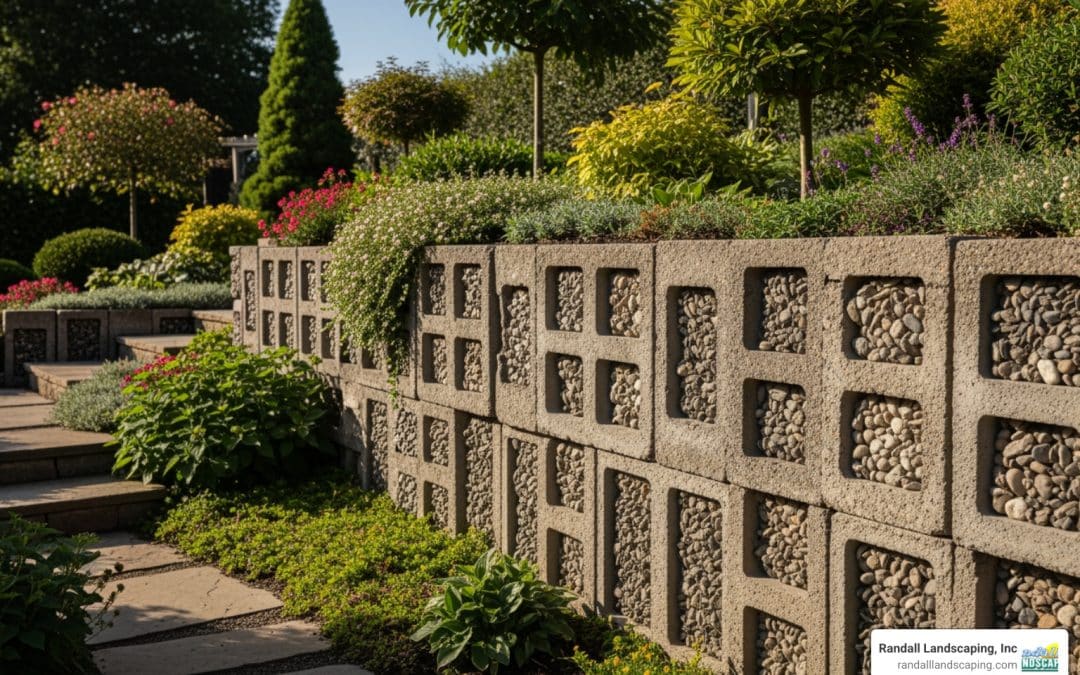
Understanding Concrete Crib Walls: What They Are and Why They Matter
A concrete crib wall is a gravity retaining structure built from interlocking precast concrete elements (headers and stretchers) that form a framework of hollow cells, which are then filled with free-draining material like crushed stone or gravel. It’s an engineered solution that brilliantly combines mass, gravity, and permeability to hold back earth.
Quick Answer: What is a Concrete Crib Wall?
- Structure: Interlocking precast concrete framework creating box-like cells.
- Fill Material: Free-draining crushed stone or gravel (typically 75mm down).
- How It Works: Relies on the combined mass of the concrete and stone fill for gravity-based stability.
- Key Benefit: Exceptional drainage capacity eliminates hydrostatic (water) pressure, a primary cause of retaining wall failure.
- Design Life: Can achieve a design life of up to 120 years when properly engineered and constructed.
- Best For: Highway embankments, slope stabilization, and residential sites with significant drainage challenges.
If you’re a homeowner in Southern New Hampshire or the Merrimack Valley, you’re no stranger to sloped properties, heavy rainfall, and the spring thaw. These conditions can create significant challenges with soil erosion and drainage. While you’ve likely considered retaining walls to create usable flat space, the concrete crib wall offers a unique and time-tested approach. First developed in 1919, this system has proven its worth for over a century.
Unlike a solid poured concrete wall, which acts as an impermeable dam, or a modern segmental block wall, which relies on geogrid reinforcement, a crib wall functions like a sturdy, open-faced cage. The interlocking concrete components form the structure, and the stone fill provides the weight needed to resist soil pressure. This design’s greatest strength is its ability to let water pass directly through it, preventing the buildup of hydrostatic pressure that can crack, bulge, or topple other wall types. This makes them exceptionally resilient in areas with poor soil drainage or high water tables.
Research and decades of real-world application confirm that crib walls are one of the most reliable gravity wall systems available. They can tolerate minor ground settlement without structural failure, a key advantage in the variable soils of New England. Furthermore, their open-faced cells can be filled with soil and planted, changing a structural necessity into a “living wall” that blends naturally with the landscape. This versatility is why they are specified for everything from major highway projects designed to last over a century to residential slope stabilization.
I’m Tommy Randall, owner of Randall Landscaping. For nearly two decades, my team and I have been designing and building hardscapes and retaining walls across communities like Andover, MA, and Salem, NH. We’ve seen how selecting the right wall system is critical for long-term success. While concrete crib walls are a specialized solution, understanding their unique benefits is key for any homeowner looking to make an informed decision about managing their property’s slopes and controlling erosion effectively.
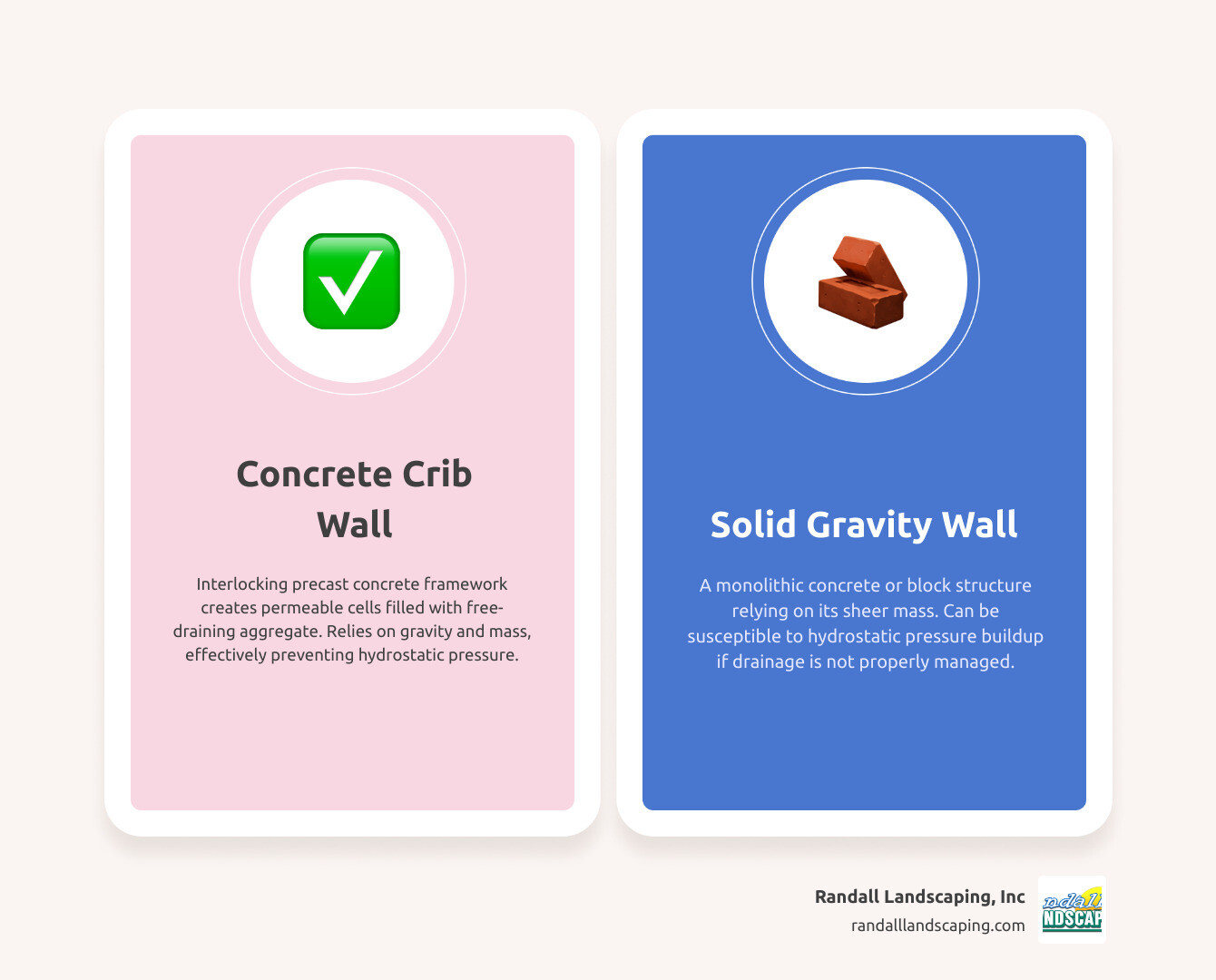
What is a Concrete Crib Wall and How Does It Work?
A concrete crib wall is a unique type of gravity retaining wall system that functions by creating a robust, permeable structure to hold back soil. Unlike traditional solid concrete walls that rely on their sheer mass and often extensive foundations, a concrete crib wall is built from a grid-like assembly of individual precast concrete elements. These elements interlock to form a series of open, box-like cells, which are then filled with a free-draining granular material such as crushed stone or gravel.
The genius of this system lies in its simplicity and effectiveness. The interlocking concrete framework acts as a giant, stable cage. The fill material within these cells provides the necessary weight and mass to resist the lateral pressure exerted by the retained soil behind the wall. Because the wall itself isn’t a solid barrier, water can drain freely through the gaps between the concrete elements and the granular fill. This is a critical distinction from other retaining walls, as it prevents hydrostatic pressure (the pressure from water buildup) from accumulating behind the wall, which is a common cause of failure in solid retaining structures.
Essentially, a concrete crib wall resists soil pressure by:
- Gravity and Mass: The combined weight of the concrete elements and the dense, compacted granular fill within the cells provides the primary resistance against the force of the earth behind it.
- Interlocking Design: The header and stretcher elements are specifically shaped with notches or lugs that lock them together, creating a stable, unified structure that distributes loads evenly across the entire wall.
- Permeability: The free-draining nature of the wall is its superpower. It allows groundwater and surface water to pass through harmlessly, eliminating the dangerous hydrostatic pressure that can destabilize and destroy other wall types.
This combination of features makes concrete crib walls an excellent choice for managing slopes and preventing erosion, especially in areas with significant rainfall, high groundwater tables, or freeze-thaw cycles—all common considerations here in the Merrimack Valley and Southern New Hampshire.
Key Components of a Concrete Crib Wall
The construction of a concrete crib wall relies on a few fundamental, yet crucial, components that work together seamlessly to create a powerful retaining structure.
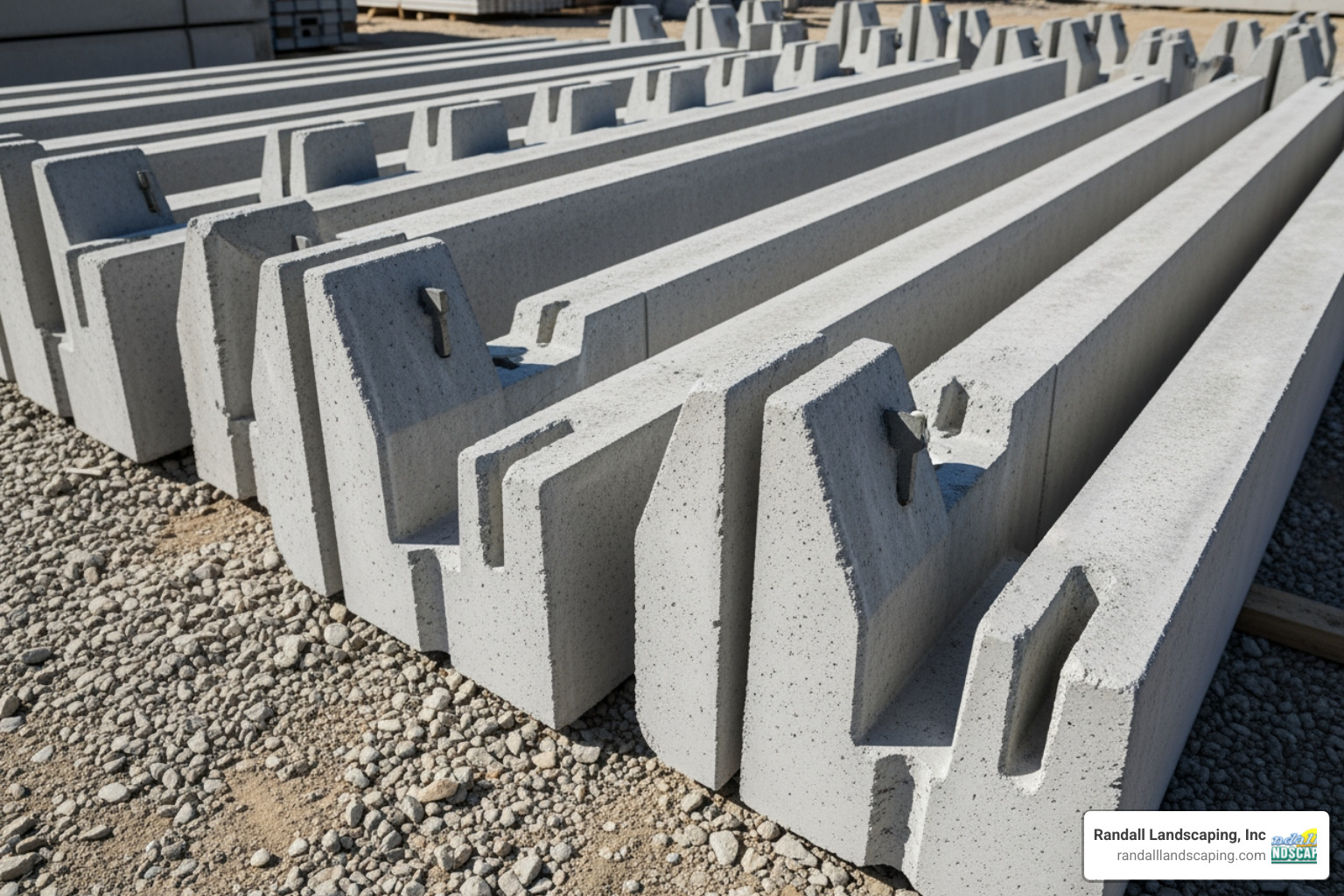
- Headers: These are the concrete elements that run perpendicular to the face of the wall, extending back into the retained soil. They act as the primary anchors, transferring the weight of the wall and the pressure from the retained soil deep into the stable ground behind the wall face.
- Stretchers: These elements run parallel to the face of the wall, forming the visible “skin” or outer framework. They interlock with the headers at each end, creating the box-like cellular structure and providing crucial lateral stability to the entire system.
- Interlocking Design: The magic is in the connection. Both headers and stretchers feature precisely engineered shapes, notches, or connectors that allow them to fit together snugly without mortar. This modularity not only creates a strong, grid-like pattern but also allows for rapid assembly on site.
- Free-Draining Aggregate: Once the concrete framework is assembled, the hollow cells are filled with clean, coarse-grained material like angular crushed stone or gravel, typically 75mm (approximately 3 inches) in size. This aggregate provides the bulk of the wall’s mass for stability and, most importantly, creates continuous voids that ensure water can drain through freely.
- Geotextile Fabric: In many professional installations, a non-woven geotextile fabric is placed behind the wall and sometimes lining the cells. This acts as a filter, preventing fine soil particles from the retained earth from washing into the aggregate fill. This is critical for maintaining the wall’s free-draining properties for its entire design life.
- Concrete Foundation: Like any substantial structure, a concrete crib wall requires a firm, level foundation. This is typically a compacted gravel base or a poured mass/reinforced concrete footing. The foundation’s design is critical for uniformly supporting the wall’s immense weight and transferring it safely to the subsoil, preventing settlement or failure.
Materials Used in Construction
The durability and strength of a concrete crib wall come from the high-quality materials used in its construction.
- Precast Concrete: The headers and stretchers are manufactured in a controlled factory environment, ensuring consistent quality, strength, and dimensions that are impossible to achieve with on-site pouring. These elements can be unreinforced for smaller walls or steel-reinforced for more demanding applications. We’ve seen systems manufactured from high-strength concrete, with compressive strengths up to 50 N/mm2 (over 7200 psi), highlighting their incredibly robust nature.
- Reinforced Concrete Elements: For taller walls or those supporting heavy loads (like roadways or parking lots), the precast concrete elements will contain steel rebar. This reinforcement dramatically improves their tensile strength, allowing them to resist bending and flexing forces over decades of service.
- Aggregate Fill: The choice of fill material is not trivial. It must be a durable, free-draining, coarse-grained aggregate. Angular crushed stone is often preferred over rounded gravel because the sharp edges interlock, providing better compaction and internal friction, which adds to the overall strength of the wall mass. It is critical to avoid using native soil for fill, as it retains water and can lead to settlement and internal pressure issues over time.
For more detailed insights into the construction of various landscape elements, check out our guide on landscape wall construction.
Advantages and Disadvantages of Crib Walls
Every retaining wall system has its strengths and weaknesses, and concrete crib walls are no exception. Understanding these can help you determine if it’s the right solution for your property in Massachusetts or New Hampshire. Here’s a comparison with other common wall types:
| Feature | Concrete Crib Wall | Solid Poured Concrete Wall | Segmental Block Wall |
|---|---|---|---|
| Drainage | Excellent; inherently free-draining design eliminates hydrostatic pressure. | Poor; requires extensive and complex drainage systems (weep holes, pipe drains) which can clog. | Good; relies on a crushed stone drainage zone and sometimes drain pipes. |
| Flexibility | High; can tolerate minor ground settlement and movement without cracking. | Very Low; rigid structure is prone to cracking from settlement or frost heave. | Moderate; modular units offer some flexibility but can shift or bulge if not properly installed. |
| Construction | Rapid; modular precast components are assembled quickly on site. | Slow; requires formwork, rebar placement, concrete pouring, and curing time. | Moderate; can be labor-intensive, especially with geogrid reinforcement layers. |
| Aesthetics | Utilitarian, industrial look. Can be softened by planting vegetation in the cells. | Can be finished with various textures, stamps, or veneers for a decorative look. | Wide variety of colors, textures, and styles available for a decorative appearance. |
| Design Life | Very Long; up to 120 years when properly designed and installed. | Long; 50-100 years, but highly dependent on drainage and reinforcement quality. | Moderate to Long; 30-70 years, dependent on installation quality and materials. |
| Excavation | Moderate; requires a larger footprint than some walls but often less deep excavation. | Extensive; often requires a deep footing below the frost line, leading to significant excavation. | Moderate; requires excavation for the base and for geogrid reinforcement layers. |
Key Advantages
The benefits of a concrete crib wall system are significant, especially for challenging sites.
- Excellent Drainage: This is the number one advantage. By allowing water to pass through the structure, crib walls eliminate the buildup of hydrostatic pressure. This single factor prevents a host of problems that plague solid walls, from bulging and cracking to catastrophic failure.
- Flexibility and Settlement Tolerance: The modular, mortarless design allows the wall to accommodate minor ground movement or settlement without cracking. For the variable soil conditions and frost heave cycles we experience in New England, this flexibility is a major asset for long-term durability.
- Rapid Construction: Because the components are precast, there’s no waiting on site for concrete to cure. A skilled crew can assemble a crib wall much faster than building a comparable poured concrete wall, reducing labor costs and project timelines.
- Cost-Effective for Specific Applications: While the initial material cost can be high, crib walls can be more economical overall for large or tall walls. Savings come from reduced excavation, the elimination of complex drainage systems, and faster installation times.
- Long Design Life: Engineered for longevity, these systems are a permanent solution. With a potential design life of up to 120 years, they are often specified for critical infrastructure like highways and railways, a testament to their durability. This is a ‘build it once, build it right’ solution.
- Potential for Vegetation: The open cells of a crib wall can be filled with topsoil and planted with vines, grasses, or shrubs. This creates a “living wall” that softens its appearance, helps it blend into the natural landscape, and provides ecological benefits.
Potential Disadvantages
Despite their strengths, crib walls aren’t the perfect fit for every situation.
- Aesthetics: The standard look of a concrete crib wall is utilitarian and can appear industrial or massive, which may not suit the aesthetic of every home or landscape design. While planting can soften this, the underlying concrete grid remains visible.
- Susceptible to Damage: The individual precast elements, particularly the front-facing stretchers, can be damaged by direct impact from vehicles or heavy equipment. While repair is possible, it can be more complex than patching a solid wall. If a wall is subject to frequent impacts, it may not be the best choice.
- Specific Backfill Required: The system’s performance is entirely dependent on using the correct free-draining aggregate. Using native soil, sand, or other improper fill will compromise drainage and lead to failure. This is not a place to cut corners.
- Large Footprint: As a gravity wall, a crib wall’s stability comes from its mass. This means the base of the wall needs to be quite wide, typically 50% to 75% of its height. This larger footprint can be a problem on properties with tight space constraints. For more information on stabilizing slopes, the U.S. Department of Transportation’s research provides valuable insights into various methods, including crib walls, in reports like Stabilizing Steep Slopes During Highway Reconstruction.
If your wall does experience issues, whether it’s a crib wall or another type, understanding the cause is the first step. Our guide to retaining wall repair can help you identify common problems.