Why Commercial Outdoor Spaces Are Worth Every Dollar
Commercial outdoor spaces are one of the most powerful — and underused — tools businesses have to attract customers, retain employees, and grow revenue.
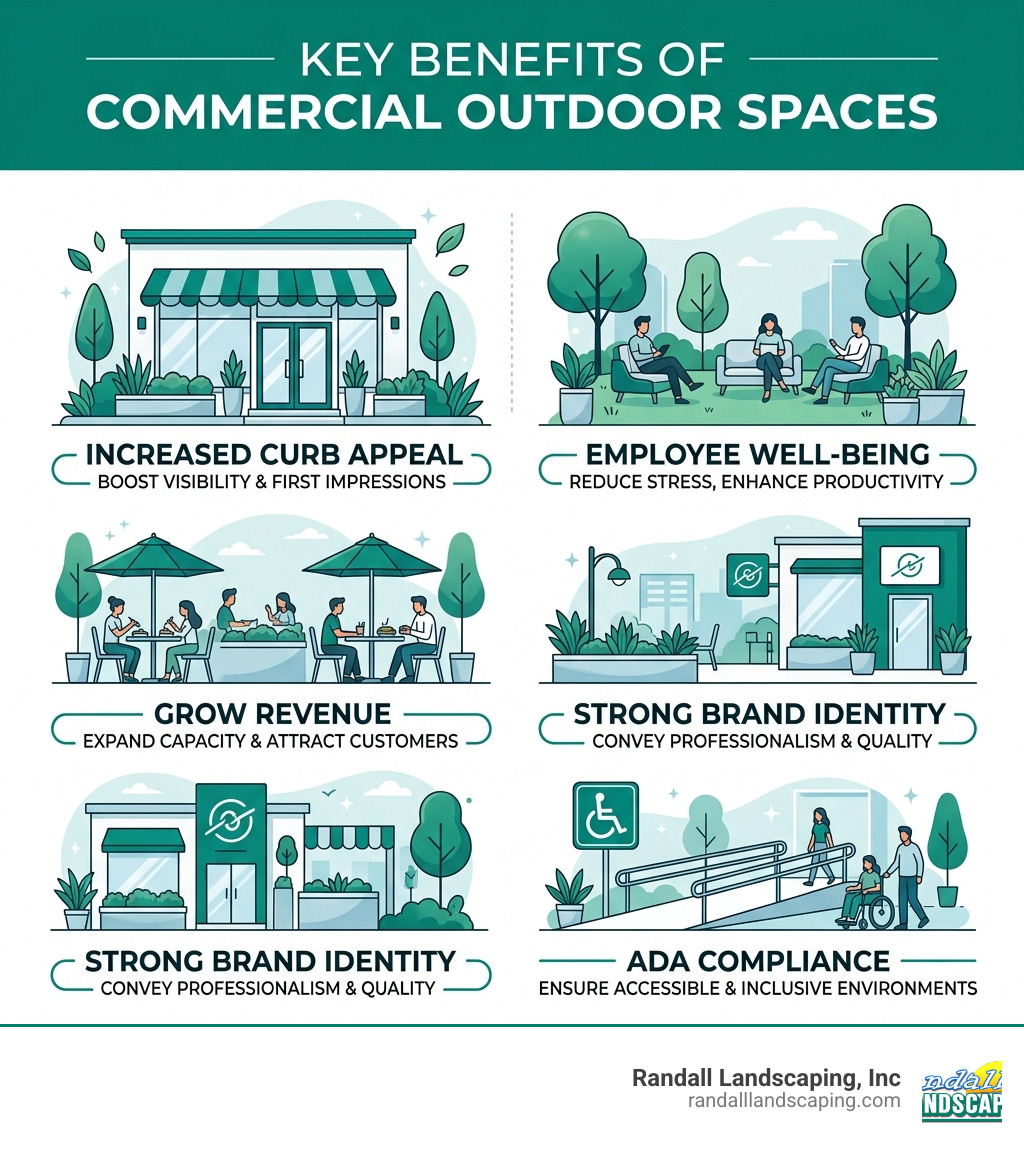
Here’s a quick overview of what makes them so valuable:
- Customer experience – Open-air seating and well-designed patios keep people staying longer and coming back
- Employee well-being – Access to green spaces reduces stress and improves focus and productivity
- Brand identity – A polished outdoor area signals professionalism and care
- Revenue growth – More usable space means more seats, more events, and more sales
- Curb appeal – First impressions matter, and your outdoor space is the first thing people see
Whether you run a restaurant, manage a corporate campus, or own a retail property, the outdoor area around your building is prime real estate. Post-pandemic, customers and employees alike have come to expect open, comfortable outdoor environments — and businesses that deliver are winning.
This guide walks you through everything: design principles, materials, layouts, landscaping, maintenance, and budgeting — so you can plan a commercial outdoor space that actually works.
I’m Tommy Randall, owner of Randall Landscaping, Inc., with nearly two decades of hands-on experience designing and building commercial outdoor spaces across Massachusetts and Southern New Hampshire. I’ll share what I’ve learned from real projects so you can make smarter decisions for your property.
Commercial outdoor spaces terms explained:
The Strategic Value of Commercial Outdoor Spaces
In the past, many businesses viewed their exterior as nothing more than a “buffer” between the sidewalk and the front door. Those days are gone. Today, commercial outdoor spaces are essential extensions of the brand experience. Since the pandemic, there has been a massive shift in how people perceive “inside” versus “outside.” Fresh air isn’t just a luxury anymore; it’s a requirement for many diners and office workers in the Merrimack Valley.
When we look at world-class examples like The Public Square and Gardens | 15 Hudson Yards, we see how native trees and expansive gardens can turn a commercial development into a neighborhood landmark. Even on a smaller scale, integrating nature through our Business Landscape Services allows local companies in Salem or Andover to create that same “destination” feel.
Consider the Crystal Court – IDS Center, which welcomes nearly 50,000 visitors per day. Why? Because it’s an urban park that offers a moment of zen in a busy day. By investing in commercial outdoor spaces, you aren’t just buying plants and pavers; you are creating a competitive differentiator. For a restaurant in Methuen, a beautiful patio can be the reason a customer chooses you over the place down the street. For an office in North Andover, a shaded courtyard is a powerful recruiting tool that supports employee well-being and work-life integration.
Design Principles and Layout Optimization
A successful commercial space doesn’t happen by accident. It requires a balance of flow, functionality, and brand consistency. If a customer has to squeeze past a server every time they go to the restroom, or if the employee “break area” is right next to the noisy dumpster, the design has failed.
When we develop Commercial Landscape Designs, we focus on creating “zones.” Just like a house has a kitchen and a living room, your outdoor space should have areas for high-traffic movement and areas for quiet relaxation.

Optimizing Layouts for Commercial Outdoor Spaces
Efficiency is the name of the game. You want to maximize seating capacity without making guests feel like they’re in a crowded elevator. Here are the gold-standard measurements we use:
- Walkways: Allow 3-4 feet between tables for standard walkways.
- Main Aisles: Ensure at least 5 feet for main walkways or aisles to accommodate staff and heavy traffic.
- Perimeter Seating: Use bar-top seating along rails to create views and save floor space.
| Venue Type | Typical Layout Strategy | Best Furniture Choice |
|---|---|---|
| Sidewalk Café | Compact, round tables | Stackable bistro chairs |
| Office Courtyard | Modular lounge “pods” | Weather-resistant sofas |
| Rooftop Bar | High-top perimeter seating | Anchored metal stools |
| Retail Plaza | Centralized clusters | Heavy-duty benches |
By following these spacing rules, you ensure a smooth traffic flow that prevents “bottlenecks,” especially during peak hours.
Ensuring Accessibility and ADA Compliance in Commercial Outdoor Spaces
Accessibility isn’t just a nice gesture; it’s the law. To ensure your property is welcoming to everyone and stays within safety codes, you must follow ADA standards. This includes:
- The 5% Rule: Ensure at least 5% of your tables are wheelchair-accessible.
- Clear Paths: Maintain a minimum 36-inch wide path at all times.
- Non-Slip Surfaces: Use materials that provide traction even when wet.
- Ramps: If your space is elevated (like a deck), integrated ramps are a must.
We always recommend checking local regulations in towns like Boxford or Dracut before breaking ground, as municipal codes can vary.
Durable Materials and Structures for High-Traffic Areas
Commercial spaces take a beating. Between the New England weather and thousands of footsteps, “residential grade” materials just won’t cut it. You need surfaces that are easy to clean and nearly impossible to break.
- Poly Lumber: This is the superstar of commercial furniture. It’s made from recycled plastic, never needs painting, and won’t rot or splinter.
- Composite and PVC Decking: While wood is beautiful, composite decking resists fading and mold. However, be careful with PVC in direct sun, as it can get quite hot.
- Hardscaping: Permanent elements like stone walls and brick patios are the backbone of any commercial build. Check out our work on Hardscaping to see how we use granite and pavers to build spaces that last for decades.
Selecting the Right Outdoor Structures
Structures give your space a sense of “place.” They provide shade, protection from light rain, and a place to mount lighting and heaters.
- Pergolas: Great for defining a space while keeping it airy. The Atkinson Pergola is a great example of how a heavy timber structure can anchor a patio.
- Pavilions: If you need 100% shade and rain protection, a pavilion is the way to go.
- Plazas: For larger properties, a sprawling plaza like the 17,000 square foot Outdoor Plaza | McGregor Square can host everything from festivals to movie nights.
In our region, we often recommend adding heating solutions like infrared heaters to these structures to extend the season into the chilly October nights.
Landscaping and Year-Round Maintenance Strategies
Landscaping is the “soft” side of your commercial outdoor spaces. It’s what provides the color, texture, and soul of the environment. For a corporate courtyard, we might suggest Low Maintenance Commercial Landscaping that uses native plants like switchgrass or coneflowers which thrive in the Merrimack Valley without constant pampering.
Strategic greenery can also solve problems. Need privacy? Use a row of arborvitae. Want to hide a loud AC unit? A vertical garden or a well-placed trellis does the trick. But remember: a landscape only looks good if it’s maintained. That’s why a Commercial Landscape Maintenance Contract is vital for keeping your investment from looking like a jungle by mid-July.
Seasonal Care and Snow Management
In New Hampshire and Massachusetts, we have two distinct seasons: “Green” and “White.” Your maintenance strategy must account for both.
- The Green Season (April 15 – Nov 15): This involves Commercial Landscape Maintenance, including mowing, mulching, and irrigation startups.
- The White Season (Nov 15 – April 15): This is where Commercial Snow Plowing becomes the priority.
Safety is the number one concern in winter. You need a partner who understands Commercial Snow and Ice Removal to prevent slip-and-fall accidents on your walkways and in your parking lots. We focus on Commercial Snow Removal Pricing that is transparent and reliable, so you aren’t left wondering if the plow will show up before your first customer does.
Budgeting and Planning Your Commercial Outdoor Spaces
Budgeting for a commercial project is different from a backyard patio. You have to consider ROI (Return on Investment). If adding 10 more tables to your restaurant patio costs $30,000 but brings in an extra $2,000 per week during the summer, the project pays for itself in just 15 weeks!
When you’re ready to start, knowing How To Get Commercial Landscape Contracts and How To Bid Commercial Landscape Maintenance will help you find the right partner. Don’t just go for the lowest price; look for 100% reliability.
Step-by-Step Implementation and Pricing
The process usually looks like this:
- Concept Sketch: Defining the “vibe” and purpose.
- Detailed Floor Plan: Nailing down the dimensions and ADA compliance.
- Material Selection: Choosing pavers, plants, and furniture.
- Permit Processing: Handling the paperwork with the town hall.
- Construction: The heavy lifting.
- Grand Opening: Promoting your new space to the world!
Average Project Costs: Based on general internet data (and not actual costs for Randall Landscaping), average commercial outdoor spaces projects range from $10,000 to $45,000+. For large-scale developments or high-end custom builds involving extensive masonry and custom structures, costs can easily exceed $135,000. Factors like drainage, lighting, and high-end materials like natural granite will influence the final number. To get a better idea of ongoing costs, check out our guide on Commercial Landscape Maintenance Cost.
Frequently Asked Questions about Commercial Outdoor Areas
Why are outdoor spaces becoming essential for commercial properties?
Post-pandemic, people prefer open-air environments. These spaces offer a “third place” between work and home, boosting employee morale and giving customers a reason to choose your business over an indoor-only competitor.
What materials are best for low-maintenance commercial use?
Poly lumber (recycled plastic) is the best for furniture. For surfaces, pavers or concrete are much easier to maintain than wood. For plants, native species that are drought-tolerant are the way to go.
How do businesses ensure ADA compliance for outdoor seating?
You must provide clear, 36-inch wide paths, ensure 5% of your tables are accessible to wheelchairs, and use non-slip surfaces. It’s always best to have a professional Landscape Project Management team review your plans.
Conclusion
Creating world-class commercial outdoor spaces is an investment in your business’s future. Whether it’s a simple walkway installation in Georgetown or a massive commercial landscaping project in Dracut, the goal is the same: to create a space where people want to be.
At Randall Landscaping, Inc., we pride ourselves on quality work and 100% reliability. We serve the entire Merrimack Valley and Southern New Hampshire, including Amesbury, Andover, Pelham, and Windham. We don’t just plant flowers; we build environments that help your business thrive.
Ready to transform your property? Contact us today to start your Commercial Landscape Designs. If you’re looking for a partner you can trust year-round, we are the Commercial Landscaper Near Me that will get the job done right.