
Why Weed Control in Georgetown Is the Key to a Healthy, Beautiful Lawn
Weed control Georgetown homeowners rely on comes down to a few core strategies. Here’s a quick overview of what works:
- Pre-emergent herbicides applied in early spring and fall to stop weeds before they sprout
- Post-emergent herbicides applied during the growing season to kill active weeds
- Cultural practices like proper mowing, watering, and fertilizing to crowd weeds out naturally
- Organic options such as corn gluten meal or vinegar for eco-conscious homeowners
- Professional programs that combine all of the above on a scheduled, seasonal basis
Weeds are more than an eyesore. They compete with your grass for water, sunlight, and nutrients. Left unchecked, they spread fast — and some, like crabgrass and bindweed, are notoriously hard to eliminate once established.
Georgetown’s warm climate and soil conditions create a near year-round growing window for weeds. Winter annuals like chickweed sprout in cooler months. Summer annuals like purslane take over in the heat. That means there’s rarely a season where you can fully let your guard down.
The good news? With the right timing, the right treatments, and a consistent plan, a weed-free lawn is absolutely achievable.
I’m Tommy Randall, owner of Randall Landscaping, Inc., and I’ve been helping homeowners tackle weed control in Georgetown and surrounding areas since 2006. In this guide, I’ll walk you through everything you need to know — from identifying what’s growing in your lawn to choosing the right treatment approach for your property.
Learn more about Weed control Georgetown:
Common Weeds in Georgetown and How to Identify Them
To win the battle against invaders, we first have to know who we are fighting. In our corner of the Merrimack Valley, the mix of humid summers and snowy winters creates a specific “hit list” of weeds that love to call your yard home. Identifying these early is the difference between a quick spot treatment and a total lawn renovation. For help with technical identification, the UMass Extension Turf Program is an excellent resource for local homeowners.
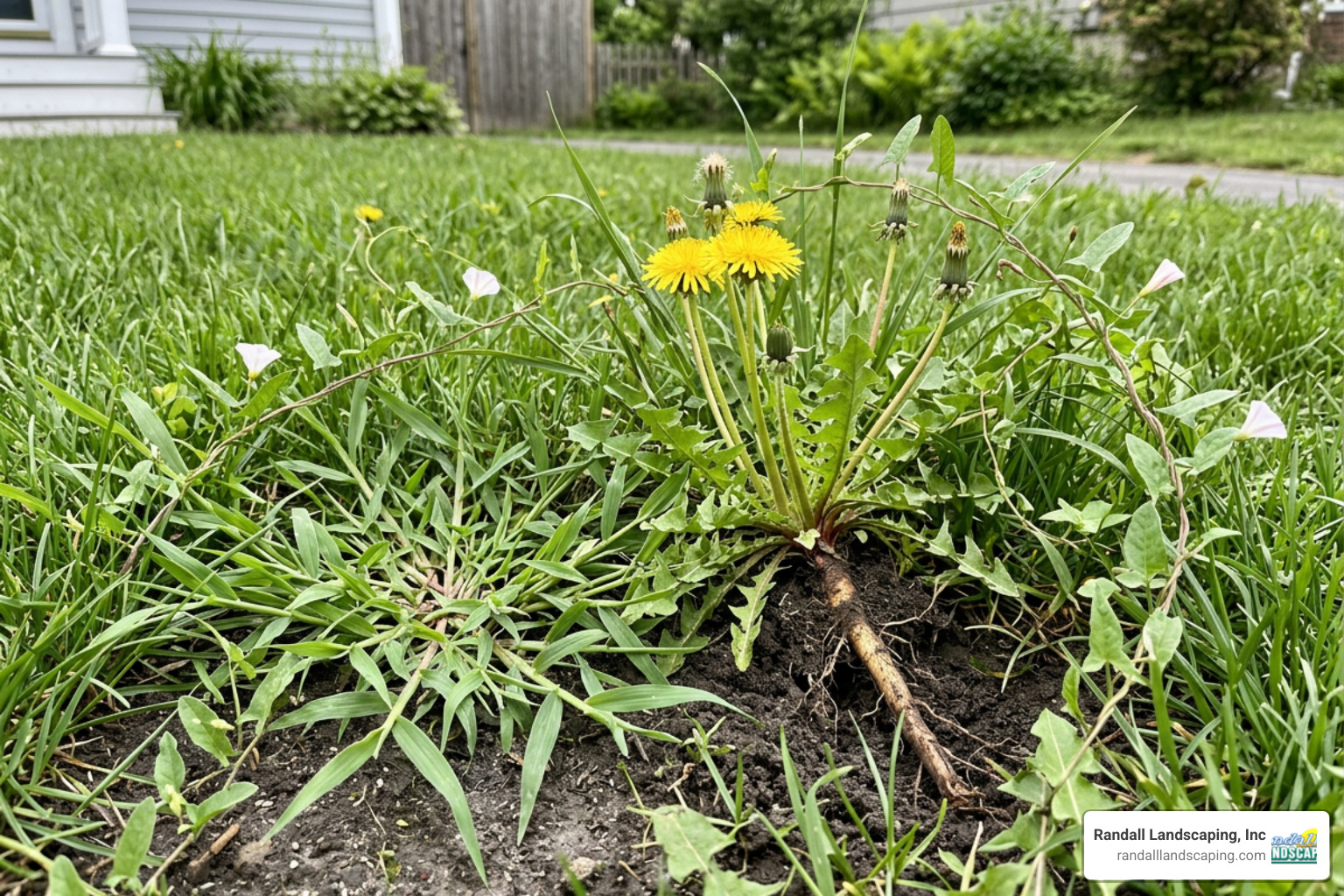
Here are the usual suspects we see when performing residential landscaping services in Georgetown:
- Dandelions: The most recognizable broadleaf weed. They have deep taproots that can reach up to a foot into the soil, making them incredibly resilient. If you don’t pull the whole root, they’ll be back before you know it.
- Crabgrass: An opportunistic annual that thrives in thin or bare spots. It spreads its “legs” out in a circular pattern and can produce thousands of seeds per plant if left to mature.
- Bindweed: Often confused with morning glories, this perennial vine twists around your grass and plants, literally strangling them as it climbs toward the sun.
- Chickweed: A common winter annual that loves the cool, moist spring weather in Massachusetts. It forms thick, low-growing mats that can smother young grass.
- Purslane: This succulent-like weed loves the heat of July and August. It stores water in its fleshy leaves, allowing it to survive even the driest Georgetown summers.
- Bermuda Grass: While used as a lawn in the south, up here in the Northeast, it is often viewed as an aggressive, invasive grassy weed that disrupts the uniform look of a fescue or bluegrass lawn.
- Foxtail: Identifiable by its fuzzy, “fox-tail” seed head, this weed is a prolific seeder that can quickly take over edges and distributed soil.
Distinguishing Broadleaf vs. Grassy Weeds
Understanding the difference between these two categories is vital because the treatments used to kill them are often very different.
Broadleaf weeds (like dandelions, clover, and chickweed) have wide, flat leaves with veins that branch out. They are often “dicots,” meaning they produce flowers. Because their leaf structure is so different from grass, we can use selective herbicides that target the weed’s unique biology without hurting your lawn.
Grassy weeds (like crabgrass and foxtail) are much trickier. They look and grow very much like your actual lawn grass. They have narrow leaves with parallel veins and jointed stems. Because they are so similar to your “good” grass, treating them with liquid sprays requires high-precision products and perfect timing to ensure we don’t accidentally yellow your turf.
Seasonal Weed Varieties
Weeds in Georgetown don’t all show up at once; they follow a strict seasonal calendar.
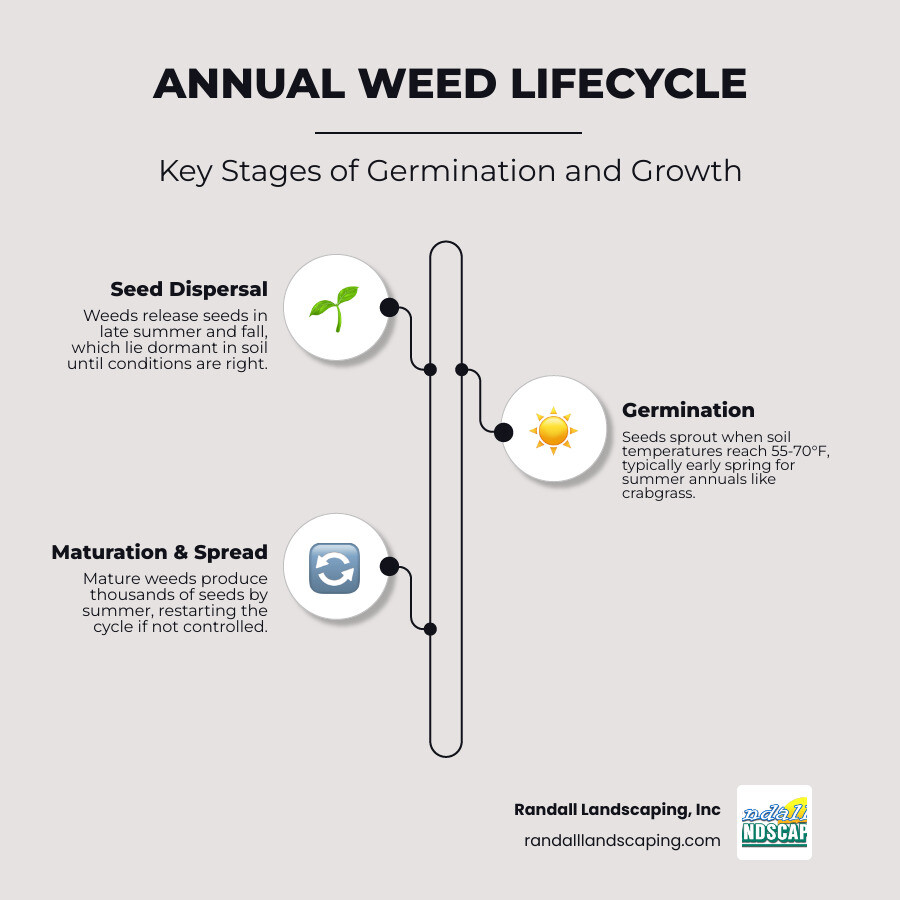
- Winter Annuals: These actually germinate in the late fall, stay dormant during the snow, and then explode into growth the moment the ground thaws in March or April. Chickweed and deadnettle are the leaders here.
- Summer Annuals: These seeds wait for the soil to warm up (usually around 55 degrees). Crabgrass is the king of summer annuals, germinating in late spring and dying off with the first hard frost.
- Perennials: These are the long-term residents. They live for multiple years and have deep root systems or underground stems (rhizomes) that survive the winter. Dandelions and clover fall into this category.
Professional Weed Control Georgetown: Pre-Emergent vs. Post-Emergent Treatments
When we talk about weed control Georgetown programs, we use a two-pronged approach. Think of it like medicine: one is a vaccine (pre-emergent) and the other is a cure (post-emergent).
Pre-Emergent Treatments work by creating a microscopic chemical barrier at the soil surface. When a weed seed germinates and tries to send up its first shoot, it hits this barrier and dies before it ever sees the sun. This is the most effective way to handle crabgrass.
Post-Emergent Treatments are applied directly to the leaves of weeds that are already visible in your lawn. These products travel down through the plant to kill it all the way to the root.
Optimal Timing for Weed Control Georgetown Applications
Timing is everything in New England. If you apply a pre-emergent too late, the “gate is already open” and the weeds have sprouted. If you apply it too early, the barrier might break down before the seeds are ready to grow. We often reference Growing Degree Days to ensure our applications coincide perfectly with weed biology.
- Late Winter/Early Spring: This is the window for your first pre-emergent round. We look for local biological indicators, like when the Forsythia bushes start blooming. That’s nature’s way of saying the soil is hitting 55 degrees—the perfect time for crabgrass prevention.
- Late Spring: A second round of pre-emergent is often applied to extend the barrier into the peak of summer, alongside post-emergent spot treatments for dandelions that escaped the winter.
- Fall: This is a critical time for weed control in Georgetown. We apply treatments to kill off perennial weeds while they are busy storing nutrients for the winter, and we put down a fall pre-emergent to stop those winter annuals from taking root.
How Soil and Climate Affect Management
Our local soil plays a huge role in how weeds grow. Much of the soil in the Merrimack Valley can be acidic or become heavily compacted.
Soil Compaction: When your soil is hard and packed down, grass roots struggle to breathe. However, weeds like pineapple weed and plantain thrive in packed soil. We often recommend aeration to loosen things up, giving your grass a competitive edge.
Rainfall Impacts: A very wet spring can wash away some herbicide barriers, while a very dry summer can stress your grass, leaving openings for heat-loving weeds to move in. We monitor the local weather patterns closely to adjust our application strengths and timing.
Managing Weeds in Hardscapes, Garden Beds, and Invasive Species
Weeds don’t just stay in the grass. They love the cracks in your driveway, the spaces between your patio pavers, and the rich soil of your mulch beds.
In garden beds, we focus on prevention. Using high-quality mulch for weed control is one of the best defenses. A three-inch layer of mulch blocks the sunlight that weed seeds need to germinate. For even more protection, we can install professional-grade landscape fabric under the mulch.
Protecting Patios and Walkways
Hardscapes are a major investment. Weeds growing in the joints of your pavers can actually push them apart over time, leading to tripping hazards and expensive repairs.
For walkway installation and existing hardscaping in Georgetown, we use a combination of:
- Power Washing: To clear out existing debris and weed roots.
- Polymeric Sand: A special sand that hardens like concrete when misted with water, making it nearly impossible for seeds to take root in the cracks.
- Sealants: High-quality sealants help protect the stone and the joints from moisture and seed intrusion.
Eradicating Invasive and Aggressive Species
Some weeds aren’t just annoying; they are ecologically damaging. Invasive species can grow rapidly and outcompete the native plants that support our local birds and pollinators. Addressing these requires long-term monitoring and aggressive root removal. We focus on growth suppression and encouraging native plant competition to keep these bullies at bay.
The Cost of Professional Weed Control in Georgetown
Many homeowners wonder if it’s cheaper to just buy a bag of “weed and feed” at the big-box store. While the upfront cost of a DIY bag is lower, the “value” often isn’t there. Professional products are more concentrated, our equipment is calibrated for even coverage, and we have the expertise to identify exactly which weed is growing so we don’t waste money on the wrong chemical.
| Factor | DIY Approach | Professional Service |
|---|---|---|
| Product Quality | Consumer-grade (lower concentration) | Professional-grade (targeted & effective) |
| Equipment | Basic spreader (often uneven) | Calibrated sprayers & spreaders |
| Expertise | Trial and error | Accurate ID & timing |
| Results | Hit or miss | Guaranteed results |
| Time | 2-4 hours per weekend | 0 hours (you relax!) |
Average Pricing and Service Packages
Note: These are average costs based on internet data and not actual costs for Randall Landscaping.
In the Georgetown area, professional lawn treatments typically range from $65 to $260+ per treatment, depending on the size of your property and the complexity of the weed issues. Most homeowners find the best value in an annual program, which usually includes 5 to 7 visits per year. Many companies offer bundled service discounts if you combine weed control with commercial landscaping or residential maintenance.
The Long-Term Value of Weed Control Georgetown Services
Investing in a professional program pays off in several ways:
- Property Appreciation: A lush, weed-free lawn can significantly boost your home’s curb appeal and overall market value.
- Time Savings: You get your weekends back to enjoy the local parks or spend time with family.
- Healthier Landscape: By eliminating competition, your grass, trees, and shrubs can grow stronger and more resistant to disease.
- Guarantees: Most professional services offer satisfaction policies—if the weeds come back between visits, we do too.
Cultural Practices to Prevent Weed Growth
The best defense is a good offense. A thick, healthy lawn is the single most effective “weed killer” there is. When your grass is dense, there is simply no room for weed seeds to reach the soil and find sunlight.
To maintain that density, we recommend these cultural practices:
- Mowing Height: Never scalp your lawn. We recommend keeping your grass at 3 to 3.5 inches. This taller grass shades the soil, keeping it cooler and preventing weed seeds from germinating.
- Proper Irrigation: Water deeply and infrequently. This encourages your grass roots to grow deep into the soil. Shallow, daily watering only helps the weeds on the surface.
- Core Aeration: This process pulls small plugs of soil out of the ground, allowing air, water, and nutrients to reach the root zone. It’s the best way to fight the compaction that weeds love.
- Overseeding: We often follow aeration with overseeding to fill in thin spots. For the best results on bare ground, we also offer hydroseeding services to establish a thick carpet of grass quickly.
Eco-Friendly and Organic Suppression Methods
For our neighbors who prefer a more natural approach, there are several effective organic options.
- Corn Gluten Meal: This is a byproduct of corn processing. It acts as a natural pre-emergent by drying out the tiny roots of germinating seeds. It also adds a bit of nitrogen to the soil.
- Vinegar Solutions: High-concentration horticultural vinegar can be used to “burn” the leaves of young weeds in cracks and beds.
- Boiling Water: A simple and effective way to kill weeds in sidewalk cracks without any chemicals at all.
- Soil Health Optimization: By balancing your soil’s pH (often with lime applications) and increasing organic matter, you create an environment where grass thrives and weeds struggle.
Maintaining Lawn Density
Weeds are “pioneer” species—they are the first things to grow in “bad” soil. By managing your lawn’s thatch layer (the organic debris between the grass blades and the soil) and maintaining a proper nutrient balance, you create a “Pest Barrier” that naturally keeps your yard looking like a golf course.
Frequently Asked Questions about Georgetown Weed Control
What is the best time to apply pre-emergent in Georgetown?
The “golden window” is usually between mid-April and early May. A good rule of thumb is to have your first application down before the yellow Forsythia blooms begin to drop. If you miss this window, you’ll have to rely much more on post-emergent treatments throughout the summer.
Are professional weed control treatments safe for pets and children?
Yes, when applied correctly. We always recommend staying off the lawn until the liquid treatments have completely dried (usually 1-2 hours) or until granular treatments have been watered in. Once dry, the products are bonded to the plants and soil and are safe for your family to enjoy.
How long does it take to see results after a post-emergent treatment?
You will usually see weeds begin to curl or turn yellow within 3 to 7 days. However, some “tough” weeds like clover or ground ivy may take two applications or up to 21 days to completely disappear.
Conclusion
A beautiful lawn doesn’t happen by accident. It’s the result of a partnership between a dedicated homeowner and a professional team that knows the local land. By combining the right weed control Georgetown treatments with smart mowing and watering habits, you can stop the “weed jungle” before it starts.
At Randall Landscaping, Inc., we pride ourselves on being 100% reliable. We live and work in the Merrimack Valley, and we understand exactly what your Georgetown soil needs to stay healthy and vibrant year-round. Whether you need a full seasonal program or help with a specific invasive species, we are here to help.
Ready to take your yard back? Request a professional lawn maintenance quote today and let’s get started on making your lawn the envy of the neighborhood!