
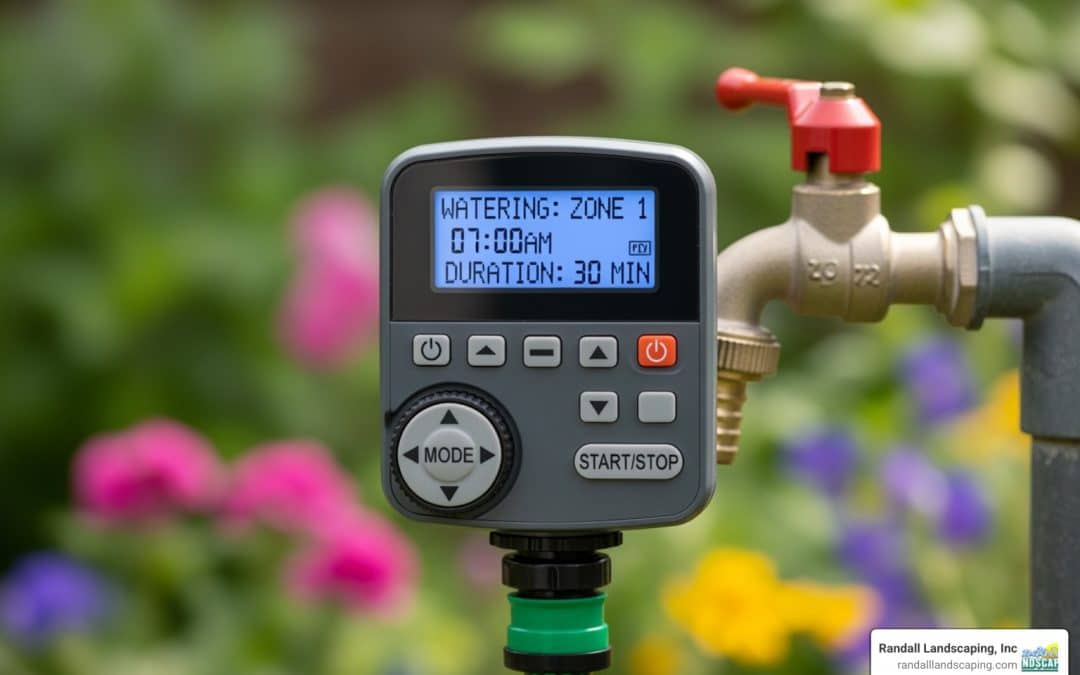
Why Every Garden Needs an Automated Watering Solution
A garden irrigation system timer transforms watering from a daily chore into an automated process that saves time, conserves water, and promotes healthier plants. The right timer eliminates guesswork, with smart systems capable of reducing outdoor water use by up to 30%, making them both eco-friendly and budget-conscious.
Quick Timer Recommendations:
- Mechanical Timers – Best for basic, supervised watering ($10-$30)
- Digital Timers – Best for programmable schedules ($25-$70)
- Smart Wi-Fi Timers – Best for app control and water conservation ($40-$250+)
- Multi-Zone Timers – Best for different garden areas with varying needs
The key is matching your timer to your garden’s needs—from simple mechanical dials for small yards to smart controllers that adjust watering based on weather forecasts.
I’m Tommy Randall, owner of Randall Landscaping Business. With 18 years in the landscaping industry, I’ve helped countless homeowners choose and install the perfect garden irrigation system timer. My experience shows that the right timer is often the difference between a thriving garden and one that struggles with inconsistent watering.
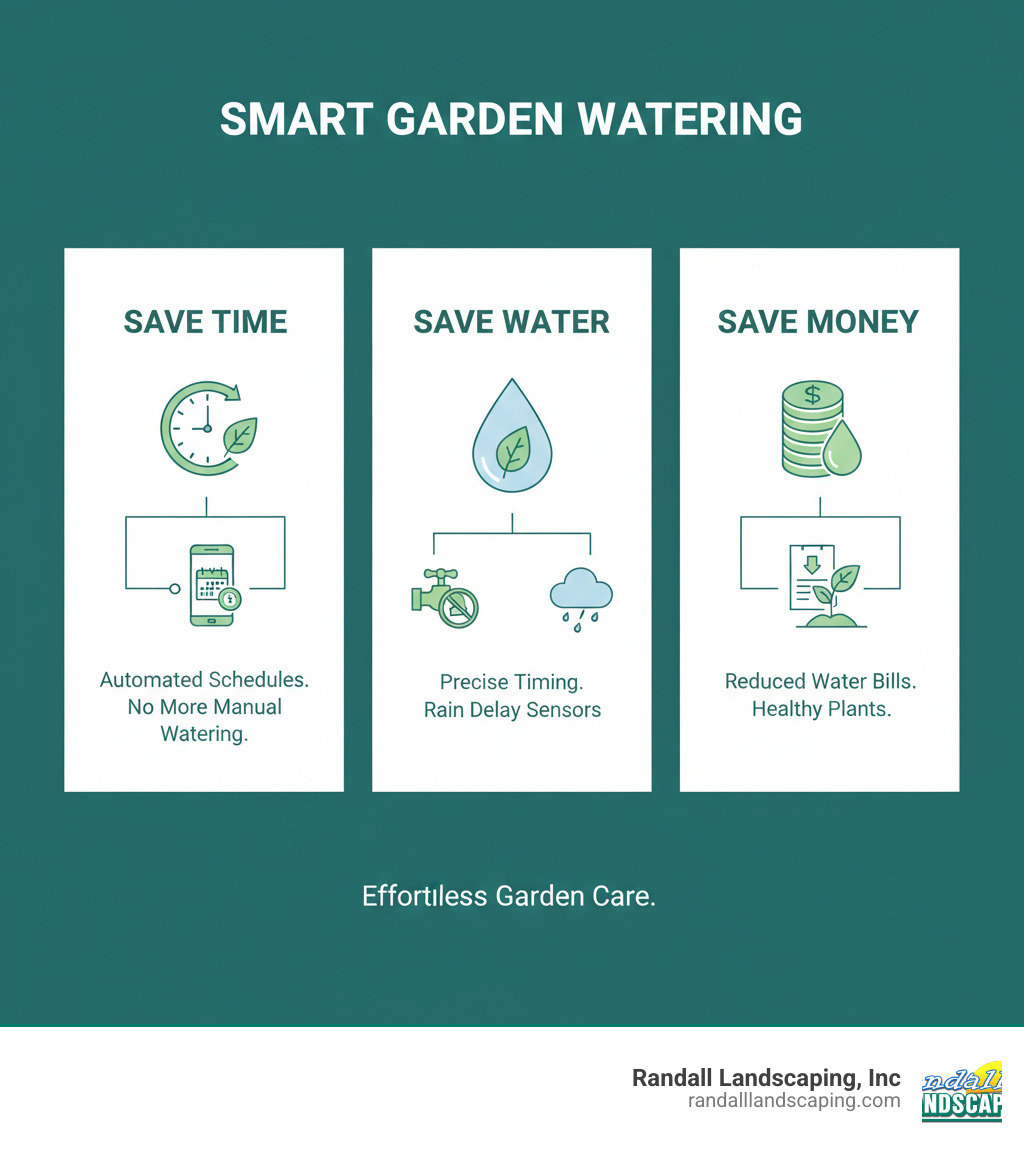
Why Your Garden Needs an Irrigation Timer
An automated garden irrigation system timer means your garden gets perfectly watered without you lifting a finger. No more rushing around with a hose or forgetting to turn off the sprinkler.
Water conservation is a major benefit. Smart watering systems can reduce outdoor water use by up to 30%. These timers deliver the right amount of water precisely when needed, cutting out wasteful runoff and evaporation common with manual watering.
Your plants thrive on consistent watering schedules. When plants receive water at the same time each day, their roots grow deeper and stronger. A timer prevents both over-watering and under-watering, two of the biggest threats to home gardens. Overwatered plants develop weak, soggy roots, while underwatered plants become stressed and struggle to survive hot summer days. A timer ensures healthier root systems that can withstand environmental stress.
The convenience is a game-changer, especially for vacations. With a timer, you can relax knowing your garden is cared for, eliminating the worry of a running sprinkler or a forgotten watering day.
Finally, you’ll save money on water bills. Precise, scheduled watering means you aren’t paying for water that runs down the storm drain or evaporates in the midday sun. Every drop is used effectively to nourish your plants.
Understanding the Types of Garden Irrigation System Timers
Choosing the right garden irrigation system timer is simple once you understand the three main categories. Each offers different features and convenience, much like choosing between a basic tool and a high-tech gadget.
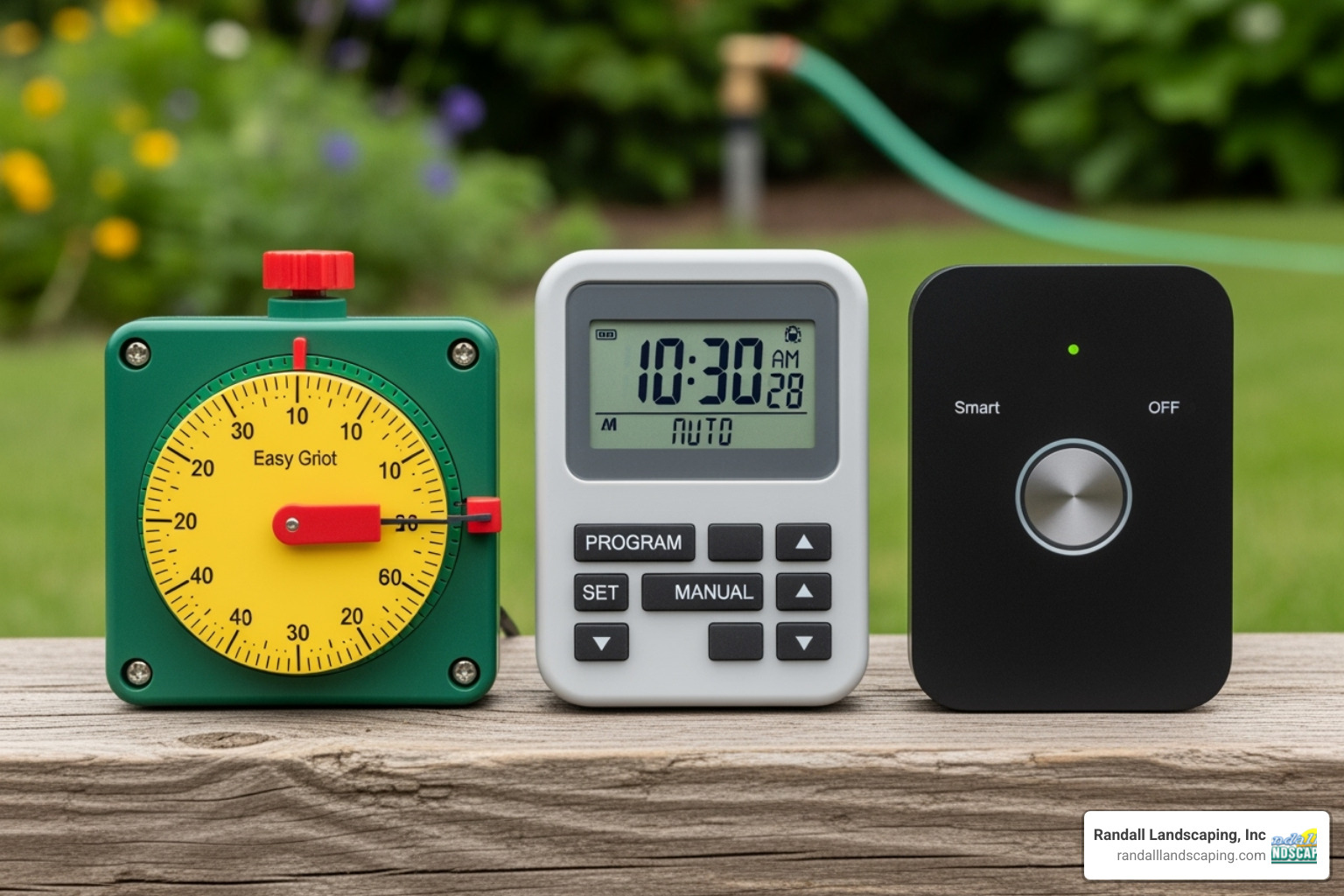
Understanding the pros and cons of each type will help you find the perfect match for your garden and lifestyle.
Mechanical Timers
For those who value simplicity, mechanical timers are the no-frills workhorses of the watering world. Their beauty lies in their simple dial operation: just twist the dial to set the watering duration. Since they operate on water pressure, there are no batteries required, making them maintenance-free from a power standpoint.
Their low cost makes them ideal for budget-conscious gardeners or for simple, supervised watering tasks. The main limitation is that they only set a duration, not a schedule, meaning you must manually turn them on each time.
Digital Timers
Digital timers offer a great balance of control and ease of use. Their main advantage is programmable schedules. Using the LCD screen, you can set specific days, times, and durations with precision. Want to water every Monday and Friday at 6 AM for 30 minutes? A digital timer makes it easy.
These timers are battery-operated, typically requiring annual battery replacement. Many models also include rain delay features, allowing you to pause the schedule for 24-72 hours with the press of a button. Once programmed, you can truly set it and forget it.
Smart (Wi-Fi) Timers
Smart timers are the cutting edge of irrigation technology. The global smart irrigation market is projected to reach USD 4.5 billion by 2030, reflecting a growing demand for systems that combine convenience with powerful water conservation.
The key feature is app control via smartphone. With Wi-Fi or Bluetooth connectivity, you can adjust your watering schedule from anywhere. The real magic is in the weather-based adjustments, where the system uses hyperlocal weather data to automatically skip watering when it rains or reduce it on humid days.
Features like water usage tracking and voice control compatibility with Alexa or Google Home add to the convenience. Smart timers don’t just automate watering—they optimize it for maximum efficiency, healthier plants, and lower water bills.
How to Choose the Right Garden Irrigation System Timer
Finding the perfect garden irrigation system timer requires matching the right tool to the job. This guide breaks down the essential factors to consider, ensuring you choose a timer that fits your garden and lifestyle.
Assess Your Garden’s Needs
Before shopping, assess your garden’s specific requirements.
- Garden Size: A small patio may only need a simple mechanical timer, while a large property benefits from a multi-zone system.
- Watering Zones: If you have areas with different water needs (e.g., a vegetable garden and a drought-tolerant flower bed), you’ll need a multi-zone timer to create separate schedules.
- Irrigation Type: Sprinklers work best with shorter, frequent cycles to prevent runoff, while drip systems require longer, less frequent sessions to water roots deeply.
- Plant Types: Grouping plants with similar water needs simplifies programming.
- Climate: Arid regions demand consistent watering, while areas with unpredictable rain benefit from rain delay or smart weather features.
This garden assessment is the foundation of a successful watering system.
Key Features to Consider
Once you know your garden’s needs, match them with the right features.
- Number of Outlets/Zones: A single-zone timer is fine for uniform spaces, but multiple zones allow you to customize watering for different areas.
- Programmability: Basic timers may offer simple daily cycles, while advanced units allow for specific start times, durations, and frequencies (e.g., every other day, multiple times per day).
- Manual Watering Button: This lets you provide extra water on demand without disrupting your programmed schedule.
- Rain Delay: Manual delays let you pause watering when storms are forecast, while automatic smart systems use weather data to skip cycles.
- Durability and Weatherproofing: Look for solid construction and good weather ratings, such as an IPX5 rating, which protects against water jets.
- Water Pressure Compatibility: Most timers require 20 to 80 PSI to function correctly. Check your home’s pressure and the timer’s specifications to ensure compatibility. Too little pressure can prevent the valve from working, while too much can cause damage.
Budget and Price Range
Garden irrigation system timer prices vary based on technology and features.
- Mechanical timers are the most budget-friendly, typically ranging from $10 to $30. Heavy-duty models can cost $90 or more.
- Digital timers are a popular mid-range option, usually costing $25 to $70. Premium multi-zone models can reach $200 or more.
- Smart timers have the highest upfront cost, starting around $40 and extending to $250 for residential models. High-end controllers can exceed $800.
These are average costs based on internet data and do not reflect actual costs for Randall Landscaping. A quality timer often pays for itself through water savings and healthier plants.
Our Top Picks for the Best Garden Irrigation Timers
After years of installing and testing irrigation systems, I’ve seen which garden irrigation system timers deliver on their promises. Here are four standout options that perform well in real-world conditions, focusing on reliability, features, and value.
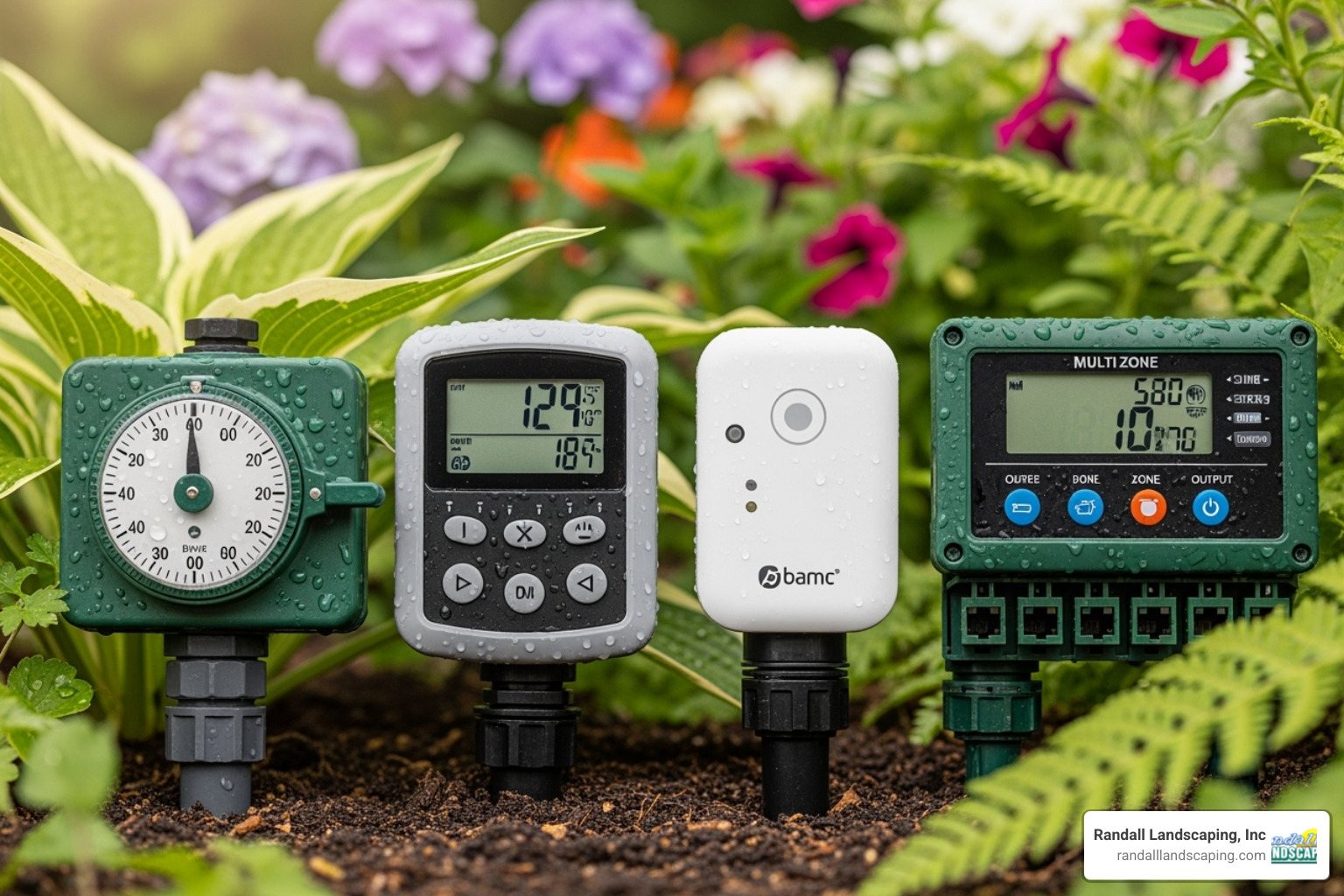
Best Overall: Digital 1-Zone Water Timer
For a reliable timer that “just works,” digital single-zone models are an excellent choice, balancing simplicity and function. They are known for reliability and durability, holding up well in New England weather. Key features include a large digital display for intuitive programming and a manual rain delay button to pause watering for 24-72 hours. Many quality models also offer a wide operating water pressure range (e.g., 7 to 116 PSI), making them versatile for different homes.
Best Smart Garden Irrigation System Timer: Wi-Fi Enabled Hose Faucet Timer
Smart timers transform your phone into a powerful irrigation controller. Look for EPA WaterSense certified models, which guarantee water savings of 20-30%. The core feature is smart watering with weather sense technology, which uses hyperlocal weather data to automatically adjust schedules and skip watering when rain is forecast. A Wi-Fi hub for remote app control lets you manage your system from anywhere, and many integrate with voice assistants. Water usage tracking provides valuable data to help you optimize your schedule.
Best for Multiple Zones: 2-Zone Digital Water Timer
For gardens with diverse needs, a two-zone timer is essential. The key benefit is independent scheduling for two zones, allowing you to create separate programs for different areas, like a lawn and a flower bed. These timers offer flexible programming options, including multiple start times per day and specific day selection. Look for thoughtful design features like an angled valve for easy hose attachment and a manual watering option for each zone. Many are expandable to a four-zone version, making them a great long-term investment.
Best Budget Garden Irrigation System Timer: Mechanical Water Timer
Sometimes, the simplest solution is best. Mechanical timers are defined by their simplicity and affordability. Just twist the dial to set a watering duration up to 120 minutes. Since no batteries are needed, they are truly maintenance-free. Quality models feature durable, high-impact construction to withstand outdoor conditions. A manual override allows for untimed, continuous water flow when needed for tasks like washing a car.
Installation and Maintenance Guide
Setting up your new garden irrigation system timer is a simple DIY project. Proper installation and routine maintenance are key to ensuring your timer functions correctly for years.
Simple Installation and Setup
Most hose-end timers can be installed in under ten minutes.
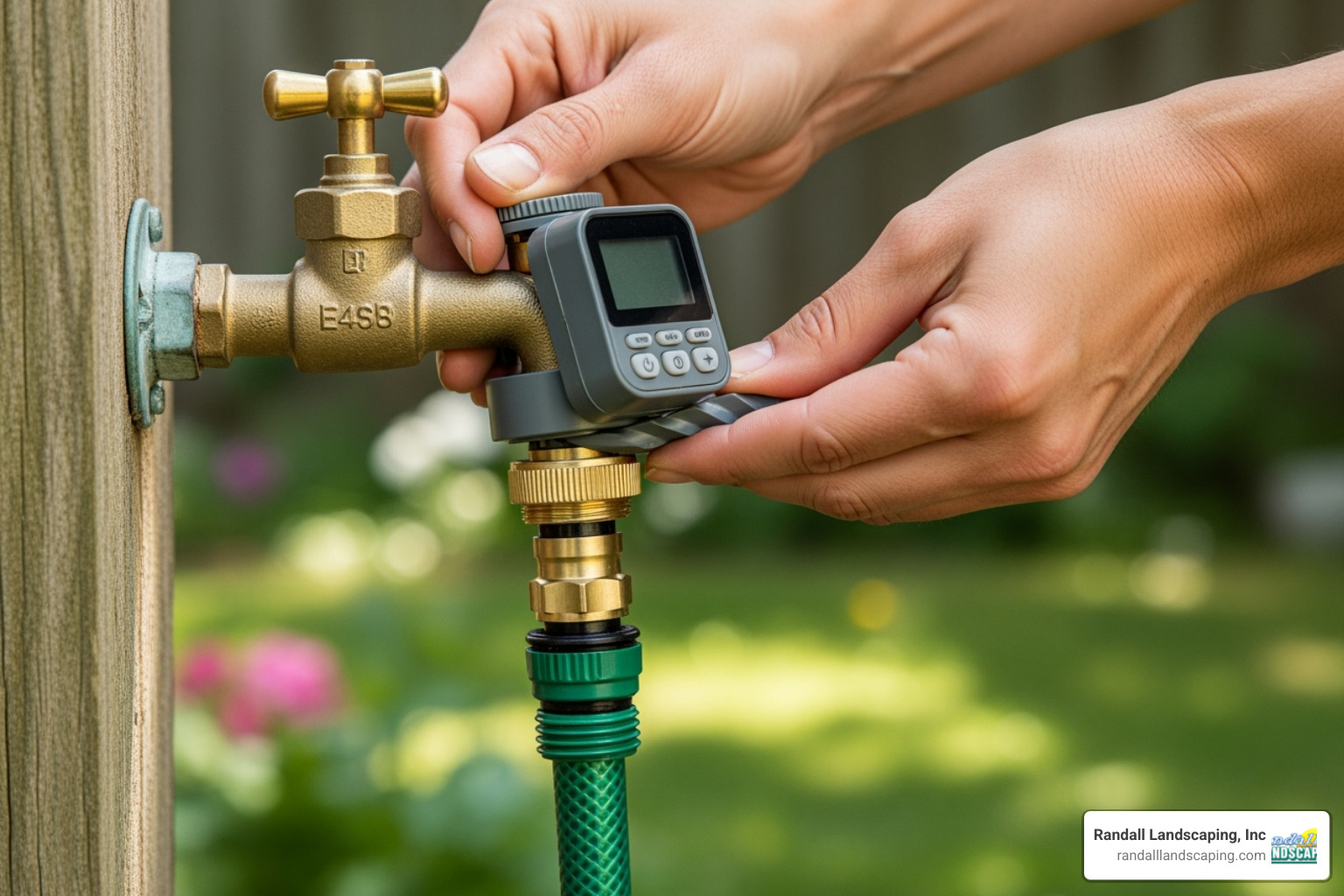
- Step 1: Attach to Spigot. Screw the timer firmly onto your outdoor spigot. Hand-tightening is usually sufficient.
- Step 2: Insert Batteries. For digital or smart timers, open the battery compartment and insert fresh batteries. For smart timers, this is also a good time to connect to the app.
- Step 3: Connect Hose(s). Attach your garden hose to the timer’s outlet. For multi-zone timers, connect a separate hose to each port.
- Step 4: Program Your Schedule. Set your watering times. Mechanical timers use a simple dial, while digital and smart timers offer more detailed programming via buttons or a smartphone app.
After connecting, turn the spigot on slowly and check for leaks, tightening connections as needed.
Essential Maintenance Tips
A little TLC will keep your garden irrigation system timer running smoothly.
- Clean the Inlet Filter: Every month, disconnect the timer and rinse the small filter screen inside the spigot connection. This prevents clogs from debris and sediment.
- Replace Batteries Annually: For digital and smart timers, replace the batteries at the start of each watering season to ensure reliability.
- Check Connections: Periodically inspect connections for leaks, as washers can wear out and fittings can loosen over time.
- Winterize: Before the first hard freeze, remove the timer from the spigot, drain any remaining water, and store it indoors. Frozen water can expand and crack the timer housing, causing permanent damage.
Frequently Asked Questions
Here are answers to the most common questions I hear from homeowners about garden irrigation system timers.
How do rain delay features work?
Rain delay is a smart water-saving feature that pauses your watering schedule when it rains. This prevents overwatering and conserves water.
- Manual rain delay, found on most digital timers, lets you press a button to pause watering for a set period (e.g., 24, 48, or 72 hours) when rain is in the forecast.
- Automatic rain delay, a feature of smart timers, uses local weather data or a physical rain sensor to skip watering cycles automatically. Some advanced systems can also connect to soil moisture sensors to prevent watering already-saturated ground.
Both types protect plants from root rot and help lower your water bill.
What water pressure (PSI) do I need for a hose timer?
Water pressure is crucial for a timer to function correctly. Most garden irrigation system timers operate best within a range of 10 to 100 PSI.
- Too little pressure may prevent the timer’s internal valve from opening or closing properly, leading to weak flow or constant dripping.
- Too much pressure can damage the timer’s internal components over time.
You can test your home’s water pressure with an inexpensive gauge from a hardware store. Always check the timer’s specifications before buying to ensure it’s compatible with your system.
Can I use one timer for both my lawn sprinklers and my flower bed’s drip system?
Yes, this is the primary purpose of a multi-zone timer. These timers allow you to set completely independent schedules for each outlet.
For example, your lawn sprinklers might run for 20 minutes three times a week, while your flower bed’s drip system runs for 60 minutes twice a week. This flexibility is essential because lawns and garden beds have very different watering needs.
By tailoring the watering schedule to each zone, you avoid common mistakes like overwatering delicate flowers or underwatering your lawn. This results in healthier plants across your entire landscape and more efficient water use.
Get a Perfectly Watered Garden, Effortlessly
A garden irrigation system timer is a small investment with significant returns in plant health, water conservation, and personal convenience. By choosing the right model—be it a simple mechanical dial, a programmable digital unit, or a feature-rich smart timer—you take the guesswork out of garden care.
Once installed, your timer ensures your plants get what they need, when they need it. You’ll enjoy a greener, healthier landscape with more free time and lower water bills. No more worrying about vacation watering or plants suffering from inconsistent care. The investment pays for itself by preventing the cost of replacing stressed plants and saving you time and frustration.
For homeowners seeking a comprehensive, professionally designed irrigation solution, our team at Randall Landscaping, Inc. ensures your system is perfectly optimized for your landscape’s unique needs. We guarantee 100% reliability and satisfaction because we understand that your landscape is an investment worth protecting.
We proudly serve residential and commercial clients throughout the Merrimack Valley and Southern New Hampshire, including communities like Andover, North Andover, Georgetown, Methuen, Plaistow, Salem, and Windham. Our 18 years of experience means you can trust us to create the vibrant landscape you’ve always envisioned.
Ready to transform your watering routine from a daily chore into an effortless, automated system?
Contact us today to learn more about our garden sprinkler system installation services!