
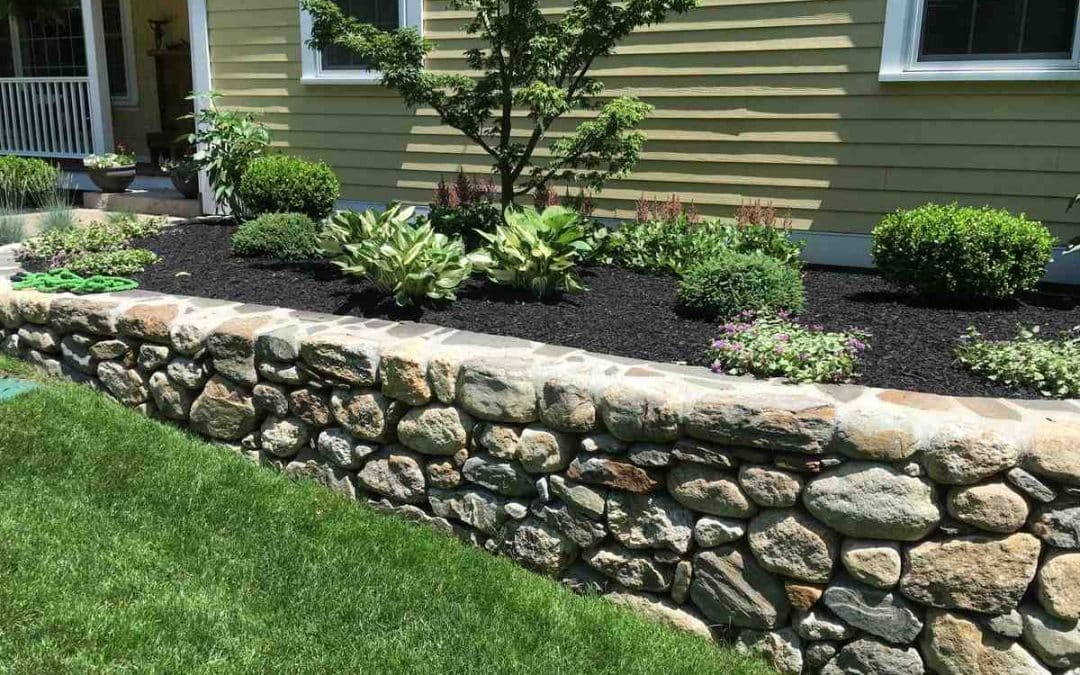
Why Your Sloped Yard Needs a Retaining Wall
A yard retaining wall is a hardworking structure that holds back soil on slopes, prevents erosion, and creates usable flat spaces in your outdoor area. Here’s what you need to know before building:
Quick Answer: Building a Yard Retaining Wall
- Purpose: Holds soil on slopes, prevents erosion, creates level areas for gardens or patios.
- Materials: Concrete blocks, natural stone, timber, or gabion baskets (average costs range from $10-$150 per sq. ft. depending on material and complexity).
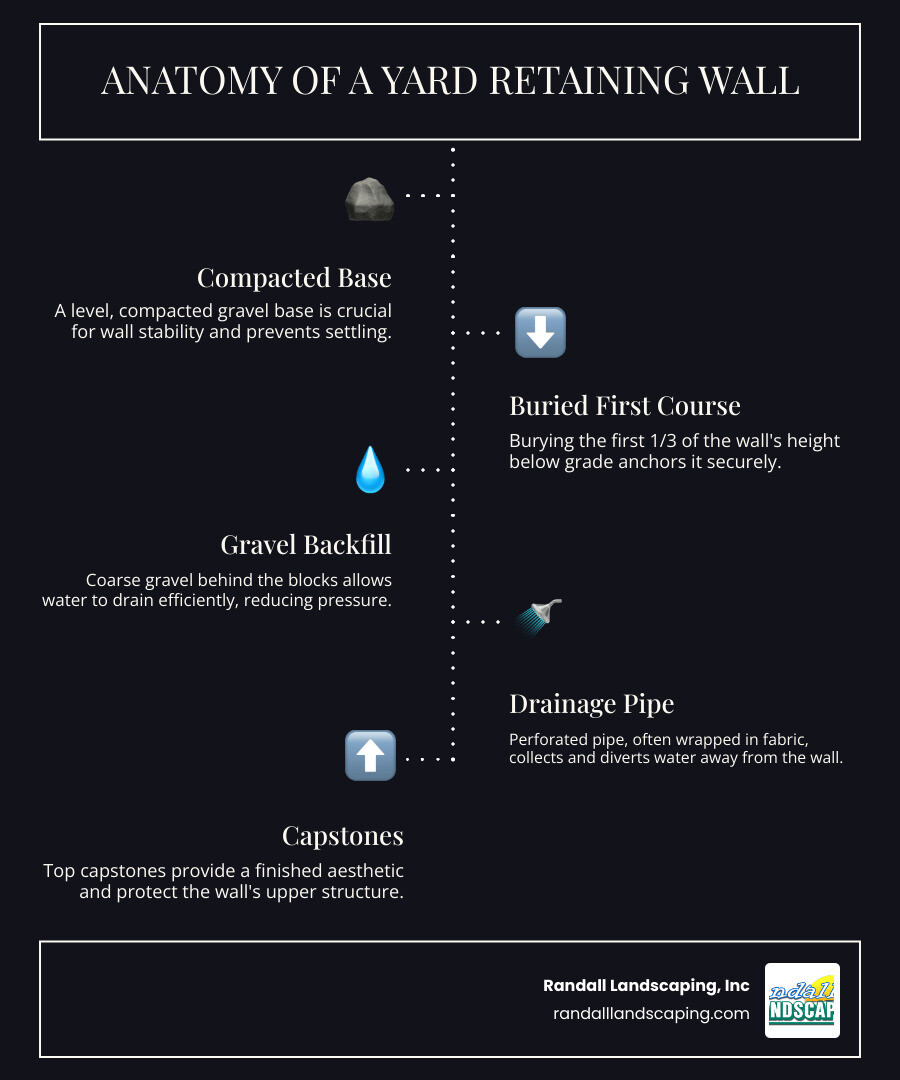
- Key Requirements: Solid gravel base, proper drainage with a perforated pipe, and a buried bottom course for stability.
- DIY-Friendly Height: Generally under 4 feet. Taller walls typically require permits and professional engineering.
- Critical Components: Compacted base, gravel backfill, drainage pipe, and setback between courses.
If your sloping yard washes away in rainstorms or you want a level patio on a hillside, a retaining wall is the solution. But a wall’s strength comes from its construction, not just its appearance. Without proper drainage, water pressure from saturated soil—weighing over 100 pounds per cubic foot—can cause a wall to bulge or collapse. Understanding basic engineering is critical to prevent failure.
The good news is that building a short retaining wall (under 4 feet) with interlocking concrete blocks is an achievable DIY project. It requires digging a proper trench, compacting a gravel base, and installing drainage. The work is physical, but the steps are straightforward.
This guide covers planning, material selection, installation, and common mistakes. I’m Tommy Randall, owner of Randall Landscaping Business, and I’ve been building yard retaining walls across Massachusetts and New Hampshire since 2006. I’m here to help you get it right the first time.
Planning Your Perfect Retaining Wall
Proper planning is the difference between a yard retaining wall that lasts for decades and one that fails. Before you start, understand your goals, choose materials wisely, and design a wall that works with your landscape.
What is the Purpose of Your Wall?
A retaining wall’s primary job is to hold soil in place on a slope, preventing erosion. It can also transform an unusable slope into flat, usable space for a patio or garden. A true retaining wall is engineered to hold back immense soil pressure, while a freestanding wall is a decorative feature on flat ground that defines spaces. For more details, see our guide on landscape wall construction.
Choosing the Right Materials: Pros, Cons, and Costs
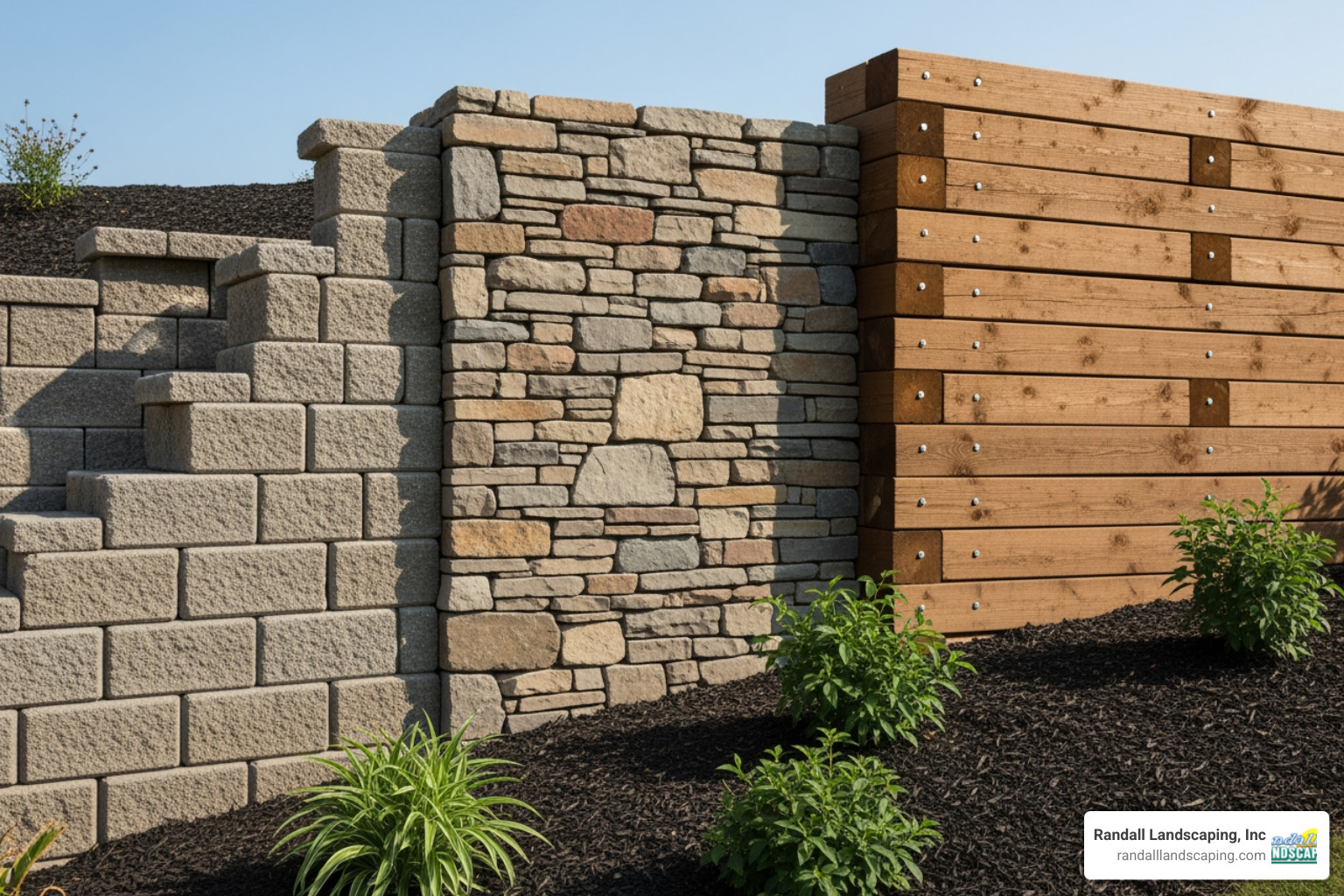
Your material choice affects budget, longevity, and appearance. In New England, materials must withstand freeze-thaw cycles.
| Material Type | Average Cost per Sq. Ft. (Installed)* | Lifespan | DIY-Friendliness | Best Use Cases |
|---|---|---|---|---|
| Modular Concrete Blocks | $15-$45 | 50+ years | High | Most residential walls under 6 feet; curved or straight walls |
| Poured Concrete | $20-$60 | 75+ years | Low | Tall walls; basement walls; commercial projects |
| Natural Stone | $25-$75 | 100+ years | Low | High-end residential; historic properties; accent walls |
| Wood/Timber | $10-$30 | 15-25 years | Medium | Short, temporary walls; rustic landscapes; tight budgets |
| Gabion Baskets | $20-$60 | 30-50 years | Medium | Modern designs; excellent drainage areas; erosion control |
*These are average costs based on internet research and do not reflect specific pricing from Randall Landscaping, Inc.
Budgeting and Essential Engineering
For a DIY project, materials might cost $15 to $30 per square foot. Professional installation typically runs $20 to $60 per square foot but can reach $150 or more for complex projects. Key factors include material choice, wall height, site preparation, and labor. For more on professional builds, see our page on quality retaining walls.
Follow these engineering principles for a stable wall:
- The 4-Foot Rule: Walls under 4 feet are often DIY-friendly and may not need permits. Taller walls require professional engineering.
- Drainage is Everything: Install a perforated drain pipe at the base and use gravel backfill to relieve water pressure.
- The 1/3 Rule: Bury the first course of your wall at least one-third of the wall’s total height to anchor it.
- Geogrid: For walls approaching 4 feet, use geogrid reinforcement for added stability. According to Oregon State University’s guide, proper soil assessment and reinforcement are critical.
Planning Your Perfect Retaining Wall
A successful yard retaining wall starts with careful planning. Rushing this phase can lead to a leaning wall within a year.
What is the Purpose of Your Wall?
A retaining wall’s main job is to hold back soil on a slope. But it also provides structural support, transforms hillsides into flat, usable space for patios, and creates raised garden beds. A true retaining wall is engineered for soil pressure, unlike a decorative freestanding wall on flat ground. Learn more in our guide to landscape wall construction.
Choosing the Right Materials: Pros, Cons, and Costs
Your material choice impacts cost, longevity, and aesthetics. For New England’s freeze-thaw cycles, engineered blocks and stone are excellent choices.
- Modular Concrete Blocks: A DIY favorite. Durable (50-100+ years) and interlocking. Average installed costs are $15-$45 per sq. ft.
- Natural Stone: Timeless beauty. Can last over a century but requires skill. Costs range from $10-$85+ per sq. ft.
- Poured Concrete: Maximum strength for tall walls. Not DIY-friendly. Costs average $20-$60 per sq. ft.
- Treated Wood/Timber: Budget-friendly and rustic, but only lasts 20-40 years. Costs average $10-$40 per sq. ft.
- Other Options: Gabion baskets ($10-$40/sq. ft.) offer modern style and great drainage. Brick ($30-$90/sq. ft.) is classic, while steel ($35-$150/sq. ft.) is for contemporary designs.
*Please note: These are average costs based on internet data and not actual costs for Randall Landscaping. Your specific project costs will vary.
Budgeting Your Project: How Much Does a Yard Retaining Wall Cost?
Nationally, homeowners spend between $3,200 and $9,200, but costs can reach $150 per square foot for premium projects. The biggest factors are materials, wall size, site preparation (grading can add $900-$3,000), and labor ($50-$100/hour). Drainage is a necessary upfront cost to prevent future failure. Learn more about what goes into quality retaining walls.
Essential Engineering: Height, Drainage, and Stability
Understanding physics is key to building a stable yard retaining wall.
- The 4-Foot Rule: Most communities require permits and engineering for walls over 4 feet tall due to the immense pressure.
- Drainage Planning: Water is the enemy. Install a perforated drain pipe at the base and use clean, angular gravel for backfill to prevent pressure buildup.
- The 1/3 Rule: Bury about one-third of your wall’s height below ground for stability.
- Geogrid Reinforcement: For walls over 4 feet, this synthetic mesh is essential. It locks the wall into the earth, preventing it from toppling. For more technical guidance, see this resource from Oregon State University.
How to Build a Block Retaining Wall: A Step-by-Step Guide
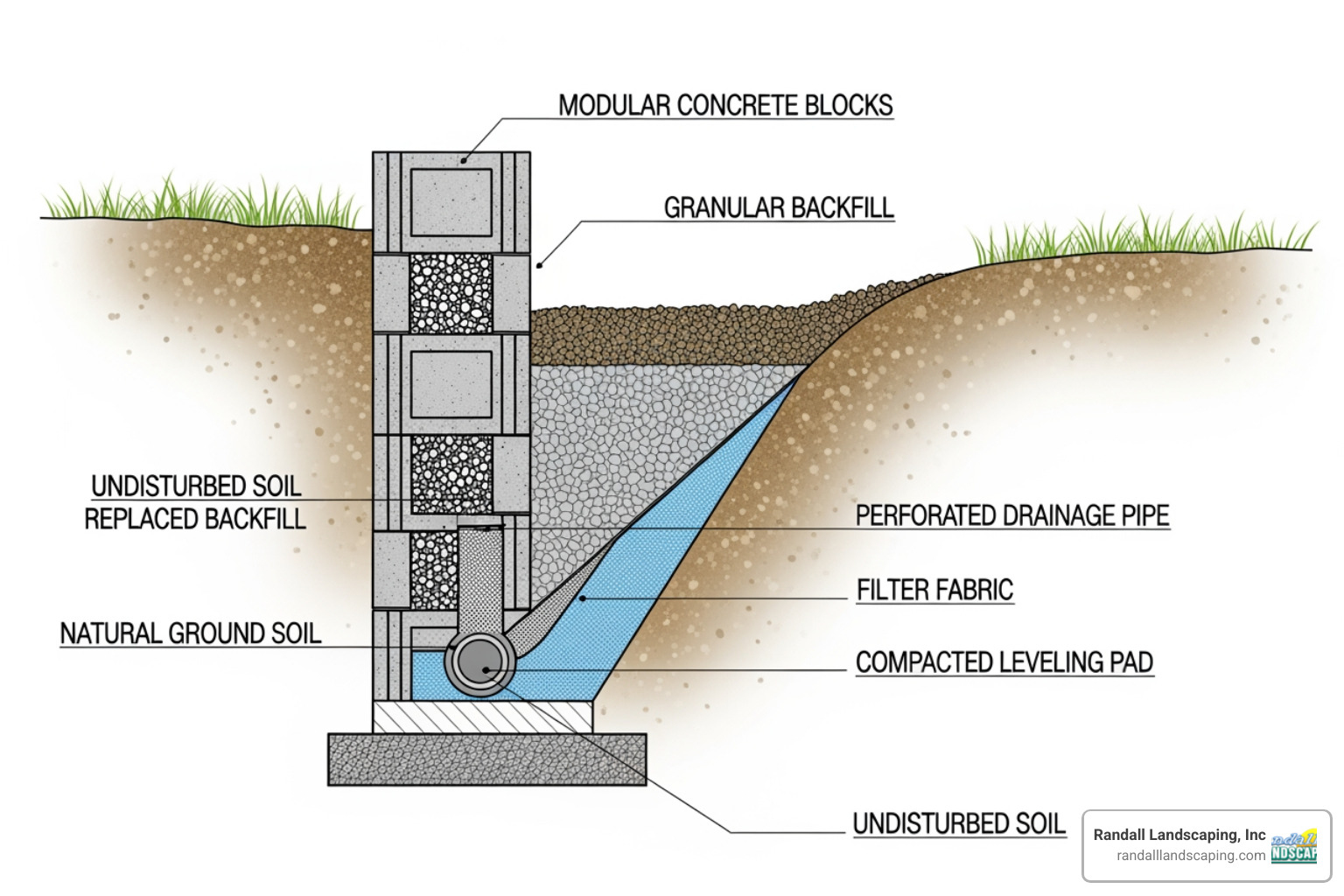
For a DIY-friendly yard retaining wall, segmental block systems are an excellent choice. This systematic approach creates a strong, stable wall. Let’s walk through the process.
Step 1: Excavation and Base Preparation
A proper foundation is non-negotiable. Start by marking your layout with stakes and string. Dig a trench at least twice the width of your block. The depth should accommodate 6 inches of base material plus enough depth to bury the first course (about 1/3 of the wall’s total height). Remove all topsoil and organic matter. Use a plate compactor to create a solid subgrade. Add 4 to 6 inches of compactable gravel (like ¾-inch minus) for your base, compacting it in 2-inch lifts until rock-solid. For more guidance, see our page on hardscaping retaining walls.
Step 2: Laying and Leveling the First Course
This is the most critical step. Place the first course of blocks on the prepared base, ensuring a portion is buried below grade. Level every block perfectly, both front-to-back and side-to-side, using a long level and a rubber mallet. An unlevel first course will throw off the entire wall, so take your time to get it right.
Step 3: Stacking, Backfilling, and Compacting
As you build upwards, follow a rhythm: stack, backfill, compact. Stagger the vertical seams between courses for strength. Most blocks have a built-in setback lip that automatically creates a slight backward lean. After laying each course, immediately backfill behind it with gravel and compact the gravel thoroughly. Do not stack the entire wall before backfilling, as this is a common and critical mistake. For more tips, see this guide from Family Handyman.
Step 4: Installing Drainage and Geogrid
After the first few courses, place a 4-inch perforated drain pipe (holes facing down) at the base of the wall, behind the blocks. Ensure it has an outlet to drain away from the wall. Cover the pipe with gravel and separate the gravel from the native soil with landscape fabric. For walls over 4 feet, install geogrid reinforcement between courses per the manufacturer’s specifications. This synthetic mesh anchors the wall to the earth, which is crucial in our New England climate.
Step 5: Capping the Wall
The capstones provide a finished look. Sweep the top course clean and apply a bead of concrete adhesive designed for landscape blocks. Set the caps firmly in place, ensuring they are aligned. Finish the area behind the wall with a layer of topsoil, sloped gently away from the structure, to allow for planting and proper surface water runoff. For professional examples, visit our residential retaining walls showcase.
Common Mistakes and When to Call a Professional
Even with careful planning, yard retaining wall projects can fail. Most mistakes are avoidable if you know what to watch for.
Top 5 DIY Retaining Wall Mistakes to Avoid
- Inadequate Foundation: Your wall is only as good as its base. Skimping on trench depth, width, or compaction will lead to shifting and failure. Remember to bury about one-third of the wall’s height.
- Forgetting Proper Drainage: Water pressure is the number one enemy of retaining walls. A missing drain pipe or insufficient gravel backfill creates a dam that will eventually break.
- Failing to Add Reinforcement: On walls approaching 4 feet or taller, geogrid fabric is not optional. It’s essential insurance against the immense lateral forces of the soil.
- Using the Wrong Backfill: Never use topsoil for backfill. It holds water and decomposes, creating pressure. Always use clean, free-draining gravel.
- Ignoring Setback and Staggering: A slight backward lean (setback) helps the wall resist pressure. Staggered joints unify the wall into a single, strong structure.
Knowing Your Limits: When to Hire a Retaining Wall Contractor
While DIY can be satisfying, some situations require a professional for safety and long-term success. Consider hiring a contractor for:
- Walls over 4 feet high: These are serious structures that require engineering and permits.
- Poor soil conditions: Heavy clay, common in the Merrimack Valley, holds water and requires expert handling.
- Steep slopes: The steeper the grade, the greater the pressure on the wall.
- Complex designs: Integrated stairs, tight curves, or tiered systems need professional skill to be structurally sound.
- When an engineer’s stamp is required: If your local building department requires it, the project is beyond typical DIY scope.
Our retaining wall builders hiring guide can help you find a qualified professional. The goal is a wall that lasts, and sometimes that means knowing when to call for help.
Frequently Asked Questions about Yard Retaining Walls
How do retaining walls help prevent soil erosion?
A yard retaining wall acts as a physical barrier, holding soil in place on a slope. It stops rain and gravity from washing away valuable topsoil, which protects your landscape and can prevent damage to your home’s foundation.
What is the difference between a freestanding wall and a yard retaining wall?
A retaining wall is an engineered structure built to withstand immense soil pressure on a slope. It requires a deep foundation and proper drainage. A freestanding wall is typically decorative, built on flat ground to define a patio or garden bed, and does not face the same structural loads.
My old wall is failing, can it be repaired?
It depends. Minor issues like a few loose capstones can often be fixed. However, significant bulging, leaning, or cracking usually points to a fundamental failure of the foundation or drainage system. In these cases, patching the wall is a temporary fix at best; a complete, properly engineered rebuild is the only safe and permanent solution. Our complete retaining wall repair guide can help you assess the damage and decide on the best path forward.
Transform Your Yard with a Lasting Retaining Wall
A well-built yard retaining wall is a powerful investment that adds beauty, usable space, and value to your property. Success hinges on three principles: plan carefully, build a solid base, and always manage water properly. Get these right, and your wall will serve you for decades.
For capable DIYers, building a wall under 4 feet can be a rewarding project. You’ll save on labor and gain hands-on knowledge of your property.
However, complex or tall walls require professional expertise. When dealing with walls over 4 feet, challenging soil like the heavy clay in our area, or steep slopes, the stakes are too high for trial and error. These situations demand engineering knowledge and specialized equipment to ensure a safe, lasting result that can withstand New England’s harsh weather.
At Randall Landscaping, Inc., we’ve been creating durable and beautiful hardscapes in the Merrimack Valley and Southern New Hampshire since 2006. We understand our local soils and climate, and we build every yard retaining wall to exceed standards, giving you peace of mind in your investment.
Whether you want to stop erosion, create tiered gardens, or add a level patio, we’re here to help you get it right. When you’re ready to transform your terrain with confidence, let’s talk.