
Why Landscape Maintenance Contracts Matter for Property Owners
Landscape maintenance contracts are formal agreements between property owners and landscaping companies outlining the scope of services, payment terms, and responsibilities for maintaining outdoor spaces.
Essential Components of a Landscape Maintenance Contract:
- Scope of Services – Detailed list of tasks (mowing, pruning, mulching, irrigation, seasonal cleanups)
- Service Frequency – How often work will be performed (weekly, monthly, seasonally)
- Pricing & Payment Terms – Total cost, payment schedule, and accepted methods
- Duration – Contract start and end dates, renewal terms
- Insurance & Liability – Coverage requirements and responsibility clauses
- Termination Conditions – How either party can end the agreement
Key Benefits:
- Protects both parties legally
- Ensures clear communication and expectations
- Provides a professional framework for service delivery
- Documents all changes and additions in writing
A solid contract transforms verbal promises into actionable commitments. The landscaping services industry grew by 12.7% in 2022, making formal agreements crucial for protecting both property owners and service providers. Without one, misunderstandings about scope, timing, or cost can quickly damage a relationship.
Whether for a commercial property, HOA, or home, a well-drafted contract ensures consistent, professional care. It clarifies what you’re paying for, when work will happen, and what to do if something goes wrong.
I’m Tommy Randall, owner of Randall Landscaping Business. Since 2006, I’ve helped property owners in Massachusetts and New Hampshire with landscape maintenance contracts. I’ve learned that the best client relationships start with clear, comprehensive agreements that eliminate surprises and build mutual trust.
Why a Formal Contract is Essential for Any Landscaping Project
A landscape maintenance contract is more than a handshake; it’s a partnership. While a handshake is friendly, maintaining your property over months or years requires something more substantial.
After nearly two decades in business, we know verbal agreements become fuzzy. Questions like service frequency, specific cleanup tasks, or repair responsibilities are answered upfront in a written contract, preventing future problems.
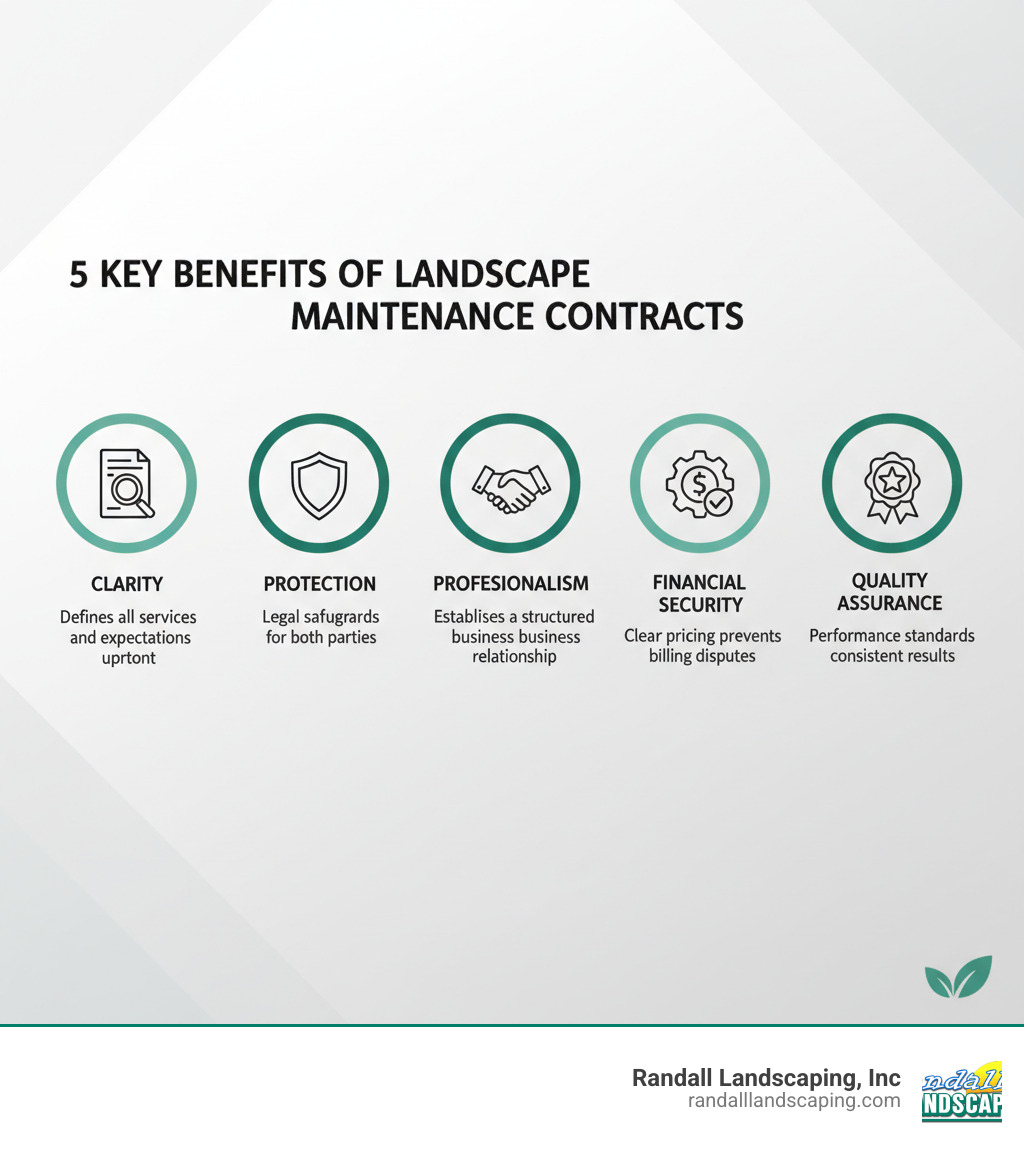
Beyond legal protection, a contract provides clarity. With everything in writing, there’s no room for misinterpretation. You know the schedule, the services, and the cost, which allows us to plan accordingly and meet your expectations. According to Forbes, transparency is crucial for building trustworthy relationships, and that’s exactly what a good contract provides.
Signing a formal agreement also professionalizes the relationship. It signals a mutual commitment—your commitment to pay and ours to deliver reliable service. This builds trust effectively.
From a practical standpoint, contracts create an invaluable legal record. If you decide six months in that you’d like us to add seasonal color plantings or adjust the mowing schedule, we can document those changes properly. Everyone stays on the same page, and there are no surprise charges or forgotten requests.
Contracts also give us the stability to serve you better. Committed clients allow us to invest in quality equipment, train skilled teams, and plan efficiently. The landscaping industry has seen significant growth, which means more competition and more fly-by-night operators. A formal contract proves we’re committed for the long haul.
Most importantly, a well-written contract ensures quality assurance. When we specify exactly what tasks we’ll perform and to what standard, you have a benchmark to measure our work against. If something isn’t meeting expectations, you can point to the contract for a professional discussion about getting back on track.
At the end of the day, landscape maintenance contracts aren’t about mistrust. They’re about creating clarity so both parties can focus on what really matters: keeping your property looking its absolute best, season after season.
Anatomy of a Comprehensive Landscape Maintenance Contract
This section breaks down the essential components every contract should include to prevent misunderstandings and ensure a smooth project from start to finish.
Key Parties and Property Details
Every solid contract starts with the basics: clearly identifying the parties involved and the service location.
Client Information should include the full legal name, contact person, phone, email, and billing address. For HOAs, this means the official name of the association or management entity.
Contractor Information details our legal business name—Randall Landscaping, Inc.—plus our address, contact info, and licensing details to build trust.
The Property Address section captures the complete physical address where we’ll be providing services.
For complex properties, a Site Map or Description of Service Areas is invaluable. It can highlight zones for intensive care, excluded areas (like personal gardens), or specific access points, ensuring no part of your property is overlooked.
The Heart of the Agreement: Scope of Services
The Scope of Services details exactly what we will do. Clarity here is crucial to avoid ambiguity.

Detailed Service Descriptions go beyond general terms. Instead of just “mowing,” we specify turf type, cutting height (e.g., 2-3 inches), frequency, and inclusion of edging and blowing. Pruning details include the type, plant species, and schedule. Every service receives this level of detail. You can learn more about our comprehensive approach on our Landscape Maintenance Services page.
Frequency of Service clarifies how often each task will be performed, such as weekly mowing from April through November or quarterly fertilization.
Exclusions (What’s Not Covered) are just as important. This section clarifies services not included, such as damage from severe storms, vandalism, or specialized tree work above a certain height. Stating exclusions prevents unexpected costs and unmet expectations.
Here’s a helpful comparison of typical services in a basic Lawn Care Contract versus a more comprehensive Landscape Maintenance Contract:
| Feature | Lawn Care Contract (Basic) | Landscape Maintenance Contract (Comprehensive) |
|---|---|---|
| Primary Focus | Health and appearance of turfgrass | Complete outdoor space management and aesthetics |
| Core Services | Mowing, edging, trimming, fertilization, weed control, aeration, dethatching, seasonal clean-ups | All lawn care services plus garden bed maintenance, pruning, mulching, irrigation management, hardscape care, and specialized treatments |
| Scope | Limited to turf and immediate surroundings | Encompasses lawns, gardens, trees, shrubs, irrigation systems, and hardscaping elements |
| Typical Frequency | Weekly or bi-weekly during growing season | Varies by service—weekly for mowing, monthly for beds, seasonal for specialized work |
Pricing, Payments, and Timelines
Having these details spelled out prevents uncomfortable conversations later.
Total Cost represents the agreed-upon price, which might be a fixed annual fee, a monthly fee, or a per-visit charge.
The Payment Schedule clarifies when payments are due (e.g., monthly, per visit, quarterly). Some 12-month contracts may have payments adjusted seasonally to reflect the workload, spreading costs fairly across the year.
Accepted Payment Methods should be clearly stated. We typically accept checks, credit cards, and electronic transfers.
Late Fee Policies detail penalties for overdue payments, such as a monthly percentage charge and the consequences of non-payment. This clarity protects both parties.
Contract Duration specifies the agreement’s length—typically 12 or 24 months—with exact Start and End Dates. Renewal Terms clarify if the contract automatically renews and under what conditions, such as requiring 30 days’ written notice of cancellation.
While pricing varies by property size and scope, average landscape maintenance contracts can range from $100 to $500+ per month for residential properties and $500 to $5,000+ per month for commercial sites in our service area. These are average costs based on internet data, not actual quotes from Randall Landscaping. We provide custom proposals for every unique property.
Essential Legal Clauses for Your Protection
These clauses are your safety net, ensuring both parties are protected.
Insurance and Liability Coverage is non-negotiable. We specify our coverage, including general liability, worker’s compensation, and business vehicle liability. The contract should state that you are named as an “additional insured” on our policy, protecting you from claims related to our work on your property.
The Termination Clause outlines how either party can end the contract, typically with written notice (e.g., 30 days). It specifies conditions for termination, such as non-payment or breach of contract, providing peace of mind for both sides.
A Dispute Resolution Process describes how to handle disagreements, usually starting with negotiation, then mediation or arbitration, to avoid costly litigation and preserve the professional relationship.
The Change Order Process for Additional Services ensures that any work outside the original scope is documented and agreed upon in writing before it begins. This prevents “scope creep” and surprise bills.
The Governing Law Clause specifies which jurisdiction’s laws will govern the contract, typically Massachusetts or New Hampshire for our clients. For more details on governing law, you can refer to Cornell Law School’s explanation.
Finally, Signatures of Both Parties are required. A signature transforms the document into a binding agreement and the foundation of a successful partnership.
Unique Considerations for Landscape Maintenance Contracts
Landscaping is a dynamic service influenced by nature and specific site needs. A robust contract anticipates these variables.
Navigating Seasonality and Weather
Landscape maintenance is profoundly affected by the seasons and weather, especially in the Merrimack Valley and Southern New Hampshire. Our landscape maintenance contracts are designed with this reality in mind.

A contract must reflect your landscape’s changing seasonal needs. Our agreements include seasonal service adjustments. For example, weekly mowing in summer shifts to fall cleanup tasks like mulching and aeration. Winter work includes dormant pruning to prepare for spring.
New England weather is unpredictable. Our contracts include weather delay clauses to address how we handle services during heavy rain, snow, or extreme heat. This clarifies how we reschedule or pause work to protect your property and our crew, avoiding surprises.
Dormant season care is also crucial, including winter watering during dry cold snaps to protect plants and turf from stress.
For our commercial clients, many landscape maintenance contracts include provisions for Commercial Snow Plowing and de-icing services. This ensures safe access throughout the colder months and is typically a separate seasonal contract.
Special Clauses for Commercial & HOA Landscape Maintenance Contracts
Managing commercial properties and Homeowners Associations requires specialized contractual considerations.
For HOAs, our contracts incorporate specific community guidelines and aesthetic standards. This ensures all work aligns with the association’s vision, maintaining uniformity and curb appeal.
High-traffic area management is crucial for commercial and HOA properties. Our contracts detail specialized care for these zones, focusing on safety, cleanliness, and appearance with more frequent maintenance like litter and debris removal.
With multiple decision-makers, communication protocols are essential. Our contracts establish clear reporting structures so property managers or HOA boards receive regular updates.
Commercial and HOA contracts often include detailed performance standards. These can specify emergency response times, cleanliness levels, or aesthetic outcomes (e.g., responding to storm damage within 24 hours), ensuring high accountability and quality.
Many of our commercial and HOA clients opt for multi-year agreements. These longer-term landscape maintenance contracts offer stability, predictable budgeting, and allow us to develop a deeper understanding of your property’s needs. Learn more about our Corporate Landscaping services and how a dedicated Commercial Landscape Maintenance Contract can benefit your business.
The Rise of Sustainable Practices in Modern Contracts
Modern landscape maintenance contracts can incorporate sustainable practices that promote healthier landscapes while minimizing ecological impact.
Sustainable water management is key. Contracts can specify smart irrigation technology that adjusts based on weather and soil moisture. We also include seasonal schedule adjustments and system checks to optimize water use and comply with local restrictions.
Integrated Pest Management (IPM) is a smarter, holistic approach to pest control. It prioritizes inspection and non-chemical controls, using targeted, reduced-risk chemical products only as a last resort. This protects the environment, wildlife, and people.
Incorporating native plant usage and climate-appropriate selections leads to reduced water needs and lower maintenance, contributing to Low Maintenance Commercial Landscaping solutions.
To prevent nutrient runoff, contracts can specify responsible fertilizer application regulations, including using slow-release products and adhering to local ordinances. We also follow Florida-Friendly Landscaping™ Guidelines principles, which emphasize environmental responsibility.
Frequently Asked Questions about Landscape Maintenance Contracts
What’s the difference between a lawn care and a landscaping contract?
Understanding this distinction is key. A lawn care contract focuses on turf health and appearance, including services like:
- Mowing, edging, and trimming
- Fertilization
- Weed control
- Aeration
- Dethatching
- Seasonal clean-ups related to the lawn
A broader landscape maintenance contract covers the entire outdoor space. This includes all lawn care services plus a wider array of tasks, such as:
- Garden bed maintenance
- Pruning of shrubs and ornamental trees
- Mulching
- Irrigation system management
- Seasonal flower planting
- Pest and disease management
- Hardscaping maintenance
- Specialized services like tree removal
- Commercial snow and ice removal
In short, a lawn care contract is a subset of a landscape maintenance contract, which provides comprehensive care for your entire outdoor environment.
How should a contract handle unexpected issues or extra work?
Unexpected issues or requests for extra work are handled through a “Change Order” clause. This clause is crucial because it:
- Requires Written Documentation: Any work outside the original scope must be formally documented.
- Outlines Agreed Costs: The cost for the additional work is clearly defined and agreed upon by both parties before work begins.
- Specifies Terms: Any new terms related to the additional work are also agreed upon in writing.
This structured approach ensures transparency and prevents misunderstandings or surprise bills.
What should I look for when hiring a contractor for my HOA?
Hiring a contractor for an HOA is a significant decision. When selecting one, look for these key elements:
- Proven Experience with HOAs: Choose companies with a track record of managing large, multi-resident properties and understanding HOA dynamics.
- Adequate Insurance Coverage: Verify they carry comprehensive liability, workers’ compensation, and auto liability insurance. Ask for a certificate naming the HOA as an additional insured to protect against claims.
- Strong References: Check references from other HOAs or large commercial clients, asking about work quality, reliability, and communication.
- Clear Communication Plan: The contractor should have a clear plan for communicating with the board and property manager, including regular updates and a process for addressing concerns.
- Detailed Scope of Work: The proposed landscape maintenance contract must be highly detailed, covering all areas and seasonal needs with specific tasks, frequencies, and performance standards.
- Understanding of Community Guidelines: The contractor must understand and agree to adhere to your HOA’s specific rules (CC&Rs) and aesthetic guidelines.
- Financial Stability: A financially stable contractor is more likely to provide consistent service.
- Sustainability Practices: Consider if the contractor offers sustainable options like IPM or water-efficient irrigation.
Choosing the right partner ensures your HOA’s landscapes improve property values and resident satisfaction. For more insights, explore information on How to Get Commercial Landscape Contracts.
Conclusion: Building a Successful Partnership Through a Clear Contract
A detailed landscape maintenance contract is the foundation of a partnership, protecting both parties and ensuring your property looks its best. Knowing the services, schedule, and cost eliminates surprises, leading to consistent, professional care that meets your expectations.
The right contract builds a relationship on trust and clear communication. You gain peace of mind, and we can focus on delivering exceptional results without misunderstandings. It’s a win-win that ensures success from the start.
At Randall Landscaping, we take pride in our 100% reliability and quality work. We’ve been serving clients throughout the Merrimack Valley and Southern New Hampshire since 2006, and we’ve learned that the most successful partnerships start with a comprehensive, clearly written contract. Whether you’re managing a commercial property in Andover, overseeing an HOA in Salem, or maintaining your home in North Reading, we believe clarity and transparency are the cornerstones of outstanding service.
Our service area includes Amesbury, Andover, Atkinson, Boxford, Dracut, Georgetown, North Andover, North Reading, Pelham, Salem, Windham, Methuen, and Lawrence. We’re ready to bring the same level of professionalism and attention to detail that has defined our work for nearly two decades.