

Why Getting Patio Paver Installation Right Matters From the Start
Patio paver installation is the process of laying individual stone, brick, or concrete units over a compacted gravel and sand base to create a durable, attractive outdoor surface.
Here’s a quick overview of how it works:
- Plan and measure your patio area, adding 10% extra for waste
- Excavate 6-8 inches deep and establish a drainage slope
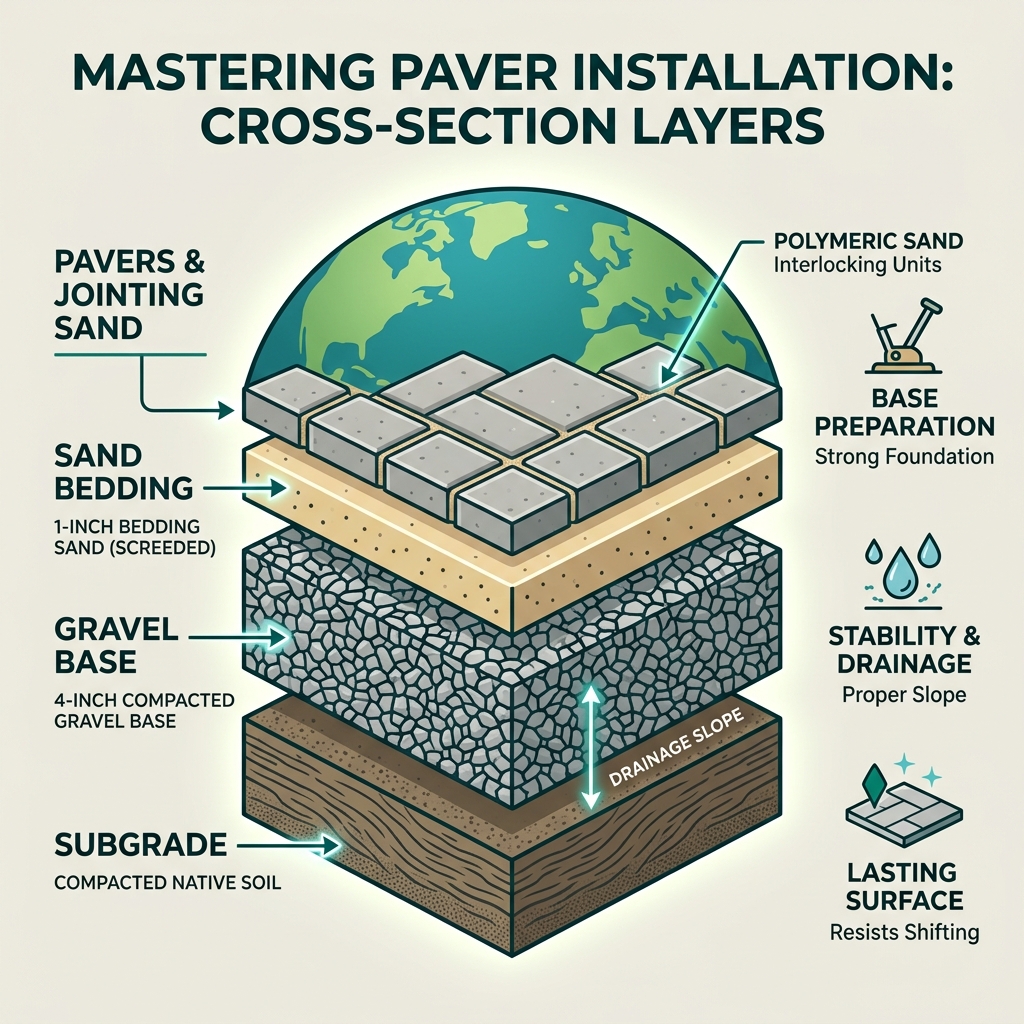
- Compact a 4-inch gravel base in 2-inch layers
- Screed a 1-inch sand bedding layer smooth and level
- Lay pavers in your chosen pattern, starting from a corner
- Cut border pavers to fit edges
- Install edge restraints to prevent spreading
- Sweep polymeric sand into joints, compact, and mist to finish
Done right, a paver patio can last 30 years or more with minimal upkeep. Done wrong, you get a wavy, shifting surface that needs repairs within a year.
That gap comes down almost entirely to base preparation, drainage, and compaction — the steps most DIYers rush through or skip.
This guide walks you through every step, from calculating materials to finishing joints, so you get it right the first time.
I’m Tommy Randall, owner of Randall Landscaping, Inc., and I’ve been involved in patio paver installation projects across Massachusetts and Southern NH since 2006. Over nearly two decades, I’ve seen what separates a patio that holds up beautifully for decades from one that starts failing after the first winter — and I’ll share all of that hard-won knowledge below.
Patio paver installation basics:
- Driveway Pavers North Reading MA
- Permeable Paver Driveway Installation
- Sealing Driveway Pavers
Essential Planning and Material Calculations
Before we ever pick up a shovel in towns like Andover or Boxford, we spend a significant amount of time with a tape measure and a calculator. Think of your materials list like a recipe; you wouldn’t try to bake a wedding cake without checking if you had enough flour and eggs. In Hardscaping, running out of gravel halfway through a Saturday afternoon is a recipe for a very long, stressful weekend.
The first step is determining your square footage. Simply multiply the length by the width of your planned area. However, we always recommend adding a 10% waste factor. If you are planning a complex design with lots of curves or diagonal cuts, bump that up to 15%. This accounts for the pavers that will inevitably break or the small off-cuts that can’t be used elsewhere.
Calculating Base and Bedding Layers
When we talk about a “solid foundation,” we aren’t just using a cliché. For a standard residential patio in the Merrimack Valley, you need a base that can handle our local freeze-thaw cycles. This typically means:
- Gravel Base: 4 inches of compacted crushed stone (Class II Road Base or 3/4-inch minus gravel).
- Bedding Sand: 1 inch of coarse, sharp sand (often called concrete sand).
To calculate how much you need in cubic yards, use these industry-standard formulas:
- For a 4-inch gravel base: Multiply your square footage by 0.01235.
- For a 1-inch sand bed: Multiply your square footage by 0.00309.
For example, if you’re building a 200-square-foot patio, you’ll need about 2.47 cubic yards of gravel and roughly 0.62 cubic yards of sand. Always round up—it is much easier to find a use for an extra pile of gravel than it is to pay for a second delivery fee.
To ensure your corners are perfectly square, we use the 3-4-5 triangle method. Measure 3 feet along one side and 4 feet along the perpendicular side. If the diagonal distance between those two points is exactly 5 feet, your corner is a perfect 90 degrees. This is a critical step in Patio Design and Construction to ensure your paver lines don’t start “wandering” as you lay them.
Selecting the Right Paver Materials
The “best” paver often depends on your aesthetic goals and how you plan to use the space.
- Concrete Pavers: These are the most common. They come in endless shapes and colors, are very durable, and often have built-in spacers to ensure even joints.
- Brick Pavers: Made of clay, these offer a timeless, classic look. They are incredibly color-fast but can be slightly more challenging to cut. Refer to the Technical Notes from The Brick Industry Association for specific brick requirements.
- Natural Stone: Materials like New England fieldstone or slate offer unmatched beauty but require a higher skill level to install because of varying thicknesses.
One tip for our neighbors in sunny spots like Georgetown or Salem: keep heat absorption in mind. Dark-colored pavers absorb significantly more sun and can become uncomfortably hot for bare feet or pets on a July afternoon.
| Feature | Concrete Pavers | Brick (Clay) Pavers |
|---|---|---|
| Durability | High (resists cracking) | Very High (lasts decades) |
| Color Variety | Endless | Limited to earth tones |
| Color Longevity | May fade over 10+ years | Never fades |
| Installation | Easier (uniform size) | Moderate (slight variations) |
Site Preparation and Excavation Requirements
Now for the part everyone loves to hate: the digging. Before your shovel even touches the dirt, you must call 811 before digging. This is a free service that marks your underground utility lines. In Massachusetts and New Hampshire, it’s not just a good idea—it’s the law. Hitting a buried gas or power line is dangerous, expensive, and a guaranteed way to ruin your relationship with the neighbors.
Once the lines are marked, we use white spray paint to outline the patio perimeter, typically extending the dig area about 6 to 12 inches beyond the actual patio size. This provides room to install edge restraints later.
Establishing Proper Drainage and Slope
Water is the primary enemy of a Custom Paver Patio. If water pools on the surface or seeps into the base without a way to escape, it will eventually cause the ground to shift or the pavers to settle unevenly.
We aim for a slope of 1 inch of drop for every 8 feet of distance away from your home’s foundation (roughly a 1% to 2% grade). To set this accurately:
- Drive stakes into the ground at the high and low ends.
- Run a tight string line between them.
- Use a line level to make the string perfectly level.
- Measure down from the string at the far end to ensure your excavation follows that same slope.
Compacting the Subgrade and Gravel Base
Once you’ve excavated to the proper depth (usually 6-8 inches for a patio), you need to compact the “subgrade” (the native soil). If the soil is loose, your patio will sink.
After the soil is firm, we recommend laying down geotextile fabric. This fabric acts as a barrier that prevents your expensive gravel from mixing with the native soil over time, which is a major cause of “lumpy” patios.
Next, add your gravel in 2-inch lifts. Do not dump all 4 inches at once! A plate compactor cannot effectively compact a thick layer of stone.
- Spread 2 inches of gravel.
- Lightly mist it with water (this helps the particles “lock” together).
- Run the plate compactor over it several times until it feels like concrete.
- Repeat for the next 2-inch layer.
Pro tip: Expect your gravel base to shrink by about 15-20% once it’s fully compacted. Factoring this into your initial order will save you a frantic trip to the stone yard.
The Core Process of Patio Paver Installation
With a rock-solid base in place, it’s time for the bedding sand. This layer is not for structural support; its only job is to provide a smooth, level surface for the pavers to sit on.
We use a technique called “screeding.”
- Place two 1-inch outside-diameter pipes (like electrical conduit) on top of your compacted gravel.
- Pour coarse concrete sand over and between the pipes.
- Use a straight 2×4 board to “screed” the sand across the pipes, pulling it toward you in a sawing motion.
- Carefully remove the pipes and fill in the indentations with a trowel.
Crucial rule: Once the sand is screeded, do not step on it. If you accidentally kick the sand, you must re-screed that area. Any footprint left in the sand will eventually show up as a low spot in your finished patio.
Choosing Patterns for Patio Paver Installation
The pattern you choose affects both the look and the strength of your patio.
- Herringbone: This is the strongest pattern because the pavers interlock at 45 or 90-degree angles. It’s ideal for high-traffic areas or driveways.
- Running Bond: This looks like a standard brick wall. It’s the easiest for DIYers because it requires the fewest cuts.
- Basketweave: A decorative pattern that creates a “woven” look.
As you lay the pavers, place them straight down into the sand. Never slide them, as this will push sand into the joints and prevent the pavers from sitting level. Use a string line every few feet to ensure your rows are staying straight. If a paver is sitting a little high, give it a gentle “persuasion” with a rubber mallet.
For more inspiration, check out this visual guide to patterns.
Precision Cutting and Edge Restraints
Unless your patio is a perfect multiple of your paver size, you’re going to need to make some cuts. While you can use a hammer and chisel for a “rustic” look, we recommend renting a masonry wet saw for a professional finish.
Safety First: Cutting concrete creates silica dust, which is a major health hazard. Always wear an N95 mask, eye protection, and ear protection. Follow all OSHA safety precautions by using a saw that uses water to suppress dust.
Once the pavers are laid, you must secure the edges. Without edge restraints, the pavers will eventually “creep” into your lawn, and the joints will open up. We use professional-grade plastic or aluminum edging secured with 10-inch steel spikes driven every 12 inches.
Finishing Joints and Long-Term Maintenance
The final step is what “locks” the whole system together. While regular sand was common years ago, we exclusively use polymeric sand for our Patio Paver Installation Services. Polymeric sand contains special additives that harden when misted with water, creating a flexible “glue” that keeps pavers in place, prevents weed growth, and stops ants from making homes in your joints.
- Sweep: Pour the sand over the dry patio and sweep it into the joints.
- Vibrate: Run the plate compactor (with a protective mat or a piece of old carpet attached to the bottom) over the pavers. This vibrates the sand deep into the joints.
- Refill: Sweep in more sand to fill any gaps created by the vibration.
- Clean: This is the most important part. Use a leaf blower to remove all dust from the surface of the pavers. If any residue remains when you add water, it can permanently stain your pavers.
- Mist: Lightly mist the joints with water. You want to dampen the sand, not wash it out.
Professional vs. DIY Patio Paver Installation
We love the DIY spirit, but it’s important to be honest about the physical demands of this project. A typical 400-square-foot patio involves moving roughly 15 tons of material by hand. Between the excavation, the gravel, the sand, and the pavers themselves, you’ll be doing a lot of heavy lifting.
If you enjoy the labor and have a few weekends to spare, DIY can be very rewarding. However, if you’re looking for a complex design, have difficult soil (like the heavy clay found in some parts of the Merrimack Valley), or simply want the peace of mind that comes with a warranty, hiring a professional for your Hardscaping / Patio Design is often the better route.
Estimated Costs and Project Timeline
Note: These are average costs based on internet data and not actual costs for Randall Landscaping, Inc.
| Project Type | Average Cost Per Sq. Ft. | Total Cost Range (approx. 400 sq. ft.) |
|---|---|---|
| DIY Installation | $5 – $15 | $2,000 – $6,000 |
| Professional Installation | $25 – $150 | $10,000 – $60,000+ |
Pricing varies wildly based on the material chosen (basic concrete vs. imported natural stone) and the amount of site preparation required. A DIY project for a 10×10 patio might take a single person 3 to 5 days of hard work. A professional crew can usually complete a much larger project in that same timeframe.
To keep your patio looking new, we recommend a regular maintenance routine:
- Sweep regularly to remove organic debris that can cause stains.
- Rinse with a garden hose occasionally.
- Seal your pavers every 3-5 years. Wait at least 30 days after installation before sealing to allow “efflorescence” (natural salt deposits) to work its way out of the stone.
Frequently Asked Questions about Paver Installation
Can I install pavers without a plate compactor?
Technically, you can use a hand tamper for a very small area (like a single step or a 2×2 landing), but for a patio, we strongly advise against it. A hand tamper simply cannot provide the uniform density required to prevent settling. Without proper compaction, your patio will almost certainly become wavy and uneven within the first year.
How long does a DIY paver patio take to complete?
For a “weekend warrior” working on a standard 200-square-foot patio, expect it to take at least two full weekends. The first weekend is usually dedicated to the “dirty work”—marking, excavating, and prepping the base. The second weekend is for laying the pavers, cutting edges, and jointing. Weather delays and the time spent hauling materials can easily extend this timeline.
What is the most common mistake in paver installation?
The most common mistake is inadequate base preparation. Many people spend all their time picking out the perfect paver and then rush through the digging and compacting. If your base is thin, uncompacted, or lacks a proper drainage slope, the most expensive pavers in the world won’t stay level. Another frequent error is “sliding” pavers into the sand bedding rather than dropping them straight down, which ruins the level surface you worked so hard to screed.
Conclusion
Mastering patio paver installation is a journey that starts deep underground. By focusing on a solid foundation, proper drainage, and meticulous compaction, you can create an outdoor living space that remains beautiful and functional for decades. Whether you’re building a cozy nook for morning coffee in Pelham or a sprawling entertainment area in North Andover, the principles remain the same: don’t cut corners on the prep work.
At Randall Landscaping, Inc., we pride ourselves on quality craftsmanship and 100% reliability. We’ve spent years perfecting our techniques to handle the unique climate and soil conditions of the Merrimack Valley and Southern New Hampshire. If the prospect of moving 15 tons of gravel feels a bit daunting, or if you want a custom design that stands out, we’re here to help. From Hardscaping / Driveway Pavers to luxury backyard retreats, we bring expert precision to every square foot.