
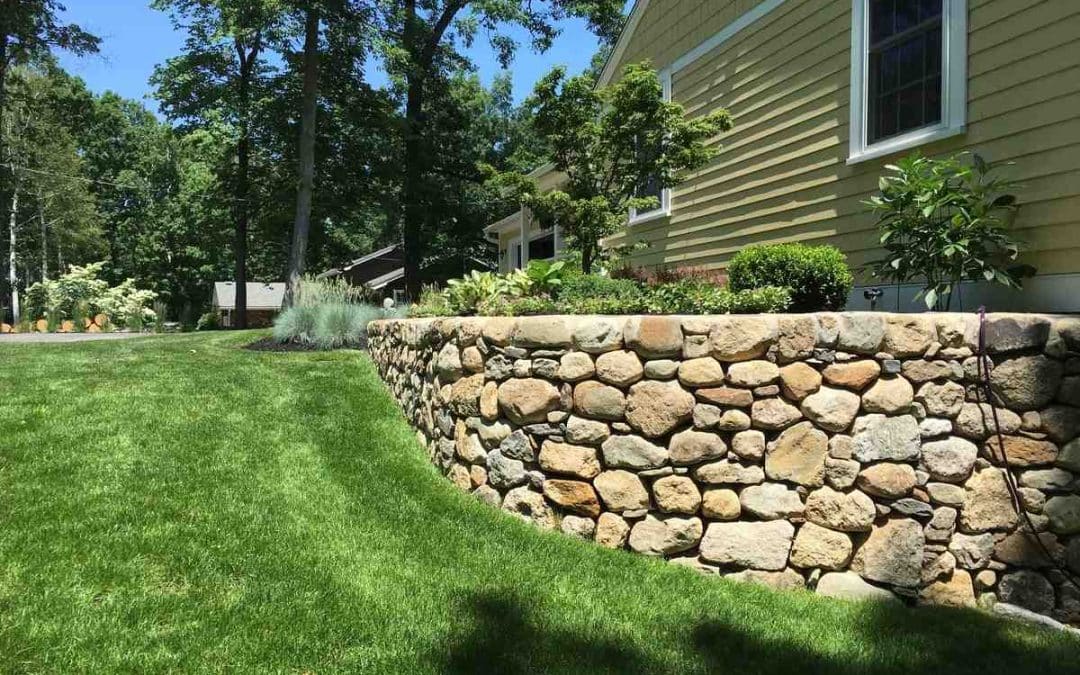
Understanding Retaining Walls in Tewksbury MA
Ever notice how Tewksbury’s beautiful rolling landscape, while scenic, creates unique challenges for homeowners? Those slopes that give our town character can also limit usable yard space and cause drainage headaches during our notorious New England weather cycles.
Retaining walls Tewksbury MA solutions transform these challenging slopes into your property’s greatest asset. More than just stacked stone or blocks, these hardscape features solve real problems while adding character to your outdoor space.
| Quick Facts: Retaining Walls in Tewksbury MA |
|---|
| Purpose: Prevent soil erosion, create level areas, manage water runoff |
| Common Materials: Natural stone, concrete blocks, brick, timber |
| Average Internet Cost Range: $30-$120 per square foot (varies by material, height, and complexity) |
| Local Considerations: Undulating terrain, New England weather cycles, permit requirements for walls over 4 feet |
| Benefits: Increased usable space, improved property value, improved drainage |
Tewksbury’s varying elevations make retaining walls practically essential for many local properties. That sloped backyard that’s currently collecting runoff and causing basement moisture? It could become your family’s favorite outdoor gathering space. The eroding hillside along your driveway? It could showcase a beautiful terraced garden that stops neighbors in their tracks.
A thoughtfully designed retaining wall doesn’t just hold back soil—it creates new opportunities. Level areas for patios where you once had unusable slopes. Garden beds where plants previously washed away. Dramatic visual interest where there was once just a problematic grade change.
Hi there! I’m Tommy Randall, owner of Randall Landscaping, Inc. After 18+ years designing and installing retaining walls Tewksbury MA homeowners depend on, I’ve seen how these structures can completely transform properties while solving serious drainage and erosion issues.
Why Tewksbury’s Terrain Makes Retaining Walls Essential
Tewksbury’s landscape tells a fascinating story of glacial history. Those retreating ice giants from thousands of years ago didn’t just disappear quietly – they left behind a legacy of rolling hills and undulating terrain that gives our town its distinctive character. While these natural contours create beautiful vistas, they present real challenges for homeowners trying to make the most of their property.
Our New England weather doesn’t make things any easier. With Tewksbury receiving around 48 inches of annual precipitation, all that water needs somewhere to go. On sloped properties, rain becomes a powerful sculptor, gradually washing away precious topsoil and potentially undermining the very foundations of your home.
Then there’s the freeze-thaw dance we all know too well in Massachusetts. When winter’s grip freezes the moisture in soil, it expands, pushing outward and upward. Come spring thaw, that soil doesn’t neatly return to its original position – it shifts downhill bit by bit. Year after year, this natural “heaving” process gradually reshapes your landscape, whether you want it to or not. This is precisely where retaining walls Tewksbury MA properties need become essential.
“Retaining walls are comprised of rock or stone carefully engineered walls that restrain soil that would otherwise fall and slide away from a foundation or damage the surrounding landscape,” explains a local hardscaping expert with over 30 years of experience in the Merrimack Valley.
Beyond solving these practical challenges, well-designed retaining walls offer significant financial benefits. Local real estate professionals consistently report that thoughtfully installed hardscaping elements like retaining walls can return 100-200% of their investment cost when selling your home. That’s protection for your property that actually pays you back!
Benefits of Retaining Walls Tewksbury MA homeowners love
When I talk with our Tewksbury clients about their finished retaining wall projects, the same benefits come up again and again.
That sloped backyard that was basically wasted space? It’s now a level patio where the family gathers for weekend barbecues. That eroding hillside that was impossible to mow? Transformed into beautiful garden terraces that add visual interest and make planting a joy rather than a chore.
Many homeowners find that safer, more functional driveways are possible with strategically placed retaining walls that prevent erosion along sloped edges or allow for widening narrow hillside drives.
I love seeing the creativity when clients realize their retaining walls can do double-duty as built-in outdoor seating. By designing walls at seating height (typically 18-24 inches), they create natural gathering spots around patios and fire pits.
The change in curb appeal is often dramatic. Well-designed retaining walls add architectural interest that sets a property apart, creating a finished, polished look that improves the entire landscape.
One Tewksbury homeowner recently told me: “Our backyard was basically unusable because of the steep slope. After installing a two-tier retaining wall system, we gained almost 400 square feet of flat space for our patio and fire pit area. It’s completely transformed how we use our outdoor space.”
How Retaining Walls Fight Erosion & Runoff
There’s actually some fascinating science behind why retaining walls work so effectively. They’re engineered to manage two powerful natural forces that are constantly at work on your property.
First, there’s lateral soil pressure – the natural force exerted by soil as gravity pulls it downhill. A properly built retaining wall Tewksbury MA properties need must stand strong against this pressure, which increases with both wall height and soil type. Clay-rich soils like those common in parts of Tewksbury exert particularly strong pressure.
Even more challenging is hydrostatic pressure – the force created when water builds up behind a wall. This is where drainage becomes absolutely crucial. Without proper water management, moisture accumulation behind a retaining wall can increase pressure by up to 33%, potentially causing failure even in otherwise well-built structures.
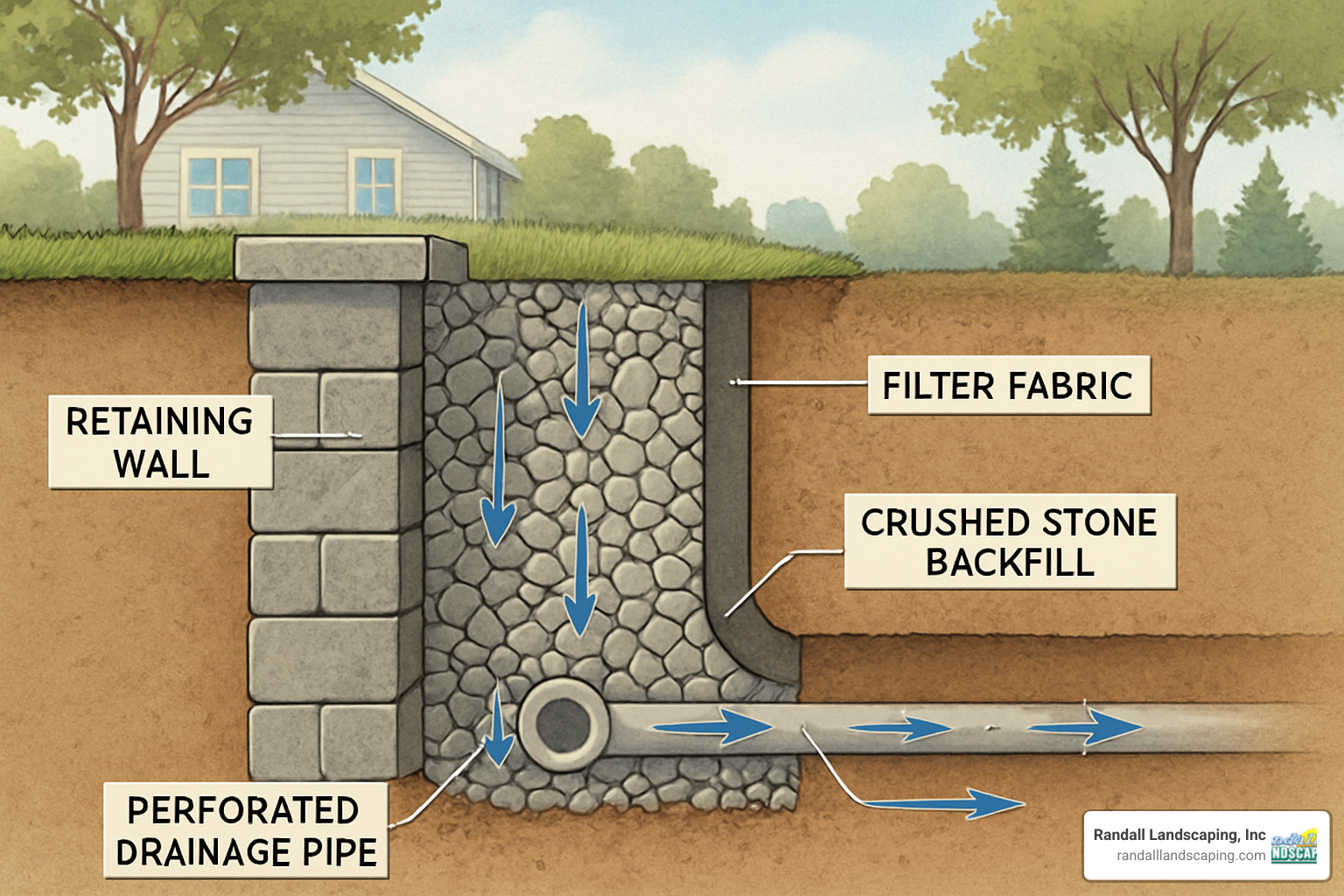
That’s why we integrate sophisticated drainage systems in every retaining wall we build. Back-drain pipes (perforated pipes installed behind the wall) collect and redirect water away from the structure. Weep holes or vents provide escape routes for water through the face of the wall. Properly graded backfill using layers of gravel and crushed stone promotes drainage, while filter fabric prevents soil from clogging these drainage materials while still allowing water through.
“The most common cause of retaining wall failure isn’t poor construction—it’s poor drainage design,” our lead hardscape designer often reminds clients. “We pay special attention to how water will move around and through our wall systems, especially in Tewksbury where the clay-rich soils can be particularly challenging.”
With the right design approach, your retaining wall doesn’t just fight gravity – it works with nature to create beautiful, functional spaces that stand the test of time and New England’s challenging weather.
Retaining Walls Tewksbury MA: Materials, Styles & Drainage Engineering
When it comes to building retaining walls in Tewksbury, choosing the right material isn’t just about looks—it’s a decision that affects everything from installation ease to how long your wall will last through our tough New England seasons.
Segmental Concrete Blocks
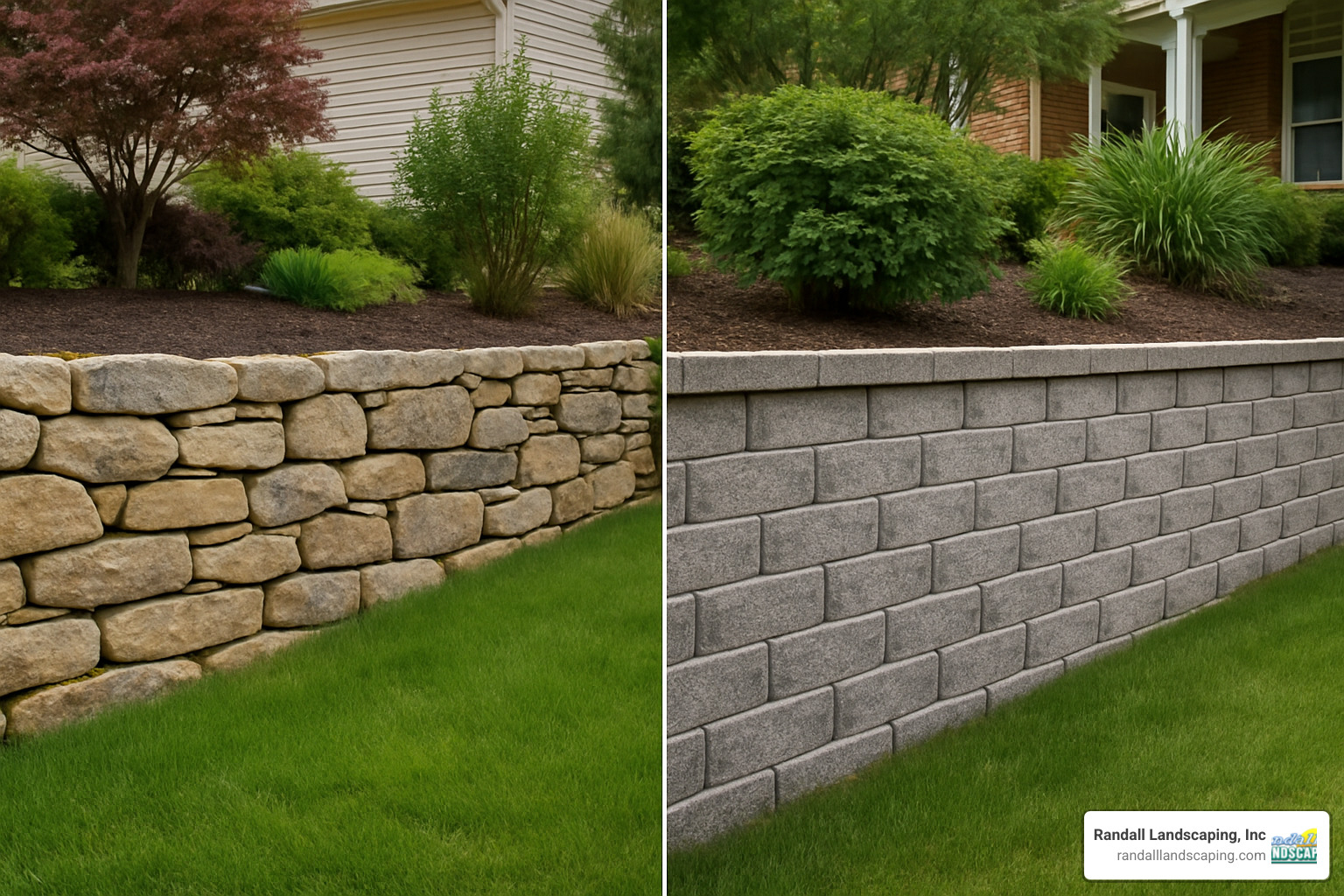
I’ve watched segmental concrete blocks become the superstar of retaining walls Tewksbury MA projects over the years, and for good reason. These blocks offer remarkable consistency—each one manufactured to exact specifications, so you know exactly what you’re getting.
Their interlocking design features (those little lips, pins or knobs you might notice) create mechanical connections between courses that significantly strengthen the wall. Plus, today’s blocks come in so many colors and textures that many visitors won’t even realize they’re looking at concrete rather than natural stone.
For homeowners who like to plan ahead, these blocks typically last 50+ years with minimal upkeep, making them an investment that truly pays off over time. And if you’re handy, their uniform size and reasonable weight make them more DIY-friendly than other options—though I always caution folks about tackling walls over 3 feet high without professional help.
Natural Fieldstone
There’s something about natural fieldstone that just says “New England.” When we install these walls, each one tells its own story because no two stones are exactly alike.
Many of our Tewksbury clients choose fieldstone for its timeless beauty and exceptional durability—these walls often last for generations when properly built. Since much of this stone comes from regional quarries, you’re essentially bringing a piece of New England’s geological history into your landscape.
I particularly love natural stone for properties with irregular spaces or curved designs, as the varying sizes and shapes allow for greater artistic flexibility. The trade-off, of course, is higher installation costs since fitting these puzzle pieces together requires skilled craftsmanship and more labor hours.
Poured Concrete
For larger commercial projects or situations where maximum strength is non-negotiable, poured concrete creates a literal solid solution. The monolithic structure offers best structural integrity for taller walls facing heavy loads.
While not as common in residential settings around Tewksbury, poured concrete walls can be dressed up with decorative stamping or staining techniques to mimic more expensive materials. This option requires professional installation with proper formwork and reinforcement—definitely not weekend warrior territory. The higher initial investment often balances out over decades of service for larger walls.
Timber
While we don’t install as many timber retaining walls as we used to, they still have their charm in the right setting. Their natural appearance works beautifully in wooded landscapes, creating a seamless transition between built and natural environments.
The affordability of timber makes it tempting for budget-conscious projects, and the ability to work with standard carpentry tools simplifies construction. However, I always have honest conversations with clients about lifespan—even pressure-treated timber eventually succumbs to our harsh New England weather, typically lasting 10-20 years compared to decades more for stone or concrete options.
There are also environmental considerations with pressure-treated lumber, as the chemicals used to prevent rot can eventually leach into surrounding soil.
| Material | Average Internet Cost Range (per sq ft) | Expected Lifespan | Maintenance Level |
|---|---|---|---|
| Concrete Blocks | $15-$60 | 50-100 years | Low |
| Natural Stone | $25-$80 | 75-100+ years | Low-Medium |
| Poured Concrete | $30-$90 | 50-100 years | Low |
| Timber | $15-$40 | 10-20 years | High |
Note: These are average costs based on internet data and not actual costs for Randall Landscaping. Actual project costs can vary significantly based on site conditions, wall height, and design complexity.
Choosing the Right Material for Your Project
When I sit down with Tewksbury homeowners to discuss material options, we talk through several important considerations beyond just price tags.
The wall should complement your home’s character—those beautiful colonial-style homes throughout Tewksbury often pair wonderfully with the timeless look of natural stone, while more contemporary houses might better match the clean lines of concrete blocks.
Budget considerations matter too, of course. I’ve found that while natural stone often carries a higher upfront cost, its exceptional durability and timeless appeal can make it more economical when viewed as a decades-long investment. That said, modern concrete blocks offer tremendous value with their balance of appearance, durability, and cost.
Durability requirements are particularly important in our climate. Tewksbury’s freeze-thaw cycles put serious stress on outdoor structures, so whatever material you choose needs to handle significant temperature fluctuations without cracking or shifting.
Your maintenance preferences also factor in. Some of my clients prefer absolute minimum upkeep, making concrete blocks an excellent choice, while others appreciate the occasional repointing that natural stone may require as part of its character and charm.
Smart Drainage Design Keeps Walls Standing
I can’t emphasize this enough: the most beautiful retaining wall in Tewksbury will fail prematurely without proper drainage engineering. After 18 years of building these structures, I’ve seen too many DIY walls fail simply because water management was treated as an afterthought.
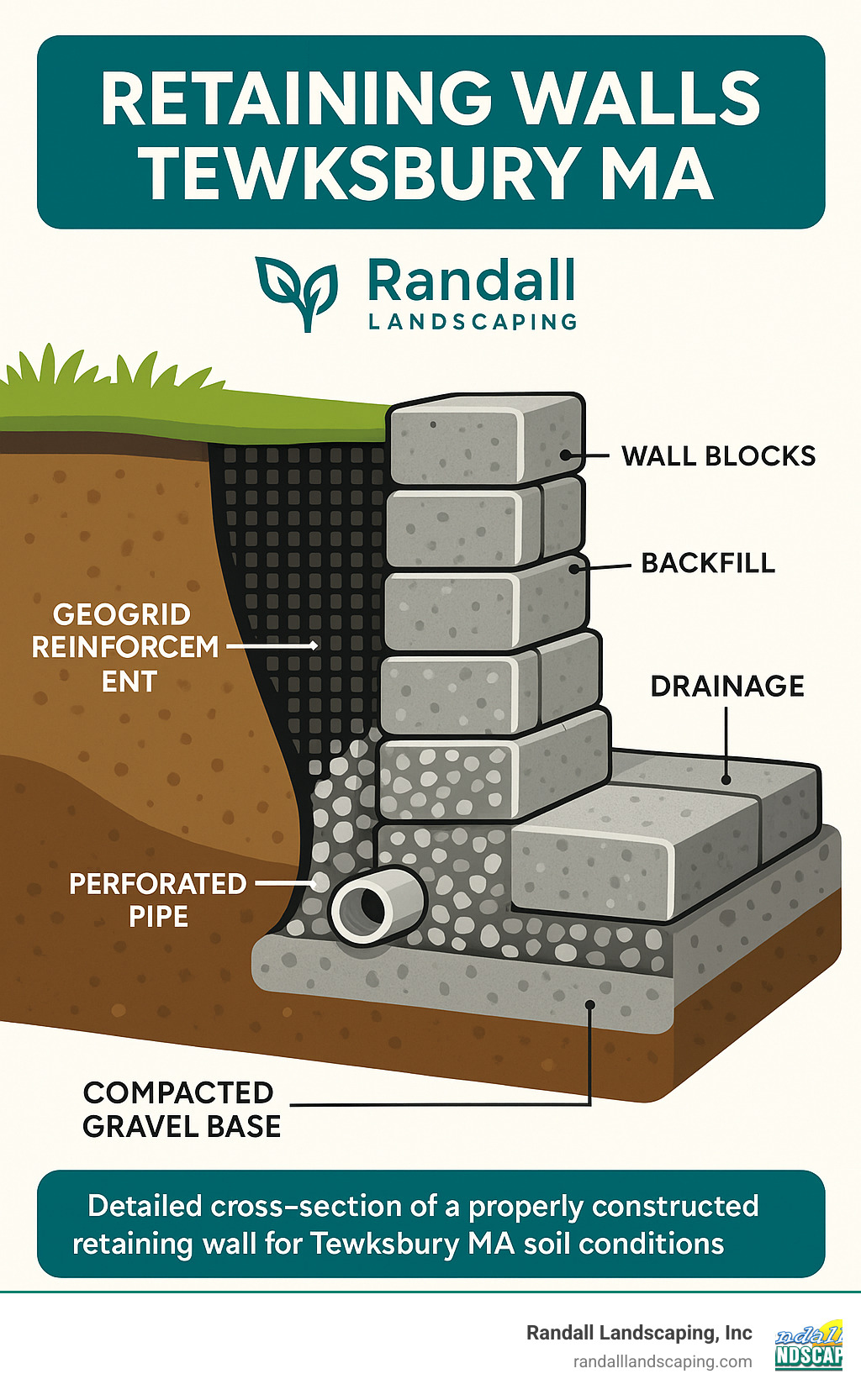
Our comprehensive drainage systems typically start with a perforated pipe nestled at the wall’s base in a bed of crushed stone. These pipes collect water and direct it away from the structure, preventing the hydrostatic pressure that can topple even well-built walls.
Behind the wall, we install crushed stone backfill—typically 3/4″ to 1″ clean stone that creates channels for water to flow through rather than pushing against your wall. We wrap this drainage zone in filter fabric, a geotextile material that keeps soil from washing into and clogging the stone while still allowing water to pass through.
The area behind the wall gets carefully graded to direct surface water away whenever possible, and for larger projects, we may incorporate additional features like swales or catch basins to manage water flow across the broader landscape.
For walls over 4 feet tall, we often incorporate geogrid reinforcement—a synthetic mesh material laid in horizontal layers within the backfill soil. This creates a reinforced soil mass that works together with the wall face to resist pressure, significantly increasing stability.
“I’ve fixed enough failed walls to know that proper drainage isn’t just a nice-to-have—it’s absolutely essential,” I often tell clients. “The few extra hours and materials devoted to getting drainage right will save thousands in repairs down the road.”
For more technical information about proper retaining wall construction techniques, the National Concrete Masonry Association offers excellent research and guidelines that we follow in our installations.
Retaining Walls Tewksbury MA Case Studies
Over our years serving Tewksbury homeowners, we’ve transformed countless challenging properties with thoughtfully designed retaining walls. Here are a few stories that showcase what’s possible:
Case Study 1: Hillside Change
I’ll never forget the look on our client’s face when they saw their completed project in north Tewksbury. Their backyard featured a steep 12-foot elevation change over just 30 feet of depth—essentially unusable space that collected runoff and caused drainage problems.
We designed a three-tier system using concrete blocks with a natural stone appearance. Each tier created approximately 10 feet of flat, usable garden space, connected by neat stone staircases. The lowest tier opened onto a new paver patio with a built-in fire pit where the family now gathers year-round.
The change was remarkable—from unusable slope to approximately 600 square feet of outdoor living space. The terraced gardens now showcase native New England plantings that thrive in the excellent drainage conditions we created. The homeowners tell me they use their yard more in one month now than they did in five years before the project.
Case Study 2: Driveway Improvement
Another memorable project involved a Tewksbury client with a narrow driveway constantly eroding at the edges due to their sloped front yard. After years of frustration—especially during winter when snow removal became a nightmare—they called us for help.
We installed a 3-foot tall natural stone retaining wall that allowed us to widen their driveway by nearly 4 feet. We incorporated landscape lighting into the wall, illuminating the driveway edge for safety while creating a stunning nighttime appearance.
The following winter, the homeowner called just to tell me how much easier snow removal had become with the widened driveway. Plus, the erosion issues that had plagued them for years were completely resolved. Sometimes the most practical improvements also become the most beautiful features of a property.
Case Study 3: Multi-Function Design
For a family in east Tewksbury, we created what I like to call a “hardworking wall”—a retaining structure that doubles as seating around their new patio space. Using concrete blocks with a complementary cap stone designed for comfortable seating, we addressed their erosion concerns while simultaneously creating built-in seating for large family gatherings.
The 24-inch height proved perfect for casual seating, eliminating the need for additional patio furniture and creating a more open feel in their outdoor space. This project perfectly illustrates how retaining walls can solve technical problems while enhancing lifestyle and entertainment options.
DIY vs. Professional Installation: Step-by-Step Guide
Thinking about tackling a retaining wall project yourself? While some smaller walls are definitely within reach of dedicated DIY homeowners, understanding the complete process is essential before you grab that shovel. Let me walk you through what’s involved in building a basic retaining wall – and help you decide if it’s a project you want to take on.
Step 1: Site Survey and Planning
Every successful wall begins with thorough planning. Start by determining exactly where your wall will go and how tall and long it needs to be. This is also the time to check for underground utilities – always call Dig Safe at 811 before you dig anywhere in Tewksbury. Trust me, hitting a gas or electric line is not the kind of excitement you want!
Local building codes matter too. In Tewksbury, walls over 4 feet typically require permits, so verify requirements before you begin. Finally, create a detailed materials list – nothing worse than being mid-project and realizing you’re short on supplies.
Step 2: Excavation and Base Preparation
A solid foundation is crucial for a lasting wall. You’ll need to dig a trench for your wall foundation – typically 6 inches deep plus an additional 6 inches for each foot of wall height. Make this trench about 12 inches wider than your actual wall blocks to give yourself working room.
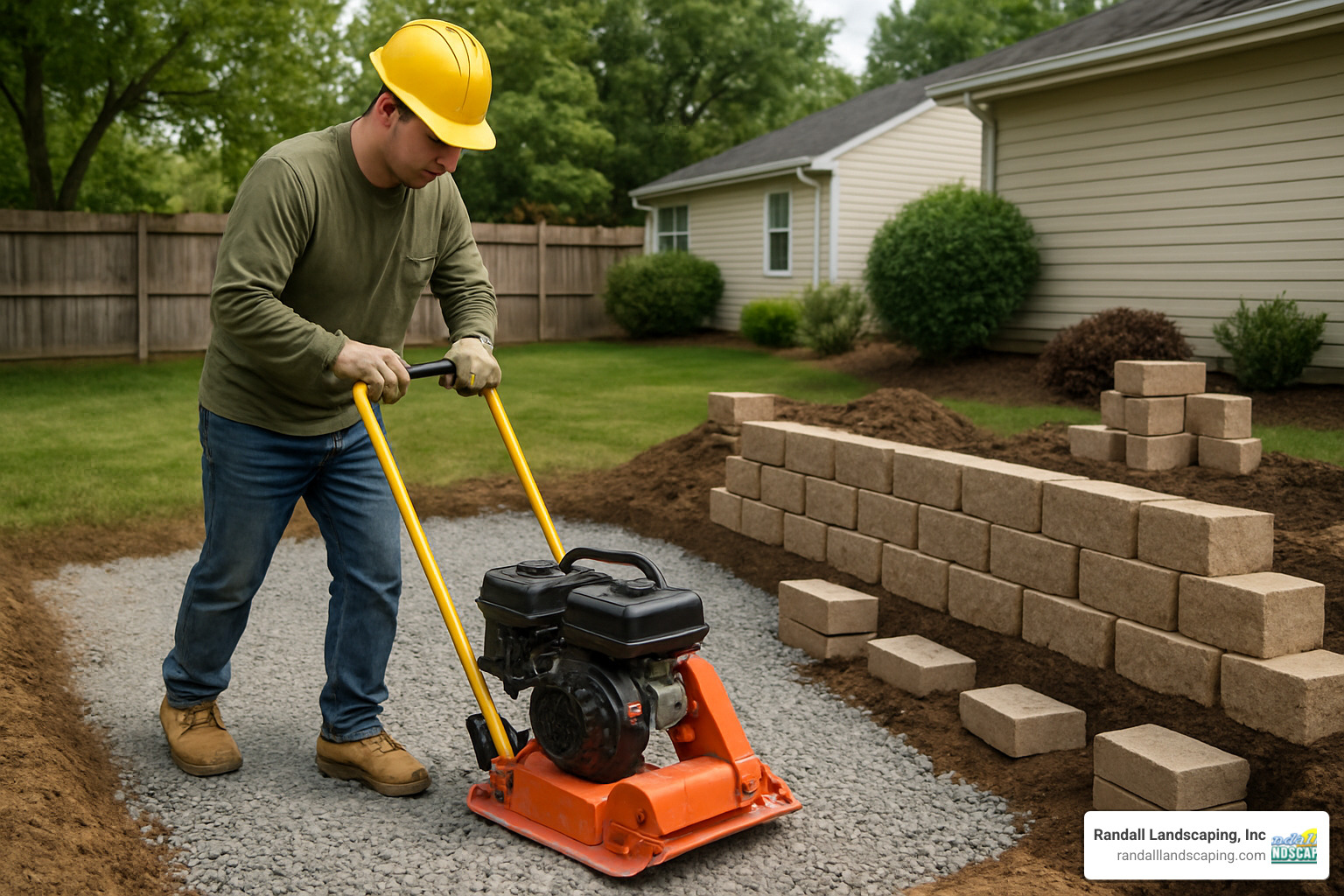
Next comes the most critical step many DIYers underestimate: proper base preparation. Add 4-6 inches of crushed stone base material and compact it thoroughly using a plate compactor. This compaction step is absolutely essential – skip it, and your wall will likely shift and fail within a couple seasons.
Step 3: First Course Installation
Your first course of blocks is where precision matters most. Take extra time to make sure each block is perfectly level both front-to-back and side-to-side. Any wobbles or misalignments here will multiply as you build upward.
As one of our clients who attempted a DIY wall told me, “I spent almost two hours just on the first row of blocks, but it was worth it. The rest of the wall went up much faster because I had a level foundation.”
After placing your first course, backfill behind it with crushed stone to start your drainage system.
Step 4: Building Additional Courses
As you add more courses, follow the manufacturer’s guidelines for proper staggering of joints. Most retaining wall systems have specific connection methods – pins, lips, or adhesive – that create structural integrity.
Remember to step back each course slightly (typically 1/2″ to 1″ per foot of height) to create what engineers call “setback” – that slight tilt into the hillside that helps the wall resist soil pressure. Continue adding drainage material behind the wall as you build upward.
Step 5: Drainage System Installation
Proper drainage is the secret to longevity for any retaining wall Tewksbury MA homeowners install. Place perforated drainage pipe at the base, making sure it’s sloped to direct water away from the wall. Continue adding crushed stone backfill behind the wall as you work upward.
Don’t forget to place filter fabric between your crushed stone and the native soil – this prevents soil from washing into and clogging your drainage system while still allowing water to pass through.
Step 6: Finishing Touches
Cap off your wall with attractive cap stones, securing them with concrete adhesive for permanence. Backfill any remaining space with soil, and add topsoil and landscaping to blend your new wall into the surrounding landscape.
When to Call a Pro Instead of DIY
While there’s definite satisfaction in completing your own retaining wall, there are several situations where professional installation makes more sense:
Walls over 4 feet in height require engineered plans and permits in Tewksbury. These taller walls face exponentially greater soil pressure and often need geogrid reinforcement and more sophisticated construction techniques.
Engineered designs become necessary when your wall will support significant loads (like a driveway) or is being built in challenging soil conditions. Our clay-rich Tewksbury soils can be particularly tricky to work with.
Difficult access situations often benefit from professional teams with specialized equipment. Getting materials to a backyard with limited access can be a logistical nightmare for homeowners.
Warranty protection comes with professional installation, giving you peace of mind that your investment is protected.
As one Tewksbury homeowner shared with us: “I initially planned to build my retaining wall myself to save money. After attending a workshop, I realized the complexity involved in proper drainage and base preparation. Hiring professionals ended up being the best decision—they completed in three days what would have taken me weeks, and I have peace of mind knowing it’s built to last.”
For more detailed information about retaining wall installation in nearby communities, you might find our guide on retaining wall installation in Dracut, MA helpful.
Selecting a Qualified Contractor
If you decide professional installation is the smart choice for your project, here’s what to look for in a qualified contractor:
Look for NCMA certification from the National Concrete Masonry Association – this indicates the contractor has demonstrated proficiency specifically in retaining wall installation.
Ask for local references from Tewksbury or nearby towns with similar soil conditions. Don’t be shy about contacting these references to ask about their experience.
Expect a written timeline and contract that clearly spells out project scope, materials, timeline, and payment terms. Vague proposals often lead to misunderstandings and disappointment.
Verify insurance coverage – any reputable contractor should carry both liability insurance and workers’ compensation coverage and be willing to provide proof.
Review their portfolio of similar projects to ensure they have experience with retaining walls like yours. An experienced contractor should be happy to show examples of their work.
Choose someone with knowledge of local conditions who understands Tewksbury’s soil challenges, permit requirements, and how our New England weather affects retaining wall performance.
At Randall Landscaping, we’ve been building retaining walls Tewksbury MA homeowners rely on for nearly two decades. Whether you’re tackling it yourself or looking for professional help, we’re always happy to answer questions and point you in the right direction.
Project Costs, Permits & Financing in Tewksbury
Let’s talk dollars and cents – the part that’s often top of mind for homeowners considering a retaining wall project. Understanding what goes into the cost helps you plan better and avoid those uncomfortable “oh, I didn’t realize that would cost extra” moments.
Based on internet research, retaining walls typically run between $30-$120 per square foot nationally. That’s quite a range, right? This wide variation exists because so many factors influence the final price tag.
Here in Tewksbury, several local factors can push your project toward either end of that spectrum:
Excavation challenges often play a major role in pricing. Many Tewksbury properties have limited access that might require specialized equipment or good old-fashioned manual digging, which increases labor costs significantly.
Our unique New England soil doesn’t make things easier either. Tewksbury’s glacial till and clay-heavy soils sometimes demand deeper foundations or extra drainage measures to ensure wall stability through our freeze-thaw cycles.
The height and length of your wall create an exponential rather than linear cost increase. Each additional foot of height requires proportionally more materials below ground, more complex engineering, and often more sophisticated drainage – all driving up the price tag.
Your choice of materials dramatically impacts your budget too. As we discussed earlier, timber might start around $15 per square foot while natural stone can easily reach $80 per square foot or more for premium selections.
When budgeting for your project, a typical cost breakdown might look something like:
- Materials: 40-50% of total cost
- Labor: 30-40% of total cost
- Equipment: 5-10% of total cost
- Design and permits: 5-10% of total cost
For larger projects, many of our Tewksbury clients explore financing options like home equity loans, landscape-specific financing through material suppliers, or personal loans from local banks. For smaller projects, credit cards might make sense, especially if you can take advantage of introductory 0% interest offers.
While retaining walls certainly represent a significant investment, they also add substantial value to your property. Beyond just creating usable outdoor space, a well-designed retaining wall can be a major selling point when it’s time to move, often returning 100-200% of the investment in terms of property value increase.
Navigating Tewksbury MA Permit Process
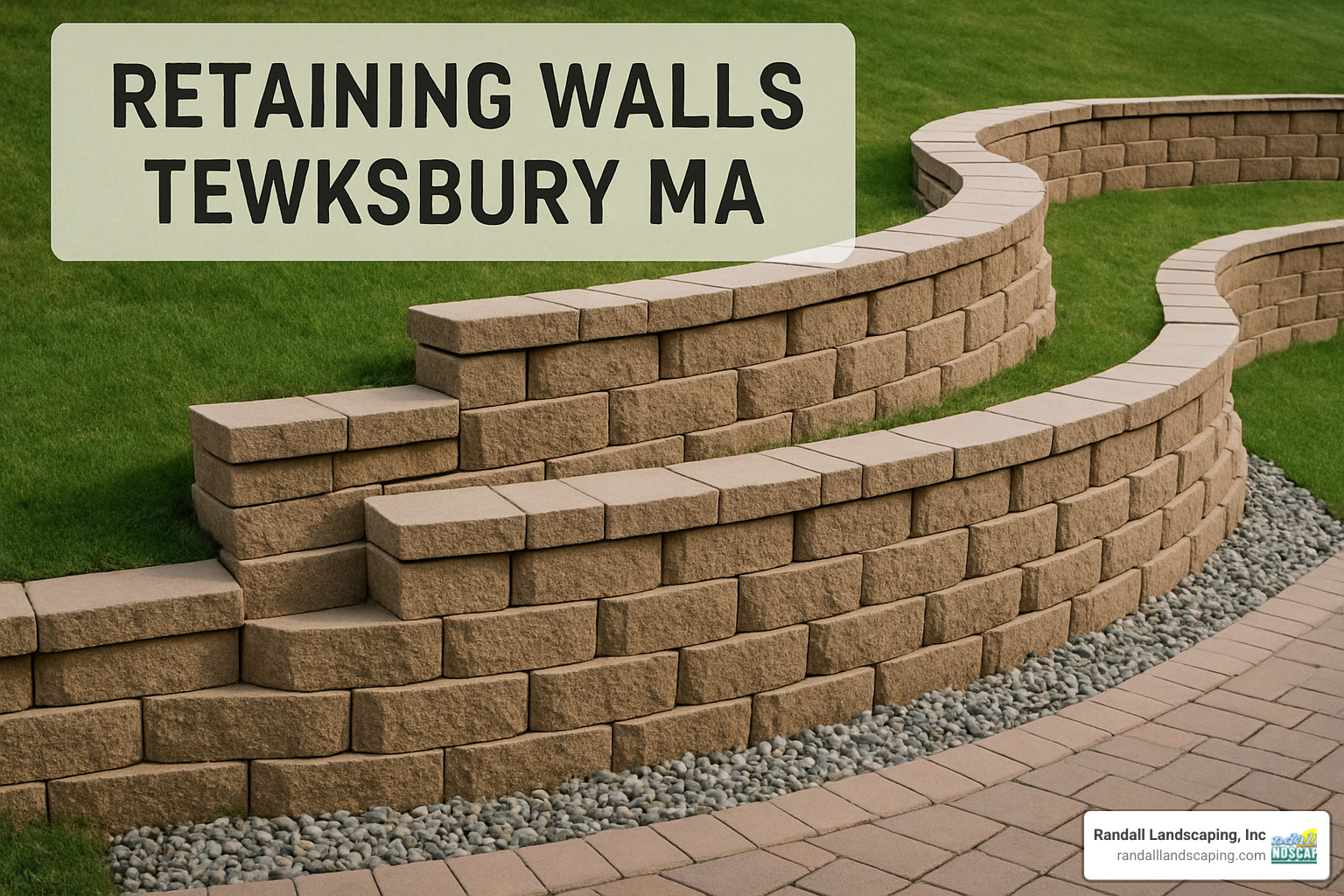
Ah, permits – not the most exciting part of your project, but absolutely essential to get right. Tewksbury’s building department requires permits for retaining walls Tewksbury MA that exceed 4 feet in height (measured from the bottom of the footing to the top of the wall).
But here’s a pro tip: even for walls under 4 feet, it’s smart to check with the building department. Walls near property lines or those affecting drainage patterns may still require review, and it’s always better to know before you build than to face potential removal orders later.
The permit process in Tewksbury typically follows these steps:
First, you’ll complete the standard building permit application available from the Tewksbury Building Department. You’ll need to provide a site plan showing where your wall will be located relative to property lines, structures, and utilities. Construction details are also required – drawings showing wall height, materials, drainage provisions, and foundation design.
For walls over 4 feet, you’ll need sealed engineering drawings from a Massachusetts-licensed Professional Engineer. This is non-negotiable and for good reason – taller walls face significantly more pressure and need proper engineering to ensure safety.
An important consideration many homeowners overlook: if your wall is within 100 feet of wetlands or 200 feet of a perennial stream, you may need additional review by the Conservation Commission. Tewksbury takes water resource protection seriously, so this is an essential checkpoint.
At Randall Landscaping, we handle the entire permit process for our clients. We prepare all necessary documentation and represent your project at any required meetings or hearings. This ensures compliance with all local regulations and a smooth approval process, saving you time and preventing headaches.
Finding Quality Materials Locally
One advantage of building a retaining wall Tewksbury MA residents enjoy is access to excellent local material sources. You don’t have to go far to find exactly what you need.
Local masonry and landscape supply yards offer wide selections of concrete blocks, natural stone, and related materials. Many display sample walls or panels to help you visualize the finished project better than any brochure or website could. Nothing beats seeing and touching the actual materials before committing.
Manufacturer showrooms like NICOLOCK have dealer locations where you can view full-size displays of various wall systems and colors. These showrooms often have knowledgeable staff who can explain the differences between products and help you find the best match for your project.
For natural stone enthusiasts, visiting a quarry allows you to select specific stones – a bit like choosing your own steak at a fine restaurant. This approach often results in better pricing for larger quantities and gives you more control over the aesthetic of your finished wall.
When selecting materials, I always recommend clients take these steps:
View full-size samples whenever possible. Colors and textures look dramatically different in small samples versus installed walls. What looks “just okay” in a sample might be stunning when installed, and vice versa.
Consider long-term color stability in your selection. Some concrete products maintain their color better than others over time. This is particularly important in our New England climate with its harsh winters and strong summer sun.
Check material availability early in your planning process. Supply chain issues can affect even stone products, and the last thing you want is to be halfway through your project when you find your chosen material is backordered for months.
Verify compatibility between different products if you’re mixing and matching. Ensure they work together dimensionally and aesthetically – not all systems are designed to integrate seamlessly.
Understand delivery logistics before finalizing your choice. Some materials require special equipment for unloading, so confirm your site can accommodate delivery requirements or be prepared for additional handling charges.
With careful planning and the right materials, your retaining wall will not only solve practical problems on your property but become a beautiful, enduring part of your landscape that you’ll enjoy for decades to come.
Maintenance, FAQs & Conclusion
A beautifully constructed retaining wall doesn’t just solve problems today—it should continue to serve your property for decades to come. With a little care and attention, your investment will maintain both its structural integrity and visual appeal through the seasons.
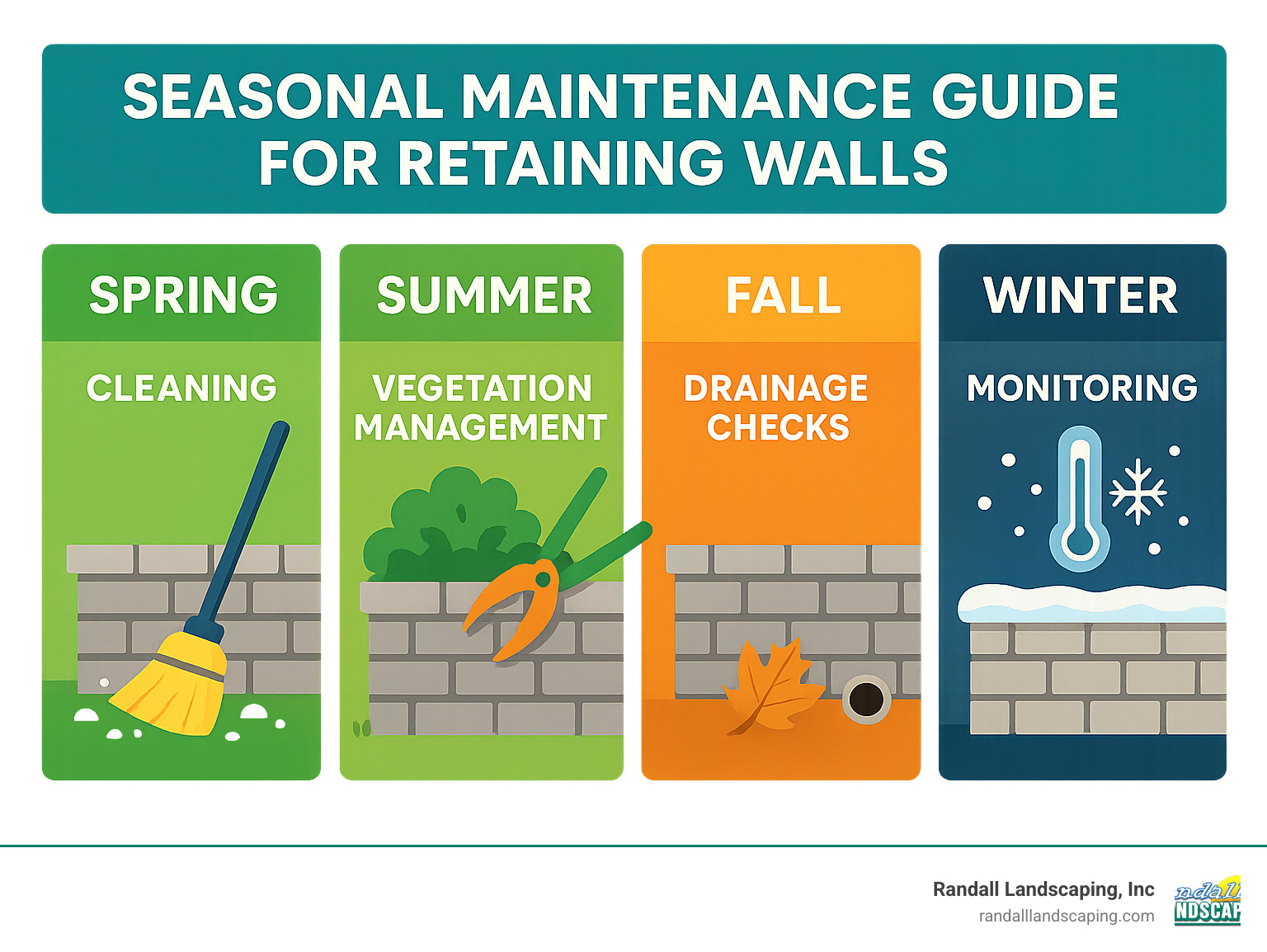
The good news is that retaining walls Tewksbury MA homeowners invest in don’t demand complicated maintenance routines. Instead, they benefit from simple seasonal attention that anyone can manage:
When spring arrives, take a walk around your wall to check for any winter damage. Our New England freeze-thaw cycles can be tough on hardscaping! Clear away any debris from drainage outlets—those little holes or pipes are your wall’s lifeline, allowing water to escape rather than building up pressure. Also take note of any soil erosion or places where water seems to be collecting. Small issues caught early are much easier to address.
Summer brings growing things, and while vegetation can beautify your wall, it can also cause problems if left unchecked. Trim back plants that are getting too close to your wall structure. Be particularly careful about trees—those with aggressive root systems should be kept at a safe distance to prevent them from gradually disrupting your wall’s foundation. If you’d like to clean your wall surface, concrete blocks can handle gentle pressure washing, while natural stone benefits from a softer touch with a brush.
As fall leaves begin to drop, be vigilant about keeping drainage areas clear. Those beautiful red and gold maple leaves may look picturesque, but they can quickly clog drainage systems. This is also a good time for a thorough inspection—look for any sections that appear to be bulging or shifting. Addressing these issues before winter arrives will help prevent more significant damage.
Winter requires a different kind of attention. Avoid piling snow directly against your wall during clearing, as this adds weight and moisture that can stress the structure. If you use de-icing products near concrete walls, be aware that some chemicals can damage concrete surfaces over time. Keep an eye out for unusual movement during freeze-thaw cycles.
For those with natural stone walls, you may need to consider repointing (replacing deteriorated mortar) every decade or so. Concrete block walls generally need less intensive care, though in our harsh New England climate, applying a sealer every 3-5 years can extend their life and appearance.
Frequently Asked Questions about Retaining Walls Tewksbury MA
When talking with Tewksbury homeowners about retaining wall projects, certain questions come up consistently. Here are straightforward answers to the most common inquiries:
Q: How high can I build a retaining wall without a permit in Tewksbury?
A: The general rule in Tewksbury is that walls under 4 feet in height (measured from the bottom of the footing to the top of the wall) don’t require a building permit. That said, walls near property lines or those affecting drainage patterns might still need review. A quick call to the Building Department can save headaches later—it’s always better to check first!
Q: How long should a properly built retaining wall last?
A: Your wall’s lifespan largely depends on the materials used. Concrete block walls typically last 50-100 years, while natural stone walls can exceed a century with proper care. Poured concrete walls generally provide 50-100 years of service, and timber walls, while initially less expensive, typically need replacement after 10-20 years. Of course, these estimates assume proper installation with good drainage and regular maintenance.
Q: How does winter weather affect retaining walls in Tewksbury?
A: Our New England winters pose unique challenges for retaining walls. As water in the soil freezes and expands, it can exert tremendous pressure on wall structures. This is precisely why we place such emphasis on drainage systems—they’re not just a good idea, they’re essential in our climate. A properly constructed wall with effective drainage will handle these seasonal stresses without issue, but walls with poor drainage often show damage after just a few winters.
Q: Can I build a retaining wall myself?
A: For smaller projects (walls under 3 feet tall) with straightforward designs, a DIY approach can be rewarding for those with good physical fitness and basic construction skills. However, larger or more complex walls involve significant engineering considerations and specialized equipment. The difference between a wall that lasts for decades and one that fails prematurely often comes down to proper base preparation and drainage installation—areas where professional experience makes a substantial difference.
Q: What’s the difference between a gravity wall and a reinforced wall?
A: Gravity walls work exactly as they sound—they rely solely on their weight to hold back the soil behind them. These walls typically work well for heights under 3-4 feet. Reinforced walls, on the other hand, incorporate geogrid or other reinforcement materials that extend into the soil behind the wall. This creates a reinforced soil mass that works together with the wall facing to resist pressure, allowing for much taller and stronger structures.
Q: How close to my property line can I build a retaining wall?
A: While Tewksbury’s zoning regulations generally allow retaining walls within setback areas, walls directly on property lines may require neighbor consent or additional permitting. Every situation is unique depending on your specific location and the purpose of the wall, so checking with the Building Department is always your safest bet.
Ready to Transform Your Yard?
If you’re looking at a sloped section of your Tewksbury property and imagining something more functional and beautiful, we’d love to help turn that vision into reality. At Randall Landscaping, Inc., we’ve spent years mastering the specific challenges of New England terrain, designing and building retaining walls Tewksbury MA homeowners can rely on for both structural integrity and visual appeal.
Our approach isn’t just about stacking blocks or stones—it’s about creating solutions that work with your unique property conditions and personal style. When you work with us, you’ll experience a thoughtful process that includes:
- A free initial consultation where we listen to your needs and carefully assess your property’s specific conditions
- A custom design that addresses your practical requirements while enhancing your outdoor aesthetics
- A detailed proposal that clearly outlines scope, timeline, and pricing with no surprises
- Professional installation by our experienced team who treat your property with respect
- A final walkthrough to ensure everything meets our high standards and your complete satisfaction
As one of our Tewksbury clients recently shared: “The retaining wall Randall Landscaping built for us not only solved our erosion problems but also created a beautiful new garden space we use constantly. Their attention to detail and focus on drainage issues we hadn’t even considered showed their expertise.”
Whether you’re dealing with erosion issues, looking to create more usable outdoor space, or simply want to improve your property’s appearance, a well-designed retaining wall offers lasting value. Contact us today to schedule your consultation and take the first step toward changing that challenging slope into one of your property’s most beautiful and functional features.
For more information about our residential landscaping services in Tewksbury MA, visit our website for details about residential landscaping in Tewksbury MA or call us directly to speak with one of our landscape design specialists.