
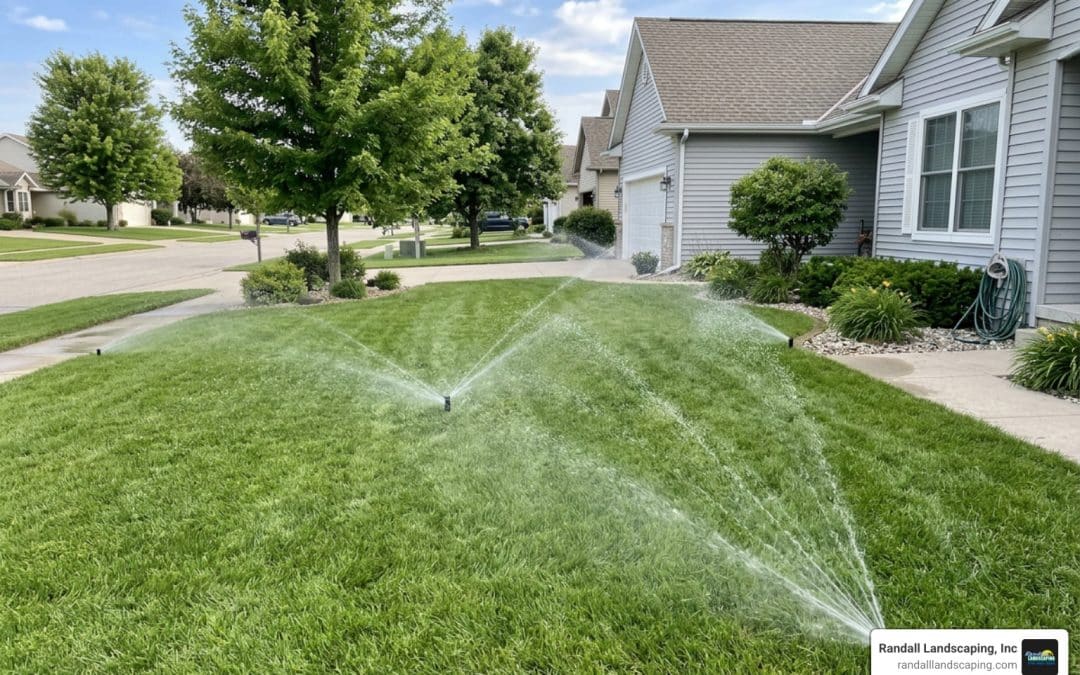
Why a Lawn Sprinkler System Is One of the Best Investments for Your Yard
A lawn sprinkler system is an automated irrigation setup that delivers water to your lawn on a set schedule — without you having to drag a hose around. Here’s a quick overview of what you need to know:
- Types: In-ground (underground), hose-end, and drip irrigation
- Average cost: $2,539 for a residential in-ground system (internet data; actual costs vary)
- Coverage: Roughly $0.20 to $1.00 per square foot
- Water savings: A well-designed system can cut outdoor water waste by up to 50%
- DIY or pro? Small, flat lawns can be DIY-friendly; larger or sloped yards benefit from professional design and installation
- Smart upgrades: App-based controllers automatically adjust watering based on weather and season
A healthy lawn needs about 1 to 2 inches of water per week. Manual watering makes that surprisingly hard to get right. You either underwater, overwater, or forget entirely during a busy week. The EPA estimates that up to 50% of outdoor water is lost through inefficient irrigation — much of it from systems that weren’t designed or adjusted properly.
An automated system takes the guesswork out of it. It waters at the right time, in the right zones, with the right amount — and modern smart controllers can even skip a cycle when rain is on the way.
I’m Tommy Randall, owner of Randall Landscaping, Inc., and I’ve been designing and installing lawn sprinkler systems across Massachusetts and New Hampshire since 2006. In this guide, I’ll walk you through everything — from system types and design to installation, smart tech, and winterization — so you can make the best decision for your property.
Choosing the Best Lawn Sprinkler System for Your Property
Selecting the right irrigation setup depends heavily on your property’s size, your budget, and how much manual effort you want to put into yard work. Different irrigation methods offer varying levels of water efficiency, initial setup difficulty, and long-term performance.
To help you visualize the differences, here is a quick comparison of the three most common watering methods:
| Feature | In-Ground Sprinklers | Drip Irrigation | Manual Hose-End Sprinklers |
|---|---|---|---|
| Water Efficiency | High (especially with smart sensors) | Very High (direct to root zone) | Low (prone to wind drift & runoff) |
| Initial Cost | Moderate to High | Low to Moderate | Very Low |
| Physical Effort | None (fully automated) | None (when automated with timer) | High (constant moving of hoses) |
| Esthetic Appeal | Excellent (heads retract underground) | Good (tubing is hidden under mulch) | Poor (visible hoses across the lawn) |
| Best For | Turf lawns, large landscapes | Flower beds, shrubs, vegetable gardens | Small, temporary patches of grass |
While manual watering is cheap up-front, it often costs more in water bills and lost plants over time. If you want a worry-free, lush yard, investing in an automated solution is the way to go. If you are trying to map out your budget, check out our resource on Your Complete Guide to Lawn Sprinkler System Costs to see how the numbers break down.
Pros and Cons of an In-Ground Lawn Sprinkler System
An in-ground lawn sprinkler system is the gold standard of lawn care. It provides unmatched convenience because the entire watering schedule runs automatically in the background. It also boosts your home’s curb appeal and marketability, ensuring that your grass stays thick and green even during the dry mid-summer months.
However, these systems do require an upfront investment. Based on national internet data, the average cost to install a residential in-ground sprinkler system is approximately $2,539. Depending on the size of your lawn, soil conditions, and the complexity of your landscaping, a typical installation can range from a budget-friendly $1,500 up to $9,500 or more for larger, highly customized properties. Please note that these are average costs based on internet data and do not represent actual pricing for Randall Landscaping, Inc.
The primary downsides of an underground system are the initial installation cost and the need for seasonal maintenance, such as spring startups and winter blowouts. If designed poorly, they can also lead to water waste through overspray. However, when properly planned and paired with modern smart controllers, the water savings can easily offset these concerns.
Drip Irrigation vs. Traditional Sprinklers
While traditional pop-up sprinklers are designed to throw water through the air to cover wide areas of turf, drip irrigation takes a completely different approach. Drip systems use flexible tubing with small emitters to drop water slowly and directly onto the soil at the base of your plants.
Because drip systems apply water directly to the root zone, evaporation loss from wind and sun is almost entirely eliminated. This makes drip irrigation incredibly efficient for watering shrub borders, perennial flower beds, and vegetable gardens.
However, drip irrigation is not practical for watering large open areas of turf grass. For a typical yard in the Merrimack Valley or Southern New Hampshire, we find that a hybrid design works best: high-efficiency pop-up spray heads for your lawn zones, and dedicated drip irrigation zones for your landscape beds.
Calculating Water Pressure, Flow Rate, and System Capacity
Before you dig a single trench or purchase your first sprinkler head, you must understand your home’s water hydraulics. Designing a system without knowing your water pressure and flow rate is like buying tires for a car without knowing the wheel size — nothing will fit or work correctly.
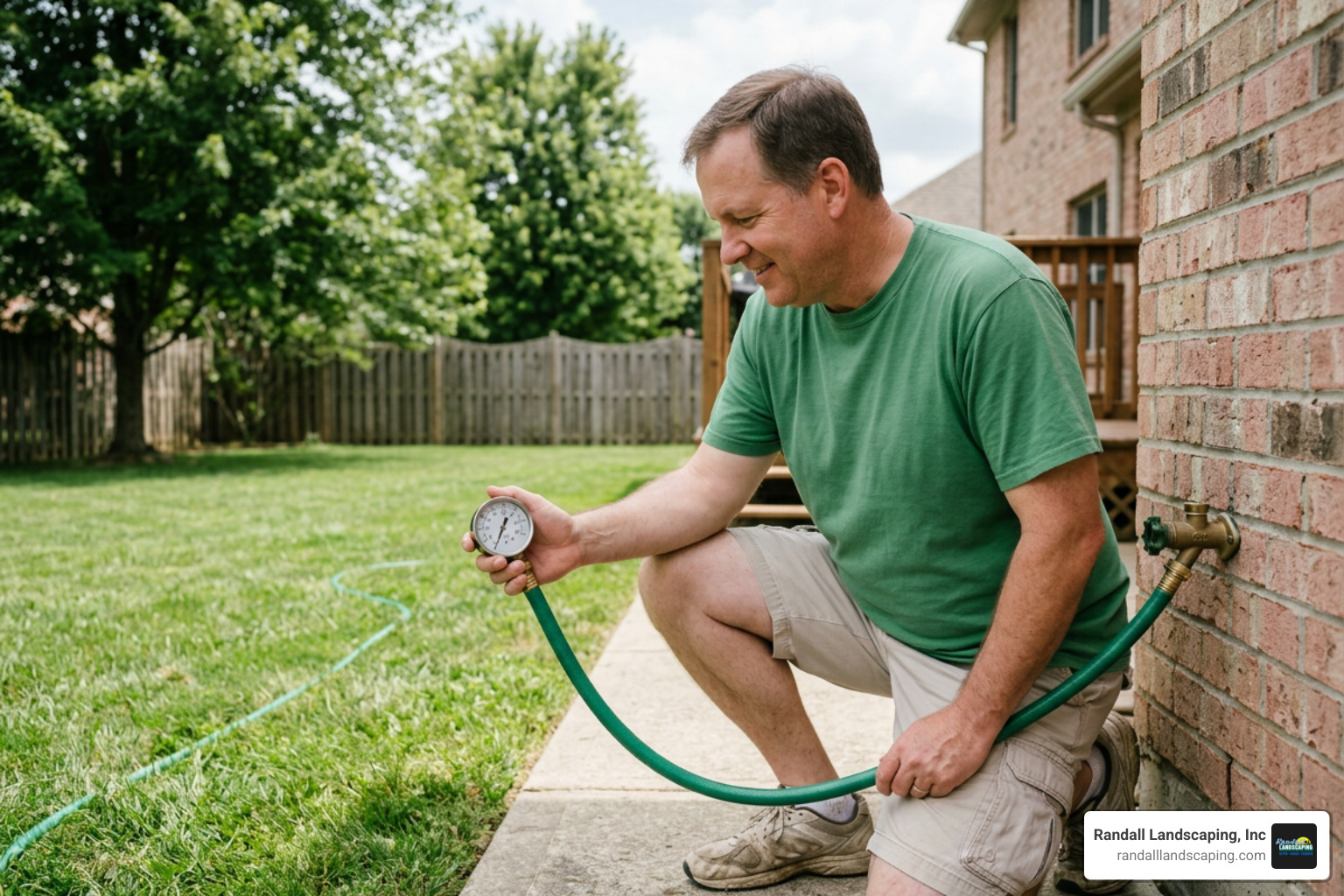
To design an irrigation system that works without losing pressure, you need to calculate three key metrics: static water pressure, water flow rate, and overall system design capacity. For a deep dive into the engineering math behind this, you can refer to the official Hunter Residential Sprinkler System Design Guide.
Sizing Your Water Meter and Service Line
Your system’s capacity is physically limited by the size of your water meter and the main service line running into your home. Common residential water meter sizes are 5/8-inch, 3/4-inch, or 1-inch. You can find this size stamped directly on the body of your water meter or listed on your monthly water utility bill.
Next, you need to identify the material and diameter of your main service line (usually copper, PVC, or galvanized pipe). A smaller pipe or meter restricts the volume of water that can flow into your system at any one time, causing a drop in working pressure. Knowing these measurements allows you to use system capacity charts to determine exactly how many gallons per minute (GPM) your home can safely supply to your irrigation system without causing a drop in household water pressure when the sprinklers turn on.
How to Perform a Bucket Test
If you don’t want to rely solely on calculations, you can easily measure your household water flow rate using the “bucket test.” This practical test tells you exactly how many gallons of water your outdoor spigot can deliver per minute.
To perform a bucket test:
- Find a bucket of a known size (a standard 5-gallon bucket works best).
- Locate the outdoor faucet closest to your water meter and make sure no other water is running inside or outside the house.
- Turn the faucet on all the way and time how many seconds it takes to fill the bucket to the very top.
- Use this simple formula to calculate your GPM: (Bucket Size in Gallons / Fill Time in Seconds) x 60 = Gallons Per Minute (GPM)
For example, if your 5-gallon bucket fills in 30 seconds, your flow rate is 10 GPM. To ensure a safety margin for daily fluctuations in municipal water pressure, we always recommend multiplying this number by 0.8 to get your safe system design capacity (in this case, 8 GPM).
Designing and Planning Your Irrigation Zones
Once you know your home’s water capacity, you can begin mapping out your yard. The golden rule of irrigation design is head-to-head coverage. This means that the spray pattern of one sprinkler head must reach all the way to the neighboring sprinkler head.
Overlapping the spray patterns ensures 100% uniform coverage. Without head-to-head spacing, you will end up with dry, brown spots in your lawn because the area directly around a sprinkler head receives less water than the area further out. Proper spacing also prevents wind drift from leaving dry patches on breezy summer days.

Determining Zones for Your Lawn Sprinkler System
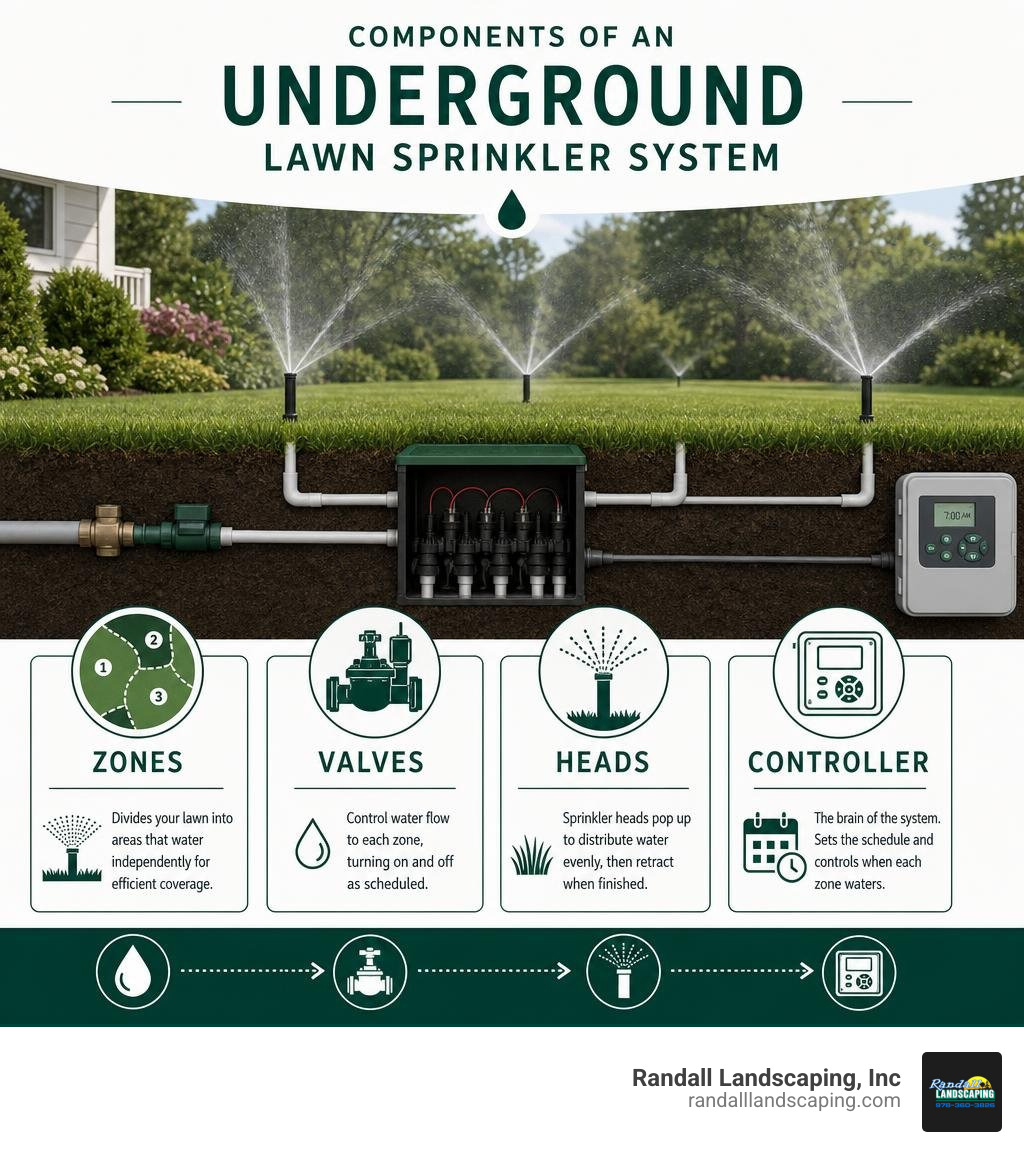
Because your home’s water supply cannot provide enough pressure to water your entire yard at the same time, we must divide your property into distinct “zones.” Each zone is controlled by its own automatic valve, allowing different sections of your yard to be watered one after another.
This process is called hydrozoning. When planning your zones, group areas with similar watering needs together:
- Sun exposure: Separate heavily shaded lawn areas from wide-open, sunny turf. Shady zones require much less water.
- Slopes and runoff: Sloped areas should be on their own zones so you can program shorter, more frequent watering cycles to prevent water from running off into the street before it can soak into the soil.
- Plant types: Never mix large turf rotors and delicate flower bed drip lines on the same zone valve. They have completely different precipitation rates.
Selecting Sprinkler Heads and Nozzles
Choosing the right sprinkler heads is critical for water efficiency. For open, expansive lawn areas, we install gear-drive rotors or rotary nozzles (like MP Rotators). These rotate slowly, throwing a thick stream of water over long distances (typically 15 to 45 feet), which allows the soil plenty of time to absorb the moisture.
For smaller, tighter, or oddly shaped lawn spaces, pop-up spray heads with matched precipitation nozzles are ideal. These spray a continuous fan of water over a shorter radius (typically 5 to 15 feet).
For maximum water efficiency, always choose pressure-regulated sprinkler bodies. These keep the water pressure at an optimal 30 to 40 PSI, preventing the water from “misting” or turning into a fine fog that simply blows away in the wind.
Step-by-Step DIY Underground Sprinkler Installation
For homeowners with small, flat yards and plenty of free time, installing a DIY underground system can be a rewarding weekend project. There are pre-packaged kits available, such as the Orbit In-Ground Sprinkler System Kit, which connect directly to an outdoor faucet and use flexible, push-fit tubing to simplify the installation process.
However, if you have a larger yard, clay soil, or multiple slopes, digging trenches and plumbing a mainline can quickly become overwhelming. In those cases, hiring a professional team for a Professional Sprinkler System Installation will save you days of backbreaking labor and prevent costly hydraulic mistakes.
Essential Tools and Materials for DIYers
If you decide to tackle the installation yourself, make sure you have the following tools and materials on hand before you begin:
- Spade shovel or half-moon edger (or a rented trenching machine to save your back)
- Polyethylene (poly) pipe or PVC pipe (poly is highly recommended in cold climates like MA and NH because it expands slightly during freeze cycles)
- Pipe cutters and PVC cement (if using PVC)
- Barbed insert fittings and stainless steel pinch clamps (if using poly pipe)
- Pinch clamp tool
- Valve box to protect your manifold valves
- Teflon tape for threaded connections
- A high-quality pressure gauge
Before putting a shovel in the dirt, always call 811 to have your local utility companies mark any underground gas, electric, or cable lines. It’s a free service, and it’s the law!
Connecting to the Main Water Line
Connecting your irrigation system to your home’s water supply is the most critical plumbing step. In most municipalities across Massachusetts and New Hampshire, you are required by law to install a backflow preventer at your system’s point of connection.
A backflow preventer is a safety device that prevents dirty sprinkler water, lawn fertilizers, and pesticides from being siphoned backward into your home’s clean drinking water supply. Depending on your local plumbing codes, you may need to obtain a permit and hire a licensed plumber to make this connection and install a certified pressure vacuum breaker (PVB) or reduced pressure zone (RPZ) valve.
Smart Controllers and Water-Saving Technologies
The brain of your modern lawn sprinkler system is the controller. Old-school mechanical dials are a thing of the past. Today’s smart controllers use your home’s Wi-Fi connection to completely revolutionize how we water our yards.
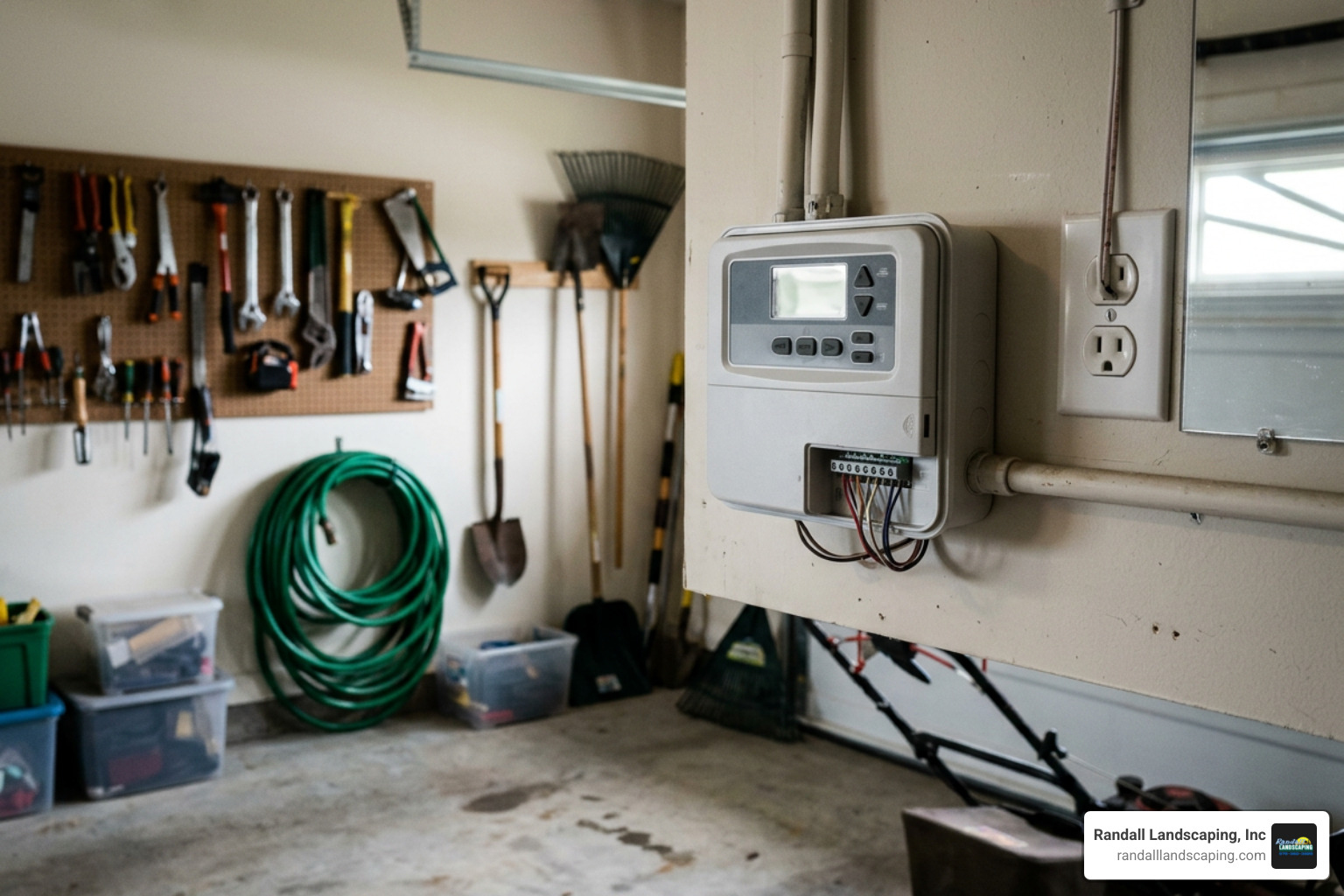
By upgrading to smart technology, you can easily prevent overwatering, save money on your water bills, and manage your lawn from anywhere in the world.
Benefits of App-Based Irrigation Controllers
App-based smart controllers, such as the Rachio 3 Smart Sprinkler Controller, take the guesswork out of seasonal adjustments. Instead of watering on a rigid schedule regardless of the weather, these systems monitor local, real-time weather stations.
If it rained yesterday, or if heavy rain is forecasted for later today, the controller will automatically skip the scheduled watering cycle. They also adjust watering runtimes based on seasonal temperatures, watering less during cool spring weeks and ramping up during hot summer stretches.
Additionally, you can easily install a rain sensor to provide a physical backup to your Wi-Fi weather data. If you want to add one yourself, read our guide on How to Install a Rain Sensor Without Short Circuiting Your Brain to avoid common wiring mistakes.
High-Efficiency Nozzles and Pressure Regulation
Smart controllers are only half of the water-saving equation; the sprinkler heads themselves must also be efficient. Traditional spray nozzles can create a fine mist at high pressures, which easily evaporates before it ever hits the ground.
By utilizing high-efficiency rotary nozzles and built-in pressure regulation, you can ensure that water is delivered in thick, wind-resistant streams. This applies water slowly and evenly, allowing the soil to absorb every drop. This technology is incredibly helpful for sloped properties in towns like Windham, NH, or Boxford, MA, where heavy runoff can easily wash away fresh mulch and soil.
Essential Maintenance, Winterization, and Troubleshooting
To keep your irrigation system running efficiently for years to come, you must perform regular seasonal maintenance. Neglecting your system can lead to underground leaks, clogged nozzles, and catastrophic pipe damage during our freezing New England winters.
How to Winterize Your Sprinkler System
In Massachusetts and Southern New Hampshire, winterization is not optional. If water is left inside your underground pipes when the ground freezes, the water will expand, cracking the plastic pipes, shattering the zone valves, and ruining your expensive backflow preventer.
The only reliable way to protect your system is the blowout method. This process uses a high-volume commercial air compressor connected to your mainline to blow all remaining water out through each individual sprinkler zone.
Because high-pressure air can easily melt plastic pipes or cause sprinkler heads to fly apart if done incorrectly, this task is best left to professionals. When autumn arrives, save yourself a massive headache by searching for a professional blowout service. You can learn more about this essential service in our article Don’t Let Your Pipes Freeze Finding an Irrigation Blowout Near Me.
Troubleshooting Common Sprinkler Problems
Throughout the spring and summer, we recommend doing a quick visual inspection of your system once a month while it is running. Here are the most common issues to look out for:
- Clogged nozzles: If a sprinkler head is barely spraying or spitting water, dirt or grass clippings are likely trapped in the internal filter screen. Simply unscrew the nozzle, rinse the screen, and pop it back in.
- Sunken heads: Over time, lawn mowers and heavy foot traffic can push sprinkler heads down into the soil. If a head doesn’t pop up high enough to clear the grass, you will need to install a simple riser extender to bring it back to lawn level.
- Underground leaks: If you notice a soggy, muddy spot in your grass when the system is off, or if you see a dramatic drop in water pressure across an entire zone, you likely have a cracked underground pipe. This requires digging up the damaged section and splicing in a new piece of pipe.
Frequently Asked Questions About Sprinklers
How much does a typical residential sprinkler system cost?
As mentioned earlier, based on national internet data, the average cost to install a residential in-ground sprinkler system is about $2,539. However, because every yard is unique, prices can range widely from $1,500 for small, simple lawns up to $9,500 or more for larger, multi-zone properties with complex landscaping, custom drip lines, and smart controllers. Please remember that these are average costs compiled from national internet data and do not reflect the actual installation rates for Randall Landscaping, Inc.
Can I install an underground sprinkler system myself?
Yes, you can certainly install a DIY system using homeowner-friendly kits. This works best for small, flat yards that only require one or two zones. However, if your yard is large, heavily sloped, or has rocky soil, the physical labor of digging hundreds of feet of trenches and the complex hydraulic calculations required to ensure proper water pressure make professional installation a much safer, more reliable option.
How often should I run my lawn sprinkler system?
Most lawns need about 1 to 2 inches of water per week, including rainfall. Instead of watering for 10 minutes every single day, it is far better to water deeply and less frequently—such as 2 to 3 times a week for 30 to 45 minutes per zone. Deep watering encourages your grass to grow deep, resilient root systems, helping your lawn stay green and healthy even during dry summer spells.
Conclusion
A professionally designed and installed lawn sprinkler system is the ultimate way to maintain a lush, green yard without wasting your weekends dragging heavy hoses around. By utilizing smart controllers, hydrozoning, and pressure-regulated heads, you can easily cut your outdoor water waste in half while keeping your grass in peak condition.
At Randall Landscaping, Inc., we pride ourselves on delivering top-quality work and 100% reliable service to homeowners and businesses throughout the Merrimack Valley and Southern New Hampshire. Whether you live in Andover, Dracut, North Reading, Salem, or Windham, we are here to help you design, install, and maintain the perfect irrigation system for your property.
Ready to transform your lawn? Contact us today to schedule your Professional Sprinkler Installation and take the first step toward a beautiful, worry-free yard!