
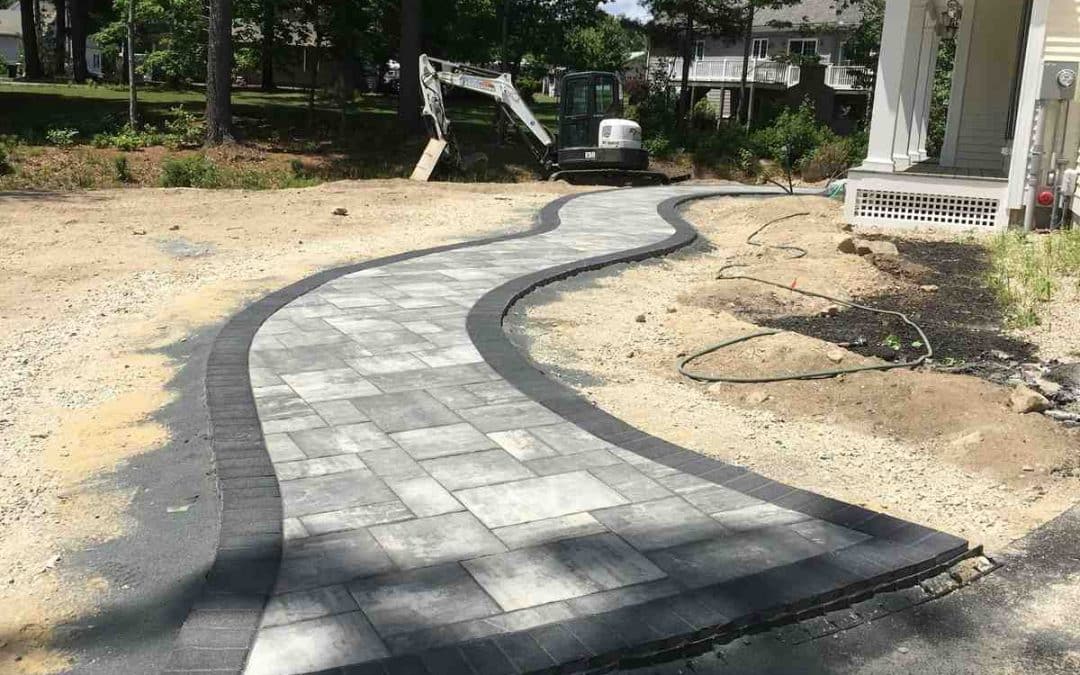
Why a Garden Path Can Transform Your Outdoor Space
Garden path installation is a rewarding DIY project that can dramatically improve both the functionality and appearance of your outdoor space. Here’s what you need to know to get started:
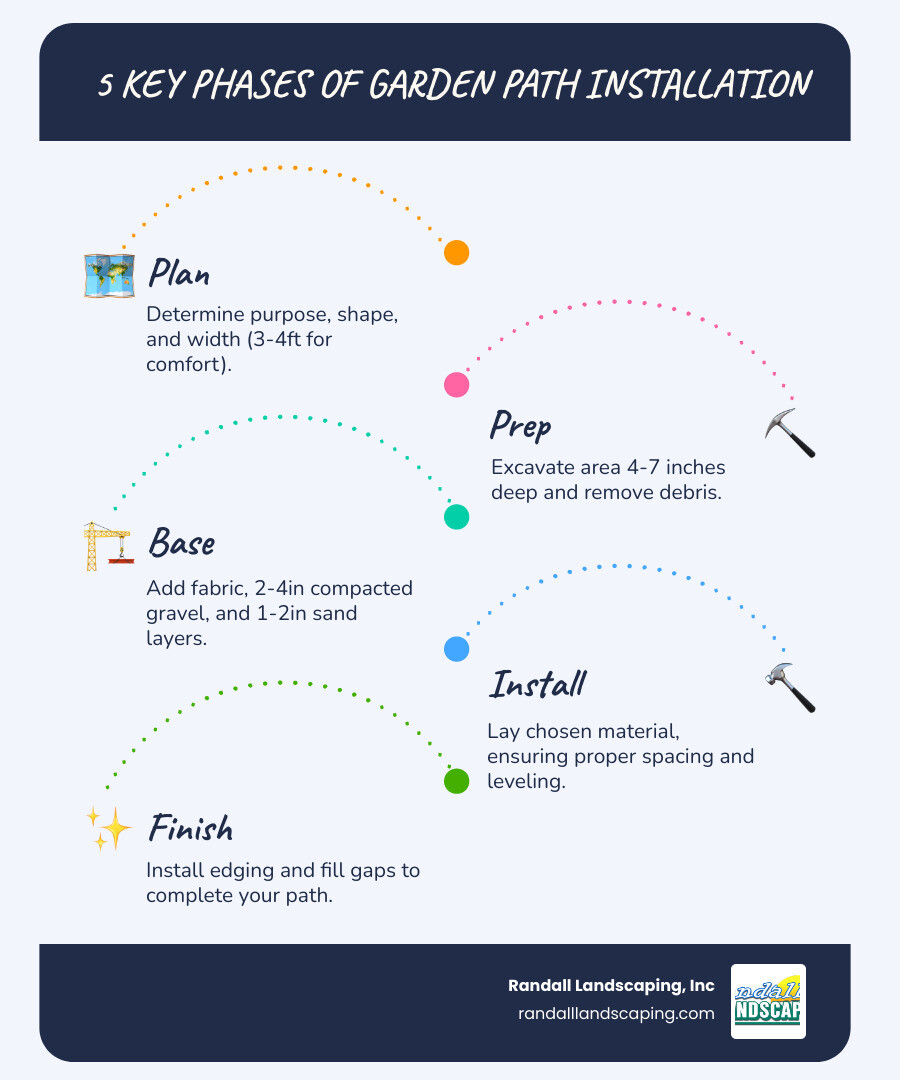
- Plan Your Path – Determine purpose, shape, and width (typically 3-4 feet for comfortable walking)
- Choose Your Material – Select from gravel, pavers, brick, or natural stone based on budget and style
- Prepare the Ground – Excavate 4-7 inches deep for most paths
- Build a Stable Base – Layer landscape fabric, 2-4 inches of compacted gravel, and 1-2 inches of sand
- Install Your Path – Lay your chosen material, ensuring proper spacing and leveling
- Add Finishing Touches – Install edging and fill gaps to complete your path
A well-designed garden path does more than connect Point A to Point B. It adds character to your landscape, prevents worn patches in your lawn, and creates inviting spaces that encourage you to explore and enjoy your yard. Whether you’re building a casual stepping stone trail through your garden beds or a formal brick walkway to your front door, the process follows the same basic principles.
I’m Tommy Randall, owner of Randall Landscaping, Inc., and I’ve been helping homeowners throughout Massachusetts and New Hampshire create beautiful outdoor spaces since 2006, with garden path installation being one of our most popular services for changing yards. In this guide, I’ll walk you through the entire process step by step, sharing the same techniques we use on professional installations so you can achieve lasting results.
Garden path installation vocab explained:
Planning and Designing Your Perfect Garden Path
Before you even think about digging, the most crucial step in any successful garden path installation is careful planning and design. This phase sets the stage for a path that not only looks great but also serves its purpose for years to come.
First, consider your path’s purpose. Is it a highly functional walkway connecting your back door to a shed or patio, or a decorative feature meandering through your flower beds? Perhaps it’s a solution to guide foot traffic, preventing your beloved pets from creating their own “racetracks” through your prized plants. The path’s primary role will influence its shape, width, and material choice.
When it comes to shape, a straight path often lends a more formal, structured look to your garden, ideal for main walkways. A curved or winding path, on the other hand, creates a more natural, informal, and inviting feel, perfect for garden strolls.
Next, think about width. A functional walkway should be at least two feet wide. However, for a more comfortable experience, especially if you anticipate two people walking side-by-side, we typically recommend paths between 36 and 48 inches wide. A path in this range allows for easy passage and can even accommodate a wheelbarrow.
To visualize your path before committing, we suggest using a garden hose or spray paint to outline your desired layout on the ground. This allows you to walk the path, adjust curves, and ensure it feels natural and functional within your landscape. This simple trick can save you a lot of backache later! For more inspiration, check out this step-by-step DIY garden path guide.
Choosing Your Path Type: Pros and Cons
The material you choose will significantly impact your path’s aesthetics, durability, and maintenance needs. Let’s explore some popular options for garden path installation:
- Loose Materials: Gravel and Mulch
- Gravel: A classic choice for informal paths, gravel offers a natural look and is generally low-maintenance. Options like river stone are excellent for garden pathways because their rounded edges are gentle underfoot and won’t harm plant stems. We have a great resource on how to install a crushed gravel walkway.
- Pros: Cost-effective, good drainage, easy to install, natural appearance.
- Cons: Can migrate or displace over time, requires edging to contain, weeds can sprout through if not properly prepared.
- Mulch: Similar to gravel in its informal appeal, mulch is another low-cost option.
- Pros: Natural, often readily available, soft underfoot, can suppress weeds.
- Cons: Decomposes and needs replenishment, can wash away on slopes, attracts insects, weeds can grow through.
- Gravel: A classic choice for informal paths, gravel offers a natural look and is generally low-maintenance. Options like river stone are excellent for garden pathways because their rounded edges are gentle underfoot and won’t harm plant stems. We have a great resource on how to install a crushed gravel walkway.
- Stepping Stones: Often made from flagstone or concrete, stepping stones create a charming, informal path that allows for planting between the stones.
- Pros: Aesthetic appeal, allows greenery to grow between, relatively simple to install for a casual look.
- Cons: Can become uneven or hazardous if not properly based, less stable than a continuous surface, individual leveling required. Explore our guide on walkways with stepping stones.
- Pavers and Bricks: For a more structured and durable path, pavers and bricks are excellent choices. They create a polished, uniform look and are ideal for formal pathways. Permeable pavers are also a great option, allowing water to drain through.
- Pros: Highly durable, stable, uniform appearance, wide variety of colors and styles, low maintenance.
- Cons: More labor-intensive to install, generally higher material cost. Learn more about paver walkway contractors.
- Natural Stone (e.g., Flagstone, Bluestone): Natural stone offers unique beauty and exceptional durability, making it a premium choice. Flagstone, with its natural, irregular shapes, is a popular option, especially here in New England. Bluestone offers a distinctive blue-gray color that ages beautifully.
- Pros: Best aesthetic appeal, extremely durable, increases property value, unique.
- Cons: Most expensive option, irregular shapes can be challenging to work with, heavy to transport and lay. We have detailed guides on building a flagstone walkway and how to install a bluestone walkway.
Gathering Your Materials and Tools
Once you’ve finalized your design and chosen your materials, it’s time to gather everything you’ll need. This preparation phase is crucial for a smooth and efficient garden path installation.
Best Materials for Durability, Cost, and Aesthetics
Selecting the right materials involves balancing durability, cost, and the aesthetic you want to achieve. Here’s a table to help you compare common options, with costs representing average prices based on internet data, which can vary widely depending on suppliers and specific product grades:
| Material | Average Cost/Sq. Ft. (Estimated) | Durability | Maintenance | Aesthetic |
|---|---|---|---|---|
| Gravel | $0.50 – $5 | Moderate | Low (requires edging, occasional raking/refill) | Natural, informal, rustic |
| Pavers | $3 – $15 | High | Low (occasional cleaning/joint refill) | Formal, versatile, uniform |
| Brick | $4 – $20 | High | Low (occasional cleaning/joint refill) | Classic, formal, traditional |
| Flagstone | $2 – $30 (premium up to $90) | High | Low (minimal, occasional joint touch-up) | Rustic, natural, neat |
As you can see, stone materials typically range from $2-$30 per square foot, with premium options like custom-cut bluestone reaching $60-$90 per square foot. These are average costs, and prices can fluctuate based on the type of stone, its origin, and local availability in the Merrimack Valley or Southern New Hampshire. A 3-ft wide by 70-ft long path can require about 3 tons of stone, so factor in delivery costs!
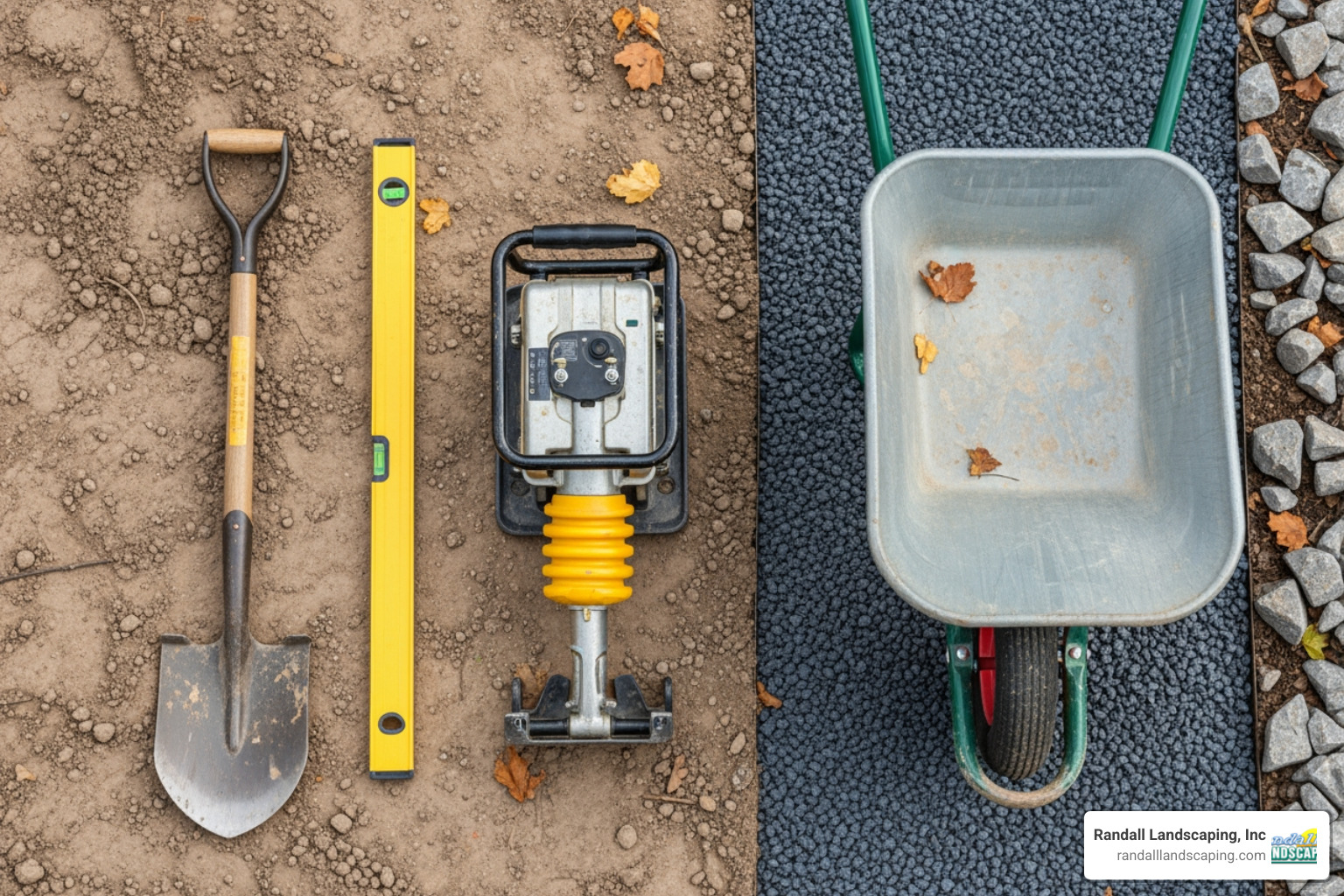
Essential Tools and Equipment Checklist
Having the right tools on hand will make your garden path installation much easier and more enjoyable. Here’s a checklist of what you’ll likely need:
- Shovel and Spade: For digging and moving soil and aggregate.
- Rake: For leveling and spreading materials.
- Wheelbarrow: Essential for transporting heavy materials like gravel, sand, and stones.
- Tamper (Manual or Plate Compactor): Crucial for compacting soil and base layers. A manual tamper works for small projects, but a plate compactor can be rented from your local hardware store for larger areas and will save you a lot of effort!
- Level (Spirit Level): To ensure your path has the correct slope for drainage and is even.
- Rubber Mallet: For tapping pavers or stones into place without damaging them.
- Tape Measure: For accurate measurements of width, depth, and spacing.
- Stakes and String: For marking out your path’s boundaries and ensuring straight lines.
- Utility Knife/Scissors: For cutting landscape fabric.
- Safety Gear: Gloves, safety glasses, and sturdy footwear are a must to protect yourself during the work.
- Garden Hose or Spray Paint: For marking your initial path layout.
- Edging: Your chosen material to define the path’s borders.
- Landscape Fabric: To suppress weeds.
The Foundation: Ground Preparation and Drainage
We can’t stress this enough: the foundation is the most critical step in your garden path installation. A poorly prepared base will lead to a path that shifts, sinks, collects water, and ultimately falls apart. Proper ground preparation ensures longevity and stability, especially with our New England weather and its freeze-thaw cycles. Getting this right means your path will be a joy, not a headache! You can find more detailed information on our base for flagstone walkway page, and this DIY walkway installation guide also provides valuable insights.
Step 1: Excavating the Path Area
- Marking the Path: Using your garden hose or spray paint, clearly define the exact route and width of your path. Use stakes and string lines to create precise, straight edges or smooth, flowing curves. This is your last chance to adjust the layout before you start digging!
- Digging Depth: The depth you need to excavate depends on your chosen material and the climate. In general, you’ll need to dig about four to six inches deep for most pathways. However, for materials like concrete pavers or brick paths, we recommend digging approximately 6.7 to 7 inches deep. For gravel paths, a shallower excavation of about 2.4 inches is often sufficient. Overall, aim for a depth of 3 to 10 inches to accommodate your base materials, ensuring proper drainage and material thickness.
- Clearing Roots and Rocks: Once you start digging, you’ll inevitably encounter roots, rocks, and other debris. Make sure to remove all of these obstructions. Any organic matter left in the base can decompose, leading to settling and uneven spots.
- Compacting the Subsoil: After excavating and clearing, compact the exposed subsoil thoroughly. Use a hand tamper for smaller areas or a rented plate compactor for larger projects. This creates a firm, stable base for the layers to follow.
Step 2: Creating a Stable Base and Ensuring Proper Drainage
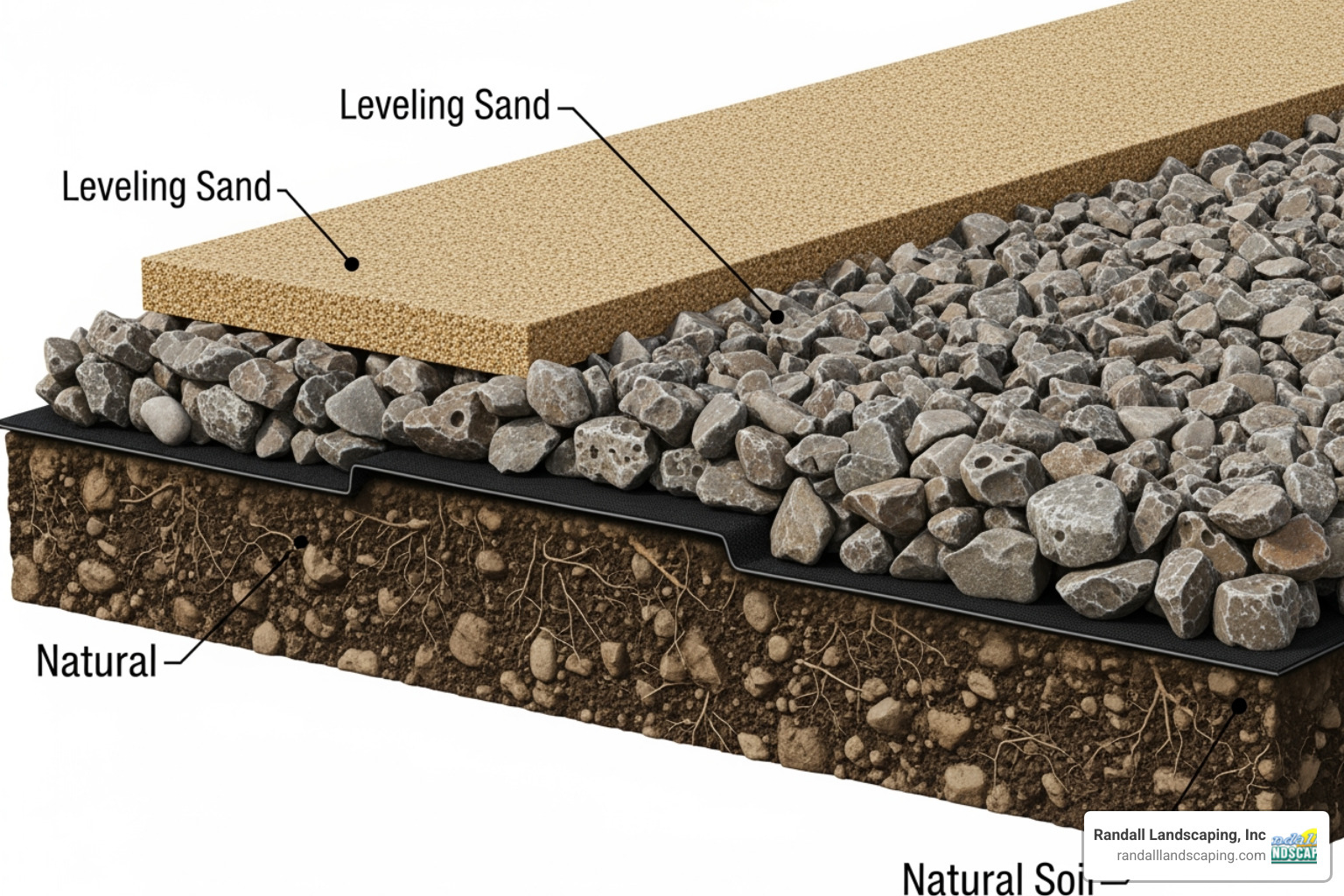
This multi-layered approach is the secret to a durable path.
- Landscape Fabric (Weed Barrier): Lay a high-quality landscape fabric across the entire excavated area. This fabric serves multiple purposes: it prevents weeds from growing up through your path materials, separates your base layers from the native soil (preventing mixing and instability), and helps maintain soil moisture. If using multiple sheets, ensure they overlap by at least 4 inches (100mm) to prevent gaps.
- Gravel Base Layer: Over the landscape fabric, spread a layer of crushed stone or coarse gravel. This layer provides crucial drainage and structural stability. We typically recommend adding 2 to 4 inches of this material. Once spread, compact it thoroughly with your tamper or plate compactor. For more detailed information on proper base preparation for hardscaping projects, the Interlocking Concrete Pavement Institute provides excellent technical resources and guidelines.
- Drainage Slope: As you lay your gravel base, ensure you create a slight slope for proper drainage. A gradient of about 1/4 inch per foot, sloping away from any structures like your house or patio, is usually sufficient. This prevents water from pooling on your path or against your home, which is especially important in our region with its freeze-thaw cycles.
- Sand Setting Bed: On top of the compacted gravel, spread a 1 to 2-inch layer of coarse sand. This “leveling sand” acts like tiny bits of crushed concrete, providing a smooth and level surface for laying your chosen path material. Use a straight edge or a long, flat board to screed the sand, ensuring it’s uniform and has the correct drainage slope. You can learn more about leveling sand.
Your Step-by-Step Garden Path Installation Guide
With the ground carefully prepared, we’re ready for the exciting part: laying your chosen path material. This is where your garden path installation truly comes to life!
Gravel and Mulch Garden Path Installation
For a simple and natural path, gravel or mulch are excellent choices.
- Spread Material Evenly: Once your base is ready, simply pour your gravel or mulch into the excavated area. Use a rake to spread the material evenly across the entire surface.
- Rake to Level: Ensure the material is level and consistent.
- Compact Lightly: For gravel, a light pass with a plate compactor or a hand tamper will help settle the stones. For mulch, simply walk over it to compact it slightly.
- Top Up as Needed: Gravel paths, especially, may settle over time and require occasional topping up to maintain their depth and appearance.
Paver and Brick Garden Path Installation
Laying pavers or bricks requires precision and patience, but the result is a beautiful, durable surface.
- Start from an Edge: Begin laying your pavers or bricks from one edge of your path, ideally against a fixed structure or a permanent edging.
- Use String Lines for Alignment: Continuously refer to your string lines to ensure your rows are straight and your pattern is consistent.
- Tap with Rubber Mallet: Gently tap each paver or brick into the sand bed with a rubber mallet. This helps them settle firmly and level with their neighbors.
- Check for Level: Regularly check the level of your pavers both individually and across the path using your spirit level. Adjust by adding or removing sand underneath as needed.
- Maintain Spacing: Leave consistent gaps between pavers or bricks. For concrete pavers, a 10mm (about 0.4 inches) gap is common, while bricks might have a 20mm (about 0.8 inches) gap.
- Cut Pavers if Needed: You may need a paver saw or brick splitter to cut pieces to fit edges or around obstacles. Always wear appropriate safety gear when cutting. For more on brick paths, check out our brick walkway contractors guide.
Natural Stone and Flagstone Garden Path Installation
Natural stone paths, especially flagstone, offer a unique, organic charm.
- Dry-Fit Stones First: Before permanently setting anything, arrange your stones in the desired pattern on top of the sand bed. This allows you to experiment with placement, minimize cuts, and ensure a pleasing aesthetic. Think of it like a giant jigsaw puzzle!
- Press into Sand Bed: Once you’re happy with the layout, carefully lift each stone and press it firmly into the sand bed.
- Maintain Spacing: For a formal look, aim for about 1/2 inch spacing between stones. For a more casual, stepping stone effect that allows for planting, you can leave wider gaps of about 2 inches.
- Level Each Stone: Use your rubber mallet to tap each stone until it’s level with its neighbors and the desired path grade. Check frequently with your spirit level. If a stone is too low, lift it and add more sand underneath.
- Mortar Option: For flagstone paths that require extra stability or a very formal look, especially in high-traffic areas, you can opt to set stones in mortar. Our guide on how to install a flagstone walkway with mortar provides detailed steps for this advanced technique. For general stone path inspiration, visit our stone walkways page.
Common Mistakes to Avoid
Even seasoned DIYers can stumble, but by being aware of common pitfalls, you can ensure your garden path installation is a resounding success and lasts for many seasons in our New England climate.
- Improper Base Preparation: This is the cardinal sin of path building. Many DIY projects fall short in the excavation step. Skipping or skimping on the compacted subsoil, landscape fabric, or gravel base will lead to a path that heaves, cracks, and becomes uneven. The foundation is everything!
- Skipping the Level: We’ve seen paths throughout the Merrimack Valley and Southern New Hampshire with unsightly puddles because a level wasn’t used. Not ensuring a consistent grade and proper drainage slope will lead to water pooling, which can cause erosion and accelerate wear and tear. Always check with a spirit level, both cross-wise and along the path’s length.
- Incorrect Spacing: Forgetting about consistent spacing can make your path look haphazard and even create trip hazards. Whether you’re aiming for tight, formal joints or wider gaps for plants, consistency is key.
- Using the Wrong Filler Material: Filling gaps between pavers or stones with regular garden soil is an open invitation for weeds. This also provides an unstable surface. Instead, use materials like polymeric sand, fine gravel, or a sand/compost mix (if you plan to plant ground covers).
- Forgetting Drainage: Even with a good base, ignoring the overall drainage of your yard can be problematic. Always plan for water to drain away from your path and any adjacent structures. A slight slope (about 1/4 inch per foot) is your best friend here.
Finishing Touches and Long-Term Maintenance
You’ve done the hard work of garden path installation, now it’s time to add those special elements that lift your path from functional to fabulous, and to ensure it stands the test of time.
The Importance of Edging
Edging is not just for aesthetics; it’s a crucial component for the longevity of your garden path.
- Purpose of Edging: Edging serves to contain your path material (especially loose materials like gravel or mulch), preventing it from spreading into your lawn or garden beds. It also defines the path’s borders, giving it a clean, finished look, and helps prevent grass and weeds from encroaching. Plastic landscape edging is particularly effective for smooth, clean lines, while bricks or stone offer a more substantial border.
- Material Options: You can choose from various edging materials to complement your path and garden style. Popular options include:
- Metal: Sleek and modern, provides a crisp line.
- Plastic: Flexible and cost-effective, great for curves.
- Brick: Classic and durable, often used with brick or paver paths.
- Stone: Natural and sturdy, perfect for stone or flagstone paths.
Elevating Your Path’s Look and Functionality
These final steps turn a basic path into a true garden feature. For more ideas on how to integrate your path with your overall landscape, explore our patios and walkway installations services.
- Filling the Gaps:
- Polymeric Sand: For pavers and bricks, polymeric sand is an excellent choice. When moistened, it hardens to lock pavers in place and inhibit weed growth.
- Fine Gravel or Sand: For gravel paths, or between stepping stones where you don’t plan to plant, fine gravel or sand can be swept into the gaps to provide stability.
- Topsoil for Plants: If you’ve chosen a stepping stone or flagstone path with wider gaps, a mix of topsoil and compost can be used as a planting medium.
- Planting Ground Covers: To soften the edges and add a touch of greenery, consider planting low-growing, durable ground covers in the spaces between stones or along the path’s borders. Creeping thyme, sedum, or moss are fantastic choices that can withstand light foot traffic and add fragrance.
- Path Lighting: Extend the usability and beauty of your path into the evening by adding lighting. Solar-powered path lights are easy to install, cost-effective, and create an inviting glow while enhancing safety.
Frequently Asked Questions about Garden Path Installation
We get a lot of questions about DIY garden path installation, so let’s address some of the most common ones to help you on your way.
How deep should I dig for a garden path?
The digging depth for a garden path is not one-size-fits-all; it largely depends on the type of material you’re using and your local climate. Generally, you should aim to dig deep enough to accommodate your base layers (landscape fabric, gravel, and sand) plus the thickness of your chosen path material.
- For Gravel Paths: You might only need to excavate about 2-4 inches.
- For Pavers, Bricks, or Stone Paths: A deeper excavation of 4-7 inches is typically required.
In regions like the Merrimack Valley and Southern New Hampshire, where we experience significant freeze-thaw cycles, digging a bit deeper and ensuring a robust gravel base is crucial to prevent frost heave and maintain the path’s stability over time.
What is the best base for a garden path to ensure it lasts?
To ensure your garden path lasts for years, a multi-layer base is paramount. The best base typically consists of:
- Compacted Subsoil: After excavation, the native soil should be firmly compacted.
- Landscape Fabric: A layer of high-quality geotextile fabric to prevent weed growth and separate soil from base materials.
- Compacted Crushed Gravel: 2-4 inches of compacted crushed stone or gravel provides essential drainage and structural support. This is the workhorse of your base.
- Leveling Sand: 1-2 inches of coarse sand provides a smooth, level bed for your path material and allows for fine adjustments during installation.
This combination creates a stable, well-draining foundation that resists shifting and settling, even with heavy use and challenging weather.
Can I just lay stepping stones on the grass?
While it might seem like a quick and easy solution, we generally do not recommend simply laying stepping stones directly on the grass. Without proper preparation, your stones will likely:
- Shift and Become Uneven: The movement of soil and foot traffic will cause the stones to tilt, sink, or become wobbly.
- Create Trip Hazards: Uneven stones are a tripping hazard, especially for children or the elderly.
- Be Overgrown by Grass: Grass will quickly grow over and around the stones, making them less visible and harder to walk on.
For a stable and safe stepping stone path, we advise excavating a shallow area for each stone, laying down a small amount of landscape fabric, and creating a mini-base of compacted gravel and leveling sand before setting the stone. This ensures each stone remains level and secure.
Conclusion: Enjoy Your New Garden Path
Congratulations! You’re now equipped with the knowledge to start on your own garden path installation project. From planning and choosing materials to preparing the ground and adding those crucial finishing touches, we’ve walked through each step to help you create a beautiful and functional addition to your outdoor space.
The satisfaction of stepping onto a path you’ve built yourself, knowing it will guide you through your garden for years to come, is truly immense. Whether you opted for the rustic charm of gravel, the classic elegance of brick, or the natural beauty of stone, your new path will undoubtedly improve your home’s curb appeal and your enjoyment of your yard.
For larger or more complex projects in the Merrimack Valley or Southern New Hampshire, or if you prefer to leave the heavy lifting to the professionals, the expert team at Randall Landscaping, Inc. is always here to help. If you need professional assistance with your project, explore our Hardscaping: Walkway Installation services. We’re committed to quality work and 100% reliability, ensuring customer satisfaction with every landscape change.