
What Does It Really Cost to Have a Walkway Installed?
How much does it cost to have a walkway installed is one of the most common questions homeowners ask before starting an outdoor project — and the answer depends on several key factors. Here’s a quick overview based on average internet data:
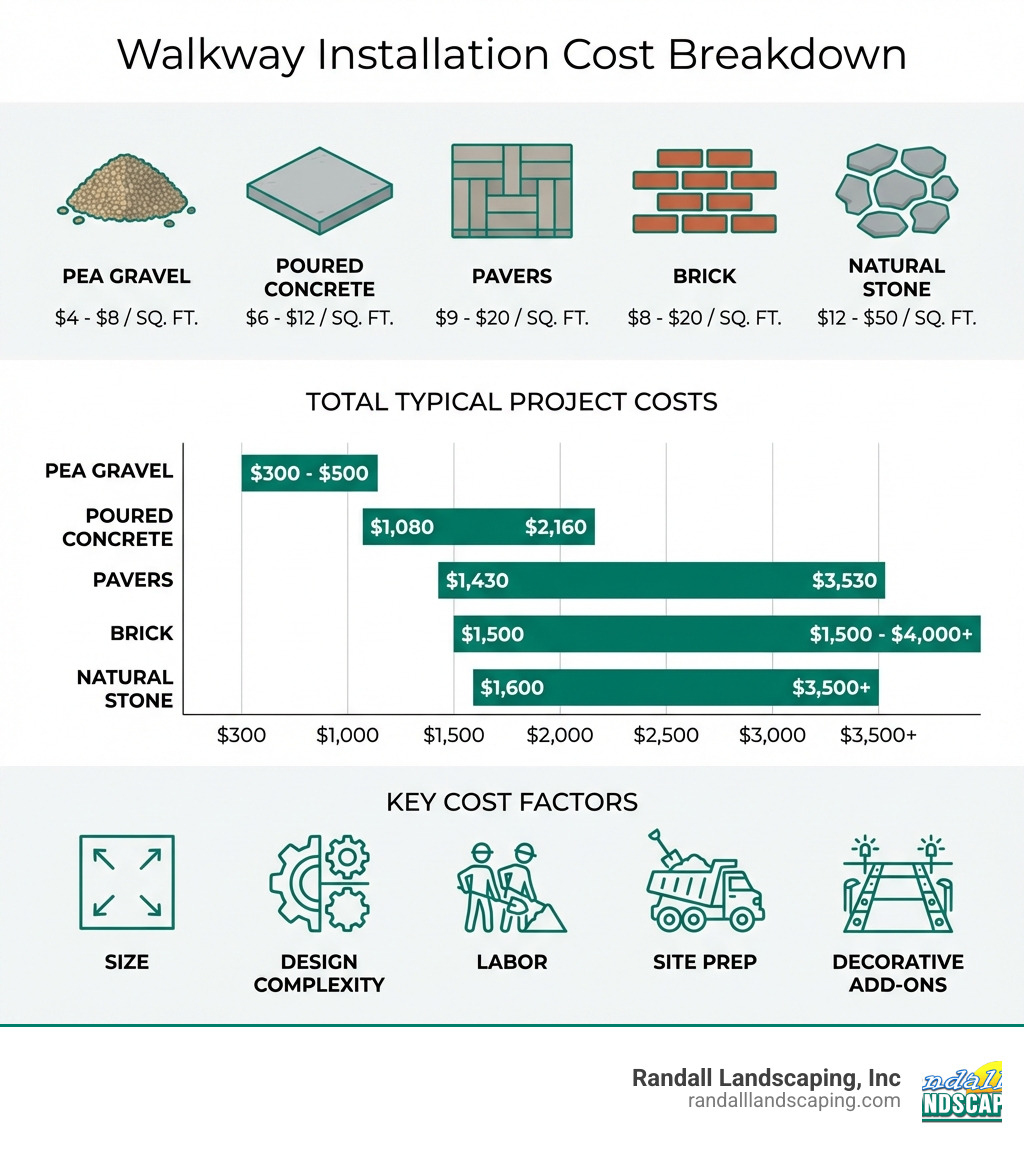
| Material | Average Cost per Sq. Ft. | Typical Total Cost |
|---|---|---|
| Pea Gravel | $4 – $8 | $300 – $500 |
| Poured Concrete | $6 – $12 | $1,080 – $2,160 |
| Pavers | $9 – $20 | $1,430 – $3,530 |
| Natural Stone | $12 – $50 | $1,600 – $3,500+ |
| Brick Pavers | $8 – $20 | $1,500 – $4,000+ |
Note: These are average cost ranges based on national internet data. Actual costs vary by region, site conditions, and project scope. Always get a local quote for accurate pricing.
Most homeowners spend somewhere between $1,565 and $3,765, with many landing near $2,665 for a standard walkway. But that number can swing significantly — a simple gravel path might cost a few hundred dollars, while a large natural stone walkway with custom features can run well above $10,000.
Your final price depends on the material you choose, the size and shape of the path, site prep work, and whether you add any extras like lighting, heating, or decorative finishes. All of that can add up faster than most people expect.
I’m Tommy Randall, owner of Randall Landscaping, Inc., and with nearly two decades of hands-on hardscape experience across Massachusetts and New Hampshire, I’ve helped hundreds of homeowners understand exactly what goes into a walkway project — including what drives the cost up or down. In this guide, I’ll walk you through everything you need to know so you can budget confidently before reaching out for a quote.
Know your how much does it cost to have a walkway installed terms:
How Much Does It Cost to Have a Walkway Installed?
When we sit down with a family in Salem, NH, or Andover, MA, the first thing we discuss is the budget. While the national averages give you a starting point, the reality of the Merrimack Valley landscape—with our rocky soil and harsh winters—often means pricing can be more dynamic.
According to various industry sources, including 2025 Concrete Walkway and Sidewalk Cost data, the national average for a professional installation sits around $2,665. However, we have seen high-end, intricate projects in our service area exceed $15,000 to $25,000 when they involve extensive masonry, retaining walls, and premium natural stones.
It is important to remember that these figures are average costs based on broad internet data and do not represent the fixed pricing of Randall Landscaping. We always recommend an on-site consultation to account for the specific pitch of your yard and the accessibility of the work area.
How much does it cost to have a walkway installed by material type?
The material you choose is the biggest lever you can pull to change your project’s price tag. In the Merrimack Valley, we have to consider how these materials handle the freeze-thaw cycle.
- Poured Concrete: This is often the most economical “hard” surface. Internet data suggests a range of $6 to $15 per square foot for basic finishes, though high-end decorative or stamped concrete can reach $28 or more. It’s durable, but in our region, if it isn’t poured correctly with the right reinforcement, it can crack during a tough North Reading winter.
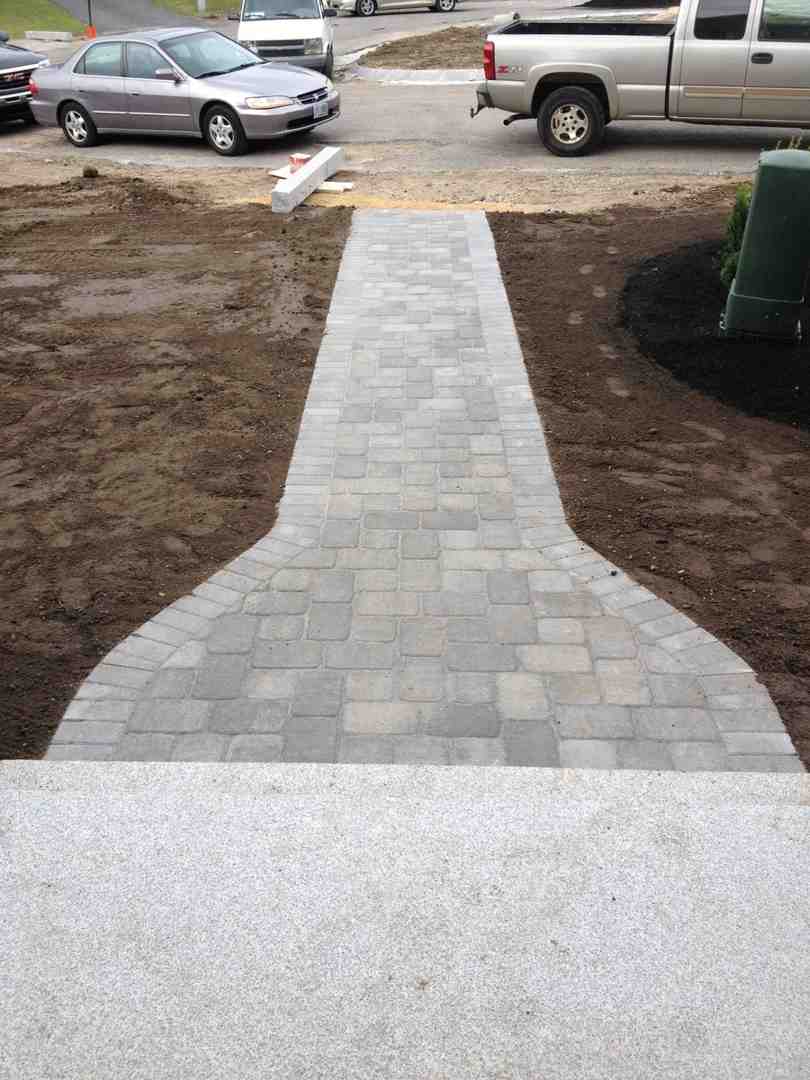
- Concrete Pavers: These are a favorite for many of our clients. They are incredibly versatile and, unlike solid concrete, they can shift slightly with the ground, making them less prone to cracking. According to our Paver Walkway Contractors Ultimate Guide, you can expect internet-based averages to range from $9 to $20 per square foot, with premium designs reaching $40+.
- Natural Stone: If you want that timeless New England look, nothing beats Stone Walkways. Whether it’s bluestone, granite, or flagstone, these materials are stunning but labor-intensive. Internet data places these between $12 and $50 per square foot. However, for a high-end flagstone path in a place like Boxford, costs can easily climb to $75+ per square foot when factoring in custom stone cutting.
- Pea Gravel: This is the budget-friendly champion. It offers a natural, crunchy feel underfoot and helps with drainage. Costs typically range from $4 to $8 per square foot. It’s a great option for secondary paths, though it does require a bit more “raking” maintenance over time.
- Brick Pavers: Brick offers a classic, warm aesthetic. Clay brick pavers usually range from $10 to $20 per square foot installed, while concrete-based “brick look” pavers are slightly more affordable at $8 to $15.
Square foot pricing and size estimates
Size is the most obvious factor in the equation. A small 80 sq. ft. path leading from a driveway to a side door is a much different beast than a 280 sq. ft. grand entrance.
To give you a better idea of the scale, let’s look at some common sizes we see in towns like Dracut and Methuen:
| Walkway Size | Pea Gravel (Low) | Concrete (Mid) | Pavers/Stone (High) |
|---|---|---|---|
| 80 sq. ft. (Small) | $320 – $640 | $640 – $1,200 | $1,600 – $4,000 |
| 140 sq. ft. (Medium) | $560 – $1,120 | $1,120 – $2,100 | $2,800 – $7,000 |
| 280 sq. ft. (Large) | $1,120 – $2,240 | $2,240 – $4,200 | $5,600 – $14,000+ |
Note: These figures are based on broad internet data and represent a wide range of potential costs. High-end custom work can often be 3x or more than the average baseline.
Primary Factors Influencing Your Installation Estimate
If you’ve ever wondered why two neighbors with the same size walkway got two completely different quotes, it’s usually because of what’s happening under the surface.
Site preparation and grading
Before a single stone is laid, we have to prepare the “canvas.” This is where the heavy lifting happens.
- Grading and Drainage: If your yard slopes toward your foundation, we have to regrade the land. Internet data suggests grading can cost between $0.08 and $2.00 per square foot. In the Merrimack Valley, proper drainage is non-negotiable to prevent ice patches in the winter.
- Excavation: We typically need to dig down 6 to 12 inches to create a proper Base for Flagstone Walkway or paver path. If we hit the famous New Hampshire ledge or large boulders, the labor time increases.
- Old Material Removal: If we have to jackhammer an old, cracked concrete sidewalk first, expect to pay between $2 and $6 per square foot just for the demolition and disposal.
Design complexity and labor rates
Straight lines are simple. Curves, circles, and intricate herringbone patterns are beautiful—but they take time.
- Complexity: A straight path requires fewer cuts and simpler forms. A winding, “flowing” path requires a craftsman to hand-cut almost every edge stone. This can increase labor time by 30% or more.
- Labor Rates: Professional Walkway Installation requires a skilled crew. According to the Homewyse Calculator: Stone Walkway prices and options, labor rates for paving contractors can range from $50 to $130 per hour depending on the expertise required. In our region, you’re paying for a crew that knows how to build a walkway that won’t heave when the ground freezes in January.
Permits and regional requirements
Don’t forget the paperwork! Many towns in the Merrimack Valley require a permit for “permanent improvements.”
- Permit Costs: These generally range from $200 to $1,000 depending on your municipality.
- Zoning and Property Lines: If your walkway connects to a public sidewalk in a city like Lawrence or Amesbury, there are strict codes regarding width and ADA accessibility that must be followed. We always check these local regulations to ensure your project is fully compliant.
Enhancing Your Path: Decorative Features and Add-ons
A walkway doesn’t have to be just a way to get from point A to point B. It can be a centerpiece of your landscape design.
How much does it cost to have a walkway installed with custom features?
If you want to go beyond the basics, there are several “upgrades” that can transform your space:
- Stamped and Stained Concrete: Stamping concrete to look like stone or wood adds $8 to $28 per square foot. Adding a custom stain can add another $2 to $4 per square foot.
- Heated Walkways: Tired of shoveling? A snow-melt system can be installed under pavers or concrete. Internet data suggests these systems cost about $12 per square foot for the heating elements, plus the cost of a boiler or electrical connection (often $3,000 to $8,000 total).
- Integrated Lighting: Adding wired low-voltage LED lighting along your path increases safety and curb appeal. Expect to pay around $150 per fixture, including the transformer and installation.
- Walkway Covers and Pergolas: For a truly grand entrance, a pergola or canopy can be installed. Steel or aluminum covers might cost $4 to $12 per square foot, while custom wood structures can reach $30+ per square foot. Many Brick Walkway Contractors can coordinate these additions.
- Landscape Integration: We often suggest adding flower beds or Walkways with Stepping Stones to soften the edges of a hardscape. Small garden walls or benches can also be added for $300 to $800 each.
Long-term maintenance and repair costs
Investing in a walkway also means planning for its future.
- Sealing: For concrete and pavers, we recommend resealing every 2-3 years. This prevents staining and protects the color. Professional resealing costs about $1.50 per square foot.
- Power Washing: A good cleaning can cost $0.20 to $0.40 per square foot and makes a 10-year-old walkway look brand new.
- Gravel Refreshing: If you have a pea gravel or crushed stone path, you may need to add a fresh layer of stone every few years to keep it looking full.
- Repairs: If a paver settles, it can be lifted and reset individually—a huge advantage over concrete. If you need to learn How to Install a Bluestone Walkway for a repair, it’s often best to call in the pros to ensure the base is corrected so the issue doesn’t return.
DIY vs. Professional Walkway Installation
We love the DIY spirit, but when it comes to hardscaping, the “savings” can sometimes be an illusion.
The DIY Reality:
- Equipment: You’ll need to rent a plate compactor, a masonry saw, and potentially a mini-excavator. These rentals can cost $500 to $1,000 for a weekend.
- Materials: You’ll pay retail prices for stone and base materials. Delivery fees for heavy pallets of pavers or yards of gravel can add $100 to $500 to your bill.
- Labor: It is back-breaking work. A project that takes our crew two days might take an inexperienced homeowner four weekends.
- The Risk: If the base isn’t compacted perfectly, your walkway will settle and become a tripping hazard within a year.
The Professional Value: When you hire us, you’re not just paying for the stones; you’re paying for 100% reliability and a warranty. We have the specialized tools, like vacuum lifters for large bluestone slabs and industrial compactors, to ensure the job is done once and done right.
If you’re considering a DIY project, we’ve put together some resources to help you understand the complexity, such as How to Install a Flagstone Walkway with Mortar and How to Install Crushed Gravel Walkway. Just remember: concrete is permanent, and pavers are heavy!
Frequently Asked Questions about Walkway Costs
What is the cheapest material for a new walkway?
Pea gravel or crushed stone is consistently the most affordable option, often costing as little as $1 to $8 per square foot for materials. Poured concrete is the most affordable “solid” surface, typically starting around $6 to $10 per square foot for a basic broom finish.
Does a new walkway increase home resale value?
Absolutely. A well-designed walkway significantly boosts “curb appeal,” which is the first thing a buyer sees. It makes the property look maintained and provides safe, easy access to the home. In many cases, homeowners see a return on investment (ROI) that covers a large portion of the installation cost through increased property value.
How long does it take to install a professional walkway?
A standard 100–200 square foot walkway usually takes a professional crew 2 to 4 days to complete, depending on the material. This includes the time for excavation, base preparation, laying the material, and finishing touches like polymeric sand or sealing.
Conclusion
Planning your outdoor space should be an exciting time, not a stressful one. While the question of how much does it cost to have a walkway installed has many answers, the best approach is to start with a clear vision of how you want to use your yard. Whether you are looking for a simple gravel path in Pelham or a grand granite entrance in Andover, the investment you make today will serve your family for decades.
At Randall Landscaping, Inc., we pride ourselves on being the Merrimack Valley and Southern New Hampshire experts in durable, beautiful hardscapes. We focus on quality work and 100% reliability because we know that in our climate, there are no shortcuts to a long-lasting walkway.
Ready to stop guessing and start building? We would love to help you design a path that fits your home and your budget perfectly.