
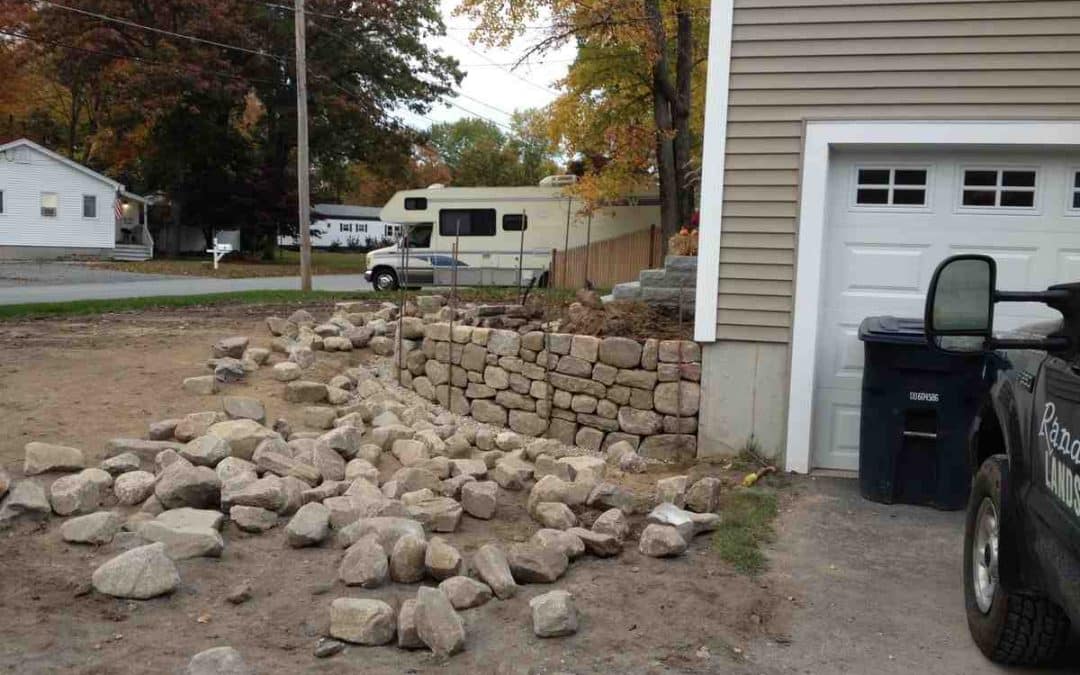
When Your Slope Can’t Wait: Finding the Right Rock Retaining Wall Contractors
Rock retaining wall contractors are specialists who design and build stone structures that hold back soil, control erosion, and turn unusable sloped land into functional outdoor space. If you need one fast, here’s what to know:
Quick answers for homeowners searching for a rock retaining wall contractor:
- What they do: Install natural stone, boulder, and rock-based walls to stabilize slopes and prevent erosion
- When you need one: Sloped yard losing soil, existing wall leaning or cracking, or you want to create level usable space
- What to look for: Licensed and insured, local experience, written warranty, knowledge of local permits
- Average cost: Roughly $25–$150 per sq ft for most projects (internet average; not a quote from Randall Landscaping)
- Permit needed? Usually yes, for walls over 4 feet — a qualified contractor handles this
- How long they last: Natural stone walls can last decades with proper drainage and installation
A sloped yard in Southern New Hampshire isn’t just an eyesore — it’s a liability. Heavy rain, freeze-thaw cycles, and the region’s clay-heavy soils create real pressure on any structure holding back hillside soil. Get the wall wrong, and you’re not just looking at a repair bill. You’re looking at lost yard space, damaged foundations, and a problem that’s hard to trace back to whoever built it.
The good news is that a well-built rock retaining wall — designed for your specific site, soil, and climate — can solve all of that while making your property look significantly better.
I’m Tommy Randall, owner of Randall Landscaping, Inc., and I’ve been designing and installing retaining walls and hardscapes across Massachusetts and New Hampshire since 2006. Working as one of the region’s trusted rock retaining wall contractors, I’ve seen what separates a wall that lasts 40 years from one that fails in the first wet season. This guide covers everything you need to know before hiring anyone.
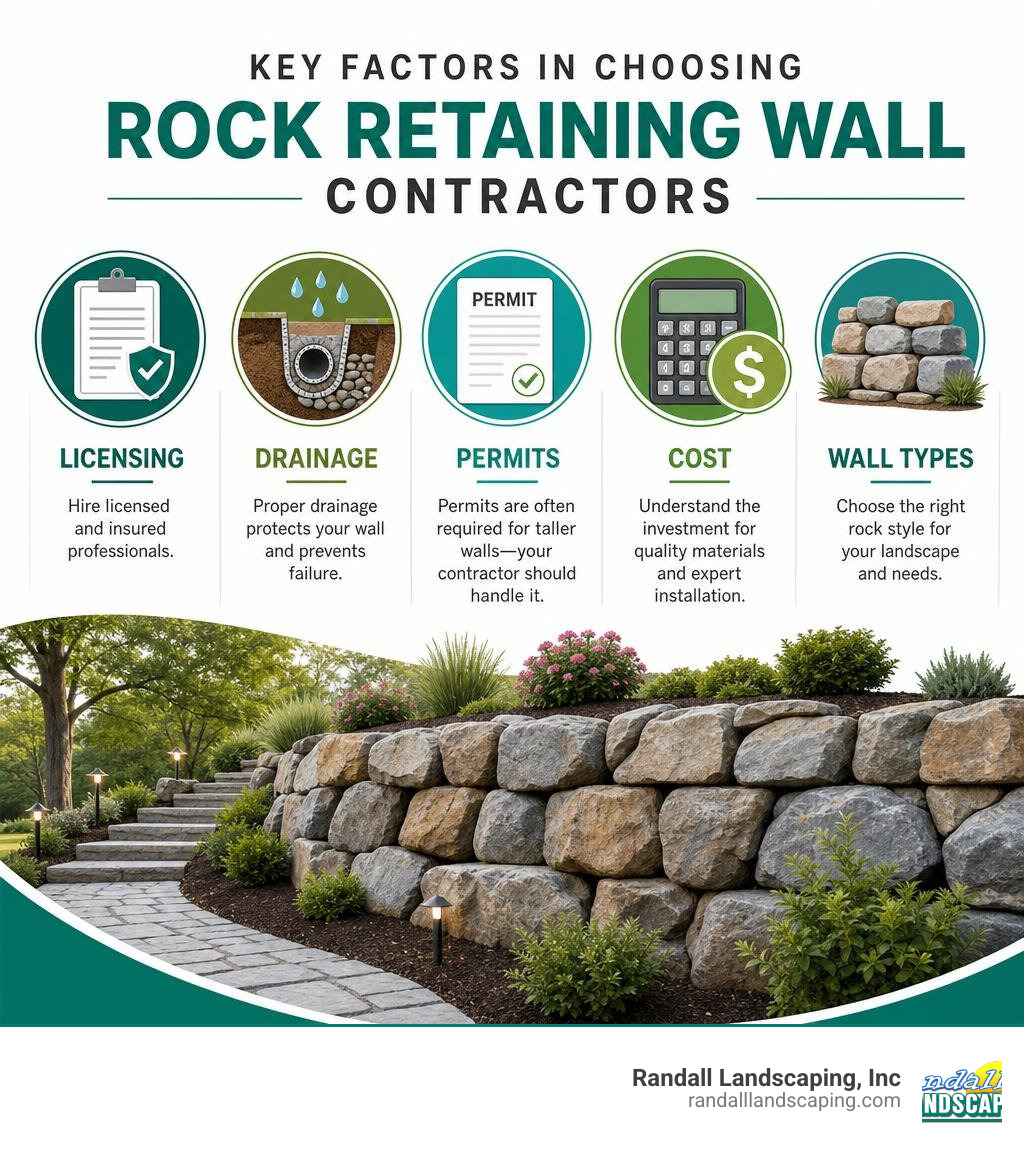
Rock retaining wall contractors word roundup:
Types of Rock Retaining Walls and Material Selection
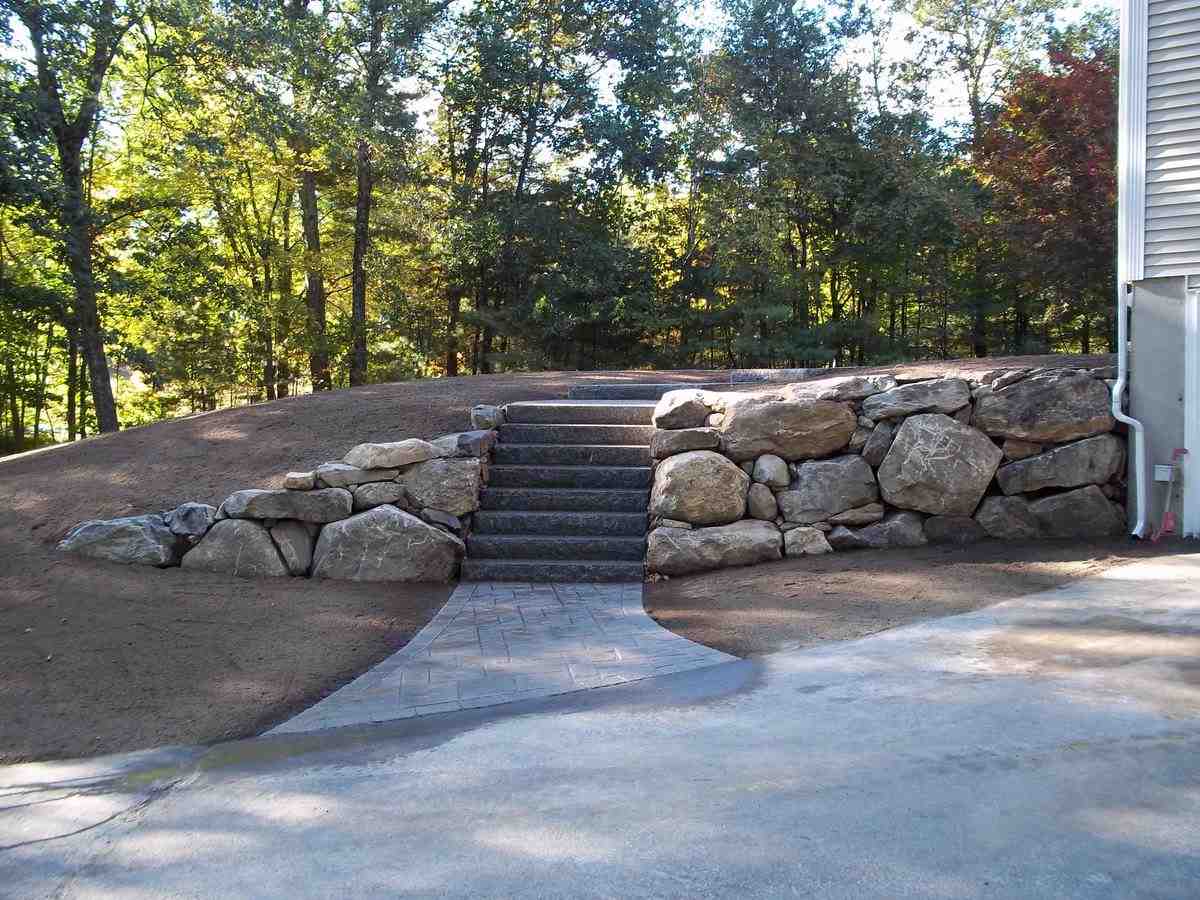
Choosing the right type of rock retaining wall isn’t just about what looks best when you’re standing on your back patio. In the Merrimack Valley and Southern New Hampshire, your wall must withstand heavy, wet clay soils, intense spring runoffs, and deep winter freezes. To make sure your wall stands strong, we have to match the construction style and material to your yard’s specific slope and soil conditions.
For a comprehensive overview of how these structures function in your yard, take a look at A Practical Guide to Retaining Walls.
Generally, we build rock walls using two primary structural methods:
- Gravity Retaining Walls: These walls rely entirely on their own massive weight and the force of gravity to hold back the soil. They are typically wider at the base and lean back slightly into the slope (a design feature known as “batter”). Because they don’t require complex tiebacks for lower heights, they are highly reliable when constructed with heavy natural stones.
- Cantilevered Retaining Walls: These walls use a structural footer (often a concrete slab) that extends beneath the soil they are retaining. The weight of the soil pressing down on the internal “heel” of the footer helps keep the vertical wall from tipping over. These are highly engineered systems designed for taller slopes or tight spaces where a massive gravity base isn’t practical.
Boulder and Natural Stone Walls
When homeowners think of classic New England charm, they think of natural stone. Boulder walls are the heavyweight champions of erosion control. Built using large, heavy boulders (often local granite or fieldstone), these gravity walls are incredibly stable. Because boulders have irregular shapes, they naturally leave small gaps that allow water to filter through, reducing water buildup behind the wall.
Granite is highly favored in our region for its exceptional durability and resistance to freeze-thaw cracking. Sandstone is another beautiful option that offers unique earthy tones, though it requires experienced Sandstone Retaining Wall Builders who know how to select weather-resistant cuts that won’t flake or degrade over time.
Gabion and Segmental Rock Systems
If you have a particularly tricky slope or a high volume of water runoff, gabion walls are an excellent, highly functional choice. These systems consist of heavy-duty wire mesh baskets filled with durable rock. Because they are completely porous, they handle extreme water pressure better than almost any other wall style. If you are dealing with a wet hillside in Pelham or Windham, searching for experienced Gabion Wall Builders Near Me is a smart way to find contractors who can install these industrial-strength, modern-looking systems.
Rock vs. Alternative Retaining Wall Materials
How does natural rock stack up against other common landscaping materials? While wood or concrete blocks have their place, natural stone offers unmatched longevity.
| Material Type | Durability | Aesthetics | Maintenance | Lifespan |
|---|---|---|---|---|
| Natural Rock / Boulders | Extremely High | Timeless, Organic | Very Low | 50 to 100+ Years |
| Concrete Block | High | Modern, Uniform | Low | 20 to 50 Years |
| Poured Concrete | High | Industrial, Clean | Medium (Cracking) | 30 to 50 Years |
| Timber / Wood | Low | Rustic, Simple | High (Rot/Pests) | 10 to 15 Years |
While timber is initially cheaper, it lacks the lifespan of masonry. Wood railroad ties rot, attract termites, and eventually buckle under pressure. If you want to compare block systems to natural stone, read our detailed guide, Build It Strong: A Complete Guide to Block Retaining Walls.
Why Rock Retaining Walls Fail: Drainage, Engineering, and Prevention

When a retaining wall fails, it rarely happens overnight. It starts with a slight tilt, a widening crack, or a sudden bulge in the middle of the wall. In New England, the primary culprit behind wall failure is water.
Our local clay and loam soils act like a sponge. When heavy rain falls or winter snow melts, the soil behind the wall becomes saturated and heavy. This water buildup creates immense hydrostatic pressure—a force so strong it can easily push over thousands of pounds of stone. Furthermore, clay soils tend to form “slip planes,” which are slick layers of wet earth that slide against one another, putting direct lateral pressure on the back of the wall. To understand how to identify these early warning signs, consult our Complete Retaining Wall Repair Guide.
The Critical Role of Drainage Systems
The secret to a wall that lasts for decades is what you cannot see behind the stone. Every professional rock wall must include a robust drainage system to relieve hydrostatic pressure. This system typically consists of:
- Gravel Backfill: A thick layer of clean, angular crushed stone placed directly behind the wall. This allows water to quickly sink down to the base of the wall rather than pressing against the stone.
- Perforated Pipe (French Drain): A perforated drain pipe wrapped in filter fabric installed at the bottom of the gravel trench to collect water and carry it safely away from the wall’s foundation.
- Weep Holes: Small openings built into the face of mortared walls that allow trapped water to escape.
Without these elements, water will freeze behind the wall during our cold Merrimack Valley winters, expanding and shifting the stones out of alignment.
Geogrid Reinforcement and Soil Anchors
For walls taller than four feet, or those supporting heavy slopes (like a driveway or a tiered lawn in Andover), gravity alone isn’t enough. We must reinforce the soil behind the wall.
This is done using geogrid, a high-strength synthetic mesh that is laid between the layers of stone and extended deep into the backfill soil. The weight of the soil presses down on the geogrid, anchoring it in place and preventing the earth from sliding forward. In extreme cases, or when repairing historic stone structures, we may also install mechanical soil anchors or tiebacks. Learn more about these heavy-duty stabilization methods in our Retaining Wall Anchors Complete Guide.
What to Look For in Professional Rock Retaining Wall Contractors
Building a rock wall is a highly specialized craft that combines heavy machinery operation, civil engineering, and artistic masonry. It is not a job for a generic handyman or a weekend DIY project. When searching for local rock retaining wall contractors, you need to vet them thoroughly to protect your property and your wallet. For a deep dive into the vetting process, check out our Retaining Wall Builders: Hiring Guide.
At a minimum, any contractor you hire should provide:
- Active Licensing: Verification that they are licensed to perform hardscaping and excavation work in Massachusetts or New Hampshire.
- Comprehensive Liability Insurance: To protect your home and neighboring properties in Boxford or Georgetown in the event of accidental damage.
- Workman’s Compensation: To ensure you aren’t held liable if a crew member is injured on your property.
- Written Warranties: A professional contractor should stand behind their craftsmanship with a multi-year warranty on both labor and structural alignment.
Why Experience Matters for Rock Retaining Wall Contractors
Every neighborhood has its own unique geological quirks. A contractor from out of state won’t understand how the dense clay in Dracut or the sandy soils near Salisbury behave under pressure. Local experience is invaluable. Experienced local contractors know exactly how deep to dig the foundation trench to get below our local frost line (which is typically 36 to 48 inches deep in Southern NH and Northern MA) to prevent winter shifting.
Before signing a contract, read our tips on Finding Local Retaining Wall Contractors Without the Stress to make sure you are partnering with a reliable team.
Questions to Ask Potential Rock Retaining Wall Contractors
When interviewing prospective contractors, don’t just ask, “How much will it cost?” Use these specific questions to gauge their expertise:
- How do you plan to handle water drainage behind this specific wall? (Listen for mentions of gravel backfill, perforated pipes, and filter fabrics).
- Will this project require a building permit or a structural engineering stamp in our town?
- How deep will you excavate for the wall’s foundation base, and what material will you use for the base?
- Do you have a portfolio of local rock wall projects you have completed in the last few years?
- Do you use your own dedicated crew, or do you subcontract the masonry work?
Costs, Permitting, and the Installation Process
A successful rock wall installation is a carefully choreographed, multi-phase process. Here is what you can expect when you work with a professional crew:
- Site Excavation & Clearing: We use excavators to carve out the slope, remove old failing timber walls or tree roots, and prepare the construction zone.
- Base Trench Preparation: We dig a deep foundation trench. A solid wall requires a compacted gravel base (usually 6 to 12 inches deep) to prevent settling.
- Stone Placement: For boulder walls, heavy machinery carefully places each stone, interlocking them for maximum structural strength. For mortared stone, master masons hand-lay and secure each piece.
- Drainage & Backfilling: As the wall rises, we install the perforated drain pipe and backfill the space behind the stone with clean, angular drainage gravel.
- Final Grading & Landscaping: We compact the soil behind the wall, restore the lawn, and clean up the job site.
You can read a detailed breakdown of these construction phases in our guide to Retaining Wall Construction Contractors.
Permitting, Engineering, and Geotechnical Requirements
In most Merrimack Valley and Southern New Hampshire towns—such as North Andover, Methuen, and Salem—building codes require a permit for any retaining wall that exceeds four feet in height.
If your wall is over this limit, or if it supports a “surcharge load” (such as a driveway, parking space, or a steep upper slope), the city or town will require a structural engineer to design and stamp the plans before construction can begin. A professional contractor will handle the coordination with local building departments and geotechnical engineers to ensure your wall is fully compliant and safe.
Cost Factors and Realistic Pricing Ranges
Please note: The pricing ranges listed below are average industry costs based on national internet data as of July 2026. They do not represent actual project quotes for Randall Landscaping, Inc. Every property has unique access, soil, and grading challenges that require an on-site evaluation.
When budgeting for your hardscaping project, keep in mind that rock retaining walls are a premium, long-term investment.
- Average Cost Range: Most standard rock retaining walls cost between $25 to $150 per square foot for materials and professional installation.
- High-End Custom Builds: For complex, highly engineered, or decorative masonry walls on difficult-to-access slopes, costs can reach up to $450 per square foot (reflecting a high-end range that is at least three times the average pricing).
The overall cost of your project will be influenced by several key factors:
- Site Accessibility: Can heavy machinery easily reach the wall site, or must materials be moved using smaller equipment or wheelbarrows?
- Stone Selection: Local New England granite and fieldstone are generally more cost-effective than specialty imported stones.
- Wall Height & Engineering: Taller walls require deeper excavation, more backfill gravel, geogrid reinforcement, and engineering permits.
Maintenance, Repairs, and Frequently Asked Questions
While natural rock walls are incredibly durable, they still require occasional inspection to ensure they continue to perform properly. Keep an eye out for weed and root intrusion, which can slowly push stones apart. Check your drainage outlets after heavy rainstorms to make sure water is flowing freely and not backing up behind the stone.
If you notice shifting stones, bulging, or cracking in your mortared joints after a harsh winter, consult our Complete Retaining Wall Repair Guide to address the issues before they lead to a total collapse.
Do I need a permit for a rock retaining wall?
Yes, in most local municipalities, any wall over four feet tall requires a building permit and engineered plans. For example, if you are looking to keep your yard level in Dracut, you can read our local zoning breakdown in Retaining Wall 101: Keeping Dracut Landscapes on the Level.
How long do rock retaining walls last?
A professionally installed natural stone wall can easily last 50 to 100 years or more. Unlike wood, which rots, or concrete blocks, which can eventually wear down, high-quality natural stone is virtually impervious to the elements.
Can a failing rock wall be repaired, or must it be replaced?
In many cases, a leaning or bulging wall can be saved if caught early. Techniques like installing helical anchors or rebuilding localized sections of the masonry can restore structural integrity without requiring a complete teardown. Learn more about your options in our Complete Retaining Wall Repair Guide.
Conclusion
A rock retaining wall is more than just a barrier against sliding dirt—it is an investment in your home’s safety, structural integrity, and curb appeal. By choosing experienced rock retaining wall contractors who understand our local New England soils and climate, you can transform your sloped yard into a beautiful, functional asset that will stand strong for generations.
At Randall Landscaping, Inc., we have spent decades building a reputation for unmatched quality, reliability, and complete customer satisfaction throughout the Merrimack Valley and Southern New Hampshire. Whether you are looking to secure a steep slope in Windham, level a lawn in North Reading, or build a stunning natural stone feature in Atkinson, our team is here to help.
Ready to secure your property and elevate your landscape? Contact us today to schedule your professional design consultation, or explore our Hardscaping / Retaining Walls services to see what we can build for you.