
What Does It Really Cost to Lay Mulch? (Quick Answer)
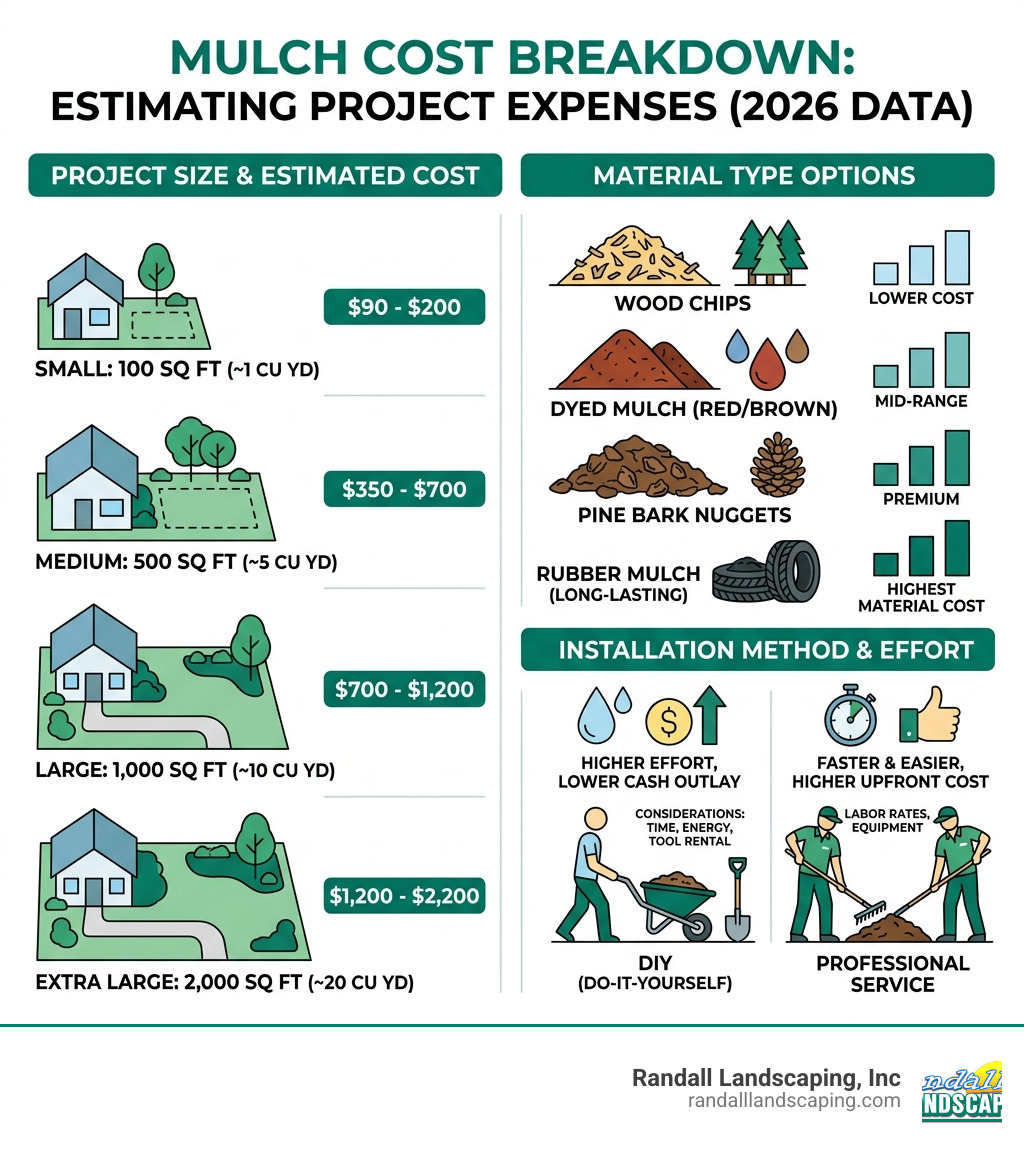
The cost of laying mulch typically runs between $75 and $325 for most homeowners, with a national average around $120. Here’s a fast breakdown based on average internet data:
| Project Size | Estimated Installed Cost |
|---|---|
| Small (100 sq ft / ~1 cu yd) | $90 – $200 |
| Medium (500 sq ft / ~5 cu yd) | $350 – $700 |
| Large (1,000 sq ft / ~10 cu yd) | $700 – $1,200 |
| Extra Large (2,000 sq ft / ~20 cu yd) | $1,200 – $2,200 |
These are average costs based on national internet data. Actual prices vary by region, mulch type, and labor rates.
These numbers include materials, delivery, and professional spreading. The wide range comes down to a few key things: what type of mulch you choose, how big your beds are, and where you live.
Here’s what makes mulch pricing tricky for most homeowners: the material itself is rarely the biggest surprise. It’s the delivery fee you didn’t budget for, the extra yard you underestimated, or the labor cost for tight garden beds that crews have to hand-carry through a narrow gate. Those are the details that turn a simple spring refresh into a bigger bill than expected.
I’m Tommy Randall, owner of Randall Landscaping, Inc., and I’ve been installing mulch across Massachusetts and Southern New Hampshire since 2006 — so I know exactly where homeowners get caught off guard on the cost of laying mulch. In this guide, I’ll walk you through everything you need to budget your project with confidence.
Cost of laying mulch glossary:
- installing mulch beds
- mulch installation
Breaking Down the Average Cost of Laying Mulch
When we talk about the cost of laying mulch, it is important to understand that you aren’t just paying for the wood chips. A professional quote usually bundles three distinct things: the material itself, the delivery to your driveway, and the labor required to move it from that pile into your flower beds.

Based on broad internet data and market research, most professional landscape companies charge between $72 and $94 per cubic yard to deliver and install mulch. However, depending on the complexity of your yard and the specific materials chosen, that range can swing significantly. For a very high-end, labor-intensive project with premium materials, costs can exceed $300 per yard in certain market conditions.
The scale of your project is the primary driver of the total price. A small accent bed near your front door is a quick stop for a crew, but a 2,000-square-foot backyard renovation requires heavy equipment and several hours of manual labor. According to How Much Does Mulch Cost to Deliver and Install?, homeowners should anticipate that total project costs scale with the volume of material needed.
Average Cost of Laying Mulch per Cubic Yard
If you are looking at the material alone, bulk mulch typically costs between $15 and $80 per cubic yard. When you add professional installation, the range shifts to roughly $75 to $350 per yard. Why such a huge gap? It often comes down to the “minimum fee.” Most landscapers have a minimum project price to cover the cost of mobilizing a crew and a large truck. If you only need one yard, you might pay $200 for that single yard installed. If you need 15 yards, the price per yard often drops because the overhead is spread out.
Volume discounts are a real thing in our industry. Many suppliers offer a 15% to 30% discount when you buy larger quantities at once. You can find more info about mulch delivery cost to see how these fees are structured for different load sizes.
Regional Price Variations and Market Trends
In the Merrimack Valley and Southern New Hampshire, we see specific trends that impact your wallet. Because our “mulching season” is concentrated in the spring, demand spikes from April through June. This can lead to higher labor rates as crews become fully booked.
In urban or densely populated areas like Lawrence or Methuen, labor rates may be slightly higher due to the cost of living and the difficulty of navigating large delivery trucks through tight streets. Conversely, in more rural spots like Atkinson or Pelham, accessibility might be easier, but the shipping distance from the mulch yard could add a few dollars to the delivery fee. Generally, the Northeast sees some of the highest labor costs in the country, often ranging from $25 to $55 per yard just for the spreading work.
Mulch Pricing by Material Type and Quality
Not all mulch is created equal. The cost of laying mulch is heavily influenced by whether you want basic wood chips or a premium, long-lasting bark.
Organic mulches (like bark and wood) are the most popular because they decompose over time, adding nutrients back into your soil. Inorganic options (like rubber or stone) cost more upfront but don’t need to be replaced every year. For a deep dive into the math, check out this Cost to Install Mulch – 2026 Price Guide.
How Material Choice Impacts the Cost of Laying Mulch
Here is a breakdown of common materials you’ll find in our neck of the woods:
- Hardwood Mulch: This is the “standard” choice. It’s affordable and stays in place well. Average installed cost: $40 – $70 per yard.
- Cedar Mulch: Known for its pleasant smell and natural ability to repel insects. It lasts longer than hardwood but costs more. Average installed cost: $90 – $140 per yard.
- Pine Bark/Nuggets: These are great for large areas and don’t break down as quickly as shredded wood. Average installed cost: $45 – $85 per yard.
- Hemlock: A favorite in New Hampshire for its rich color and safety for pets and kids. Average installed cost: $50 – $110 per yard.
- Rubber Mulch: Often used in playgrounds. It’s very expensive upfront but lasts a decade. Average installed cost: $80 – $160 per yard.
If you are concerned about the environment, there are more info about eco-friendly mulch options that focus on sustainable sourcing and natural dyes.
Bagged vs. Bulk Mulch: Which is More Cost-Effective?
We often see homeowners at big-box stores in Salem or Andover loading up their SUVs with plastic bags of mulch. While this seems convenient, it’s almost always the most expensive way to do it.
One cubic yard of mulch is equivalent to about 13.5 or 14 standard 2-cubic-foot bags. On average, buying by the bag costs about 35% more than buying in bulk. If your project requires more than two cubic yards, you are better off having a bulk pile dropped in your driveway. Beyond the price, bulk mulch is often higher quality and provides a more consistent color than bags that may have sat in a sunny parking lot for months. For those focusing on smaller plots, you can find more info about garden bed mulching to see when bags might actually make sense.
Labor, Delivery, and Professional Installation Factors
The “muscle” behind the mulch is where a large chunk of your budget goes. Professional landscapers generally charge between $35 and $110 per hour for labor, depending on the crew size and equipment used.
Several factors can push these labor costs toward the higher end:
- Site Access: Can we get a wheelbarrow to the bed? If we have to carry mulch through a finished house or up a steep flight of stairs, labor time doubles.
- Minimum Service Fees: Most pros have a minimum charge (often $150-$300) to ensure the job is worth the trip.
- Distance: Delivery fees usually range from $50 to $150 per load. If you live far from the mulch yard, expect to pay more.
For more details on how these numbers are crunched, see 2026 Mulch Installation Costs: Material & Spreading Prices.
Manual Spreading vs. Mulch Blowing Costs
For very large properties or steep hillsides where wheelbarrows are useless, we sometimes use blower trucks. This involves a massive truck with a long hose that literally “blows” the mulch into place.
- Manual Spreading: $35 – $70 per yard (labor only).
- Mulch Blowing: $38 – $60 per yard (labor only), or $60 – $120 per yard (installed with material).
Blowing is incredibly fast and results in a very even, smooth finish. It’s often the most cost-effective choice for commercial sites or large residential acreages in towns like Boxford or Windham. You can find more info about mulch installation blowing to see if your property is a good candidate for this technology.
Site Preparation and Cleanup Expenses
You can’t just throw new mulch over a mess of weeds and expect it to look good. Proper preparation is essential. Landscapers often charge $50 to $75 per hour for prep work, which includes:
- Weeding: Pulling the existing weeds so they don’t poke through the new layer.
- Debris Removal: Clearing out fallen branches or leaves.
- Soil Leveling: Ensuring the bed is flat so the mulch doesn’t wash away in the first rainstorm.
Using a professional ensures you get more info about mulch for weed control through proper layering techniques.
Essential Add-ons and Preparation Expenses
If you want that “magazine-ready” look, there are a few extras to consider. These add-ons can increase the cost of laying mulch, but they also increase the longevity of the project.
Edging and Border Installation
A clean edge is the difference between a DIY job and a professional one. We recommend “spade edging” (cutting a clean trench into the turf), but many homeowners prefer permanent borders.
- Plastic Edging: $1 – $3 per linear foot.
- Metal/Aluminum Borders: $3 – $6 per linear foot.
- Stone Masonry/Cobblestones: $10 – $15+ per linear foot.
A well-defined edge prevents your grass from “creeping” into your mulch beds. Read more info about landscape mulch installation for the best edging pairings.
Long-Term Maintenance: Topping Off vs. Replacement
You don’t always need to start from scratch. We follow the 50% rule: if your mulch is just faded but still thick, a “top-off” (adding about 1 inch of new material) is usually enough. This typically costs about half of a full installation.
However, if your mulch is more than 4 inches deep, it can actually harm your plants by suffocating the roots. In that case, we recommend removing the old stuff before adding new. Removal and disposal fees usually run $50 to $100 per load. For tips on keeping your soil healthy, check more info about moisture retaining mulch.
DIY vs. Professional Mulch Installation
Can you do this yourself? Absolutely. Should you? That depends on your back and your free time.
If you DIY, you’ll save on labor ($20-$55 per yard). However, you’ll need to rent or buy tools (wheelbarrow: $100+, pitchfork: $40, rake: $30) and spend your entire weekend hauling heavy loads. For many of our clients in North Reading or Pelham, the 100% reliability of a professional crew is worth the investment. Get the more info about mulch installations complete guide to weigh your options.
Calculating Your Mulch Needs
The biggest mistake people make is under-ordering. Use this simple formula: (Square Footage x Desired Depth in inches) / 324 = Cubic Yards needed.
- 2-inch depth: Best for refreshing existing beds. One yard covers 162 sq ft.
- 3-inch depth: Best for new beds and weed suppression. One yard covers 108 sq ft.
If you aren’t sure about the math, you can search for more info about mulching services near me to have a pro come out and measure for you.
Tips for Saving Money on Your Mulch Project
- Buy in Bulk: As mentioned, skip the bags.
- Prep the Site Yourself: If you pull the weeds and trim the bushes before the crew arrives, you’ll save on hourly labor.
- Bundle Services: Ask your landscaper for a discount if you combine mulching with a spring cleanup or mowing contract.
- Off-Season Timing: Some companies offer “early bird” specials in late March or “fall refresh” discounts.
You can also look into more info about environmental mulch to see if locally sourced wood chips are available at a lower price point.
Frequently Asked Questions about Mulching Costs
How much mulch do I need for a standard flower bed?
A typical front-of-house garden bed is about 200 square feet. At a 3-inch depth, you would need roughly 2 cubic yards.
When is the best time of year to install mulch?
In the Merrimack Valley, late spring (after the ground has thawed and dried) is best. This helps trap moisture before the summer heat hits. Fall is also a great time to protect perennial roots from the winter freeze.
Do I need a permit for large-scale mulch delivery?
For residential properties in our service area (like Salem or Andover), you almost never need a permit. However, if you are blocking a public sidewalk or street with a massive pile, you should check with your local town hall.
Conclusion
The cost of laying mulch doesn’t have to be a mystery. By understanding the material types, calculating your yardage accurately, and knowing what to expect for labor, you can transform your property without any financial surprises.
At Randall Landscaping, Inc., we pride ourselves on quality work and 100% reliability. Whether you are in Dracut, Atkinson, or anywhere else in the Merrimack Valley and Southern New Hampshire, our goal is your total satisfaction. We treat every yard like it’s our own, ensuring that every edge is crisp and every bed is perfectly leveled.
Ready to give your home the curb appeal it deserves? Get a professional mulch installation quote from us today and let’s get your garden glowing!