

How Much Does a Cobblestone Driveway Price Run in 2026?
Cobblestone driveway price ranges vary widely depending on size, material, and labor. Here’s a quick snapshot based on average national data:
| Project Type | Average Cost Range |
|---|---|
| Cost per square foot (installed) | $20 – $75+ |
| Typical home driveway (average) | $8,600 – $24,800 |
| 2-car driveway (~480 sq ft) | $17,300 – $75,000+ |
| Materials only (per sq ft) | $10 – $25 |
| Labor only (per sq ft) | $10 – $25 |
These are average costs based on national internet data and do not reflect actual pricing from Randall Landscaping, Inc.
There’s something timeless about a cobblestone driveway. It brings to mind old European streets and centuries-old craftsmanship — and that charm comes with a real price tag worth understanding before you commit.
Whether you’re budgeting for a modest single-car entrance or a sweeping two-car driveway lined with granite Belgian blocks, the total investment depends on far more than just the stone itself. Material choice, site conditions, base preparation, and local labor rates all play a major role — and the gap between a basic install and a specialty finish can be enormous.
This guide breaks it all down clearly, so you can plan your project with confidence.
I’m Tommy Randall, owner of Randall Landscaping, Inc., and I’ve been designing and installing cobblestone and paver driveways across Massachusetts and New Hampshire since 2006. Over nearly two decades of hands-on hardscape work, I’ve seen how the right cobblestone driveway price planning — and the right installation — makes all the difference in long-term value. Let’s walk through everything you need to know.
Understanding the Cobblestone Driveway Price in 2026
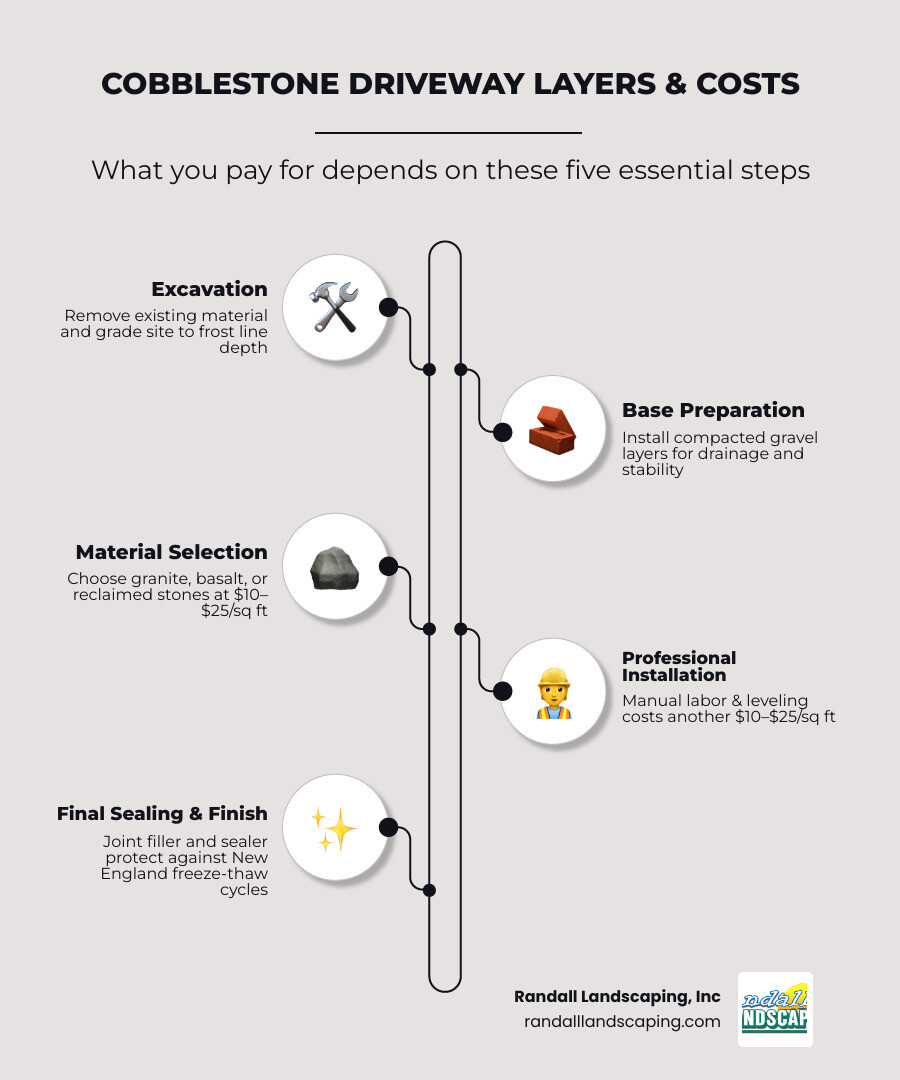
For most homeowners in Merrimack Valley and Southern New Hampshire, cobblestone sits at the premium end of driveway materials. Based on current internet cost data, the average installed price usually falls somewhere between $20 and $50 per square foot, while higher-end or specialty installations can climb to $75 per square foot and beyond. Some cost calculators for 2025 to 2026 also place standard installation in the upper $20s to upper $30s per square foot for more basic scopes of work.
That sounds like a big spread because it is a big spread. Cobblestone projects are highly sensitive to site conditions, design details, and stone type.

A useful way to think about price is by breaking it into two buckets:
- Materials: usually about $10 to $25 per square foot on average internet pricing
- Installation labor: usually about $10 to $25 per square foot, sometimes much more on difficult sites
Labor often accounts for roughly half of the total investment. That is not because contractors are having too much fun with your budget. It is because cobblestone is labor-intensive, requires careful base work, and demands precision if you want the driveway to survive freeze-thaw cycles without turning into a bumpy history lesson.
Here is a quick comparison of average national internet pricing:
| Driveway Material | Typical Installed Cost Per Sq Ft | Typical Lifespan |
|---|---|---|
| Gravel | $3 – $7 | 5 – 15 years with replenishment |
| Asphalt | $7 – $15 | 15 – 30 years |
| Concrete | $8 – $18 | 30 – 50 years |
| Brick pavers | $12 – $30 | 25+ years |
| Concrete pavers | $15 – $35 | 30 – 50+ years |
| Cobblestone | $20 – $75+ | 50 – 100+ years |
For broader national averages, see this 2025 cobblestone driveway cost guide.
Material Selection and Cobblestone Driveway Price
Not all cobblestone is priced the same. Stone choice has a direct effect on both appearance and budget.
Common options include:
- Granite: the most common choice for driveways, highly durable, slip-resistant, and excellent in freeze-thaw climates
- Basalt: dense and durable, often premium priced
- Limestone: attractive but generally less ideal than dense granite for heavy-duty cold-climate driveway use
- Reclaimed antique cobblestone: usually more expensive because of sourcing, sorting, and the unique aged look
- Newly quarried cobblestone: more uniform in size and appearance, often easier to install cleanly
- Belgian blocks: rectangular granite blocks commonly used for aprons, borders, and full driveway surfaces
Reclaimed cobblestone often costs more than newly quarried material, sometimes up to double, but many homeowners love the weathered patina and historic character. New stone offers a cleaner, more uniform finish and can simplify layout.
If you want a broader look at paver and driveway style options, our Driveway Pavers North Reading Guide is a helpful starting point.
Labor and Professional Installation Impact on Cobblestone Driveway Price
Professional installation matters even more than the stones themselves. A cobblestone driveway is only as good as the foundation underneath it.
A standard professional installation typically includes:
- Layout and measurements
- Excavation
- Grading for drainage
- Compacted gravel base
- Bedding sand or stone dust
- Hand-setting the stones
- Joint filling, often with polymeric sand
- Final compaction and cleanup
Some cost references describe a typical build-up as a 6-inch gravel base plus a 1-inch bedding layer, while others recommend 8 to 12 inches of compacted base for driveways in frost-prone regions. In our Massachusetts and Southern NH service area, that deeper, properly compacted base is often where long-term performance is won or lost.
For a customizable benchmark, see the 2026 cobblestone driveway cost calculator.
Key Factors Influencing Your Total Investment
Even with the same square footage, two cobblestone driveways can land at very different prices.
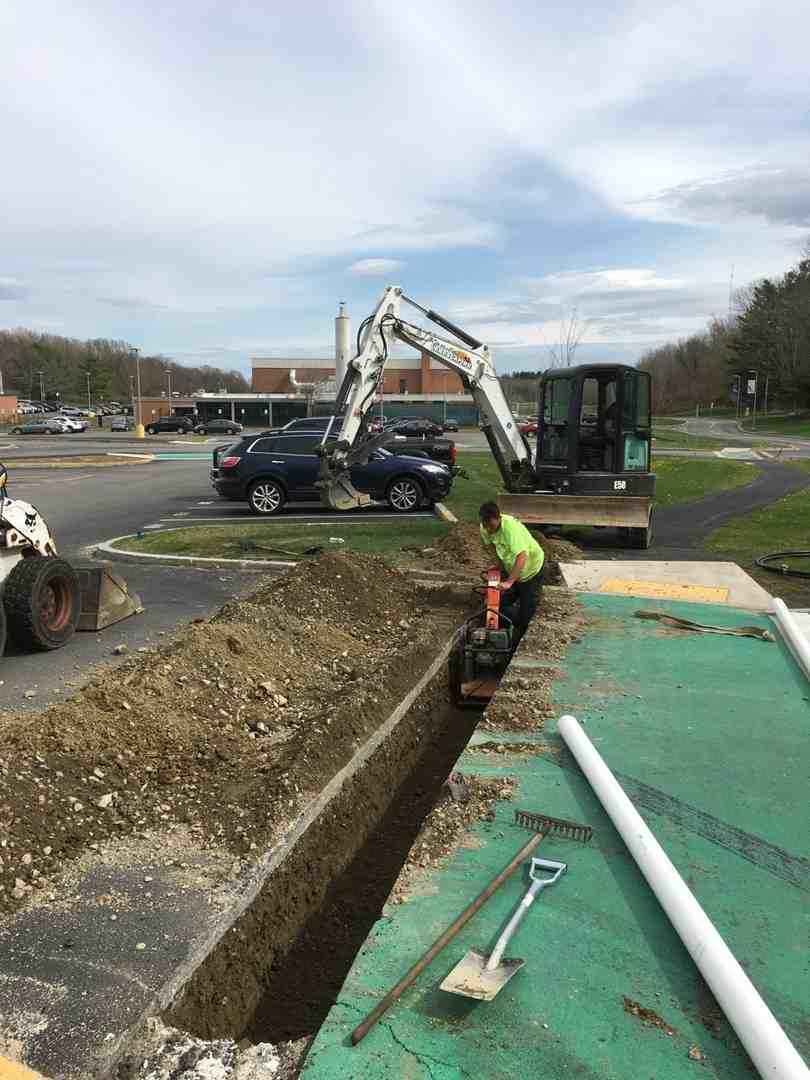
The biggest cost drivers are:
- Driveway size
- Existing driveway removal
- Excavation depth
- Soil and drainage conditions
- Slope
- Site accessibility
- Stone type and size
- Pattern complexity
- Edge restraints and borders
- Permit requirements
- Delivery and hauling costs
Typical site preparation steps include:
- Remove old asphalt, concrete, or gravel as needed
- Excavate to the required depth
- Correct soft soil or drainage issues
- Install geotextile fabric where appropriate
- Add and compact crushed stone base in lifts
- Screed the bedding layer
- Set stones by hand
- Fill joints and compact
- Final grading and cleanup
Old driveway removal alone can add meaningful cost. National internet data often places concrete removal around $1,000 to $2,500, with grading and leveling sometimes adding another $1,000 to $3,300.
If you’re comparing surface options in our area, our Driveway Pavers North Andover Guide offers more local project context.
Regional Pricing and Site Conditions
In Merrimack Valley and Southern New Hampshire, site conditions matter a lot because we live in a freeze-thaw climate. Winter has a way of exposing shortcuts.
The main regional cost factors include:
- Frost-depth preparation
- Clay or poorly draining soils
- Sloped driveways
- Tight access for equipment
- Hauling spoil off-site
- Material delivery logistics
- Local labor rates
Driveways in colder climates often need 8 to 12 inches of compacted gravel base to resist movement under vehicle weight and frost action. That deeper base increases excavation, stone base material, trucking, and labor costs, but it also protects the finished surface.
For broader price benchmarks by project type, see How Much Does Cobblestone Pavers Cost to Install? (2026).
Customization and Specialty Finishes
This is the part where budgets can go from sensible to “well, it is beautiful.”
Custom upgrades that increase total cost include:
- Circular or fan patterns
- Decorative borders
- Contrasting apron bands
- Reclaimed antique stone
- Mortared edging
- Heated driveway systems
- Extra drainage structures
- Specialty joint fillers
- Integrated lighting
Polymeric sand is a common joint option because it helps lock stones in place and can reduce weed growth compared to loose sand. Heated driveway systems are another major upgrade, often adding substantial cost per square foot but offering real snow and ice benefits in our climate.
For inspiration, browse The Ultimate Gallery of Driveway Paver Ideas.
Long-Term Value: Durability and Maintenance
The biggest reason homeowners choose cobblestone despite the higher upfront cost is longevity.
A properly installed cobblestone driveway can last 50 to 100+ years, and some well-built stone surfaces last far longer. That puts cobblestone in a completely different category from asphalt, which often needs replacement in 15 to 30 years, and even ahead of many concrete installations.
Cobblestone also offers:
- Excellent load-bearing strength
- Strong freeze-thaw performance when properly installed
- High curb appeal
- Classic, old-world character
- Low likelihood of full-surface replacement
- Easier spot repairs than poured concrete
Possible drawbacks include:
- High upfront cost
- Bumpier ride than smooth asphalt or concrete
- Slower, more labor-intensive installation
- Potential for weeds or joint loss if neglected
- Snowplow blade compatibility concerns
On sealing, dense granite cobblestone often does not require routine sealing the way some manufactured pavers do. Still, some homeowners choose selective sealing for appearance or stain resistance depending on the product and joint system. Our Sealing Driveway Pavers Guide explains when sealing makes sense and when it does not.
For a general comparison of costs and durability, see this cobblestone driveway pricing overview.
Ongoing Maintenance and Repair Costs
Cobblestone is relatively low-maintenance, but it is not no-maintenance.
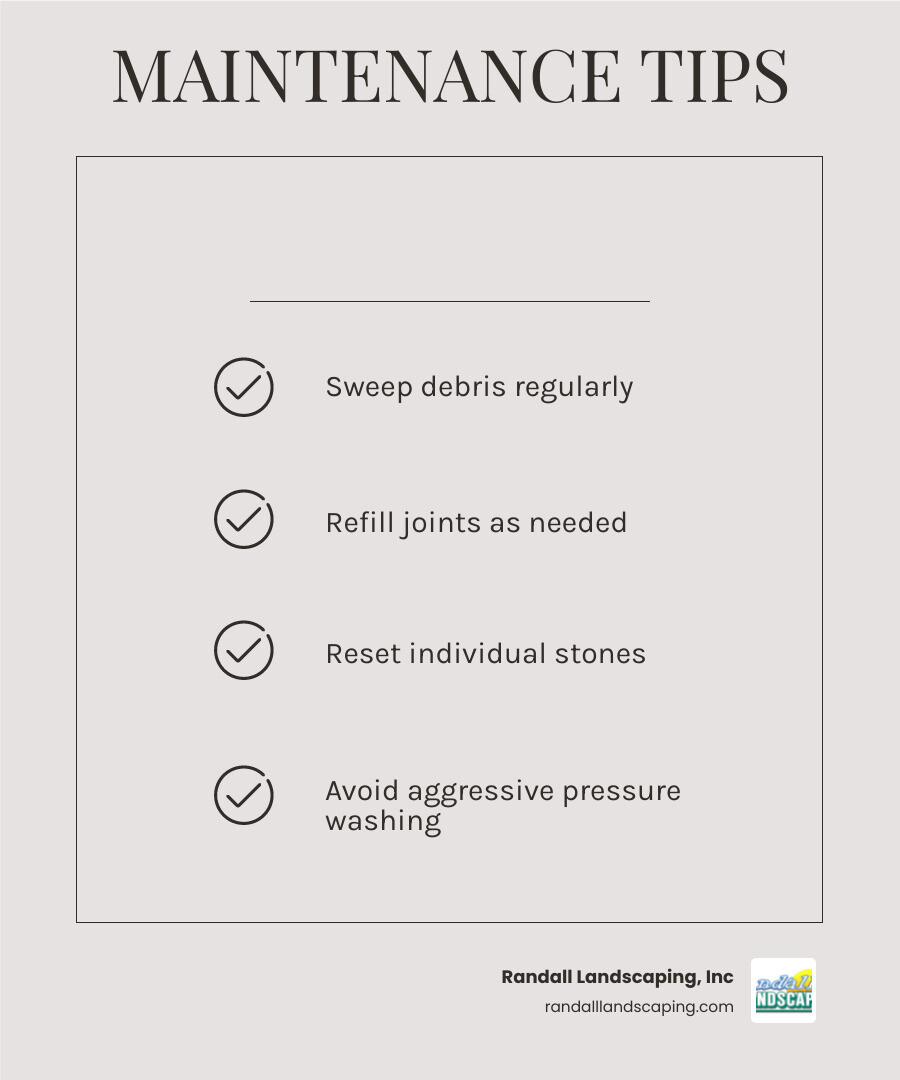
Typical upkeep includes:
- Sweeping debris
- Occasional rinsing with a hose
- Managing weeds in joints
- Refilling joints when needed
- Resetting individual stones if movement occurs
- Spot cleaning oil or rust stains
Average internet data suggests:
- Sealing, where applicable: about $1 to $3 per square foot
- Typical repair work: about $650 to $2,000 for many common jobs
- Individual repair pricing: around $10 to $70 per square foot depending on scope
The good news is that repairs are often localized. If one section settles, you can usually lift and reset that section rather than replace the whole driveway.
A few care notes for our climate:
- Avoid aggressive pressure washing, which can erode joints
- Refill polymeric or joint sand when necessary
- Use shovels or snow blowers carefully in winter
- Avoid truck-mounted plow blades directly on cobblestone unless the setup is specifically designed to protect the surface
If you’re also comparing drainage-forward hardscape options, our guide on permeable paver installation is worth reading.
Frequently Asked Questions about Cobblestone Costs
Is a cobblestone driveway more expensive than concrete?
Yes, upfront, usually by a lot.
Average national internet data often shows concrete around $8 to $18 per square foot installed, while cobblestone commonly lands around $20 to $75+ per square foot. So if you are only comparing initial price, concrete usually wins.
But long-term value is where the conversation changes. Concrete can crack and be harder to repair invisibly. Cobblestone costs more to install, but it can last decades longer and individual stones or sections are easier to reset. If your priority is historic character, long lifespan, and premium curb appeal, cobblestone can make sense.
Can I save money by installing a cobblestone driveway myself?
Technically, yes. Realistically, we do not recommend it for most homeowners.
DIY material costs may run about $10 to $25 per square foot, but that does not include the value of your time, the rental of compactors or excavation equipment, disposal fees, or the cost of fixing mistakes. A plate compactor alone may cost roughly $75 to $200 per day to rent, and excavation equipment costs can climb quickly.
The bigger issue is performance. Cobblestone installation is not just laying pretty stones. It requires:
- Proper excavation depth
- Correct slope for drainage
- Base compaction in lifts
- Accurate setting bed preparation
- Tight, consistent stone placement
- Joint stabilization
If the base fails, the driveway fails. DIY can make sense for a very small border or apron detail, but a full driveway is usually a professional job.
How long does a cobblestone driveway last compared to asphalt?
Cobblestone can last 50 to 100+ years with proper installation and maintenance. Asphalt typically lasts about 15 to 30 years.
That means one cobblestone driveway may outlast multiple asphalt replacement cycles. Asphalt does cost much less upfront, but it usually needs sealing, patching, and eventual resurfacing or replacement. Cobblestone generally asks for more money in the beginning and less drama over the long haul.
Conclusion
If you’re researching cobblestone driveway price, the short version is this: cobblestone is one of the most expensive driveway materials to install, but it is also one of the longest-lasting and most visually distinctive. For homeowners in Merrimack Valley and Southern New Hampshire, success comes down to the right stone, the right base, and the right installer.
At Randall Landscaping, Inc., we focus on quality work and 100% reliability because a driveway is not just a surface. It is part of your home’s first impression, daily function, and long-term value. Whether you’re considering a full cobblestone driveway, a Belgian block apron, or a cobblestone border paired with another paver system, good planning makes all the difference.
If you’re ready to explore options, take a look at our professional driveway paver services.
Pricing Disclaimer: Note: The figures mentioned in this guide are average costs based on national internet data and do not represent actual pricing for Randall Landscaping, Inc. For a 2-car driveway (approx. 480 sq. ft.), homeowners typically see a wide range of $8,600 to $75,000+ depending on material rarity and site complexity.