How Much Does It Cost to Install Grass in a Backyard?
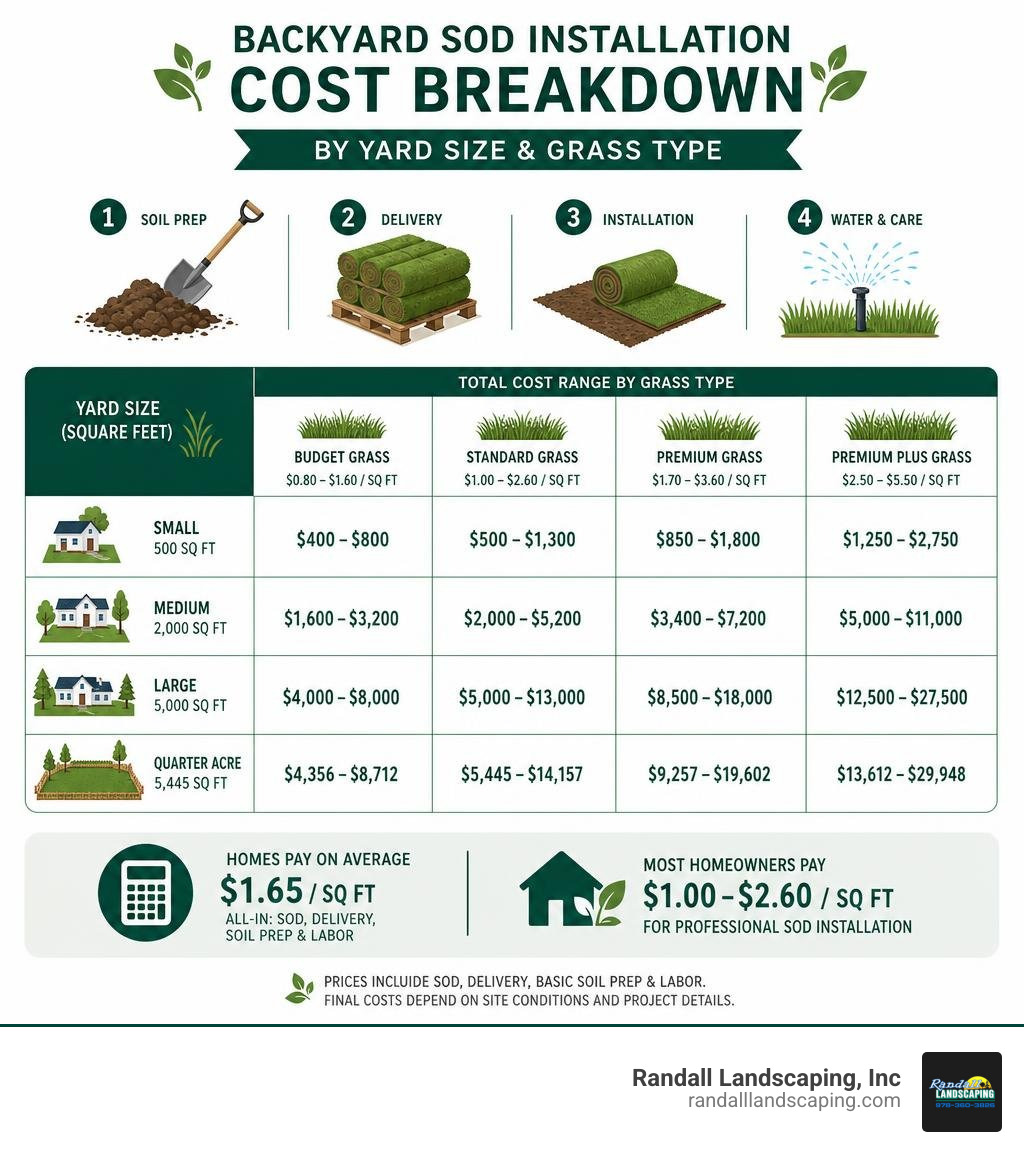
The cost to install grass in a backyard runs anywhere from $0.80 to $5.50 per square foot in 2026, depending on your yard size, grass type, and how much prep work is needed. Here’s a quick snapshot:
| Project Size | Typical Cost Range |
|---|---|
| Small (500 sq ft) | $400 – $2,750 |
| Medium (2,000 sq ft) | $1,600 – $11,000 |
| Large (5,000 sq ft) | $4,000 – $27,500 |
| Quarter acre (5,445 sq ft) | $5,400 – $14,200+ |
Quick answer: Most homeowners pay between $1.00 and $2.60 per square foot for professional sod installation, with a national average of around $1.65 per square foot — all in, covering sod, delivery, basic soil prep, and labor.
High-end projects with premium grass types, heavy grading, or difficult access can push past $6.00 per square foot.
These numbers can feel overwhelming at first glance. But once you understand what drives the cost, budgeting for your new backyard lawn becomes a lot less stressful.
That’s exactly what this guide breaks down — so you can make a smart decision for your yard and your wallet.
I’m Tommy Randall, owner of Randall Landscaping, Inc., and I’ve been helping homeowners in Massachusetts and New Hampshire understand the cost to install grass in a backyard — and get real value from every dollar they spend — since 2006. Whether you’re weighing sod against hydroseeding or trying to figure out what soil prep will run you, I’ll walk you through what I’ve seen on the ground over nearly two decades in this business.
Glossary for cost to install grass in backyard:
Average Cost to Install Grass in Backyard in 2026
When you begin researching how to transform a patchy, weed-filled backyard into a lush green oasis, the first question is always about the bottom line. In 2026, the national average cost to professionally install sod sits right around $1.65 per square foot. However, because every backyard has its own unique layout, soil condition, and accessibility challenges, you will find a wide pricing range in the real world.
Please note that these are average costs based on compiled internet data and do not represent the actual pricing models for Randall Landscaping, Inc.
Depending on the complexity of your site, the price to buy and lay sod typically ranges from $0.80 to $5.50 per square foot. For highly complex, high-end residential projects that require extensive clearing, massive grading adjustments, or premium specialty cultivars, costs can easily exceed $6.00 per square foot. This wide range reflects the difference between a simple “roll-out” job on prepped soil and a full-scale backyard excavation.
To help you visualize how these square-foot rates translate to total project costs, we can look at the average numbers across different backyard sizes. You can also play with a Sod Installation Cost Calculator (2026) to get a baseline estimate for your specific dimensions.
Backyard Sod Installation Cost Comparison Table
| Lawn Size (Sq. Ft.) | Low-End Estimate ($0.80/sq ft) | Mid-Range Estimate ($1.65/sq ft) | High-End Estimate ($5.50+/sq ft) |
|---|---|---|---|
| 500 sq ft (Small patio border) | $400 | $825 | $2,750+ |
| 1,000 sq ft (Compact suburban backyard) | $800 | $1,650 | $5,500+ |
| 2,000 sq ft (Average backyard lawn) | $1,600 | $3,300 | $11,000+ |
| 5,000 sq ft (Spacious backyard) | $4,000 | $8,250 | $27,500+ |
| 10,000 sq ft (Nearly a quarter-acre) | $8,000 | $16,500 | $55,000+ |
As you can see, the high-end pricing is more than three times the average cost. This is because site preparation, turf removal, and grading often cost more than the sod itself. For a deeper look into how these numbers are calculated, check out The Complete Guide to Sod Installation Cost.
Cost Breakdown by Grass Type
Choosing the right grass variety is one of the most important decisions you will make. It doesn’t just dictate your upfront material cost; it determines whether your lawn will survive the harsh winters of New England or brown out under the summer sun.
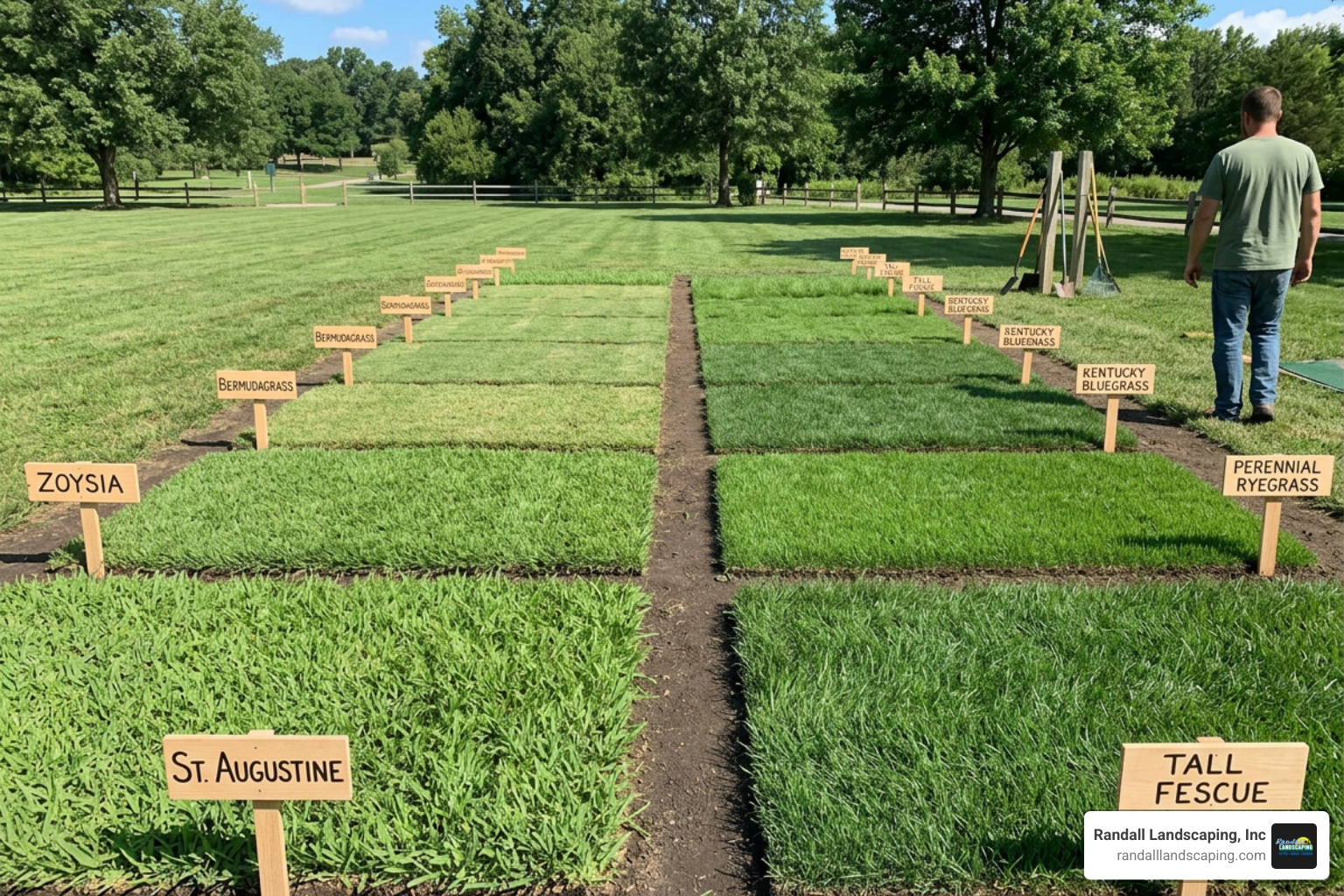
Sod is generally grown and sold in two main categories: warm-season grasses and cool-season grasses. Let’s look at how these options break down in terms of cost and regional suitability.
Warm-Season Grasses and the Cost to Install Grass in Backyard
Warm-season grasses thrive in hot, southern climates (think Texas, Florida, and Arizona). They are incredibly drought-tolerant and love the baking summer sun, but they go completely dormant and turn brown when temperatures drop.
- Bermuda Grass ($0.35 – $0.85/sq ft material cost): This is the most affordable warm-season grass. It is highly resilient, handles heavy foot traffic beautifully, and recovers quickly from damage.
- Zoysia Grass ($0.85 – $1.25/sq ft material cost): A premium, luxury option. Zoysia grows slowly, which means you mow 30% to 40% less often, and it feels like a plush carpet underfoot. However, it is one of the most expensive sod varieties on the market.
- St. Augustine ($0.65 – $1.10/sq ft material cost): Popular in coastal regions due to its salt tolerance and broad blades, though it requires consistent watering and maintenance.
- Bahia Grass ($0.45 – $0.90/sq ft material cost): A tough, low-maintenance utility grass that thrives in poor soils but lacks the dense, manicured look of premium turf.
A quick reality check for our local homeowners: If you live in our service area—including Andover, Boxford, Salem, or Windham—warm-season grasses are not suitable for your backyard. The freezing New England winters will kill these varieties, meaning you would have to replant your lawn every single year!
Cool-Season Grasses and the Cost to Install Grass in Backyard
For our climate in the Merrimack Valley and Southern New Hampshire, cool-season grasses are the gold standard. These varieties are genetically built to handle freezing winters, wet springs, and moderate summers.
- Kentucky Bluegrass ($0.30 – $0.60/sq ft material cost): The classic New England lawn. It features a stunning deep blue-green color and spreads via underground stems (rhizomes), allowing it to self-heal bare spots. It requires moderate watering and plenty of sunlight.
- Tall Fescue ($0.35 – $0.65/sq ft material cost): An incredibly durable, deep-rooting grass that is highly drought-resistant and handles shaded backyards much better than Bluegrass. It is perfect for active families with kids and pets.
- Fine Fescue ($0.35 – $0.60/sq ft material cost): Exceptional shade tolerance and low fertilizer requirements make fine fescues a great choice for wooded backyards in places like Pelham or Atkinson.
- Perennial Ryegrass ($0.30 – $0.55/sq ft material cost): Famous for its lightning-fast germination and rich green color, ryegrass is often blended with bluegrass to create a tough, disease-resistant turf.
Key Factors Influencing Your Backyard Sod Budget
When a professional estimator looks at your backyard, they aren’t just measuring the square footage. They are looking at a puzzle of logistical and environmental factors that will shape your total cost to install grass in backyard.
- Yard Size: While larger yards cost more overall, the cost per square foot often drops when buying in bulk. Sod farms sell by the pallet, and ordering multiple pallets can reduce your material costs by 15% to 40%.
- Yard Shape Complexity: A perfectly square yard is easy to sod. A curved, irregular yard with winding garden beds, fire pits, and mature trees requires extensive cutting, shaping, and waste material, adding 10% to 15% to the labor bill.
- Accessibility: Can we get a skid steer or a compact track loader into your backyard? If you have a narrow walk-through gate, steep slopes, or delicate stone steps, our crew has to move pallets of sod by hand or wheelbarrow. This extra physical labor can increase overall installation costs by 15% to 20%.
Site Preparation, Grading, and Old Grass Removal
You’ve probably heard the saying, “A house is only as strong as its foundation.” The exact same rule applies to your lawn. If you lay fresh, expensive sod over compacted, weed-infested soil, the roots will suffocate, and your investment will die within a season.
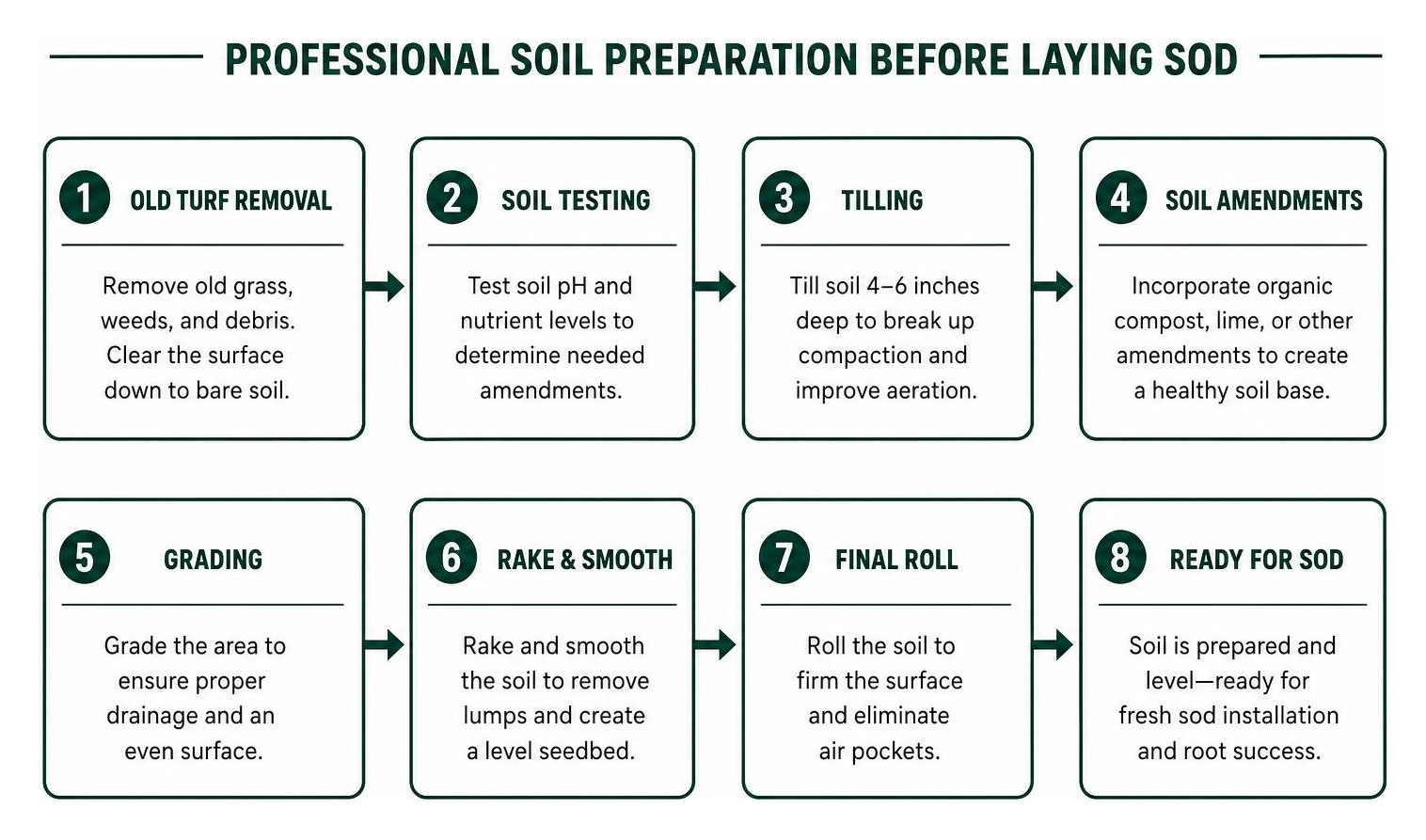
Proper site preparation is where the magic happens, but it is also the most labor-intensive part of the project:
- Old Turf Removal ($0.25 – $2.00/sq ft): We must strip away the old, dead grass and weeds. Doing this right requires a motorized sod cutter to slice the old root system away cleanly. To understand whether you can bypass this step, read The Ultimate Guide to Installing Sod Over Your Current Lawn.
- Soil Testing ($15 – $50): We test the soil pH and nutrient levels to see what amendments (like lime or organic compost) are needed to help the new roots thrive.
- Tilling and Amending ($0.30 – $0.80/sq ft): Tilling the soil 4 to 6 inches deep breaks up compaction, allowing water, oxygen, and roots to penetrate deeply.
- Grading and Leveling: We reshape the dirt to ensure rainwater drains away from your home’s foundation rather than pooling in the middle of your new lawn.
Delivery Fees and Irrigation Adjustments
Sod is incredibly heavy. A single pallet of sod covers 400 to 500 square feet and weighs between 1,500 and 3,000 pounds depending on how wet the soil is. Because of this weight, delivery requires specialized flatbed trucks with forklift attachments.
- Delivery Fees: Typically range from $50 to $230 per load, though some suppliers waive this fee for orders exceeding 1,000 square feet.
- Irrigation Adjustments: Fresh sod must be watered immediately after installation. If you have an existing sprinkler system, we often need to adjust the height of the sprinkler heads so they sit flush with the new, higher soil line. Minor head adjustments and zone testing can run $200 to $800, while major repairs or adding new zones can cost significantly more.
DIY vs. Professional Sod Installation
When looking at the cost to install grass in backyard, many homeowners wonder: “Can I save a bundle by laying the sod myself?”
It is a tempting thought. Doing the labor yourself can save you roughly $0.55 to $1.00 per square foot. For a 2,000-square-foot yard, that is a potential savings of $1,100 to $2,000. But before you head to the local rental yard, it is important to understand the realities of DIY sodding.

The True Cost of DIY
To lay sod successfully on your own, you will need to rent specialized commercial equipment:
- Sod cutter (for removing old grass): $80 – $120 per day
- Rototiller (for prepping soil): $60 – $90 per day
- Heavy lawn roller (for packing the sod down): $20 – $40 per day
- Disposal fees for old turf and debris: $100 – $250
Beyond the rental fees, there is the ticking clock. Sod is a living, breathing plant with a shelf life of only 24 to 48 hours once harvested. If it sits on a pallet in your driveway on a hot summer afternoon, it will quickly heat up, ferment, and die. A professional crew of three or four landscapers can prep and install a 2,000-square-foot lawn in a single day. For an inexperienced homeowner, that same project can drag into a grueling, multi-day, back-breaking weekend.
If you make a mistake—such as leaving air pockets under the sod or failing to roll it properly—the roots won’t make contact with the soil, and the grass will die. When you hire a professional team like us, we handle the heavy machinery, guarantee proper soil-to-root contact, and provide a professional warranty. To compare industry labor standards, you can review the Lawn Installation Cost: 2026 Pricing Guide or read about our approach to Professional Sod Installation.
Sod vs. Seeding vs. Hydroseeding
If your budget is tight, sod is not your only option for growing a beautiful backyard. Let’s compare the three primary methods of lawn installation to see how they stack up in cost, timeline, and success rates.
- Broadcast Seeding ($0.04 – $0.18/sq ft): This is the cheapest method by far. You prep the soil, throw down seed with a spreader, rake it in, and water. The catch? It takes 3 to 6 months of daily attention to establish, and a single heavy rainstorm can wash your expensive seed down the driveway.
- Hydroseeding ($0.15 – $0.30/sq ft): A fantastic middle ground. We spray a slurry of grass seed, water, starter fertilizer, and wood-fiber mulch onto your prepared soil. The green mulch locks in moisture and prevents erosion on slopes. Hydroseeding is highly successful, though it still requires 2 to 3 months to look like a mature lawn.
- Sodding ($1.00 – $2.60/sq ft installed): The premium option. It gives you an “instant lawn” in a single afternoon. It is the best choice for steep slopes where erosion is a major threat, or for homeowners facing strict HOA deadlines.
To dive deeper into the financial trade-offs of these three methods, read Sod Pricing 101: What is the Real Price for Installing Sod?.
Frequently Asked Questions About Backyard Sodding
To help you plan your project, here are answers to the most common questions we hear from homeowners in the Merrimack Valley and Southern New Hampshire.
What is the best time of year to install sod in New England?
The absolute best window to install cool-season sod in our region is late summer to early fall (mid-August through September). During this time, the soil is warm, the autumn rains are beginning, and weed seeds are dormant, giving your new grass the perfect environment to root. Spring (mid-April to May) is the second-best window, though you will face more weed competition. We highly recommend avoiding the scorching mid-summer heat, as keeping new sod alive in July requires massive amounts of water and carries a higher risk of disease.
How long does it take for new sod to root?
Sod starts growing shallow feeder roots within 10 to 14 days of installation. You can test this by gently tugging on a corner of a sod piece; if you feel resistance, the roots are taking hold. It takes about 4 to 6 weeks of consistent care for the root system to grow deep and fully bond with the underlying soil.
How soon can I walk on or mow my new sod?
You should keep children, pets, and heavy lawn furniture off the new grass for at least the first two weeks. Light foot traffic for watering is fine, but heavy use can shift the sod pieces and ruin the root-to-soil connection. You can perform your first mow after about 14 days, once the roots have anchored. Set your mower deck to its highest level (at least 3 inches) so you don’t scalp the young blades, and ensure your mower blades are extremely sharp to avoid tearing the grass out of the ground.
Conclusion
Installing a new backyard lawn is a major investment, but it is also one of the few home improvements that consistently pays off. A lush, healthy lawn can boost your home’s market value by up to 20% and instantly elevate your outdoor living space.
At Randall Landscaping, Inc., we believe in doing things right the first time. We serve homeowners throughout the Merrimack Valley and Southern New Hampshire—including Andover, Boxford, Dracut, Georgetown, North Andover, Methuen, Salem, Pelham, and Windham. Our team brings quality work, 100% reliability, and deep local expertise to every single backyard we touch.
If you are ready to stop fighting with a patchy yard and want a professional, beautiful lawn that lasts, we are here to help. Explore our New Lawn Installation Services today, and contact us to schedule a personalized, on-site consultation for your backyard!