

Why Walkways Matter for Your Home and Safety
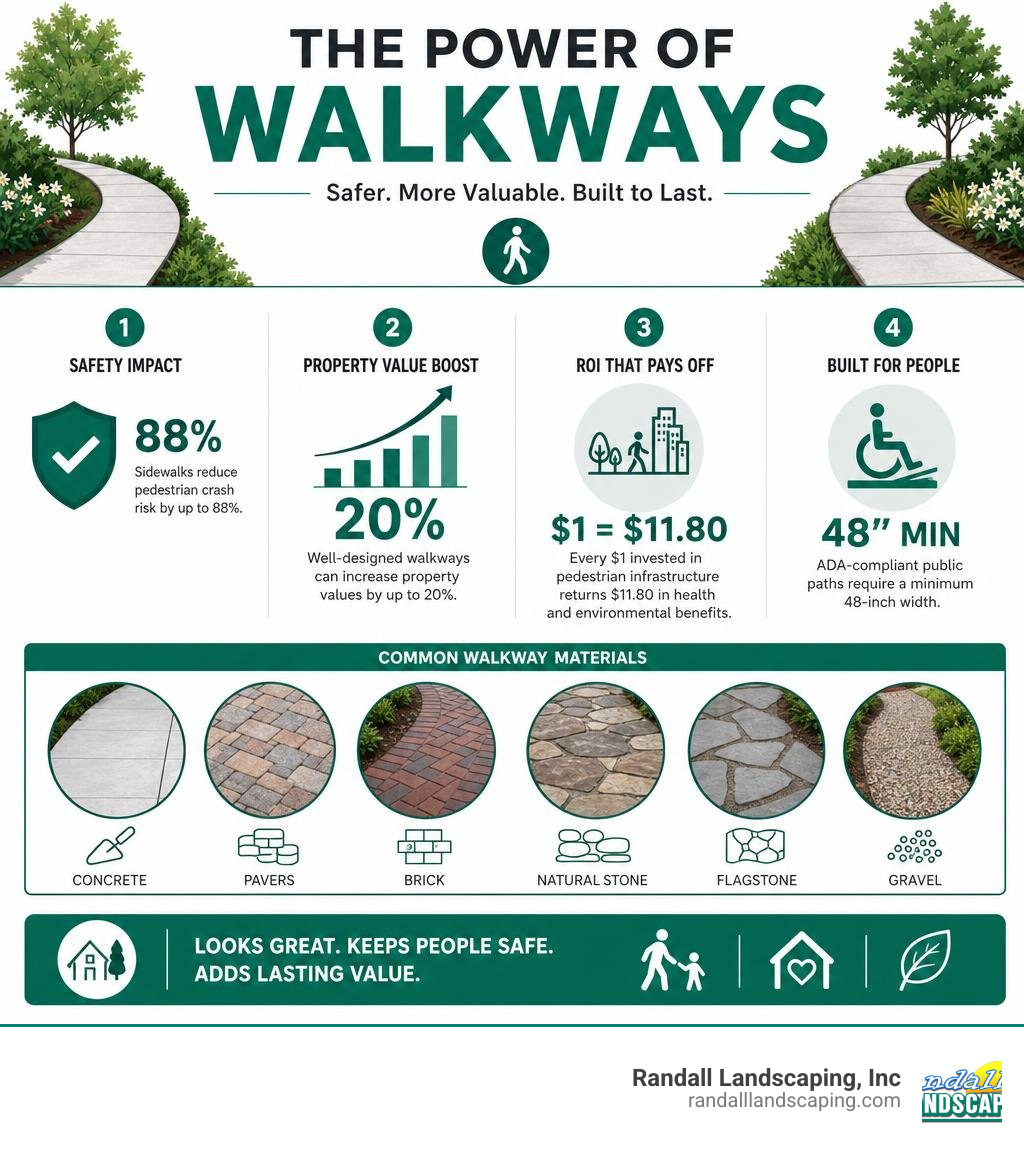
Walkways are one of the most practical and impactful upgrades you can make to any property. Here’s a quick overview of what they are and why they matter:
| What You Need to Know | Key Facts |
|---|---|
| What is a walkway? | Any defined path for foot or wheelchair travel — includes sidewalks, garden paths, pavers, and more |
| Common materials | Concrete, pavers, brick, natural stone, flagstone, gravel |
| Safety impact | Sidewalks reduce pedestrian crash risk by up to 88% |
| Property value boost | Well-designed walkways can increase property values by up to 20% |
| Health & ROI | Every $1 invested in pedestrian infrastructure returns $11.80 in health and environmental benefits |
| Accessibility | Must meet ADA standards for public paths; minimum 48-inch width required |
Whether you want a simple garden path or a formal front entry, the right walkway does three things at once: it looks great, keeps people safe, and adds lasting value to your home.
Consider this — 67.1% of US adults walk for leisure or transportation every week. Yet more than 6,200 pedestrians are killed and 75,000 are injured in roadway crashes each year, many in areas without proper walking paths. Good walkway design isn’t just curb appeal. It’s a genuine safety issue.
For homeowners in Southern NH and Massachusetts, a well-built walkway also solves everyday practical problems: muddy shortcuts across the lawn, uneven ground near the front door, poor drainage after heavy rain, and that general feeling that your outdoor space just isn’t finished.
I’m Tommy Randall, owner of Randall Landscaping, Inc., and I’ve been designing and installing walkways for residential clients across Massachusetts and New Hampshire since 2006. In this guide, I’ll walk you through everything you need to know — from choosing the right materials to avoiding the most common installation mistakes.
Main Types of Pedestrian Paths and Their Purposes
When we think of a walkway, we might picture a simple path leading to a front door. In reality, the term covers a wide spectrum of pedestrian infrastructure. According to the Federal Highway Administration (FHWA), a walkway can be a sidewalk, a shared-use path, a pedestrian walkway, or even a paved roadway shoulder. Each serves a distinct purpose within our communities and neighborhoods.
Understanding these differences helps us design paths that are appropriate for their setting. For example, a sidewalk in a busy commercial district requires different materials, widths, and safety standards than a winding gravel trail through a local conservation area.
In our region, we are lucky to have beautiful examples of both structured and natural pedestrian paths. Residents regularly explore beautiful local trail networks, such as the Andover Trails, the Amesbury Trails, and the scenic paths winding through Boxford State Forest. These natural pathways allow us to connect with nature, while urban sidewalks keep us safe along busy main roads.

Residential Garden Paths and Stepping Stones
In residential landscaping, garden paths and stepping stones are the ultimate way to guide visitors through your yard while protecting your grass. Unlike a formal front walkway, a garden path can be whimsical, winding, and deeply integrated into your flower beds and trees.
If you want a path that blends seamlessly with nature, installing walkways with stepping stones is a fantastic option. By spacing natural flat stones within a lawn, mulch, or groundcover, you create a visually appealing trail that feels organic. For a more structured approach, checking out a garden path installation complete guide will show you how to combine gravel, edging, and stone to build a low-maintenance, highly durable path that prevents soil erosion.
Urban Sidewalks and Public Pedestrian Access Routes
In public spaces, walkways shift from aesthetic features to critical safety infrastructure. Well-designed public sidewalks create connected networks that allow residents of all ages and physical abilities to navigate their towns.
According to federal safety data, communities with extensive, well-connected walkway networks see a 30% reduction in pedestrian accidents compared to those without. This is why transportation agencies place a high priority on providing continuous, accessible routes, particularly near school zones and transit stops. Ensuring equitable access to safe walking routes is a key focus of modern urban planning, helping to reduce vehicle traffic and encourage healthier, active lifestyles.
Paving Materials: Pros, Cons, and Costs
Choosing the right material is the most important decision you will make for your new walkway. The material affects not only the look of your home but also the path’s durability, slip resistance, maintenance needs, and total installation cost.
To help you compare your options, we’ve compiled a quick reference table based on average industry data.
Note: The prices listed below are average estimated ranges based on national internet data and do not represent actual pricing for Randall Landscaping, Inc. Every property has unique soil, grading, and accessibility factors that influence the final cost.
| Material | Pros | Cons | Average Cost Range (Per Sq. Ft.) |
|---|---|---|---|
| Gravel / Crushed Stone | Highly affordable, excellent drainage, easy DIY install | Can shift, requires weeding, not ideal for snow removal | $5 – $18 |
| Poured Concrete | Smooth surface, highly durable, low maintenance | Can crack in freeze-thaw cycles, plain appearance | $10 – $35 |
| Interlocking Pavers | Endless design patterns, highly durable, easy to spot-repair | Higher initial cost, requires proper base prep | $18 – $60 |
| Traditional Brick | Timeless, classic look, eco-friendly options | Limited colors, can chip over time if low-quality | $20 – $65 |
| Natural Flagstone / Bluestone | Gorgeous natural variations, extremely long-lasting | Irregular shapes require skilled labor to install | $25 – $85 |
Pavers and Bricks
For homeowners who want a perfect balance of beauty, strength, and design flexibility, concrete pavers and traditional clay bricks are hard to beat. Because they are individual units fitted together over a flexible base, they can expand and contract naturally during our harsh New England winters without cracking.
If you’re considering this route, a walkway paver installation complete guide will explain how the interlocking system works. For those who love a classic, historic look, making a walkway with bricks in a herringbone or running bond pattern adds instant historic charm to colonial and craftsman-style homes alike. If you are a hands-on homeowner, learning the fundamentals of making walkway with pavers or reading walk this way: building your own brick or paver path can give you a great appreciation for the craft—though hiring a professional ensures the grading and base are flawless. You can also consult our paver walkway contractors ultimate guide to see what to look for when hiring a pro.
Natural Stone and Flagstone
There is nothing quite like the organic beauty of natural stone. Flagstone and bluestone are premium materials that offer unmatched texture, color depth, and durability. Whether laid dry on a gravel base or set in mortar, these stones create a high-end look that elevates any landscape.
When planning a natural stone path, you’ll want to review our resources on building a flagstone walkway and our flagstone walkway installation complete guide. One popular choice in our area is bluestone, known for its deep blue-gray tones that look stunning against green lawns. You can learn more in our guide on how to install a bluestone walkway.
If you prefer a highly structured, formal look, setting the stone in concrete is the way to go. Be sure to read how to install a flagstone walkway with mortar and our flagstone walkway mortar guide to understand how to prevent moisture from getting trapped under the stone, which can cause the mortar to pop during freezing weather. For more inspiration, explore our overview of stone walkways and our stone walkway contractors guide 2025.
Concrete and Gravel
If budget and utility are your primary concerns, poured concrete and crushed gravel are excellent choices. Poured concrete provides a flat, solid surface that is incredibly easy to shovel in the winter. However, plain concrete can look a bit sterile. To dress it up, check out concrete walkway ideas: an essential guide for tips on decorative stamping, staining, and exposed aggregate finishes.
On the other end of the spectrum, gravel paths offer a soft, rustic feel that is perfect for woodland gardens or casual side paths. They are highly permeable, allowing rainwater to soak directly into the ground. Learn the right way to construct one by reading how to install crushed gravel walkway, which emphasizes the importance of using sturdy landscape fabric and a solid border to keep the stones from migrating into your lawn.
Designing Safe, Accessible, and Durable Walkways
A beautiful walkway is useless if it is unsafe or uncomfortable to walk on. When we design walkways, we must carefully consider human ergonomics, water drainage, and accessibility.
In Massachusetts, public and commercial walkways must strictly adhere to the 521 CMR 22 Massachusetts Architectural Access Board Regulations. These state rules specify that public walkways must be at least 48 inches wide with a clear, unobstructed path of at least 36 inches. They also dictate how level changes, slopes, and drainage grates must be handled to prevent tripping hazards or barriers for those using wheelchairs. Even if you are building a private path on your residential property, following these basic safety guidelines ensures your home is safe for grandparents, young children, and delivery drivers alike.

ADA Compliance and Public Rights-of-Way
For public streets, municipal properties, and commercial developments, accessibility is mandated by federal law. The Access Board’s PROWAG 2023 Accessibility Guidelines establish the minimum standards for public rights-of-way.
These guidelines require that pedestrian access routes have a running slope no steeper than 5% (unless matching the natural grade of an adjacent roadway) and a cross slope of no more than 2%. Any level changes between 1/4 inch and 1/2 inch must be beveled with a gentle 1:2 slope, and anything greater than 1/2 inch requires a compliant ramp. Additionally, detectable warning surfaces (tactile paving) must be installed at transitions to vehicular areas to assist visually impaired pedestrians.
Integrating Steps and Slopes
If your yard has a slope, your walkway will need to handle the grade change gracefully. For gentle slopes, a winding path that follows the natural contours of the land is often the best solution. For steeper drops, you will need to integrate structural steps or retaining walls.
Building a path on a slope requires precise math and structural engineering. In our guide, pave your way: designing and building a walkway with integrated steps, we explain how to calculate the rise and run of your steps to ensure they are comfortable to climb. When done right, integrating stone or paver steps with low retaining walls not only makes your yard safer but also creates stunning vertical interest and planting pockets for flowers.
Maintenance, Sustainability, and Pitfall Prevention
Like any outdoor home investment, a walkway requires a small amount of ongoing care to keep it looking pristine and performing well for decades.
Our local climate in Merrimack Valley and Southern NH brings hot, humid summers and freezing, snowy winters. This constant temperature swing puts immense stress on hardscapes. Regular maintenance—such as sweeping away organic debris, applying joint sand when needed, and sealing pavers—protects your walkway from water penetration and weed growth.
Commercial Note: For unique industrial applications, such as accessing rooftop HVAC units or solar panels, specialized systems like the Walksafe Roof Walkway System are used to distribute weight evenly and prevent damage to commercial roof membranes. But for your home, standard ground maintenance is all you need!
Permeable Walkways and Green Infrastructure
As environmental awareness grows, many homeowners are opting for sustainable, eco-friendly walkway designs. Traditional solid concrete and asphalt walkways prevent rainwater from soaking into the ground, forcing dirty runoff into municipal storm drains.
Permeable walkways solve this problem. By using permeable interlocking concrete pavers (PICPs), porous concrete, or loose aggregates like gravel, rainwater filters directly into the soil below. This recharges the local water table, reduces erosion, and prevents ice from pooling on the surface of your path during winter freeze-thaw cycles.
Common Pitfalls in Building Walkways
Most walkway failures have nothing to do with the surface material and everything to do with what lies beneath it. The single biggest mistake DIYers and low-bid contractors make is poor base preparation.
If you don’t excavate deep enough, fail to compact the soil, or skip the gravel sub-base, your walkway will eventually sag, buckle, and shift. To prevent this, we recommend reading lay it right: a step-by-step guide to your paver walkway base. A proper base acts as a foundation, allowing water to drain away from the stones and preventing frost heaving. For a complete look at the entire construction sequence, check out our walkway installation complete guide 2025.
Frequently Asked Questions
What is the most durable material for a residential path?
Interlocking concrete pavers and natural stones like bluestone are widely considered the most durable options for our local climate. Because pavers are individual pieces set on a flexible sand-and-gravel base, they can shift slightly with the freezing and thawing ground without cracking.
How much does it cost to install a path in 2026?
Based on average internet data, a professional walkway installation can range anywhere from $10 to over $80 per square foot depending on the material, grading, and site preparation required. Simple gravel paths sit on the lower end, while custom mortared bluestone or premium pavers sit on the higher end. For a precise estimate tailored to your property, it is always best to schedule a professional consultation.
Do I need a permit to build a path on my property?
In many Merrimack Valley and Southern NH towns, simple at-grade residential walkways do not require a building permit. However, if your path requires structural retaining walls, sits close to a property line, or crosses a designated wetland buffer zone, you will likely need local approval. Always check with your town hall or HOA before breaking ground.
Conclusion
A beautiful, professionally installed walkway does more than connect Point A to Point B—it enhances your home’s safety, elevates its curb appeal, and adds real, measurable value to your property.
At Randall Landscaping, Inc., we have spent the last two decades building a reputation for quality work and 100% reliability. We proudly serve homeowners and businesses throughout the Merrimack Valley and Southern New Hampshire, including:
- Massachusetts: Amesbury, Andover, Boxford, Dracut, Georgetown, North Andover, North Reading, Methuen, Lawrence
- New Hampshire: Atkinson, Pelham, Salem, Windham, Plaistow
Whether you want to build a winding flagstone path through your garden or install a grand paver entry to your front door, our team of skilled masons is here to bring your vision to life. Ready to transform your landscape? Schedule a Walkway Installation Consultation with us today!