Can Landscape Lighting Be Installed in Late Fall Before the Ground Freezes?
You'll learn when late-fall lighting installation still works, what changes once the ground freezes, and how to use the early dark to plan a better layout.
The short answer
- Yes. While the soil can still be dug, late fall is a practical time to install low-voltage landscape lighting.
- Once the ground freezes hard, burying wire gets difficult, and in-ground runs may have to wait for the spring thaw.
- Early darkness makes this the best season to see exactly where your property needs light.
- If the ground freezes before your install, finish the design now so work can start as soon as the soil softens.
Why late fall is a smart time to think about lighting
When it's dark by the time you pull into the driveway, you notice every shadowy step, every dim corner of the walkway and every spot where you fumble for the keys. That's exactly why late fall is when most homeowners start asking about landscape lighting, and it's also why it's a good time to plan it.
A few things work in your favor this time of year:
- You see the real problem. Long evenings show you where light is actually needed. In June, you'd be guessing.
- The leaves are down. Bare branches reveal tree structure, which makes it easier to decide which trees deserve an uplight and where the beams will fall.
- Plants are dormant. Running wire through beds when perennials have died back means less disturbance to roots and foliage than in the middle of the growing season.
- You'll use it right away. Lighting installed now pays off through the longest nights of the year.
At Randall Landscaping, we work with homeowners in Salem, NH and in Andover, North Andover, Methuen, Lawrence and Haverhill, MA, where the question every fall is the same: is there still time before winter shuts the ground down?
What frozen ground changes about installation
Most residential landscape lighting is low-voltage. A transformer steps household power down, and cable runs from the transformer to each fixture. That cable is typically buried in a shallow trench, and many fixtures sit on stakes pushed into the soil.
All of that depends on soil you can work. While the ground is still soft, an installer can slice narrow trenches, tuck cable in and close them up with little sign they were there. Once the ground freezes solid, a few things get harder:
- Trenching becomes slow and rough. Frozen soil breaks in chunks instead of opening cleanly, which leaves a messier lawn and beds.
- Stakes won't seat properly. Fixtures pushed into partly frozen ground can sit loose or crooked, then shift as the soil thaws.
- Snow hides the layout. Once there's snow cover, it's hard to see bed edges, sprinkler heads and the other things an installer needs to work around.
In our area, there's often a stretch of late fall when nights are cold but the ground below the surface is still workable. How long that window lasts varies from year to year, and it can close quickly after a hard cold snap. If you're hoping for an install before winter, the sooner you start the conversation, the better your odds.
A light frost on the surface doesn't necessarily stop work, but deep, hard-frozen soil usually does.
If the ground freezes first: what can still happen and what waits
Missing the window doesn't mean starting from zero in spring. A lighting project has several parts, and only some of them depend on digging.
Work that usually doesn't depend on soft soil
- Design and layout. Deciding fixture types, locations, beam direction and where the transformer will go can all happen now, and it's easier to do in the dark season.
- Some hardscape-mounted fixtures. Depending on how a patio, wall or step was built, certain fixtures may attach to stone or masonry rather than going into soil. Whether that's possible on your property is something an installer has to evaluate in person.
Work that usually waits for the thaw
- Burying cable across lawns and beds
- Setting staked path lights and uplights in soil
- Any runs that cross areas where the ground is frozen solid
Planning a spring hardscape project? Coordinate them
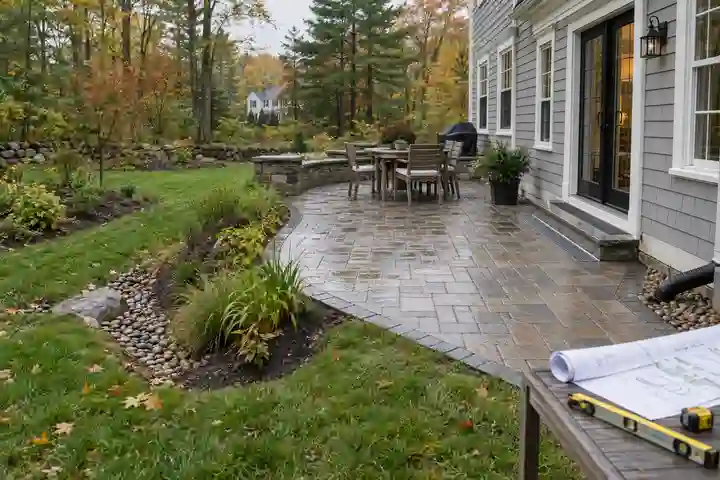
If you're already thinking about a new patio, walkway, retaining wall, pool deck or outdoor kitchen next season, plan the lighting at the same time. It's far easier to route cable while a hardscape is being built than to work around finished stone later. Steps, wall caps and seating areas can be lit cleanly when the wiring is part of the original plan.
Use the dark evenings to plan your layout
Whether your install happens this season or next, a little homework now makes for a better result. Pick a dry evening, grab a flashlight and your phone, and walk the property the way you and your guests actually use it.
- Start at the driveway. Note where you park, where you step out and how you get to the door. Mark any spot where you hesitate or look down to check your footing.
- Walk every path and step. Steps, grade changes and walkway edges are the top safety priorities. Note which ones feel uncertain in the dark.
- Stand at the street. Look back at the house. Which features would you like to see at night: a specimen tree, the front entry, a stone wall?
- Check the backyard from inside. Look out the windows you use most. Lighting a tree line or garden bed can make a dark yard feel like part of the room.
- Think about neighbors. Notice where light could shine into a neighbor's windows or straight into drivers' eyes. Good design aims light down and at its target.
- Take photos and notes. Nighttime photos, even grainy ones, are useful to share during a design conversation.
Also note where your exterior outlets are, but just look. Leave covers and electrical boxes closed. If a new outdoor outlet or any wiring change is needed to power a transformer, that's work for a licensed electrician.
Write down every spot where you instinctively slow down in the dark; those are usually the first places that need light.
Getting your yard ready for a late-season install
If you're aiming to get lighting in before winter, a few prep steps help the work go smoothly and protect what's already in the ground.
- Mark what's buried. Flag sprinkler heads and valve boxes, invisible pet fence lines, septic components and anything else you know is underground. Even after an irrigation blowout, those lines are still there and can be nicked by a trench.
- Plan for utility marking. Before any digging, buried utility lines should be located through the call-before-you-dig service (811 in the US). Ask your installer how they handle this, and don't dig test holes yourself.
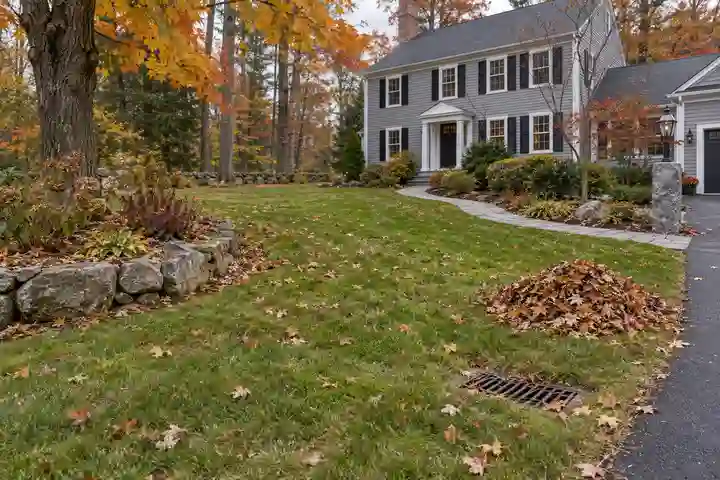
- Clear leaves from beds and walkway edges. It's easier to see bed lines, edging and existing fixtures without a blanket of leaves.
- Keep paths and gates clear. Move hoses, furniture and seasonal decorations out of the way so the crew can reach the work areas.
- Think about holiday lights. If you string lights on shrubs or trees, mention it. You don't want new fixtures sitting right where you'll be standing on a ladder.
You can see the kinds of lighting work we do on our landscape lighting page, and if you'd like to talk through your property, you can reach us through our contact page.
Flag your sprinkler heads before any lighting work begins; they're easy to hit and easy to miss under fallen leaves.
Living with new lighting through the first winter
Lighting installed in late fall goes straight into its hardest season. A little awareness keeps the system working until spring.
Watch the plow and shovel lines
Path lights near driveway edges and walkways are the most likely to get clipped by a plow, snowblower or shovel. Ideally they're set back from where snow gets pushed. If any sit close to the edge, let whoever clears your driveway know where they are, or mark them with tall driveway stakes, set well clear of the fixtures and cable runs, before the first storm.
Be thoughtful with ice melt
Avoid piling salt-heavy snow or ice melt directly onto fixtures. Shovel and blow snow away from lights rather than onto them where you can.
Expect some buried fixtures
After a big storm, short path lights may disappear under the snow. That's normal. Clearing them by hand with a soft brush or gloved hand is fine; avoid chipping at ice around a fixture with a shovel or tool.
Adjust the timer as days lengthen
If your system runs on a timer instead of a photocell, the on-time that worked during the darkest weeks will turn lights on in daylight by late winter. Adjust it as sunset moves later.
Do a spring walk-through
Freeze-thaw cycles can nudge staked fixtures out of line. Once the ground thaws, walk the yard at dusk, note any lights that are leaning, aimed off target or out, and straighten them. Clean lenses of winter grime so the light comes through clearly. It's also a good time to see whether spring growth will block any beams as plants leaf out.
Common questions
Do LED landscape lights work in freezing temperatures?
Generally, yes. LEDs tend to handle cold well, and outdoor-rated fixtures are built for exposure to the weather. The bigger winter risks are physical ones, like plows, shovels and heavy ice.
What happens if the ground freezes before my installation date?
The in-ground parts of the project, such as buried cable and staked fixtures, usually wait until the soil thaws. You can still finish the design over the winter so installation can start as soon as conditions allow.
Can lighting be added to a patio or retaining wall I already have?
Often it can, but the approach depends on how the hardscape was built and where cable can be routed. An installer needs to look at the patio or wall in person to see what's practical. If you're planning new hardscaping, it's easiest to include lighting from the start.
Should I do the wiring myself to save time before winter?
Plug-in lighting kits are sold for homeowners, but anything involving outlets, hardwiring or changes to your home's electrical system should be left to a licensed electrician. Digging also carries the risk of hitting buried utilities or irrigation lines, so utility locating should happen before any trench is opened.