

The Tree Mulching Mistake That’s Silently Killing Your Trees
Tree ring mulch is one of the simplest things you can do for your trees — and one of the most commonly done wrong.
Here’s what you need to know at a glance:
| Topic | Quick Answer |
|---|---|
| What is it? | A flat, donut-shaped ring of mulch around a tree’s base |
| Ideal depth | 2–4 inches (1–2 inches in wet soils) |
| Ideal diameter | 4–6 feet minimum, expanding with canopy |
| Trunk contact | None — always leave the root flare exposed |
| Best materials | Wood chips, bark mulch, or recycled rubber rings |
| Biggest mistake | Piling mulch against the trunk (“mulch volcano”) |
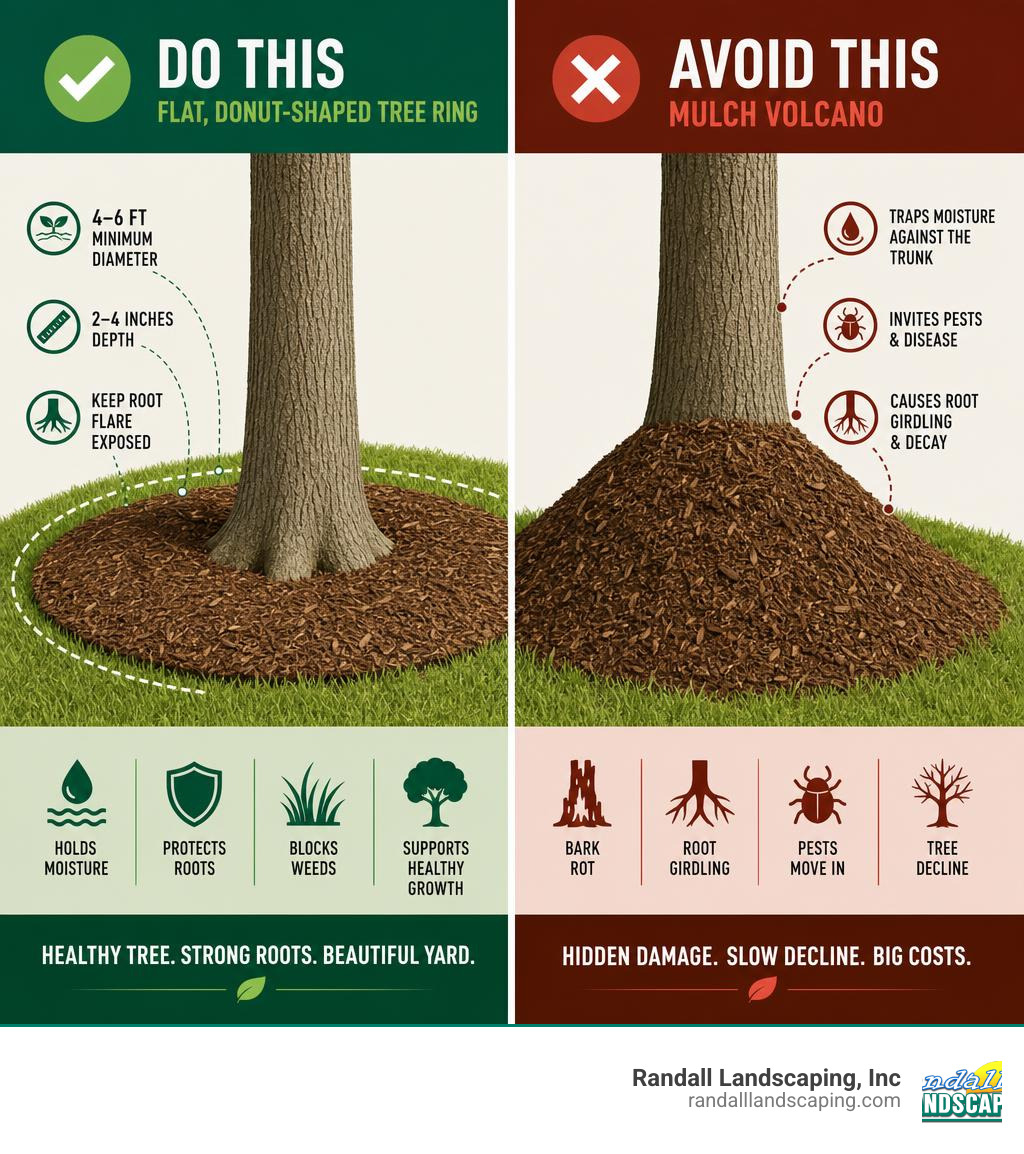
Done right, a tree ring protects roots, holds moisture, blocks weeds, and gives your yard a clean, finished look. Done wrong — think mulch piled up against the trunk like a little volcano — it slowly strangles your tree. Bark rots. Roots girdle. Pests move in. The tree declines over years, and most homeowners never connect the dots.
It’s a quiet problem in yards all across Southern New Hampshire and the Merrimack Valley. And in May 2026, with the growing season fully underway, there’s no better time to fix it.
I’m Tommy Randall, owner of Randall Landscaping, Inc., and over nearly 20 years of installing and maintaining landscapes across Massachusetts and New Hampshire, I’ve seen how proper tree ring mulch technique makes the difference between a thriving tree and a struggling one. In this guide, I’ll walk you through exactly how to get it right.
Quick look at Tree ring mulch:
What Tree Ring Mulch Is-and Why Volcano Mulching Hurts Trees
Tree ring mulch is a circular mulched zone around a tree. It can be made with loose organic mulch, a preformed rubber ring, a recycled mat, coco fiber, or another surface material designed to cover soil around the root zone.
The goal is simple: create a protected, breathable area where roots can grow without fighting turf, mower wheels, weeds, heat, drought, and soil compaction.
The mistake is just as simple: piling mulch against the trunk.
That pile is often called a mulch volcano. It may look tidy for a week, but it creates a damp collar around bark that was never meant to stay wet. Over time, that can encourage bark decay, insect entry, fungal pressure, and girdling roots. Research on mulch and tree health points to the same core principles we follow in the field: keep mulch shallow enough for oxygen exchange, keep it off the trunk, and maintain the root flare.
The best tree ring looks like a donut, not a mountain. Delicious for trees, less exciting for breakfast.
Tree ring mulch basics for beginners
A healthy tree ring has four basic traits:
- It is flat or gently tapered.
- It is usually 2 to 4 inches deep.
- It is thinner in wet soils, often closer to 1 to 2 inches.
- It never touches the trunk.
For most young trees, a 4 to 6 foot diameter ring is a strong starting point. Bigger is often better, especially as the tree grows. Tree roots do not stop at the edge of the little circle around the trunk. Many absorbing roots are farther out, often near and beyond the canopy drip line.
Organic tree ring mulch also mimics the forest floor. In woods, trees naturally grow with leaves, twigs, and decomposing organic matter over their roots. In lawns, we remove that layer and replace it with turf competition. A proper mulch ring gives some of that protection back. For more on why organic materials help soil life, see our guide to organic mulch benefits.
How tree rings differ from traditional loose mulch
Traditional loose mulch is spread by hand, wheelbarrow, or blower. It may be bark mulch, wood chips, shredded leaves, composted mulch, or a blend. It conforms easily to tree roots, edging, and curves.
Preformed tree rings are different. These are usually rubber, recycled material, coco coir, or fabric-like mats cut into circular shapes with a center opening and slit seam. They are faster to place and can reduce frequent replenishing, but they do not improve soil the way decomposing wood mulch does.
Here is the practical difference:
| Option | Best For | Main Tradeoff |
|---|---|---|
| Loose wood or bark mulch | Soil health, moisture, root protection | Needs refreshing |
| Rubber tree rings | Low-maintenance spots, mower protection | Does not feed soil |
| Coco fiber mats | Biodegradable weed suppression | Breaks down faster than rubber |
| Fabric mats | Short-term weed control | Can clog or restrict exchange over time |
| Stone rings | Decorative dry areas | Can heat soil and compact roots |
If you are comparing loose materials, our bark mulch and wood chips guide is a helpful next read.
Tree ring mulch mistakes that choke trees
The biggest mistakes we see are:
- Piling mulch against bark.
- Making mulch too deep.
- Creating a trench or “tree moat” that cuts roots.
- Installing fabric under mulch and leaving it for years.
- Compacting mulch into a hard mat.
- Using sour or anaerobic mulch that smells rotten.
- Forgetting to widen the ring as the tree grows.
- Covering the root flare.
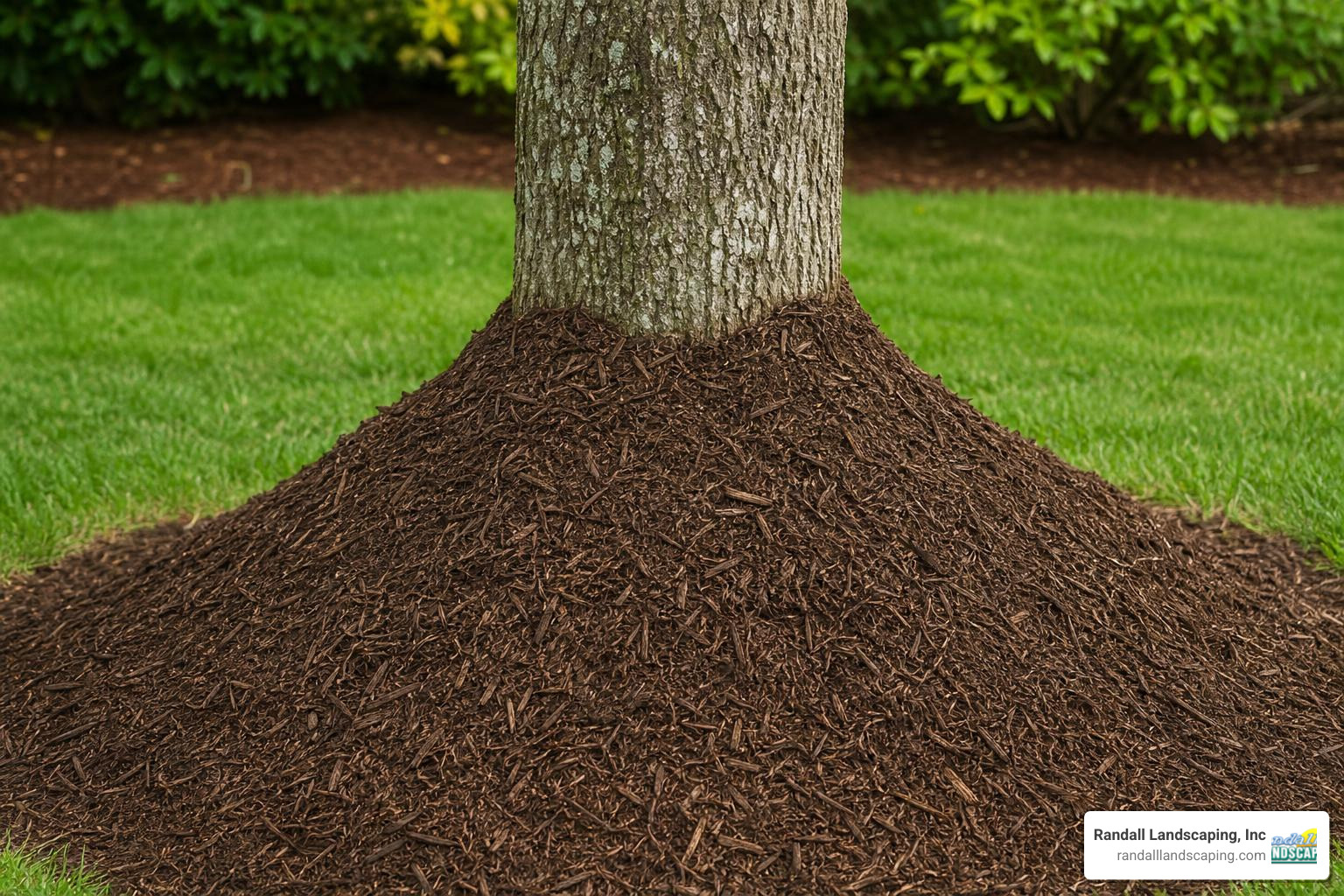
Mulch should protect roots, not bury the trunk. If you cannot see the base flare where the trunk widens into the root system, pull mulch back gently until that flare is visible.
How to Install Tree Ring Mulch the Right Way
Installing Tree ring mulch is not complicated, but the details matter. The best method is gentle, shallow, and tree-first. That means no deep digging, no root cutting, and no “let’s bury the base and hope for the best.”
For a technical overview of proper mulch depth and application, the University of Tennessee’s tree mulching best practices are a solid reference.
Step 1: Size the ring around the tree, not the trunk
Start by looking at the canopy, not just the trunk.
For a newly planted or young tree, we recommend a 4 to 6 foot diameter ring when space allows. A 3 foot ring is better than nothing, but it is usually a minimum, not the goal.
For established trees, expand the ring outward over time. Ideally, mulch should reach toward the drip line, which is the area under the outer edge of the canopy. In a lawn, even expanding a narrow ring by 12 to 24 inches can reduce turf competition and mower damage.
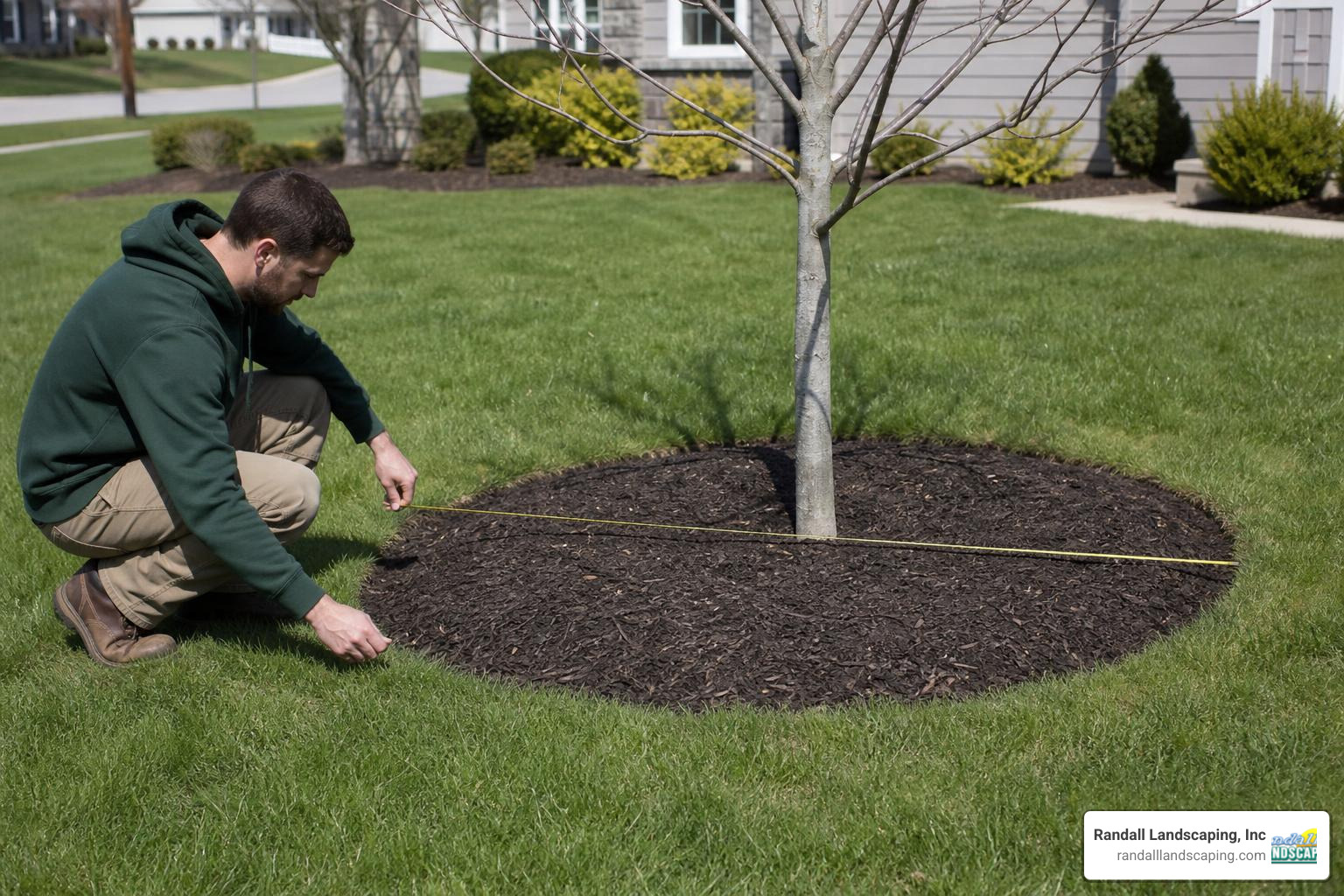
A simple method:
- Put the tree trunk in the center.
- Measure out 2 to 3 feet in several directions for a 4 to 6 foot ring.
- Mark the edge with a hose, rope, spray paint, or landscape marking paint.
- Step back and check the shape before removing grass.
Step 2: Prepare the soil without damaging roots
Remove grass and weeds inside the ring carefully. The key word is carefully.
Do not dig deep. Most feeder roots are in the upper soil zone, where oxygen and moisture are easiest to access. Cutting through those roots to make a sharp trench defeats the purpose.
Instead:
- Skim turf with a flat shovel or sod cutter.
- Pull weeds by hand where possible.
- Loosen only crusted surface soil.
- Avoid chopping into visible roots.
- Keep the root flare exposed.
- Lightly dampen dry soil before mulching.
If weed pressure is your main concern, we have a deeper guide on mulch for weed control.
Step 3: Install loose organic tree ring mulch
For loose organic mulch, aim for a finished depth of 2 to 3 inches in most Merrimack Valley and Southern New Hampshire landscapes. In drier, exposed areas, up to 4 inches can be appropriate. In wet or poorly drained areas, stay closer to 1 to 2 inches.
Good organic choices include:
- Aged bark mulch.
- Arborist wood chips.
- Composted mulch.
- Shredded leaves.
- Native recycled tree and shrub mulch.
Spread the mulch evenly. Near the trunk, taper it thinner and leave several inches of open space around the bark. The final shape should look like a wide, flat donut.
That open center matters. It allows airflow around the trunk and helps prevent rot. Organic mulch also supports microbial activity, improves soil structure as it decomposes, and helps retain moisture. For more on that benefit, see our guide to moisture retaining mulch.
Step 4: Install rubber Tree ring mulch or preformed mats
Rubber Tree ring mulch and preformed mats install differently.
Most have:
- A center hole.
- A slit seam.
- A textured top.
- A flexible, water-permeable structure.
- Optional landscape staples.
To install one:
- Clear weeds and grass from the area.
- Place the slit around the tree trunk.
- Check that the center opening does not touch the bark.
- Cut the opening larger if needed.
- Lay the ring flat on soil.
- Secure with staples if the product calls for it.
- Recheck trunk clearance during the growing season.
Never let a preformed ring girdle a trunk. Trees expand every year. If the opening becomes tight, cut it wider or remove the ring.
Choosing the Best Tree Ring Mulch Material for Your Landscape
There is no single best material for every tree, every soil, and every property. We choose based on drainage, maintenance goals, tree age, aesthetics, and long-term soil health.
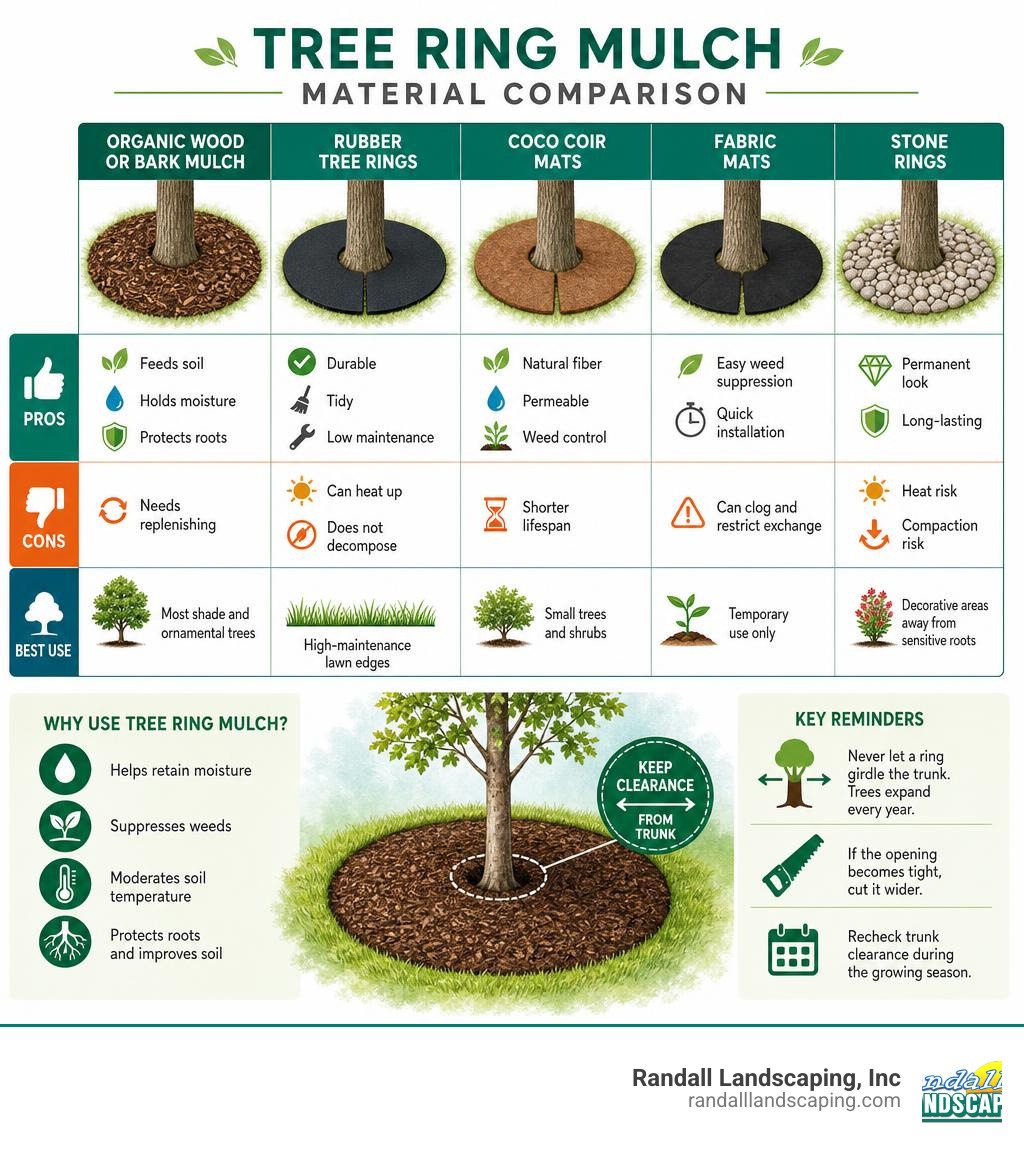
| Material | Pros | Cons | Best Use |
|---|---|---|---|
| Organic wood or bark mulch | Feeds soil, holds moisture, protects roots | Needs replenishing | Most shade and ornamental trees |
| Rubber tree rings | Durable, tidy, low maintenance | Does not decompose, can heat up | High-maintenance lawn edges |
| Coco coir mats | Natural fiber, weed control, permeable | Shorter lifespan | Small trees and shrubs |
| Fabric mats | Easy weed suppression | Can clog and restrict exchange | Temporary use only |
| Stone rings | Permanent look | Heat and compaction risk | Decorative areas away from sensitive roots |
Organic mulch for soil health and long-term tree growth
For tree health, organic mulch is usually our first choice. Wood chips, bark mulch, composted mulch, shredded leaves, and recycled tree trimmings break down gradually. That breakdown adds organic matter and supports the living soil system around the tree.
Research summarized in university extension materials shows that properly mulched soils can hold more water and support better root growth than bare or compacted soils. Organic mulch also helps moderate soil temperature, which matters during hot summer stretches and freeze-thaw cycles.
If you already use organic mulch in planting beds, the same principles apply around trees. You can learn more in our guide to organic mulch for flower beds.
Rubber Tree ring mulch for low-maintenance areas
Rubber Tree ring mulch is popular because it stays in place, resists decomposition, and can reduce trimming around trees. It is often made from recycled rubber, which can help divert material from landfills.
The advantages:
- Long lifespan.
- Good weed blocking.
- Less frequent replenishment.
- Clean look.
- Mower and string-trimmer buffer.
- Often available in black, brown, red, or tan tones.
The tradeoffs:
- It does not feed soil.
- It may absorb and hold heat.
- It is not biodegradable.
- It must be monitored so it does not touch or constrict the trunk.
We use rubber mulch carefully and selectively. It can make sense in low-maintenance ornamental areas, but for sensitive trees or landscapes where soil improvement is the priority, organic mulch usually wins. For a broader discussion, see our article on rubber mulch use.
Permeability: why air, water, and nutrients must reach roots
Tree roots need more than water. They also need oxygen. Soil microbes need air exchange too. A good tree ring should allow:
- Rainwater to soak through.
- Oxygen to reach the upper root zone.
- Carbon dioxide to escape.
- Nutrients to move into the soil.
- Microbial life to stay active.
This is why compacted mulch, clogged fabric, and overly thick layers cause problems. When water sits on top or air cannot move through, roots suffer.
Permeable rubber rings and coco mats can work if they stay open and flexible. Organic mulch works well when it is not over-applied or compacted. If sustainability is part of your decision, our eco-friendly mulch options guide covers more material choices.
Benefits, Costs, Durability, and Environmental Tradeoffs
A good tree ring gives both landscape and tree-health benefits. The trick is choosing the right material and maintaining it.
How tree rings control weeds, retain moisture, and protect roots
Tree rings help by:
- Blocking sunlight from weed seeds.
- Reducing turf competition.
- Slowing soil moisture evaporation.
- Moderating soil temperature.
- Protecting roots from foot and mower compaction.
- Reducing string-trimmer and mower injuries.
- Limiting erosion on bare soil.
- Improving curb appeal.
- Buffering roots during winter cold and summer heat.
This is especially helpful for young trees. Newly planted trees are already under stress. A proper mulch ring gives them a better root environment while they establish.
Average prices and lifespan based on internet data-not Randall Landscaping costs
The following are average retail price examples based on internet data as of May 2026. These are not Randall Landscaping prices, quotes, or service costs.
| Product Type | Common Retail Range | Notes |
|---|---|---|
| 24-inch rubber tree ring | About $15 to $60+ | Smaller trees and shrubs |
| 36-inch rubber tree ring | About $35 to $120+ | Common residential size |
| Fabric or coco mats | About $10 to $75+ | Often sold in singles or packs |
| Larger premium rings | About $75 to $150+ | Larger diameter or thicker materials |
| Loose organic mulch | Varies widely | Cost depends on material, delivery, and labor |
| Edging kits | About $20 to $150+ | Optional for crisp borders |
Retail listings commonly show tree rings from about $10 to $150, with many basic products clustering near the middle of that range. Organic mulch may cost less upfront per tree, but it needs periodic refreshing. Rubber rings cost more initially but typically last longer.
Actual installed cost depends on site access, number of trees, bed preparation, edging, material choice, disposal, and whether the work is part of a larger landscape maintenance visit.
Environmental considerations of recycled rubber rings
Recycled rubber rings have real environmental pros and cons.
Potential benefits:
- Reuses tire-derived material.
- Reduces need for frequent replacement.
- Can reduce herbicide or trimming needs.
- Helps keep material out of landfills for a time.
Potential concerns:
- Rubber is not biodegradable.
- It may shed small particles over time.
- It can absorb heat in sunny areas.
- End-of-life disposal must be considered.
- It does not build soil organic matter.
- Some gardeners avoid it near edible crops or sensitive planting areas.
For trees in lawns, rubber rings can be practical when installed correctly. For soil-building landscapes, we often prefer organic mulch. Our environmental mulch guide goes deeper into those tradeoffs.
Climate, Tree Species, and Maintenance Tips for Healthy Rings
Tree ring performance changes with climate, soil, and tree type. In our service areas, we deal with cold winters, freeze-thaw cycles, wet springs, summer drought, clay pockets, sandy soils, and plenty of mower season. A ring that works well in one yard may need adjustment in another.
Cold-climate and New England performance
In Merrimack Valley and Southern New Hampshire landscapes, tree rings help with:
- Winter root insulation.
- Spring soil moisture retention.
- Summer drought protection.
- Reduced frost heave around young trees.
- Cleaner mowing during the growing season.
- Less erosion during heavy rain.
But wet spring soils need caution. If a site stays soggy, do not pile mulch deeply. Use a thinner layer and keep the trunk fully open to airflow. In areas exposed to road salt or plowed snow, spring cleanup is important so debris and salty buildup do not sit against trunks.
Matching tree ring mulch to tree age and species
Young trees benefit from wide, clean rings because they reduce grass competition and mower damage.
Established shade trees benefit when rings expand outward, especially maples, oaks, birches, ornamental trees, and conifers growing in lawn areas. Shallow-rooted or drought-sensitive trees often appreciate organic mulch because it buffers the root zone.
Fruit trees and ornamental flowering trees can also benefit, but keep mulch away from trunks and graft unions. Do not use a one-size-fits-all mat that rubs against bark or hides the root flare.
A simple rule: as the canopy grows, the ring should grow too.
Maintenance schedule after installation
A healthy tree ring is not “set it and forget it.” It is more like “set it and check it before it becomes a tiny forest pancake.”
Use this schedule:
| Timing | What To Do |
|---|---|
| Monthly in growing season | Check trunk clearance and remove weeds |
| Spring | Rake loose mulch, inspect depth, clean debris |
| Summer | Watch for drought stress and hydrophobic dry mulch |
| Fall | Refresh thin areas before winter if needed |
| Annually | Widen the ring as the tree grows |
| Every visit | Keep root flare visible |
For loose mulch, maintain 2 to 4 inches total depth. Do not keep adding new mulch every year without checking what is already there. If old layers are too deep, remove or redistribute before adding more.
For rubber rings, check the center opening at least once per year. If the trunk is getting close, cut the opening wider. For more bed maintenance tips, see our guide to garden bed mulching.
Frequently Asked Questions About Tree Ring Mulch
Is Tree ring mulch safe for trees?
Yes, Tree ring mulch is safe when it is installed correctly. The key is trunk clearance, permeability, and proper depth.
Safe tree rings:
- Do not touch the bark.
- Leave the root flare visible.
- Allow water and air through.
- Stay shallow enough for oxygen exchange.
- Are widened as the tree grows.
Unsafe tree rings are usually too deep, too tight, or piled into volcanoes.
Where can consumers buy tree ring mulch products?
Consumers can buy tree ring products from garden centers, landscape suppliers, home improvement stores, and online marketplaces. Common sizes include 24-inch and 36-inch rings, with larger sizes available for some products.
Loose organic mulch is usually available by bag, cubic yard, or bulk delivery. For larger properties, commercial sites, or multiple tree rings, bulk mulch and professional installation are often more efficient than bag-by-bag work.
Should I use a preformed ring or loose wood mulch?
Use loose organic mulch if your priority is long-term tree health, soil improvement, and natural appearance.
Use a preformed rubber or coco ring if your priority is low maintenance, quick installation, and weed suppression around small trees.
Choose based on:
- Tree age.
- Soil condition.
- Moisture needs.
- Weed pressure.
- Budget.
- Desired look.
- Maintenance level.
- Whether you want the material to improve soil over time.
When in doubt, we usually lean organic around valuable trees.
Conclusion
The right tree ring is simple: wide, flat, breathable, and pulled away from the trunk.
No volcano. No buried bark. No tight rubber collar. No mystery mulch mountain slowly plotting against your maple.
A good Tree ring mulch installation protects roots, suppresses weeds, holds moisture, reduces mower damage, and improves curb appeal. Organic mulch is best for soil health. Rubber and recycled rings can work for low-maintenance areas when they are permeable, properly sized, and checked regularly.
At Randall Landscaping, Inc., we install and maintain landscapes throughout the Merrimack Valley and Southern New Hampshire with a focus on quality work, customer satisfaction, and 100% reliability. If your trees need proper rings, clean mulch beds, or a full landscape refresh, we can help you get it done right.
Ready to stop choking your trees and start ringing them right? Schedule professional mulch installation.